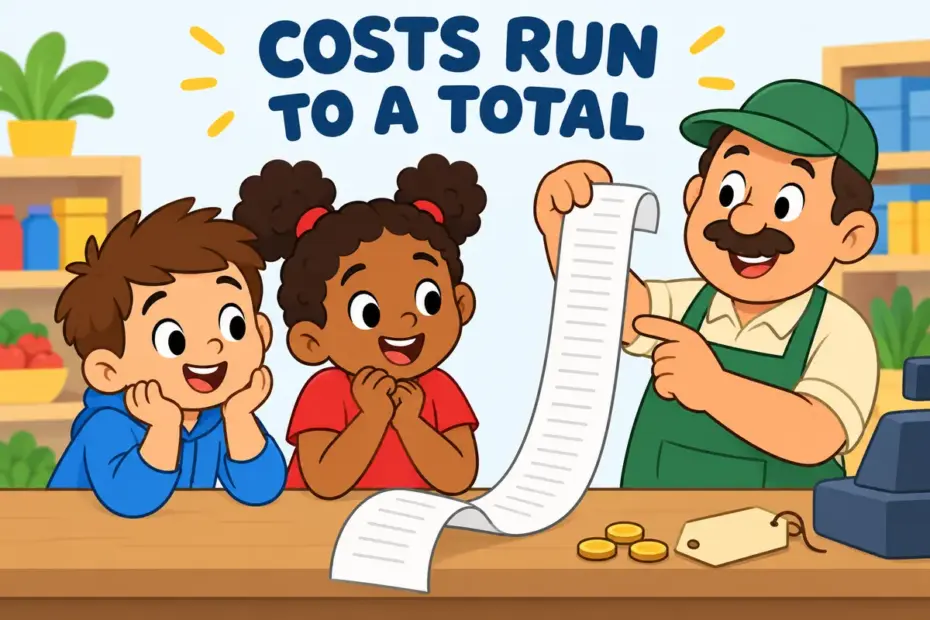
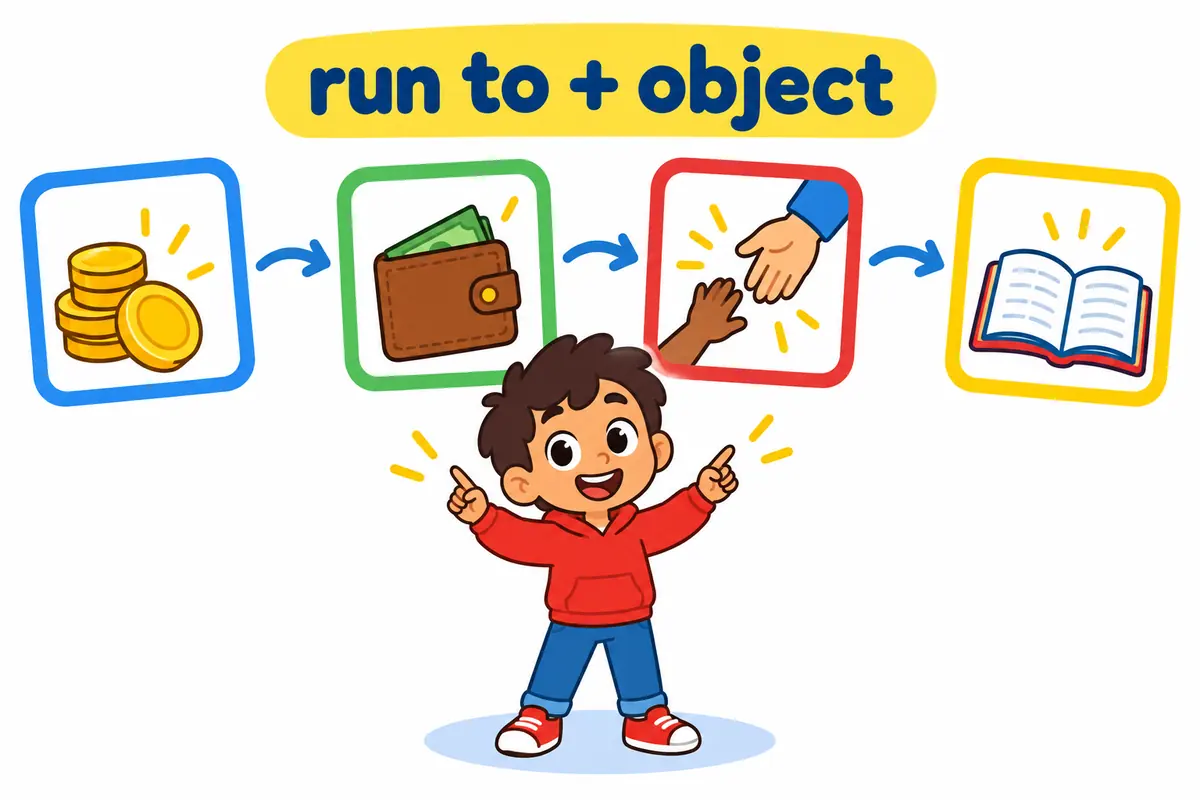
Run to is an inseparable phrasal verb with a handful of everyday senses: a cost can run to a total, a family can run to a price, a child can run to a parent, and a report can run to many pages. In each case the particle to stays joined and an object follows the verb.
Run to at a glance
- Run to is an inseparable phrasal verb with several everyday senses, so context decides which one is active.
- It can mean to reach a total, to be enough to afford something, or to turn to someone for help.
- It is transitive: a figure, an object or a person follows the verb, and the particle to never separates.
- The past form is ran to and the participle is running to; there is no common passive.
- The commonest error is writing run to when the meaning is run out, which describes something being used up.
What does run to mean?
Run to is a transitive phrasal verb whose meaning shifts with its subject. A figure reaches a total, a budget is enough or not enough to afford something, a person turns to someone for help, and a text extends to a length. The Cambridge entry for run to groups these uses under reaching and turning. Where the point is a plain total, amount to a figure is the more formal verb.
| Sense | Plain meaning | Example sentence |
|---|---|---|
| Reach a total | Add up to a particular amount | The repairs ran to four thousand pounds. |
| Afford | Be enough to pay for something | We cannot run to a new car this year. |
| Turn for help | Go to someone for comfort or support | The child ran to her mother after the fall. |
| Extend in length | Cover a number of pages or miles | The index alone runs to ninety pages. |
| Deteriorate, fixed | Fall into a neglected state | The lawn has run to seed this summer. |
One limitation is worth stating. Run to is not a single idea, so a sentence without a clear subject can leave the reader guessing. The verb also has no common passive, and the used-up meaning belongs to run out of rather than run to, a distinction that trips many learners because the two sound similar.
How do you use run to in a sentence?
Keep run and to together, because the particle never separates. The subject decides the sense: a cost reaches a figure, a person turns for comfort, a document stretches to a length. The five patterns below cover the uses a reader is most likely to meet in print.
| Pattern | Example | What it signals |
|---|---|---|
| amount + run to + figure | The final bill ran to six hundred pounds. | A cost or quantity reaches a total. |
| can or cannot + run to + thing | She can run to a taxi but not a meal. | Affordability, often in the negative. |
| person + run to + person | He runs to his sister whenever he worries. | Seeking comfort or support. |
| document + run to + length | The report runs to forty pages. | Physical or printed extent. |
| run to + seed or fat | The old orchard has run to seed. | A fixed phrase meaning neglected or grown wild. |
If you need to say that a supply is exhausted, use reach for a total and run out for the end of something, keeping the two verbs apart. The afford sense is the one most often used in the negative, so cannot run to is a fixed piece of everyday English. For the turn-for-help sense, seek help is the formal equivalent.
Run to in a sentence: examples across contexts
The examples below move from a kitchen table to a finance report while the verb stays joined. In each sentence the subject tells you which sense is active, so read the noun before the verb and the meaning usually becomes clear at once.
| Context | Example sentence | Why this works |
|---|---|---|
| Household budget | The heating bill ran to more than we had saved. | The reach-a-total sense with a concrete sum. |
| Workplace | The project cost runs to three times the estimate. | A formal estimate reaches a figure. |
| Conversation | I cannot run to a holiday this year. | The afford sense in the negative. |
| Family | The toddler ran to her father when the dog barked. | The turn-for-help sense, physical and literal. |
| Publishing | Her first novel runs to well over four hundred pages. | The extend-in-length sense for a text. |
| Gardening | The vegetable patch had run to seed by August. | The fixed deterioration phrase. |
| Finance | Losses ran to several million before the sale. | A news register with a large total. |
| Letter writing | Do let me know if the cost runs to more than twenty pounds. | A polite check on a possible total. |
| Sports | The match ran to a fifth set and nearly three hours. | The extend-in-time overlap with run to a length. |
| Charity | Donations ran to a sum the organisers had not expected. | The reach sense with an abstract subject. |
| Everyday planning | We can run to one takeaway, not a restaurant. | The afford sense in a shared decision. |
| School report | The essay runs to eight pages of close argument. | The length sense in academic writing. |
Run to vs run out
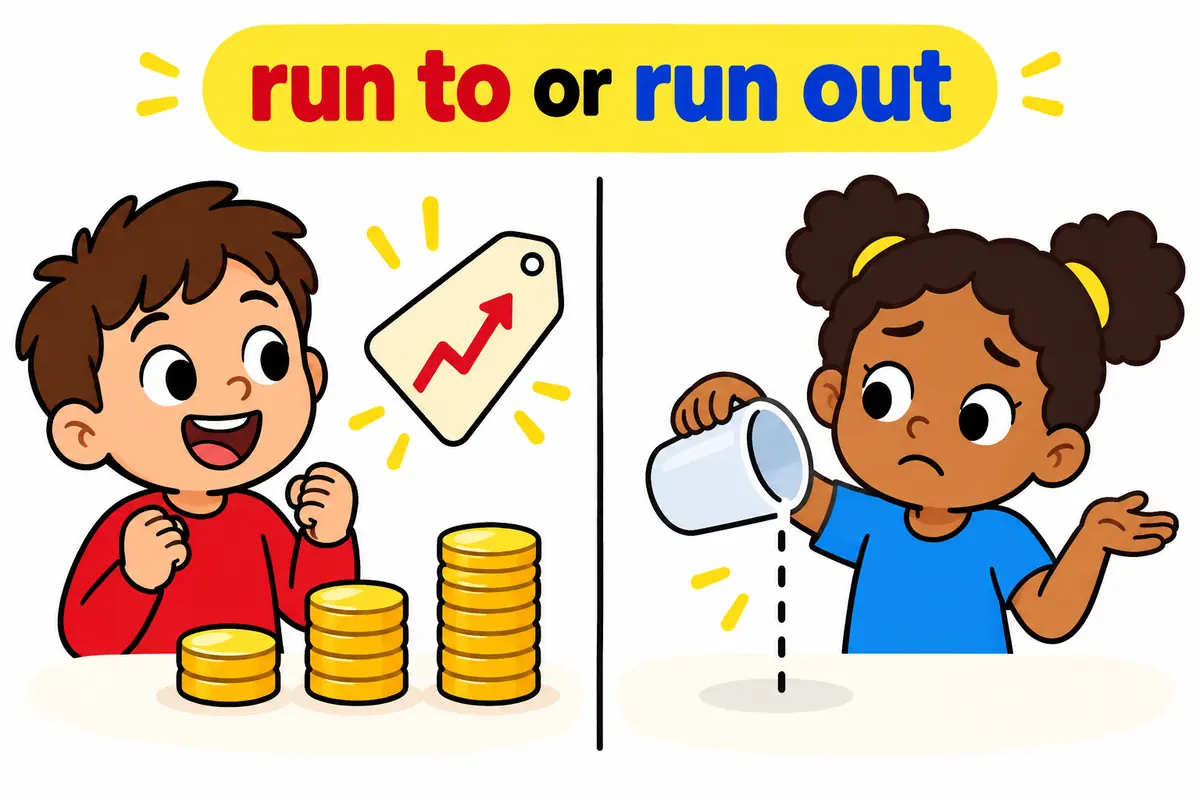
Run to and run out are easily confused because both describe money and supplies. Run to moves towards a reachable figure or price, while run out means something is used up and gone. One gains a total, the other loses a supply.
| Attribute | run to | run out |
|---|---|---|
| Core job | Reach a total, afford, or turn for help | Be used up or come to an end |
| Direction | Towards something you gain or reach | Towards nothing left |
| Typical subject | A cost, a document, a person | A supply, patience, time |
| Separable | No: run to it stays joined | Often: we ran out of milk |
| Register | Neutral, slightly British | Neutral and worldwide |
Verdict: use run to when something reaches a total or a budget can afford a price, and run out when the supply itself is finished.
Word forms and grammar of run to
Run to inflects with run, and the particle stays fixed through every form. The related verb extend to a length is the neutral paraphrase for the length sense, and the table keeps the forms apart from run through, which means to review. Another fixed pattern, tend to, also keeps its particle joined before a verb.
| Form | Part of speech | Example |
|---|---|---|
| run to | base phrasal verb | The bill may run to a thousand pounds. |
| runs to | third person singular | Her collection runs to fifty paintings. |
| ran to | past tense | The meeting ran to two hours. |
| running to | present participle | Costs are running to twice the forecast. |
| run-to | noun, rare | The run-to of the lease was short. |
| run through | related phrasal verb | Let me run through the figures with you. |
Common mistakes with run to
- Incorrect:
The total ran to out of control.Correct: The total ran out of control. Rule: Run out means come to an end or go uncontrolled; run to needs a figure or thing. - Incorrect:
We have run to milk.Correct: We have run out of milk. Rule: The used-up sense is run out of, never run to. - Incorrect:
She ran to the shop to buy milk yesterday ran to ten pounds.Correct: She ran to the shop, and the bill ran to ten pounds. Rule: The two senses are separate clauses; keep them apart. - Incorrect:
The report runs at forty pages.Correct: The report runs to forty pages. Rule: The length sense takes to, not at. - Incorrect:
He ran his mother to when he was scared.Correct: He ran to his mother when he was scared. Rule: With the turn-for-help sense, to introduces the person and cannot be moved.
Practice using run to
Work through the six items, then check the reasoning rather than only the answer.
- Fill the gap: The legal costs eventually ______ nearly ten thousand pounds.
- Choose the better word: We have (run to / run out of) coffee, so I will buy more.
- Correct the error: The index runs at two hundred pages.
- Build a sentence: use cannot run to about a pricey school trip.
- Spot the register: which fits a finance report — Losses ran to two million, or We lost loads and it ran to tons.
- Rewrite with a noun: The repairs reached a total of five hundred pounds. Use run to.
Answers
- ran to — the cost reached a total, the reach sense of the verb.
- run out of — coffee is used up, so the verb is run out of, not run to.
- The index runs to two hundred pages — the length sense takes the preposition to.
- Model answer: Our family cannot run to the ski trip this winter.
- Losses ran to two million — a report keeps figures and avoids slang.
- The repairs ran to five hundred pounds — the verb replaces reached a total.
The bottom line
Use run to in a sentence when a cost reaches a total, a budget can afford a price, a person turns for help, or a text extends to a length, and keep the particle joined. The two facts that decide most sentences are that the sense comes from the subject and that the used-up meaning belongs to run out. Where a formal total is needed, amount to and reach are the plainer verbs.
Frequently asked questions about run to
What does run to mean?
Run to has several connected senses. It can mean reach a total, as in the bill ran to fifty pounds; be enough to afford, as in we cannot run to a new sofa; turn to someone for help, as in the child ran to her mother; or extend in length, as in the report runs to forty pages.
Is run to the same as run out?
No, and they often appear together in learner errors. Run to moves towards something you reach or gain, so a cost runs to a figure. Run out means be used up or come to an end, and the full phrase is usually run out of, as in we ran out of time.
Can you run to someone for help?
Yes. One sense of run to means to go to a person for comfort or support, as in the frightened child ran to her father. The preposition to always introduces the person, and the phrase stays joined, so the sentence never separates run and to.
Why does run to sometimes mean afford?
The afford sense grew from the reach sense: if your money reaches a price, you can run to it. So can you run to a taxi means can your money reach the cost. The negative, cannot run to, is the most common form, and it usually refers to an expense rather than an object.