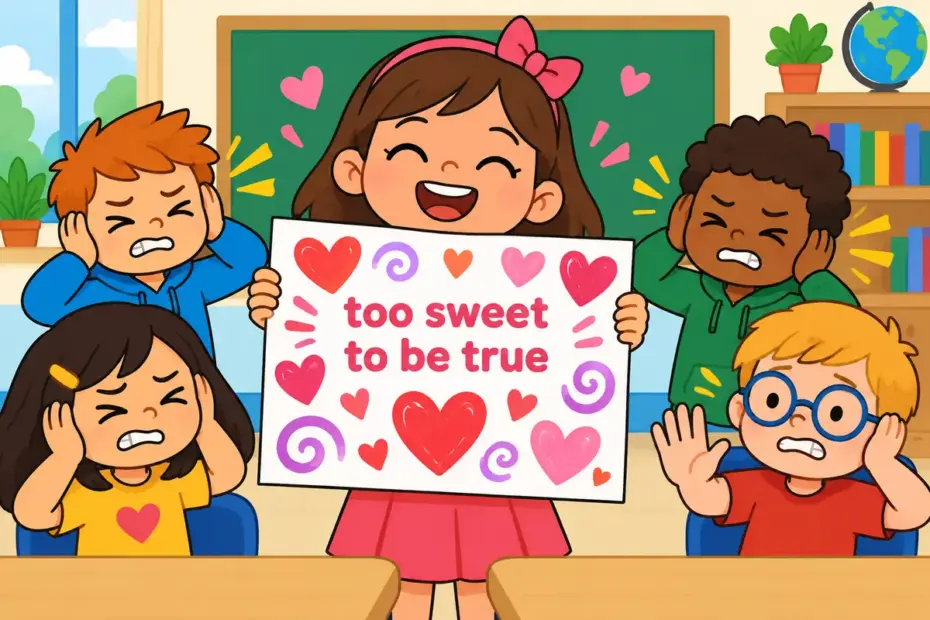
Saccharine describes something so sweet or sentimental that it feels artificial and hard to take. To use saccharine in a sentence, apply it to a tone, a remark or a style rather than to real sugar: “The card had a saccharine message.” The adjective carries disapproval, so it rarely appears as a plain compliment.
Saccharine at a glance
- Saccharine is an adjective; it stays the same before singular and plural nouns.
- The main sense is excessively sweet or sentimental in a way that feels fake.
- A second, older sense means of or containing sugar, now mostly technical.
- The strongest patterns are a saccharine smile, tone or voice.
- The commonest error is confusing saccharine with saccharin, the artificial sweetener.
- Because it is a criticism, saccharine never improves a compliment that was meant sincerely.
What does saccharine mean?
Saccharine is an adjective meaning excessively sweet, sentimental or ingratiating, usually in a way that feels insincere. The Cambridge entry for saccharine also records the literal sense of relating to sugar, which survives mainly in technical writing.
| Sense | Plain meaning | Example sentence |
|---|---|---|
| Overly sentimental | Sweet in a way that feels fake | The film ends with a saccharine speech. |
| Ingratiating | Flattering in a cloying way | He gave a saccharine welcome to the investors. |
| Containing sugar | Relating to sugar (technical, dated) | The syrup has a saccharine taste. |
The likeliest confusion is with saccharin, the artificial sweetener, which is a noun and drops the final e. Context keeps the two apart: a saccharine remark carries false sweetness, while a spoon of saccharin is a chemical. The older sugar sense of saccharine survives mainly in technical writing, where it describes substances rather than people.
Saccharine is close to sentimental but stronger: it adds the judgment that the sweetness is excessive and false, so a genuinely moving scene should never be called saccharine. Because the criticism is about intent, the adjective works best with a concrete subject such as a remark, a photo or an ending rather than with an abstract noun.
How do you use saccharine in a sentence?
Saccharine nearly always modifies a noun such as tone, smile or ending, so it stays close to genuinely sentimental writing without sharing its approval. Speech avoids the adjective when it wants to be kind, because saccharine accuses the speaker of dishonesty rather than merely describing a style. In reviews, though, it is efficient: one word signals that the emotion on screen was manufactured for effect, which is why critics reach for it whenever a finale tries too hard.
| Pattern | Example | What it signals |
|---|---|---|
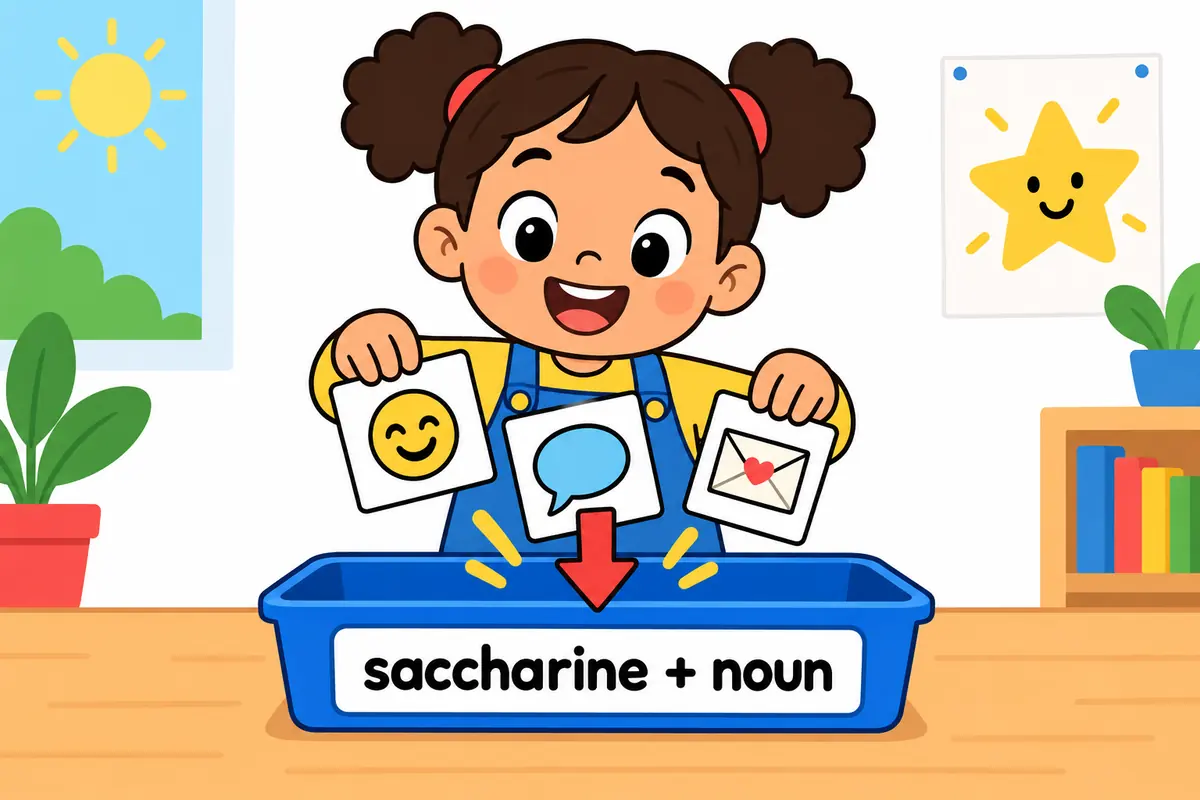
| saccharine + noun | She answered in a saccharine voice. | Attaches the criticism to a tone or manner. |
| too saccharine | The ending felt too saccharine for me. | Marks the sweetness as excessive. |
| saccharine + sweetness | The song is all saccharine sweetness. | Doubles the sense of fake sugar. |
| sound / seem saccharine | The praise sounded saccharine. | Judges a remark as insincere. |
| more saccharine | Each sequel is more saccharine than the last. | Compares rising sentimentality. |
Saccharine in a sentence: examples across contexts
Saccharine turns up wherever critics fault performed warmth, from film reviews to office email. The word stings most when the sweetness looks deliberate, so a greeting card is fair game while a clumsy but honest compliment is not. That distinction runs through every example below.
| Context | Example sentence | Why this works |
|---|---|---|
| Film review | The finale is saccharine, all slow smiles and swelling strings. | Critics use it to fault forced emotion. |
| Workplace | His saccharine email fooled nobody on the team. | Colleagues mark flattery as insincere. |
| Advertising | The advert is saccharine enough to make viewers wince. | Media writing attacks manufactured warmth. |
| Conversation | That is a saccharine way to say congratulations. | Speech uses it for overdone praise. |
| Literary essay | The novel avoids the saccharine ending its rivals prefer. | Formal writing contrasts honesty with sentiment. |
| Music review | The ballad turns saccharine after the second chorus. | Reviewers track a slide into sentimentality. |
| Family remark | Do not be saccharine; just tell me what happened. | Everyday speech rejects fake gentleness. |
| Technical writing | The saccharine layer was removed during refining. | The older sugar sense survives in industry. |
| Social media | The post is too saccharine to read without laughing. | Online writing mocks performed sweetness. |
| Diplomacy | A saccharine statement can hide a firm warning. | Analysts read tone for insincerity. |
| School report | The report avoids a saccharine tone when praising effort. | Teachers choose honesty over flattery. |
| Podcast script | The host cut the saccharine introduction and started with facts. | Editors delete forced warmth. |
Saccharine vs cloying
Saccharine and cloying both attack excessive sweetness, but cloying leans on physical revulsion while saccharine leans on fakeness.
| Attribute | saccharine | cloying |
|---|---|---|
| Core meaning | Falsely sweet or sentimental | So sweet that it sickens |
| Focus | Insincerity and performance | Excess and physical revulsion |
| Typical subject | Tone, remark, ending, advert | Smell, taste, flattery, atmosphere |
| Strength | Sharp, often mocking | Heavier, often literal |
| Example | a saccharine speech | a cloying perfume |
Choose saccharine when the sweetness is insincere, and cloying when it is simply too much to bear. A quick test helps: if a remark would annoy a reader because it seems dishonest, saccharine fits, but if it would leave that reader feeling overfull, cloying is the sharper word.
Word forms and grammar of saccharine
Saccharine stays an adjective, while the sugar family also gives the noun saccharification, the process of turning starch into sugar. It has no standard adverb, so writers attach it to a noun, as in a saccharine smile, rather than inventing saccharinely. The related noun saccharinity is rare and belongs to literary criticism, where it names the quality itself.
| Form | Part of speech | Example |
|---|---|---|
| saccharine | adjective | The note was saccharine. |
| more saccharine | comparative phrase | This version is more saccharine. |
| most saccharine | superlative phrase | It is the most saccharine song here. |
| saccharinity | noun (rare) | The saccharinity of the scene wears thin. |
| saccharin | different noun | She sweetens tea with saccharin. |
| saccharinely (non-standard) | adverb error | Wrong: He smiled saccharinely. Right: He gave a saccharine smile. |
Common mistakes with saccharine
Most saccharine errors confuse it with the sweetener or use it for praise. A thick, honeyed style is better called syrupy, which names the texture rather than the insincerity, while mawkish names sentiment that has gone weak and thin.
- Incorrect:
She added saccharine to her coffee.Correct: She added saccharin to her coffee. Rule: The sweetener is the noun saccharin; saccharine is the adjective for false sweetness. - Incorrect:
The speech was warmly saccharine and moved everyone.Correct: The speech was warm and moved everyone. Rule: Saccharine criticises the sweetness as fake, so it cannot sit beside genuine praise. - Incorrect:
His saccharine welcomed the guests.Correct: His saccharine welcome greeted the guests. Rule: Saccharine is an adjective, so it cannot be the subject of a sentence. - Incorrect:
I was saccharine by the cake.Correct: The cake was saccharine. Rule: The adjective describes the sweet thing, not the person who tastes it. - Incorrect:
She gave a saccharine smile that showed how happy she was.Correct: She gave a warm smile that showed how happy she was. Rule: A saccharine smile is false, so it cannot be offered as proof of real happiness. - Incorrect:
The team was saccharine about winning.Correct: The team was euphoric about winning. Rule: Saccharine means falsely sweet, while euphoric means genuinely overjoyed.
Practice using saccharine
Work through the seven items, then read the reasoning rather than only the answers.
- Fill the gap: The advert was so ______ that viewers rolled their eyes at its fake warmth.
- Choose the better word: She stirred a spoon of (saccharine / saccharin) into her tea.
- Correct the error: The letter was touching and a little saccharine, so it made us cry with joy.
- Build a sentence: use a saccharine tone about a customer-service reply that sounds insincere.
- Spot the register: which belongs in a film review — the finale is saccharine, or the finale is really really sweet?
- Rewrite with the synonym: The perfume is sweetly heavy. Replace sweetly heavy with cloying.
- Correct the error: He smiled saccharinely at the interviewers.
- Rewrite for a formal review: The ending is really really sweet and fake. Replace the last four words with saccharine.
Answers
- saccharine — the fake warmth is exactly what the adjective criticises.
- saccharin — the sweetener is the noun saccharin, without the final e.
- The letter was touching but a little saccharine — saccharine implies the sweetness is false, which clashes with real tears of joy.
- Model answer: The reply came in a saccharine tone that nobody believed.
- The finale is saccharine — a review uses the precise critical adjective.
- The perfume is cloying — cloying means sweet to the point of revulsion.
- He gave the interviewers a saccharine smile — saccharinely is not standard, so use the adjective with a noun.
- The ending is saccharine — one precise adjective replaces the vague description, sweet and fake.
The bottom line
Use saccharine in a sentence to criticise sweetness that feels false or overdone, and attach it to a tone, a remark or a style. Two nuances settle most sentences: saccharine is always a judgment, never neutral praise, and the sweetener is spelled saccharin, without the final e. For sweetness that sickens more than it deceives, cloying is the stronger word. The safest check is to ask whether the sweetness is performed: if it is, saccharine earns its place, and if the feeling is real, choose warm instead.
Frequently asked questions about saccharine
Is saccharine an insult?
Almost always, yes. Saccharine says the sweetness is excessive and insincere, so it works as a criticism of a speech, an advert or a tone. A writer who means genuine warmth chooses touching, warm or heartfelt. Using saccharine as praise is one of the clearest signals of a mixed-up word.
What is the difference between saccharine and saccharin?
Saccharin is a noun and names the artificial sweetener, spelled without a final e. Saccharine is an adjective describing false sweetness. The two differ by one letter and by grammar, so she added saccharin to her coffee is right, while she added saccharine to her coffee is a common slip.
Can saccharine mean literally sugary?
It can, in older and technical writing. The sugar sense survives in phrases such as a saccharine taste or the saccharine layer, which appear in food and industrial texts. In general modern English the figurative sense dominates, so readers assume criticism unless the context is clearly technical.
What is a synonym for saccharine?
Cloying, mawkish, syrupy and treacly all overlap, but each tilts differently. Cloying stresses sweetness that sickens, mawkish stresses weak sentiment, and syrupy suggests a thick, pouring style. Saccharine itself leans hardest on the idea of fake, performed warmth rather than mere excess.