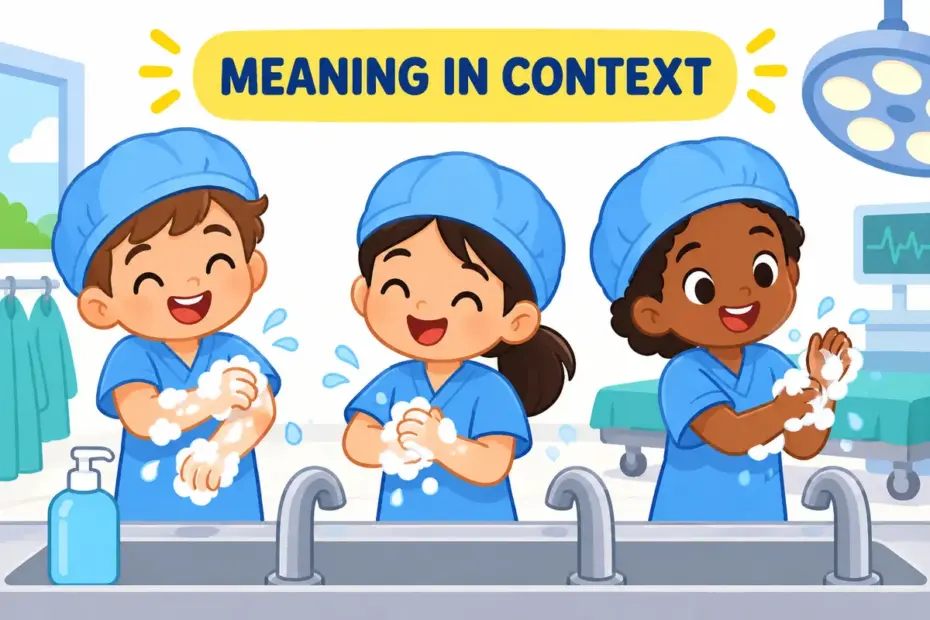
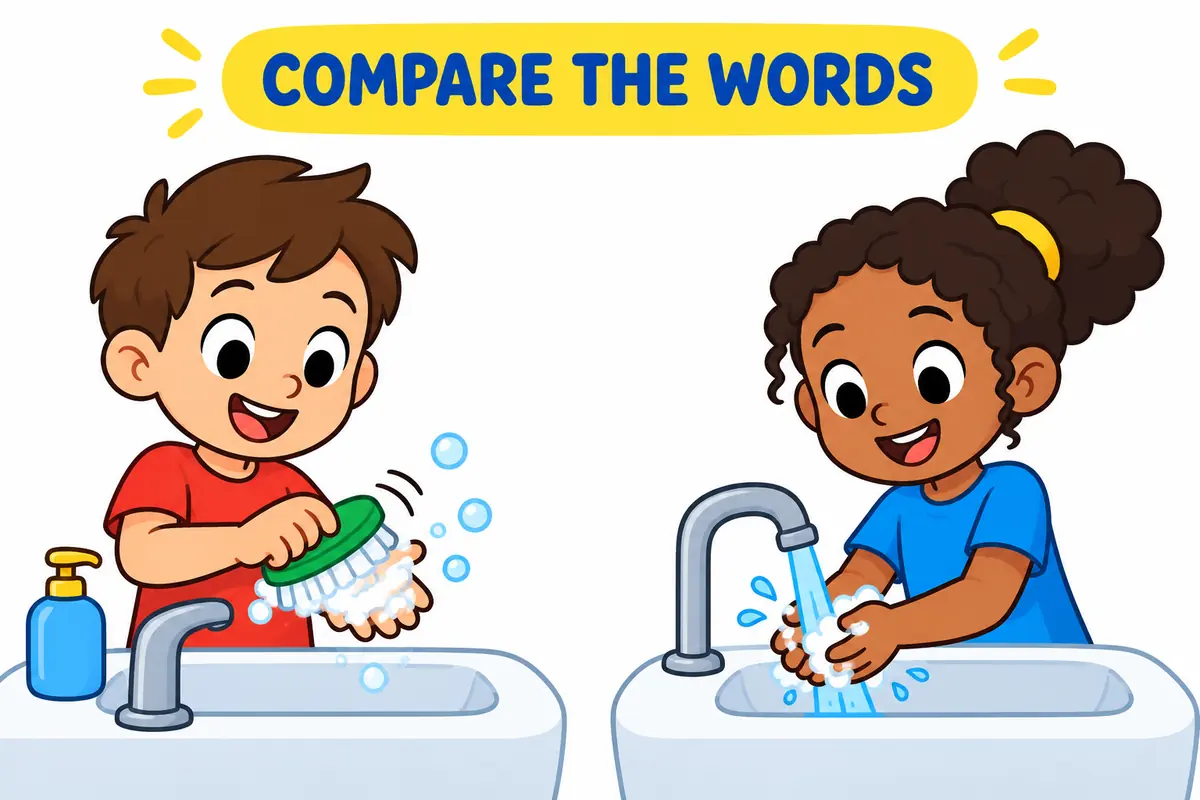
Scrub up in a sentence usually describes washing thoroughly, especially before a medical procedure or another clean task. In some British usage, scrub up can also mean to look smart after dressing. “The surgeon scrubbed up before entering the operating room” shows the hygiene sense.
Scrub Up at a glance
- Scrub Up functions as verb and follows regular inflection patterns.
- A common pattern is scrub up before + activity / scrub + object + up.
- The phrase is clearest when its object or surrounding context is stated.
- A frequent learner error is treating scrub up as interchangeable with wash.
- Use a plainer alternative when the idiom’s register or extra implication is unwanted.
What does scrub up mean?
Scrub up is a phrasal verb meaning to wash or clean oneself thoroughly, especially before an operation. The Cambridge Dictionary: scrub up entry describes the core usage; the exact sense depends on the grammatical frame. For a simpler synonym, consider bathe. Scrub Up is not a universal substitute for that plainer word: choose it only when its specific implication is intended. You can also compare groom when selecting a more precise expression.
| Sense | Plain meaning | Example sentence |
|---|---|---|
| Primary | Scrub up is a phrasal verb meaning to wash or clean oneself thoroughly, especially before an operation. | The surgeon scrubbed up before the procedure. |
| Contextual | A related use shaped by its object or setting | Please scrub the muddy boots up before storing them. |
How do you use scrub up in a sentence?
The useful pattern is scrub up before + activity / scrub + object + up. Keep the object close enough to make the intended meaning clear; a particle may move around a short object, but a pronoun normally sits between the verb and particle.
| Pattern | Example | What it signals |
|---|---|---|
| scrub up before + activity / scrub + object + up | The surgeon scrubbed up before the procedure. | The core meaning in a natural frame. |
| past form + object | Please scrub the muddy boots up before storing them. | A completed action or state. |
| pronoun + particle | They scrub it up before lunch. | Typical placement of a short pronoun object. |
Compare the everyday alternative clean: the phrasal verb is more idiomatic, while a single-word verb may sound more neutral in formal writing.
Scrub Up in a sentence: examples across contexts
The following examples keep the phrase in distinct settings so its grammar and tone are easy to compare.
| Context | Example sentence | Why this works |
|---|---|---|
| Classroom | The surgeon scrubbed up before the procedure. | A concrete task shows the core pattern. |
| Workplace | Please scrub the muddy boots up before storing them. | The object makes the intended sense explicit. |
| Conversation | I would scrub up that before tomorrow. | The base form follows would. |
| News report | The report said the manager scrub up after the dispute. | A past-tense form anchors the event. |
| Academic writing | The study discusses how people scrub up in this setting. | The bare form follows how people. |
| Please scrub up the relevant item before sending the reply. | An imperative gives a direct instruction. | |
| Travel | We watched the guide scrub up before the group arrived. | The bare infinitive follows watched. |
| Family conversation | She has scrub up every detail for the trip. | The participle follows has. |
Scrub Up vs wash
These expressions overlap in some situations, but they do different work: scrub up carries the particular sense above, while wash states the simpler related action or idea. A useful distinction is whether you need the idiom’s extra shade of meaning.
| Attribute | scrub up | wash |
|---|---|---|
| Core meaning | Scrub up is a phrasal verb meaning to wash or clean oneself thoroughly, especially before an operation. | A related, more general meaning |
| Typical context | Informal or idiomatic phrasing | Broad neutral usage |
| Grammatical form | verb | Usually a verb |
| Implication | Specific nuance from the particle | Less idiomatic, direct meaning |
Verdict: choose scrub up for its specific idiomatic implication and wash when the plain meaning is enough.
Word forms and grammar of scrub up
The verb inflects regularly. Keep the particle with the verb phrase, and use the conventional object position shown in the table.
| Form | Part of speech | Example |
|---|---|---|
| scrub up | verb, base | I scrub up the material today. |
| scrubs up | verb, third person | She scrubs up each topic. |
| scrubed up | verb, past | They scrubed up yesterday. |
| scrubing up | verb, participle | He is scrubing up now. |
| scrubbing-up | related noun | The dictionary lists scrubbing-up as a related form. |
Common mistakes with scrub up
- Incorrect: I scrubed yesterday. Correct: I scrubed it yesterday. Rule: Include the object when the verb requires one.
- Incorrect: She scrub it up. Correct: She scrubs it up. Rule: Add the third-person singular ending to the verb.
- Incorrect: They have scrubed it. Correct: They have scrubed it. Rule: The participle follows have; do not add a second past marker.
- Incorrect: The phrase always means wash. Correct: Use scrub up only when its idiomatic nuance fits. Rule: Similar meanings do not make two expressions interchangeable.
Scrub up is tied to thorough cleaning. In medical settings, it commonly refers to washing hands and arms carefully before an operation or sterile procedure. “The surgical team scrubbed up before entering the operating room” is a conventional context. The phrase does not merely mean taking an ordinary shower; the setting often implies careful preparation and hygiene.
The verb is usually intransitive in the surgical sense: a person scrubs up, rather than scrubbing up a patient. To describe washing an object, choose the simple verb scrub with a direct object: “She scrubbed the pan clean.” The article’s earlier example “scrub the muddy boots up” is not a safe model for this meaning, so use “scrub the mud off the boots” or “scrub the boots clean” instead.
In some British usage, scrub up can also describe someone making themselves clean and smart in appearance. The compliment “You scrub up well” means the person looks good when dressed up, often with a lightly teasing tone. This idiomatic meaning is different from the surgical procedure, and context makes the distinction clear: operating rooms, gowns, and sterile equipment signal hygiene; parties or formal clothes signal appearance.
Related forms follow ordinary verb patterns: scrubs up, scrubbed up, and scrubbing up. The final consonant is doubled before -ed and -ing. The phrase can take a following time or purpose phrase, as in “scrub up before the procedure.” A pronoun is not normally placed between the verb and the particle in this intransitive use, because there is no object to move.
Use wash for routine cleaning, sterilize when the process specifically destroys microorganisms, and scrub up when you mean the preparatory washing routine or the informal appearance idiom. Avoid implying that washing alone makes equipment sterile: the words describe different processes. In clinical writing, precise procedural language matters, so name the actual preparation required instead of relying on a broad idiom.
| Context clue | Meaning | Example |
|---|---|---|
| Before an operation | Wash carefully for a sterile procedure | The surgeon scrubbed up before the incision. |
| Preparing for a clinical task | Clean hands and arms thoroughly | Please scrub up before assisting in the procedure. |
| Formal clothes or a party | Look smart after dressing | He scrubs up well for evening events. |
| Cleaning a cooking pot | Use scrub with an object, not scrub up | She scrubbed the pot clean. |
In healthcare contexts, the phrase often names a preparatory routine rather than a guarantee about the room or tools. A sentence such as “The surgeon scrubbed up” tells readers that the surgeon washed carefully; it does not by itself state that every instrument was sterilized or that the procedure followed a particular protocol. If the procedural requirement matters, name the required hand preparation and follow the institution’s terminology.
The informal appearance sense is usually intransitive too: “You scrub up well” is a comment about how someone looks after dressing. It is often said after seeing someone in smart clothes, and can be complimentary or teasing depending on the relationship. It does not mean that the person physically scrubbed themselves immediately beforehand. Avoid using the phrase in formal descriptions of clothing, where “look smart” or “dress neatly” is clearer.
For a learner, the particle up is part of the idiom and is not a general marker that can be attached to any cleaning verb. “Wash up” can mean wash dishes in some contexts; “scrub the surface” takes a direct object; “scrub up” describes the person’s preparation or appearance. Learn each as a separate pattern instead of translating the particle word by word.
Practice using scrub up
- Fill the blank: She ___ the list as each task was completed.
- Choose: The phrase meant “Scrub up is a phrasal verb meaning to wash or clean oneself thoroughly, especially before an operation.”: scrub up or wash?
- Correct the form: He scrub the details yesterday.
- Write a sentence using the pattern scrub up before + activity / scrub + object + up.
- Choose the more neutral alternative for a formal report: scrub up or wash?
- Fill the blank: They have ___ the plan before the meeting.
Answers
- scrubed; the sentence describes a completed action.
- scrub up; it is the expression with the stated specific sense.
- He scrubed it yesterday; a transitive use needs an object.
- Answers vary; the sentence should include the requested grammatical frame.
- wash; a plain verb is usually more neutral in formal prose.
- scrubed; have takes the past participle.
The bottom line
Scrub up in a sentence is easiest to use when the sentence gives enough context to identify its intended meaning. Match the phrase to its normal grammatical pattern, and keep its tone in mind. Choose a simpler alternative when the idiomatic implication is unnecessary.
Frequently asked questions about scrub up
Is scrub up formal or informal?
Scrub Up is an idiomatic expression whose tone depends on context and region. It can sound natural in conversation, while a plainer alternative may suit a formal report better. Readers should check whether the phrase’s particular nuance is intended before choosing it in professional writing.
Can the object come between the words?
With many phrasal verbs, a short noun object can appear before or after the particle, while a pronoun normally comes between the verb and particle. For this expression, follow familiar examples and avoid placing a long object where it makes the sentence difficult to parse.
What is a simple synonym for scrub up?
Wash may work as a broad alternative in some sentences, but it does not reproduce every implication of scrub up. Choose the synonym only after checking the full context. If the phrase expresses a more specific attitude or result, replacing it may change the meaning.
How can I remember the meaning?
Learn scrub up as part of a short phrase with its usual object or complement, then write an original sentence in a familiar setting. Comparing that sentence with a plain alternative such as wash helps reveal the extra nuance and makes the grammar easier to remember.