Sell out is a phrasal verb with two senses: every ticket or item has been bought, or a person has betrayed their principles for gain. To use sell out in a sentence, keep the particle out with the verb: “The concert sold out in an hour.” The subject decides which sense a reader hears.
Sell out at a glance
- Sell out is a separable phrasal verb whose particle is out.
- Its forms are sell out, sold out, selling out and the noun sellout.
- The stock sense is neutral; the betrayal sense is strongly negative.
- Fixed patterns include sell out, sell out a friend, sell out to a rival and be sold out.
- The commonest error is putting a pronoun object after the particle, as in sell out them.
What does sell out mean?
Sell out means either to sell all of something until none is left, or to abandon a person or a cause in exchange for money or advantage. The Cambridge entry for sell out lists both families of sense, and they behave differently in a sentence. The stock sense is intransitive, so the show simply sold out. The betrayal sense is transitive, so somebody sells out a person or an ideal, and a person who betrays a cause is the nearest plain equivalent. One limitation is worth stating plainly: sell out does not mean to leave a position for honest reasons, so a person who resigns on principle has not sold out. That is simply to abandon a position, and the verb carries no shame.
| Sense | Plain meaning | Example sentence |
|---|---|---|
| Sell all stock | Every item or seat is bought | The first print run sold out in a week. |
| Betray a person | Abandon someone for personal gain | He sold out his teammates for a promotion. |
| Sell out to a buyer | Accept a takeover or a compromise | The family firm sold out to a chain. |
| Be sold out | Passive form, often of a group betrayed | The staff felt sold out by the deal. |
How do you use sell out in a sentence?
The verb is separable, which means the particle out can move past a noun object but not past a pronoun. Five patterns cover nearly every real sentence, and the position of out is the part learners get wrong.
| Pattern | Example | What it signals |
|---|---|---|
| sell out, no object | The final show sold out. | Intransitive stock sense; nothing is betrayed. |
| sell out + noun object | He sold out his friends. | Transitive betrayal sense with the object after out. |
| sell + noun object + out | He sold his friends out. | The same meaning with the particle moved right. |
| sell + pronoun + out | He sold them out. | A pronoun must sit between the verb and the particle. |
| sell out to + buyer | The startup sold out to a rival. | Names the party that gains from the deal. |
The separability is not optional. A noun can sit on either side of out, but a pronoun has one home only: sell them out is correct, and sell out them is not English. In a relative clause the particle simply stays put, as in the friends he sold out.
Sell out in a sentence: examples across contexts
The phrasal verb keeps its shape while the subject changes, and the subject is what tells a reader whether goods or people are being discussed. The ten sentences below move from a box office to a boardroom.
| Context | Example sentence | Why this works |
|---|---|---|
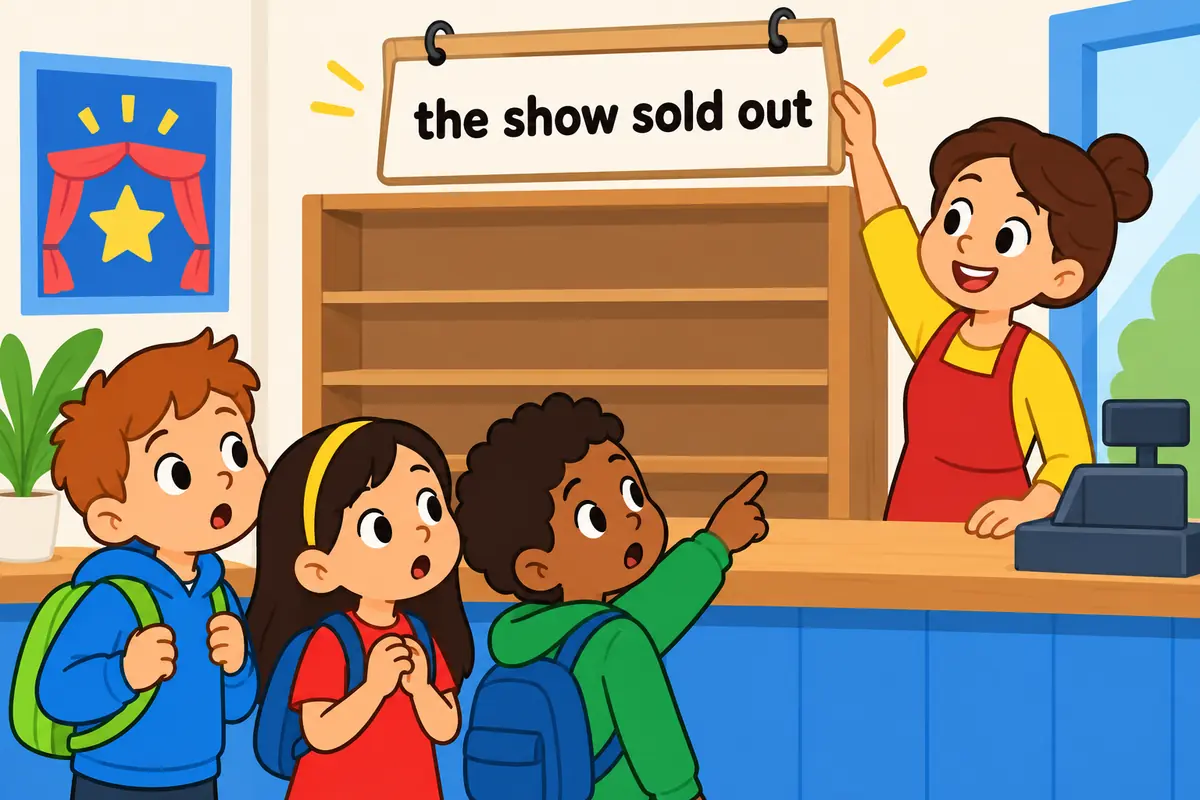
| Classroom | The school play sold out in two days. | Shows the neutral stock sense in a familiar setting. |
| Workplace email | The morning session has sold out, so we opened a second. | Present perfect suits a completed sale. |
| News report | The founder sold out to a larger rival after ten years. | Sell out to names the buyer precisely. |
| Music writing | The band was accused of selling out after the advert. | The betrayal sense with a cause rather than a person. |
| Sports report | The defender sold out his teammates by leaking the tactics. | Transitive use with a noun object after out. |
| Conversation | I wanted those boots, but they sold out in my size. | Ordinary speech uses the stock sense loosely. |
| Business news | The chain sold out of umbrellas before the storm. | Sell out of names the product that ran short. |
| Politics | The minister was said to have sold out the campaign’s promises. | Betrayal sense applied to abstract promises. |
| Literary prose | He felt he had sold out every idea he once believed in. | The past perfect shows a completed betrayal. |
| Retail notice | The limited edition was sold out by nine in the morning. | Passive be sold out describes the goods, not the shop. |
The two senses rarely collide, because a queue appears in the stock rows and a person or a promise appears in the betrayal rows. When both are present, context decides at once.
Sell out vs back out
Sell out and backing out of a deal share the particle out, which is why learners mix them, but they describe opposite kinds of failure. One turns toward an advantage; the other retreats from a promise.
| Attribute | sell out | back out |
|---|---|---|
| Core meaning | Betray, or exhaust the stock | Withdraw from an agreement |
| Direction | Turns toward the other side or empties | Retreats from a plan already made |
| Typical object | Friends, a cause, tickets, a product | A deal, a promise, an agreement |
| Motive | Money or personal advantage | Fear or a change of mind |
| Connotation | Treacherous in the betrayal sense | Unreliable, but not treacherous |
Verdict: choose sell out when somebody gains by abandoning loyalty, and choose back out when somebody simply leaves a promise behind. To surrender a principle suggests giving it up under pressure, and to capitulate to pressure stresses the same yielding, though neither is as personal as sell out.
Word forms and grammar of sell out
The phrasal verb grows a past form, a participle and a noun, and the noun spelling changes between one word and a hyphen. The table keeps the forms and their jobs apart.
| Form | Part of speech | Example |
|---|---|---|
| sell out | phrasal verb, base | They sell out every December. |
| sold out | past tense and past participle | The show sold out early. |
| sold-out | adjective, hyphenated | A sold-out crowd filled the hall. |
| selling out | present participle and gerund | Tickets are selling out fast. |
| sellout | noun, one word | The deal was a sellout. |
| sell-out | noun or adjective, British style | A sell-out tour of the country. |
The same particle out builds other phrasal verbs with very different meanings, including blow out, which means to extinguish or to fail suddenly. The verb alone is sell, so the third person singular adds to the verb, not the particle: the shop sells out.
Common mistakes with sell out
- Incorrect:
He sold out them.Correct: He sold them out. Rule: A pronoun object must sit between the verb and the particle. - Incorrect:
She sold out of her friends.Correct: She sold out her friends. Rule: The betrayal sense takes a direct object, not the preposition of. - Incorrect:
The concert was sold out of tickets.Correct: The concert sold out, or the concert was sold out. Rule: Sold out of names a product that ran short, as in we sold out of bread. - Incorrect:
The shop sell out every morning.Correct: The shop sells out every morning. Rule: Third person singular adds s to the verb sell, giving sells out. - Incorrect:
He is such a sell out.Correct: He is such a sellout. Rule: The noun is written as one word, sellout.
Practice using sell out
Work through the seven items, then read the reasoning in the answers rather than only the key.
- Fill the gap: The new phone ______ out within an hour.
- Choose the better word: The player (sold out / backed out) his teammates by leaking the plan.
- Correct the error: The band sold out of their fans.
- Build a sentence: use sell out to about a small company taken over by a bigger one.
- Spot the register: which belongs in a news report — tickets sold out in record time, or the tickets went like hotcakes, seriously?
- Rewrite with a pronoun: He sold out his partner. Replace the object with the pronoun them, keeping the correct order.
- Fill the gap: We ______ out of milk before noon.
Answers
- sold — the past tense of the phrasal verb is sold out, and the stock sense is intransitive.
- sold out — the player betrayed his own side; backing out would mean he withdrew from a deal.
- The band sold out their fans — the betrayal sense takes a direct object, not of.
- Model answer: The family bakery sold out to a national chain last spring.
- Tickets sold out in record time — a report keeps the plain verb and drops the slang.
- He sold them out — a pronoun must sit between the verb and the particle.
- sold — sell out of names the product that ran short, here the milk.
The bottom line
Use sell out in a sentence when stock is exhausted or when somebody trades loyalty for gain, and place the particle out according to what follows it. Two nuances decide most sentences: a pronoun object must sit between the verb and out, and a buyer after sell out takes the preposition to. The noun kept for a person who betrays a cause is called a traitor, which is the harsher label for the same act.
Frequently asked questions about sell out
Is it sell out or sellout?
Both exist, but they are different parts of speech. Sell out, two words, is the phrasal verb, as in the show sold out. Sellout, one word, is the noun meaning a betrayal or a full house, as in the deal was a sellout. British style often hyphenates the noun as sell-out.
What does it mean to sell out your friends?
To sell out your friends is to abandon their trust in exchange for money, a promotion or some other advantage. It is a strong accusation, because the phrase implies a deliberate trade rather than a mistake. The verb is separable, so you can also say you sold your friends out.
Can sell out be positive?
In the stock sense it can be welcome news, because a sold-out show or a sold-out run means demand was strong. In the betrayal sense it is always negative, and calling an artist a sellout criticises them for compromising their values. The subject and the object tell you which reading applies.
What is the difference between sold out and sold out of?
Sold out alone means everything has gone, as in the tickets sold out. Sold out of needs a product and means the shop has none of that item left, as in we sold out of bread. The version with of names the missing product, while the version without it describes the whole event.