Sentient is an adjective meaning able to perceive or feel things, so a sentient being can experience pain, warmth or comfort. To use sentient in a sentence, place it before the being or after a linking verb: “Every sentient creature deserves care.” The noun is sentience.
Sentient at a glance
- Sentient is an adjective; its noun is sentience and its opposite is insentient.
- It describes the capacity to feel and perceive, not the ability to reason.
- Typical partners are sentient beings, sentient creatures and sentient life.
- It appears in philosophy, animal-welfare writing, biology and science fiction.
- The commonest error is swapping it for conscious, which describes being awake and aware moment by moment.
What does sentient mean?
Sentient is an adjective meaning able to perceive or feel things, especially to experience pleasure and pain. The Cambridge entry for sentient gives that sense, and the Merriam-Webster entry records the same capacity for feeling. The word comes from a Latin verb for feeling, and it names a capacity rather than an event: a being is sentient because it can feel at all, whether or not it is feeling something right now. Biology uses it for animals with a nervous system, animal-welfare writing uses it to argue that such creatures matter, and science fiction uses it for machines that seem to have inner experience. A useful near-synonym is alive, but alive only says a thing is living, while sentient adds the ability to feel.
| Sense | Plain meaning | Example sentence |
|---|---|---|
| Capable of feeling | Can experience pain, pleasure or comfort | Every sentient creature deserves care. |
| Perceiving the world | Able to take in sensations and surroundings | Sentient life needs water and shelter. |
| Self-aware (science fiction) | A machine that seems to have inner experience | The ship became sentient in the final act. |
One limitation is worth stating plainly. Sentient does not mean clever, and it does not mean self-aware in the human sense; a fish is sentient without solving puzzles, and a thermostat is neither. It is also not the right word for a passing state, which is conscious, or for noticing a fact, which is aware. Where the point is simply that something is living, alive is the plainer choice.
How do you use sentient in a sentence?
Sentient is an adjective, so it either sits before a noun or follows a linking verb such as be, seem or become. The table shows the patterns that cover almost every real sentence, including the noun phrase sentient being.
| Pattern | Example | What it signals |
|---|---|---|
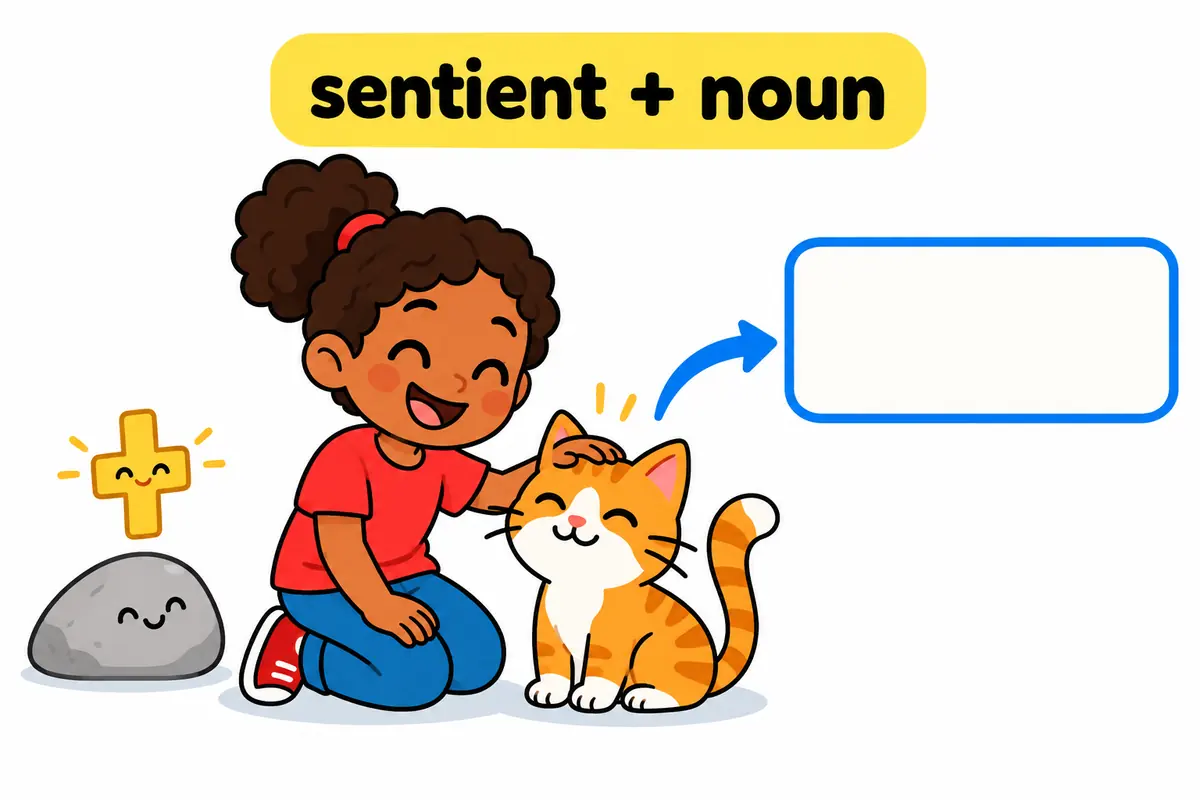
| sentient + noun | Sentient creatures share the forest. | Attributive use, the commonest pattern. |
| be / seem / become + sentient | The robot seemed sentient. | Predicative use after a linking verb. |
| any / every + sentient being | Every sentient being matters. | Fixed noun phrase common in ethics. |
| sentient + life / species | Sentient life may exist elsewhere. | Collective use in science and fiction. |
| become sentient | The program became sentient overnight. | Change of state, mostly in science fiction. |
The linking-verb test is the quickest check. If the word can follow seems or becomes and still describe a capacity to feel, sentient is doing its job; if it describes being awake right now, the writer wants conscious instead. Attributive use is by far the more common of the two.
Sentient in a sentence: examples across contexts
Sentient moves between a science lesson and a science-fiction script without changing its meaning. The ten sentences below each name the being and the feeling it can have.
| Context | Example sentence | Why this works |
|---|---|---|
| Classroom | The class listed every sentient creature in the pond. | Uses the word as an ordinary describing adjective. |
| Biology | Only sentient animals with a nervous system can suffer. | The scientific sense, tied to a capacity. |
| Animal welfare | Farms have a duty to protect sentient livestock. | Links the word to ethical obligation. |
| Philosophy | Moral status may rest on being sentient rather than clever. | Distinguishes feeling from reasoning. |
| Science fiction | The probe became sentient after years in deep space. | The machine sense, a change of state. |
| News report | The ruling treats sentient beings as more than property. | Formal register in a legal story. |
| Medicine | The patient stayed sentient throughout the scan. | A rare clinical use for feeling and responding. |
| Conversation | My dog is clearly sentient; she sulks when ignored. | Informal evidence of feeling, the everyday sense. |
| Environmental writing | Sentient life fills even the coldest ocean vents. | Collective use for a whole ecosystem. |
| Book review | The novel grants its sentient machines a fragile memory. | Literary use blending feeling and awareness. |
| Religious writing | Many traditions extend compassion to every sentient being. | Shows the noun phrase in ethical and spiritual prose. |
Only the medical example leans on the idea of being awake, and even there the writer means a continuing capacity to feel, which is why sentient still fits.
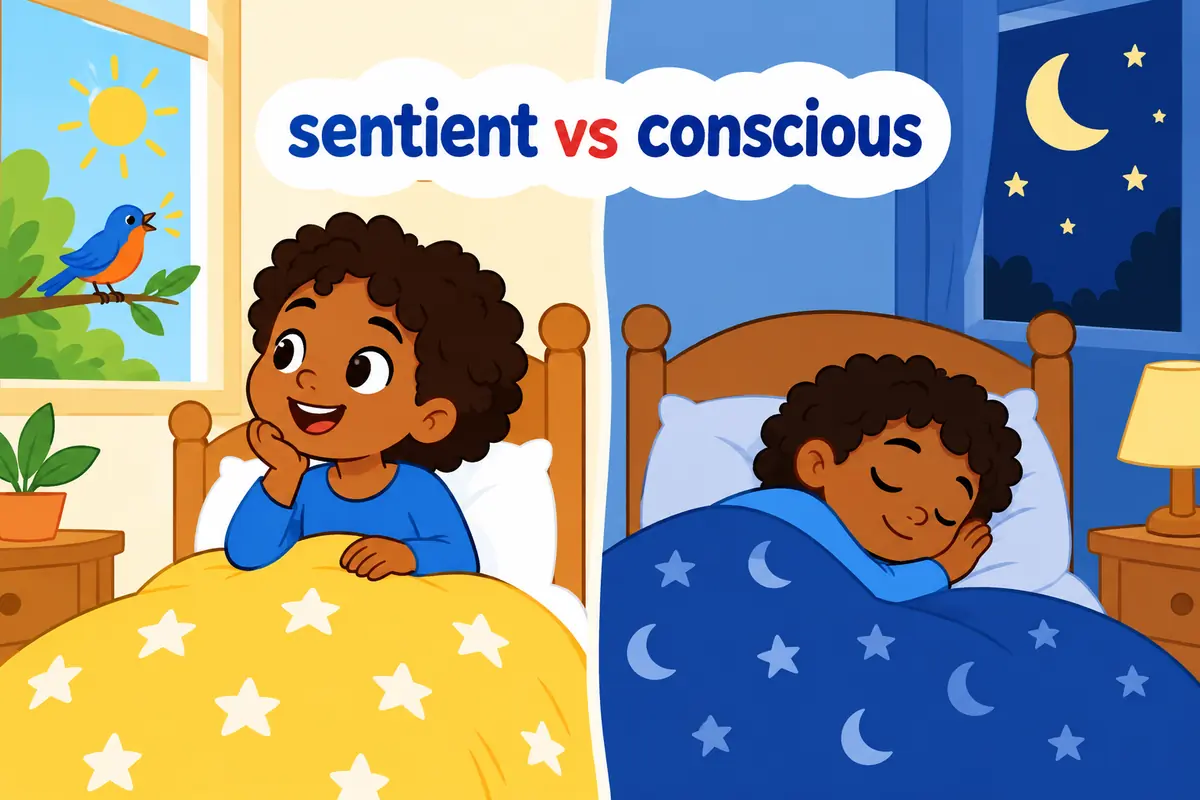
Sentient vs conscious
Sentient and conscious overlap but answer different questions. Sentient is about the capacity to feel at all; conscious is about being awake and aware of oneself and the surroundings at a given moment.
| Attribute | sentient | conscious |
|---|---|---|
| Core meaning | Able to perceive or feel | Awake and aware of self and surroundings |
| Scope | A capacity, usually lasting | A state, which can change minute by minute |
| Typical subject | Animals, beings, machines | People, patients, minds |
| What it implies | Capacity for sensation and feeling | Awareness of that sensation or of a fact |
| Opposite | Insentient, as in insentient matter | Unconscious, as in an unconscious patient |
| Register | Formal, scientific and philosophical | Neutral to medical |
To be conscious of a risk is to know it; to be sentient is to be capable of feeling at all. Nearby words sharpen the contrast: aware of the rule and cognizant of the cost both name knowledge, and perceptive about people praises quick insight rather than feeling. Verdict: choose sentient for the capacity to feel and conscious for the state of being awake or aware.
Word forms and grammar of sentient
Sentient has a noun, a rare adverb and a regular negative, and the negative is the form most often misspelled. The table lists the forms learners need, including the opposite that marks a thing as unable to feel.
| Form | Part of speech | Example |
|---|---|---|
| sentient | adjective | Sentient animals can suffer. |
| sentience | noun | The debate about machine sentience continues. |
| sentiently | adverb, rare | The creature acted sentiently, testing the door. |
| insentient | adjective, opposite | Insentient matter cannot feel pain. |
| non-sentient | adjective, hyphenated | Non-sentient machines can still help. |
| sentient being | noun phrase | Every sentient being was counted. |
Keep the opposites straight. Insentient is the direct denial of feeling, while inanimate describes objects that were never alive, and a numb person is sentient but temporarily unable to feel. A non-sentient system can behave in complex ways, so behaviour alone never proves sentience.
Common mistakes with sentient
- Incorrect:
He was sentient of the danger.Correct: He was aware of the danger. Rule: Sentient never takes of; aware and cognizant are the words for noticing something. - Incorrect:
After the operation she was sentient again.Correct: After the operation she was conscious again. Rule: Regaining wakefulness is the state of being conscious, not the capacity to feel. - Incorrect:
The sentient program solved every puzzle.Correct: The sentient program felt lonely. Rule: Sentient means able to feel, not clever; cleverness belongs to intelligent. - Incorrect:
She is very sentient about the new rules.Correct: She is very aware of the new rules. Rule: For knowledge of facts, aware or cognizant replaces sentient. - Incorrect:
A rock is not sentient.Correct: A rock is inanimate and insentient. Rule: Inanimate names lifelessness and insentient names the absence of feeling, so the pair is more precise.
Practice using sentient
Work through the seven items, then check the reasoning rather than only the answer.
- Fill the gap: Ethicists argue that every ______ being deserves protection.
- Choose the better word: After the anaesthetic wore off, the patient was (sentient / conscious) again.
- Correct the error: The octopus is sentient of the divers nearby.
- Build a sentence: use become sentient about a robot in a story.
- Spot the register: which belongs in a biology essay, sentient animals can suffer, or animals really do feel it?
- Rewrite with the noun: The evidence that the species can feel changed the law. Use sentience.
- Choose the better word: A thermometer is not (insentient / intelligent), though it responds to heat.
Answers
- sentient – the being is capable of feeling, the ethical sense of the adjective.
- conscious – waking up is a state of awareness, not a capacity.
- The octopus is aware of the divers nearby – sentient cannot take of.
- Model answer: In the final chapter the robot becomes sentient and asks to choose its own work.
- Sentient animals can suffer – a biology essay keeps the precise adjective and formal phrasing.
- The sentience of the species changed the law – the noun names the capacity directly.
- intelligent – a thermometer shows no feeling; the question is about intelligence, not sentience.
The bottom line
Use sentient in a sentence for the capacity to feel and perceive, whether the being is an animal, a person or a fictional machine, and keep it out of sentences about waking up or noticing facts. Two details decide most sentences: the adjective describes a lasting capacity rather than a passing state, and it never takes the preposition of. Where the meaning is being awake, conscious is the right word; where the meaning is simply living, alive will do.
Frequently asked questions about sentient
Is sentient the same as conscious?
No. Sentient means able to perceive and feel, which is a lasting capacity of a being. Conscious means awake and aware of oneself and the surroundings, which is a state that can come and go. An animal is sentient all its life but conscious only when awake, so the two words answer different questions.
Can a machine be sentient?
In everyday reality, no current machine is known to feel anything, so scientists treat them as non-sentient. In philosophy and science fiction, a sentient machine is one that seems to have inner experience. The word names the capacity to feel, not the ability to compute or to pass tests.
What does sentient mean for animals?
A sentient animal is one that can feel, including pain and comfort, and the word anchors many animal-welfare arguments. It does not require high intelligence, because fish and insects may be sentient without reasoning like people. The claim is about feeling, which is why it carries moral weight. A plant responds to light, but that response is not feeling.
What is the noun form of sentient?
The noun is sentience, as in the sentience of animals or a debate about machine sentience. The rare adverb is sentiently, and the opposites are insentient and non-sentient. Sentience names the capacity itself, so it fits sentences that discuss feeling as an idea.