Set forth in a sentence means to present or state something formally, and in older writing it can also mean to begin a journey. The phrasal verb is transitive in its main sense, so a person or document sets forth a plan, a claim or a set of rules. “The report sets forth three options for the council.”
Set forth at a glance
- Set forth is a phrasal verb; its forms are set forth, sets forth, setting forth and the unchanged past set forth.
- Its main sense is to present or state something formally; a second sense is to set off on a journey.
- The phrase is fixed: the words set and forth stay together and the object follows them.
- Typical subjects are a report, a document, a policy or a person speaking formally.
- Register is formal and often legal or official; the journey sense sounds literary or old-fashioned.
- The nearest lookalike is set out, which shares both senses but also means to intend.
What does set forth mean?
Set forth is a phrasal verb meaning to present ideas or rules in a clear, formal way, and, in a second sense, to begin a journey. The Cambridge entry for set forth records both, and the difference is grammatical as well as historical: the presentation sense is transitive, while the journey sense stands alone. In a modern document the presentation sense does almost all the work.
| Sense | Plain meaning | Example sentence |
|---|---|---|
| Present formally | State or explain something in writing or speech | The contract sets forth the duties of each party. |
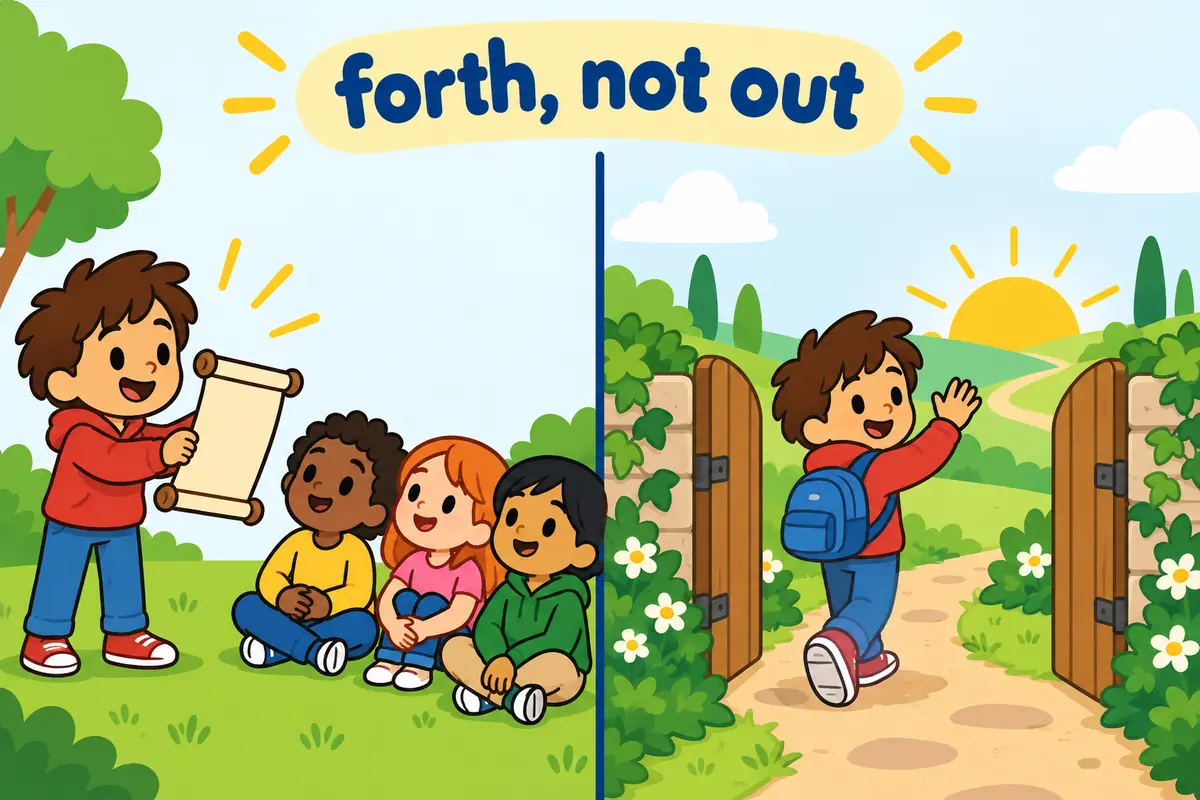
| Begin a journey | Set off, especially in old or literary prose | They set forth at dawn with two horses. |
One limitation is worth stating plainly. Set forth is not a casual verb. In an email to a colleague, “the report sets forth three options” can sound stiff, and the plainer state or list usually reads better. Reserve set forth for contracts, rulings, oaths and formal statements of principle.
How do you use set forth in a sentence?
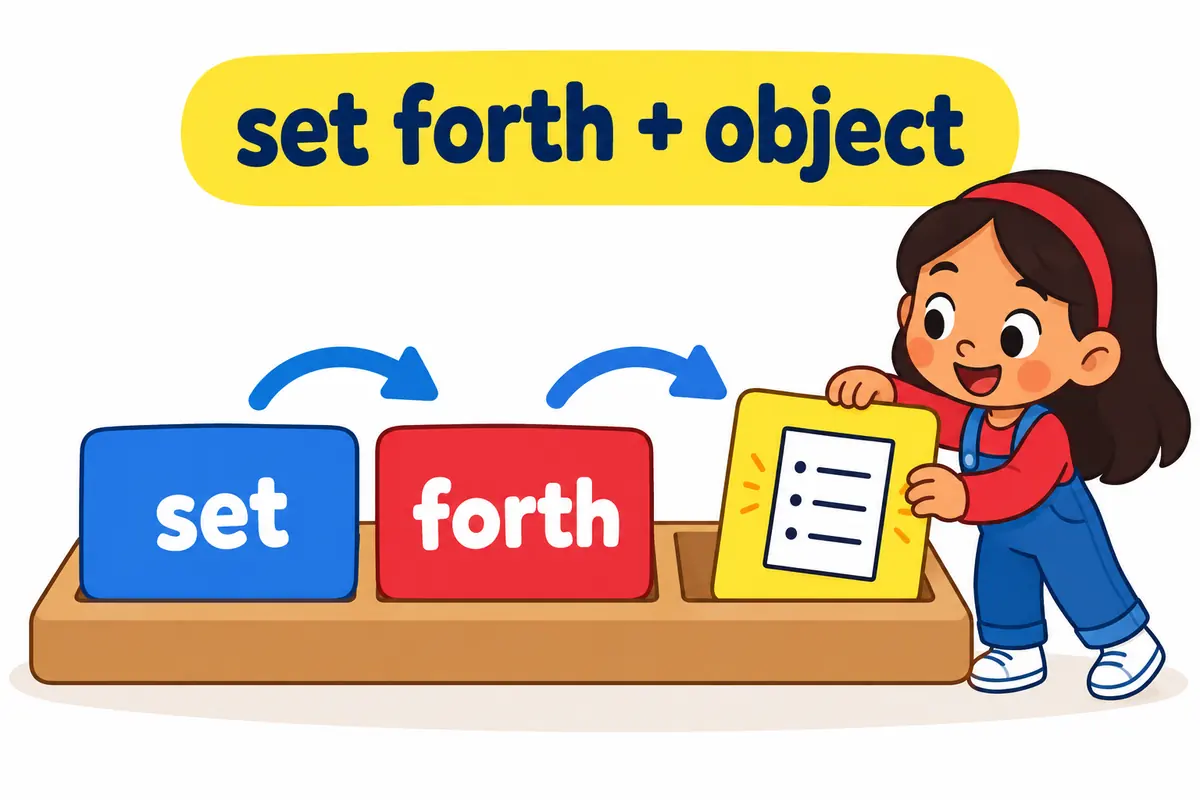
The particle does not move. You write set forth a proposal, not set a proposal forth, and forth never strands at the end of the phrase. That fixed order is the main thing to remember, because the similar verb set out behaves differently.
| Pattern | Example | What it signals |
|---|---|---|
| subject + set forth + object | The policy sets forth the rules for late payment. | Formal presentation of written terms. |
| set forth + object + in + document | She set forth her reasons in a short memo. | Names the document carrying the statement. |
| as set forth in | Payment is due as set forth in clause four. | Legal cross-reference, a fixed formula. |
| be set forth | The conditions are set forth on the last page. | Passive, focusing on the written terms. |
| set forth + on + journey | The travellers set forth on a long road. | Literary journey sense, with no object. |
Where a plainer verb fits, state the facts is the everyday choice, and it carries no ceremonial weight.
Set forth in a sentence: examples across contexts
Set forth keeps the same formality while the subject changes from a statute to a letter. The nine sentences below each name the document or speaker presenting the material.
| Context | Example sentence | Why this works |
|---|---|---|
| Legal writing | The lease sets forth the tenant’s duties in plain terms. | Standard verb for written terms. |
| Academic prose | The chapter sets forth a theory of early reading. | Presents a position, not just a fact. |
| Workplace email | The memo sets forth the new booking procedure. | A formal document is the subject. |
| News report | The ruling sets forth why the appeal failed. | Names a court decision as the source. |
| Government writing | The charter sets forth the rights of residents. | Ceremonial statement of principle. |
| Business proposal | We set forth three costed options for the board. | First person plural in a formal offer. |
| Classroom | The teacher set forth the rules before the game. | Spoken formality, still transitive. |
| Conversation | He set forth his whole argument over dinner. | Standard in speech, but slightly grand. |
| Historical writing | They set forth at first light for the coast. | Literary journey sense, no object. |
Set forth vs set out
These two phrasal verbs overlap on both senses and are the commonest source of confusion. To declare an intention is the plainer alternative when no document is involved.
| Attribute | set forth | set out |
|---|---|---|
| Present sense | State terms or principles formally | Explain a plan or argument in order |
| Journey sense | Yes, but literary and old-fashioned | Yes, and still current |
| Intend sense | No | Yes, as in set out to win |
| Usual settings | Contracts, rulings, charters | Reports, plans, everyday prose |
| Particle order | Fixed; object follows | Fixed; object follows |
Verdict: choose set forth for formal statements of terms, and set out for a plan, a journey or a stated intention. Writers who want a single neutral verb can use propose a solution or state instead.
Word forms and grammar of set forth
Set is irregular, so the past form adds no -ed: the past of set forth is set forth. The particle forth is fixed and never becomes a separate word at the end of the sentence.
| Form | Part of speech | Example |
|---|---|---|
| set forth | phrasal verb, base | They will set forth the terms tomorrow. |
| sets forth | verb, third person singular | The code sets forth the safety rules. |
| setting forth | verb, present participle | Setting forth a clear claim helps the reader. |
| set forth | verb, past and past participle | The charter was set forth on stone. |
| setted forth | non-standard past | Avoid setted forth; the past is simply set forth. |
The same base verb appears in set apart, which means to make different or reserve, a job far removed from formal presentation.
Common mistakes with set forth
- Incorrect:
The report set the options forth.Correct: The report set forth the options. Rule: Forth is fixed and does not separate from set. - Incorrect:
She setted forth her reasons.Correct: She set forth her reasons. Rule: Set is irregular, so the past form does not add -ed. - Incorrect:
He set forth on the plan.Correct: He set forth the plan. Rule: The presentation sense takes a direct object, not on. - Incorrect:
The emails set forth on a journey.Correct: The travellers set forth on a journey. Rule: Only the journey sense is intransitive, and it needs a person or group. - Incorrect:
I will set forth that the deadline is tight.Correct: I will state that the deadline is tight. Rule: Set forth takes a noun phrase, never a that-clause.
Practice using set forth
Work through the six items, then read the reasoning rather than only the key.
- Fill the gap: The agreement ______ the duties of both sides.
- Choose the better word: The explorers (set forth / set out) at sunrise for the pass.
- Correct the error: The manual sets the steps forth clearly.
- Build a sentence: use as set forth in about a payment due under a contract.
- Spot the register: which fits a legal notice — the terms are set forth below, or here are the rules, take a look?
- Rewrite in the passive: The council set forth the conditions last month.
Answers
- sets forth — a document presenting terms takes the fixed phrase with the object after it.
- set out — a journey still uses set out in current English, though set forth is possible and literary.
- The manual sets forth the steps clearly — forth cannot move away from set.
- Model answer: Payment is due on the first day, as set forth in clause four.
- The terms are set forth below — a legal notice uses the formal fixed phrase.
- The conditions were set forth by the council last month — the passive keeps the written terms in focus.
The bottom line
Use set forth in a sentence when a document, ruling or speaker presents terms or principles formally, and keep the phrase intact before its object. The two decision points are the fixed particle, which never moves, and the that-clause, which the verb cannot take. When the setting is informal, state, list or expound a theory usually reads better; the same base also appears in come forth, a different verb that shares only the particle.
Frequently asked questions about set forth
Is set forth formal or old-fashioned?
The presentation sense is formal but current, and it appears constantly in contracts, charters and rulings. The journey sense is the old-fashioned one, because modern travel writing prefers set out or set off. Use set forth for written terms, and reach for set out when anyone is leaving.
What preposition follows set forth?
In the presentation sense there is usually no preposition, because the verb takes a direct object: the memo sets forth the rules. In the fixed legal phrase as set forth in, the preposition in introduces the document. The journey sense takes on, as in they set forth on a long road.
Can set forth mean to start a journey?
Yes. This is a real second sense, but it now sounds literary or historical. A novel may say the company set forth at dawn, while a modern report would say they set out. The journey use is intransitive, so no object follows the phrase.
How is set forth used in legal writing?
Legal writing uses set forth to introduce terms, conditions and findings, and the phrase as set forth in works as a cross-reference. It signals that the text is authoritative and complete. The object is normally a noun phrase, and the words set and forth never separate.
“Setting forth” in writing refers to the act of clearly stating and laying out information, guidelines, or requirements in a structured and coherent manner. This phrase is often used to present details or instructions, ensuring clarity and understanding for the reader.
When an idea, rule, or concept is “set forth” in a document or communication, it is being formally established or introduced. The use of this term helps to convey precision and organization in conveying information, making it easier for the reader to comprehend and follow the content being presented.
7 Examples Of Set Forth Used In a Sentence For Kids
- Set forth on a new adventure every day.
- Set forth your goals and dreams.
- Set forth in the morning with a smile.
- Set forth kindness and love in your heart.
- Set forth to learn something new each day.
- Set forth your crayons and draw a beautiful picture.
- Set forth to be the best version of yourself.
14 Sentences with Set Forth Examples
- Set forth a plan for your semester schedule to stay organized.
- Make sure to set forth clear goals for your academic year.
- Set forth your arguments with evidence in your research paper.
- It’s important to set forth your ideas clearly in your presentations.
- Set forth a budget for your expenses during the college year.
- Always set forth a backup plan in case things don’t go as expected.
- Set forth a study schedule to make sure you cover all your syllabus.
- Set forth a plan to balance your academics and extracurricular activities.
- Set forth a plan to manage your time effectively during exams.
- Set forth a plan to improve your study habits.
- Set forth a plan to stay healthy and fit while in college.
- Make sure to set forth a plan for internships and job applications.
- Set forth a plan for professional development during your college years.
- Don’t forget to set forth a plan for your post-graduation goals.
How To Use Set Forth in Sentences?
To use “Set Forth” in a sentence, start by understanding that this phrase means to begin a journey or to present an idea clearly and thoroughly.
Here is an example of how to incorporate it into a sentence: “Before we set forth on our road trip, we need to make sure the car is packed with all the essentials.”
When using “Set Forth,” keep in mind that it can refer to physically embarking on a journey or metaphorically presenting an argument or plan.
Another example sentence could be: “The CEO set forth a new policy that aimed to improve employee satisfaction within the company.”
Remember to always consider the context in which you are using this term to ensure your sentence is clear and accurate.
Incorporating “Set Forth” into your vocabulary can add depth and clarity to your writing and conversations. Practice using it in different scenarios to become more comfortable with its usage.
Keep exploring other synonyms and variations of this phrase to expand your language skills and better express your thoughts and ideas.
Conclusion
In summary, the examples of sentences with the phrase “set forth” showcase how this term is used to introduce or explain something in a clear and straightforward manner. Whether it is in legal documents, agreements, or instructions, “set forth” is employed to outline specific details, requirements, or conditions. By using this phrase, writers can provide readers with a precise and concise description of what is being laid out or established.
Overall, the usage of “set forth” helps to bring clarity and structure to written content by defining parameters and putting information in an organized and easily understandable format. Its purpose is to ensure that expectations are clearly defined and communicated, making it an essential tool for conveying important information effectively in various contexts.


