Ship off means to send someone or something away, usually to a distant place and often with little ceremony. To use ship off in a sentence, give it an object and a destination: “The shop shipped the order off to Dublin.” The verb is separable, so ship them off is also correct.
Ship off at a glance
- Ship off is a separable phrasal verb meaning to send someone or something away, usually to a distant place.
- Its forms are ships off, shipped off and shipping off; the past participle is shipped, not ship.
- The object may follow off or sit between ship and off, and a pronoun must take the middle position.
- The destination usually arrives in a phrase with to, and people can be shipped off against their wishes.
- The phrase is neutral in register but often carries a hint that the sending was abrupt.
What does ship off mean?
Ship off is a transitive phrasal verb meaning to send someone or something away, usually to a distant place. The Cambridge entry for ship off records the sense of sending goods by ship or transport, and the same words extend easily to people who are sent away. The two common situations are commercial and personal: a warehouse ships off an order, and a family ships a child off to a distant school. In commercial writing, consign the goods to storage is the formal cousin of ship off.
The phrase usually implies distance and a certain finality. Posting a letter to a neighbour is not shipping it off, because the journey is short and routine. When a person is the object, the tone can shift toward reluctance or even relief, as though the sender is glad to be rid of the task or the person. That second colour is why reporters reach for ship off when an institution moves someone quietly out of the way. When the motive is political and the tone is severe, exile a leader is the sharper verb.
| Sense | Plain meaning | Example sentence |
|---|---|---|
| Send goods | Dispatch goods to a distant buyer or store | The factory shipped off the first order on Monday. |
| Send a person away | Move someone to a far place, often unwillingly | They shipped their son off to a school abroad. |
| Send away abruptly | Remove someone with little ceremony | The club shipped the veteran off to a smaller team. |
How do you use ship off in a sentence?
Ship off is separable, so the object can follow the particle or slip between the verb and off, and a pronoun must go in the middle. The destination takes to, and the passive is common when the sender does not matter. Information about time arrives in a separate adverb or phrase, because ship off describes the sending rather than the arrival.
| Pattern | Example | What it signals |
|---|---|---|
| ship off + noun | They shipped off the crates. | The object after the particle |
| ship + noun + off | They shipped the crates off. | The object between verb and particle |
| ship + pronoun + off | They shipped them off. | The only place a pronoun may go |
| ship off + noun + to + place | They shipped the furniture off to the coast. | The destination of the goods |
| be shipped off | He was shipped off to a distant branch. | Passive: the person or goods, not the sender |

Ship off in a sentence: examples across contexts
Each sentence below shows ship off in a different setting, from an online shop to a colonial history book.
| Context | Example sentence | Why this works |
|---|---|---|
| Online shop | We ship off every order within one working day. | The destination is understood from the business context. |
| Warehouse | Staff shipped off the pallets before the audit. | The object and the timing both appear. |
| Family move | They shipped their belongings off to the new flat. | To names the destination of the goods. |
| Boarding school | His parents shipped him off at the age of eight. | The person as object carries a hint of reluctance. |
| Military posting | The unit was shipped off to a base overseas. | The passive keeps the focus on the soldiers. |
| News report | The company shipped off two hundred jobs to a cheaper site. | Ship off extends to work and roles. |
| Sports column | The club shipped off its veteran striker in January. | A deliberate, businesslike sending. |
| Office reassignment | Managers often transfer staff rather than ship them off without warning. | The comparison makes the abrupt tone clear. |
| Humanitarian aid | Aid agencies shipped off supplies within hours of the flood. | The speed follows from the emergency. |
| Email to a supplier | Could you ship off the sample to our Dublin office? | A polite request with a clear destination. |
| History book | Colonial officials shipped off prisoners to distant islands. | A grave use, softened by distance and time. |
| Diary | I shipped the last box off and closed the door. | The split object keeps the tone personal. |
Ship off vs send off
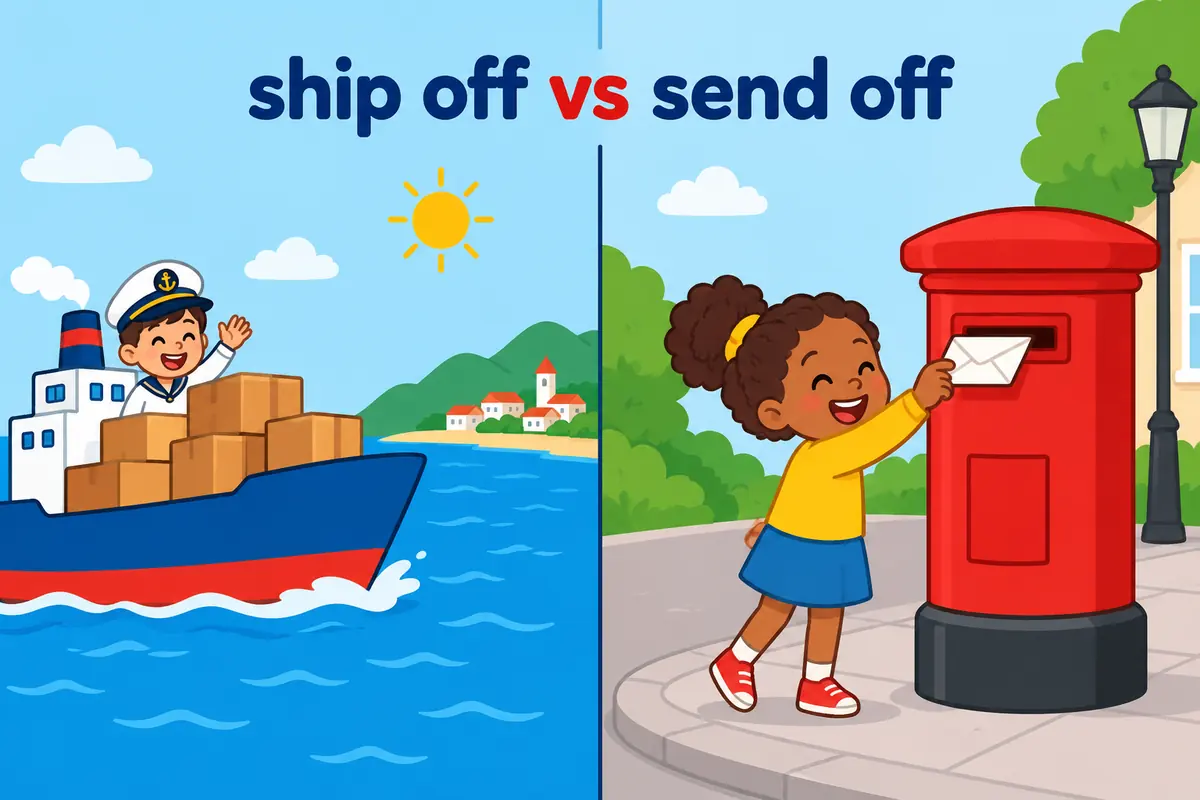
Ship off and send off overlap, but they differ in distance and tone. To dispatch a parcel is the neutral business verb, and to banish someone from a country is far more forceful than to ship them off. The opposite of shipping goods away is to retain the goods in the warehouse.
| Attribute | Ship off | Send off |
|---|---|---|
| Distance implied | Usually far, often overseas | Any distance, short or long |
| Tone | Can suggest abruptness or relief | Neutral and general |
| Typical object | Goods, orders, people moved away | Letters, parcels, teams, players |
| Extra senses | Mainly physical sending | Also to make a player leave the pitch |
| Register | Everyday and commercial | Everyday, broad and flexible |
Use ship off when the sending covers a real distance or sounds a little abrupt, and send off when the journey is short or the tone must stay neutral.
Word forms and grammar of ship off
| Form | Part of speech | Example |
|---|---|---|
| ship off | base form | They ship off orders every morning. |
| ships off | third person singular | The depot ships off hundreds of boxes a day. |
| shipped off | past tense and past participle | The goods were shipped off on Friday. |
| shipping off | present participle and gerund | Shipping off the stock takes two people. |
| ship | base verb and noun | The company ships worldwide; the ship left at dawn. |
| ship off it | non-standard word order | Incorrect: They shipped off it. |
The base verb carries its own transport sense, as in the company ships worldwide, so the particle off is what adds the idea of sending something away. The same word also names a vessel, which is why the transport sense feels natural, though a parcel can be shipped off by lorry or plane just as easily.
Common mistakes with ship off
They shipped off it to the coast.Correct: They shipped it off to the coast. Rule: a pronoun must sit between the verb and the particle.He was shipped off a distant school.Correct: He was shipped off to a distant school. Rule: the destination needs to before the place.They shipped off him to the branch office.Correct: They shipped him off to the branch office. Rule: the pronoun goes in the middle, never after off.The goods were ship off yesterday.Correct: The goods were shipped off yesterday. Rule: the passive uses the past participle shipped.We shipped off the meeting to next week.Correct: We pushed the meeting back to next week. Rule: ship off means send to a place, not postpone in time.The parcel shipped off to arrive on Friday.Correct: The parcel was shipped off on Friday. Rule: ship off names the sending, not the arrival.
Practice using ship off
- Fill in the blank: The depot ____ off the last pallet at noon. Use the past form.
- Choose the better phrase: Sending a crate to a far port is best called shipping it off / sending it off.
- Correct the error: They shipped off it to the coast.
- Correct the error: He was shipped off a distant school.
- Correct the error: The boxes were ship off yesterday.
- Build a sentence about a family move using ship plus the object plus off.
- Spot the register: Which sentence suits a business email, and which suits a family diary?
- Fill in the blank: The old computers ____ off to a recycling centre last month. Use the passive past form.
Answers
- shipped. The past form matches the completed action at noon.
- shipping it off. The long distance makes ship off the better fit.
- They shipped it off to the coast. The pronoun goes between ship and off.
- He was shipped off to a distant school. The destination needs to.
- The boxes were shipped off yesterday. The passive needs the past participle.
- Sample: They shipped their furniture off to the new flat. To names the destination.
- The business email takes Could you ship off the sample today?; the diary gets I shipped the last box off and closed the door.
- were shipped. The passive past needs were plus the past participle shipped.
The bottom line
Ship off in a sentence works best when something or someone travels a real distance and the sending feels decisive. The verb is separable, so ship it off is correct and ship off it is not, and the destination takes to. When the journey is short or the tone must stay neutral, send off is the safer choice.
Frequently asked questions about ship off
Is ship off separable?
Yes. Ship off is separable, so the object can follow the particle or sit between the verb and off. You can say they shipped off the boxes or they shipped the boxes off. A pronoun must take the middle position, so ship it off is correct and ship off it is not.
What is the difference between ship off and send off?
Both mean to send something away, but ship off usually implies a long journey and can sound abrupt, while send off is broader and more neutral. You ship off an order to a distant port, but you might simply send off a short note to a neighbour. In sport, send off also means to dismiss a player.
Can you ship off a person?
Yes. When the object is a person, ship off means to send them away to a distant place, often with little say in the matter. Parents might ship a child off to school abroad, and a company might ship an employee off to a far branch. The tone often hints at reluctance or relief.
What is the past tense of ship off?
The past tense is shipped off, and the same form works as the past participle. She shipped off the parcel yesterday, and the parcel was shipped off yesterday. Note that the base verb ship has one p, but the past form doubles the p to shipped, so ship off never becomes shiped off.