
Sinister in a sentence describes something that suggests evil, harm, or approaching danger: “The detective discovered a sinister plan.” Sinister is an adjective, so it can modify a noun or follow a linking verb, as in “The empty hallway seemed sinister.” The word expresses menace, sometimes only as someone’s impression.
Usage corrections to the examples below: Sinister does not simply mean strict, expensive, or unpleasant. A professor who gives low grades is not automatically sinister. “A sinister investigation” suggests the investigation itself is threatening or malicious; for an ordinary inquiry into disturbing events, write “an investigation into sinister events.”
Sinister: key facts at a glance
- Sinister is an adjective commonly associated with evil or threatening harm.
- “A sinister smile” and “The smile looked sinister” are both grammatical patterns.
- The adverb is sinisterly, as in “The villain smiled sinisterly.”
- An ominous appearance does not prove an evil intention.
- In heraldry, sinister also has a technical meaning connected with the bearer’s left side.
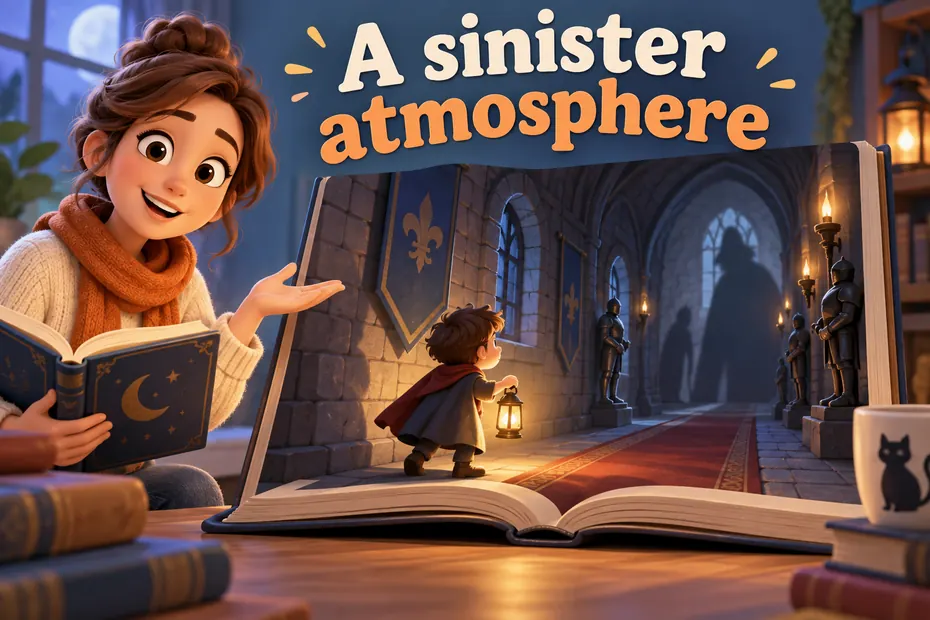
What does sinister mean in everyday English?
Sinister can characterize evil motives or suggest that something troubling is about to happen. Merriam-Webster’s dictionary entry covers evil, disaster, and signs of impending trouble. That range explains why the adjective fits both “a sinister scheme” and “a sinister silence,” although a silence has no intentions of its own.
Separate conduct from atmosphere. A character’s plan to sabotage a rescue can be sinister because its purpose is harmful. A deserted room can feel sinister because its darkness and unexplained sounds create apprehension. The first description concerns a motive; the second concerns an observer’s response to a setting.
The older article’s examples sometimes attach sinister to ordinary difficulties. “Serious consequences of plagiarism” is a clearer educational statement than “sinister consequences,” unless the writer intentionally suggests a threatening or morally troubling punishment. Likewise, a tuition increase may cause concern, but the increase alone does not establish hidden wrongdoing.
How do you use sinister in a sentence?
Place sinister before the noun it describes, or after a linking verb such as seem, look, or become. Keep the noun specific so readers can identify whether you mean a person’s intentions, a suspicious action, or a disturbing atmosphere.
| Pattern | Original example | Meaning |
|---|---|---|
| Adjective before a noun | A sinister message arrived at midnight. | The message suggested a threat. |
| After a linking verb | The deserted theatre looked sinister. | Its appearance created unease. |
| Something sinister about | There was something sinister about the offer. | The speaker suspected a troubling motive. |
| Sinister turn | The story took a sinister turn. | The events became more threatening. |
| Adverb modifying an action | The fictional villain laughed sinisterly. | The manner of laughing seemed menacing. |
Do not add -ly when the adjective describes the subject after a linking verb. “His expression looked sinister” describes the expression. “He smiled sinisterly” describes how he smiled. The difference is grammatical function, rather than a rule that every word after a verb must be an adverb.
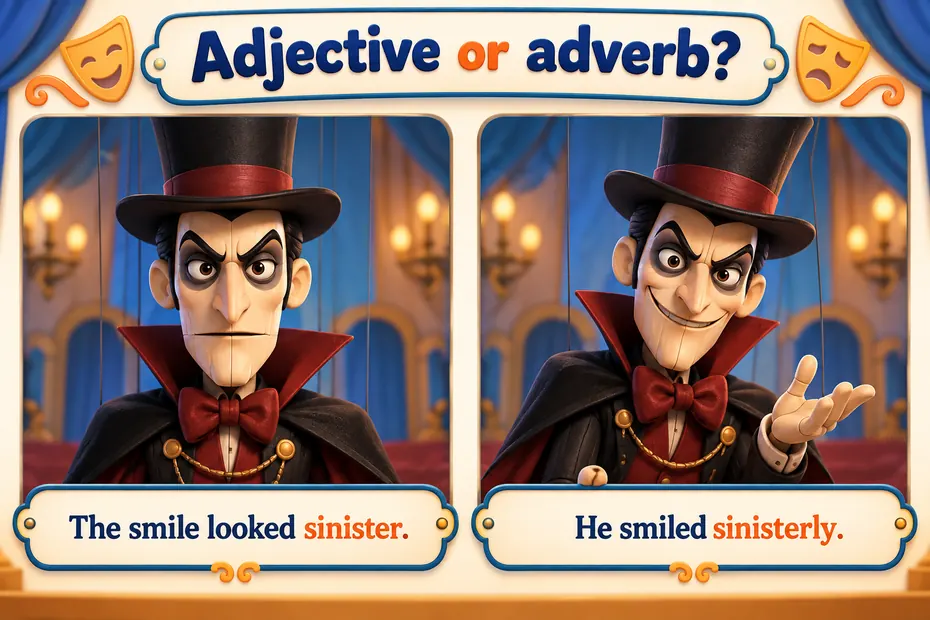
Original sinister sentence examples
These sentences illustrate several common uses. The fictional settings make the threatening language clear without presenting a person’s appearance or occupation as evidence of bad character.
- The villain revealed a sinister plan to steal the crown.
- A sinister whisper interrupted the scene.
- The deserted station seemed sinister after sunset.
- She wondered whether the generous offer concealed a sinister motive.
- The detective found a sinister note beneath the door.
- Nothing sinister had happened; the noise came from a loose window.
- The music gave the harmless puppet a sinister appearance.
- The mystery took a sinister turn when the witness disappeared.
- His sinister intentions became clear when he threatened the team.
- The actor smiled sinisterly before leaving the stage.
The sixth example shows an important limitation: the word can be used to reject a suspicion. “Nothing sinister happened” does not assert wrongdoing. Adding “seemed,” “appeared,” or “to the narrator” can also distinguish an impression from a confirmed claim.
Sinister, ominous, and suspicious: what differs?
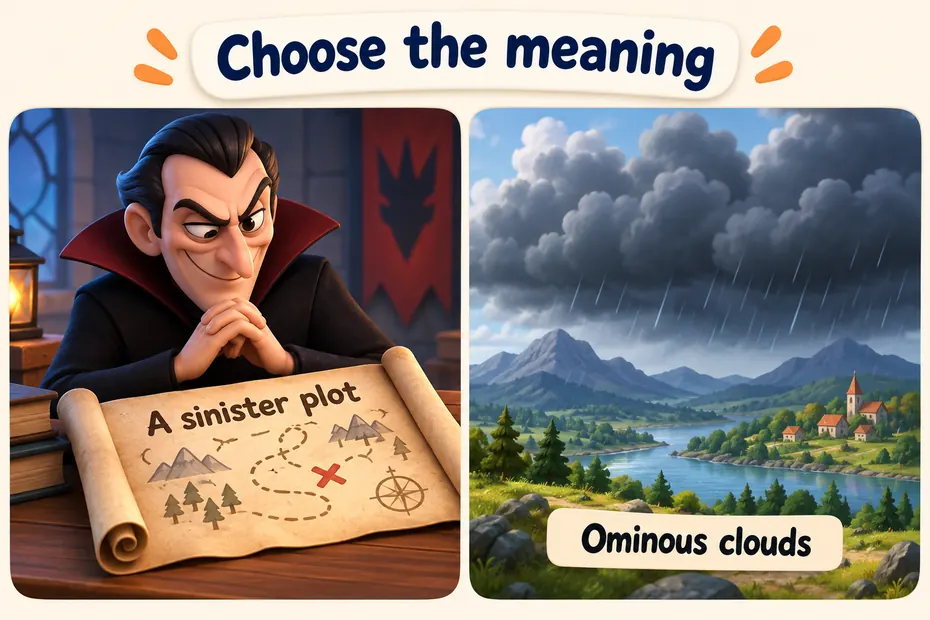
Sinister emphasizes menace or evil, ominous suggests approaching trouble, and suspicious indicates doubt or mistrust. The words overlap, but they do not fit every context equally well. Merriam-Webster’s definition of ominous focuses on signs that foreshadow misfortune.
“Ominous clouds” naturally suggests bad weather ahead. “Suspicious charges” suggests that a bill deserves checking. “A sinister plot” suggests a deliberately harmful scheme. A writer can use “sinister clouds” for a dramatic atmosphere, but the more ordinary weather description is ominous. Choose the word that states the intended inference.
Frequently asked questions
Does sinister always mean someone is evil?
No. Sinister can describe an atmosphere or apparent warning of danger without identifying an evil person. “The abandoned building looked sinister” reports an impression. For real people, the adjective makes a strong judgment, so explain the behavior or evidence that supports it instead of relying on appearance.
Can I say “more sinister”?
Yes. Use “more sinister” and “most sinister” for comparison: “The second message sounded more sinister than the first.” Avoid inventing sinisterer or sinisterest in standard prose. The comparison should have a clear basis, such as stronger threats, more ominous details, or a darker fictional mood.
Does sinister mean left-handed?
The word has a historical connection with Latin for the left side, and it retains a specialized left-side meaning in heraldry. That background is not a judgment about modern left-handed people. In an ordinary sinister sentence, readers usually understand threatening or evil unless the technical context clearly indicates otherwise.
What is an easy example for a beginner?
“The villain had a sinister plan” is a clear beginner example because the noun and context support the adjective’s meaning. “The room seemed sinister” introduces the atmospheric use. In either case, use a complete sentence, choose a specific noun, and avoid treating every unpleasant event as sinister.

Have you ever encountered a situation or person that made you feel uneasy, as if something dark or evil lurked just beneath the surface? This feeling of foreboding is often described as “sinister.”
The word “sinister” is used to characterize something that is perceived as threatening, harmful, or evil. It is often associated with a sense of danger or wickedness, creating a feeling of fear or unease in those who encounter it.
7 Examples Of Sinister Used In a Sentence For Kids
- The sinister shadow made me scared.
- I saw a sinister looking cat near the bushes.
- The witch’s cackle sounded sinister.
- The old haunted house looked sinister at night.
- The monster in the story had a sinister grin.
- The thunderstorm made everything look sinister outside.
- The dark cave seemed very sinister to the explorers.
14 Sentences with Sinister Examples
–Sinister rumors of cheating during exams spread throughout the college campus.
– Students were warned about the sinister consequences of plagiarism in their assignments.
– The older students shared sinister ghost stories during a late-night dorm room bonding session.
– The campus lighting at night gave off a sinister vibe, especially near the abandoned building.
– Some students avoided the sinister professor who was known for failing most of his students.
– The student council elections took a sinister turn when scandalous posters were put up against the candidates.
– A group of students embarked on a sinister investigation into the mysterious disappearances on campus.
– The sudden increase in tuition fees raised sinister suspicions among the students.
– The misleading advertisements for internships turned out to be sinister schemes to collect personal data.
– The security warning about a potential threat on campus had students on edge, fearing sinister intentions.
– The mysterious package left outside the college gate had a sinister aura, causing panic among the students.
– A student’s sinister plan to sabotage a group project was discovered before any harm was done.
– The abandoned library on campus had a sinister atmosphere, perfect for a spooky storytelling night.
– The sinister messages left on a professor’s office door alarmed both students and faculty members.
How To Use Sinister in Sentences?
Sinister is used to describe something that is menacing, threatening, or evil. When using the word sinister in a sentence, it is important to place it correctly to convey the intended meaning.
Here is a simple guide on how to use sinister in a sentence:
-
Identify a situation or object that gives off a feeling of malevolence or danger. For example, “The sinister figure lurking in the shadows filled her with dread.”
-
Introduce the sinister element in the sentence to emphasize the sense of foreboding. For instance, “The old abandoned house had a sinister vibe that made us hesitant to enter.”
-
You may also use sinister to describe a person’s intentions or actions that are perceived as harmful. For instance, “His sinister smile made her question his true motives.”
-
Remember to pay attention to the context in which you are using the word sinister to ensure it fits appropriately within the sentence.
By following these guidelines, you can effectively incorporate the word sinister into your writing to create a sense of unease or dread. Experiment with different sentence structures and contexts to enhance your understanding and usage of this evocative term.
Conclusion
In summary, the examples of sentences with the keyword “sinister” demonstrate its use in portraying a sense of foreboding or evil. Whether describing a mysterious figure with sinister intentions or a dark and ominous atmosphere, this word conveys a sense of menace or danger. Through various contexts, the word “sinister” helps to create a chilling tone, making it effective in writing that aims to evoke fear or unease.
Overall, the word “sinister” serves as a powerful tool in language to set a sinister mood or convey malevolent motives. Its usage in sentences adds depth and tension to descriptions, effectively drawing readers into dark and ominous scenarios. This keyword is key in creating an unsettling atmosphere and portraying characters or situations with malicious undertones.