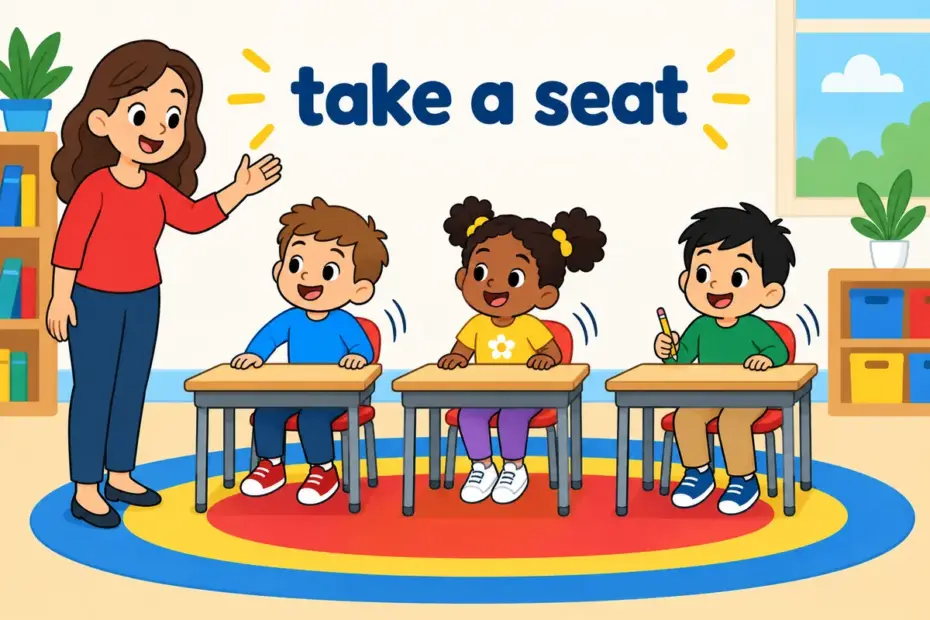
Sit down means to move from standing into a seated position, and it also names a formal meeting for a serious talk. To use sit down in a sentence, keep the two words together after the subject: “Please sit down while the judge reads the order.” The plain use is fixed, and the noun form takes a hyphen.
Sit down at a glance
- Sit down is a two-word verb; its forms are sits down, sat down and sitting down.
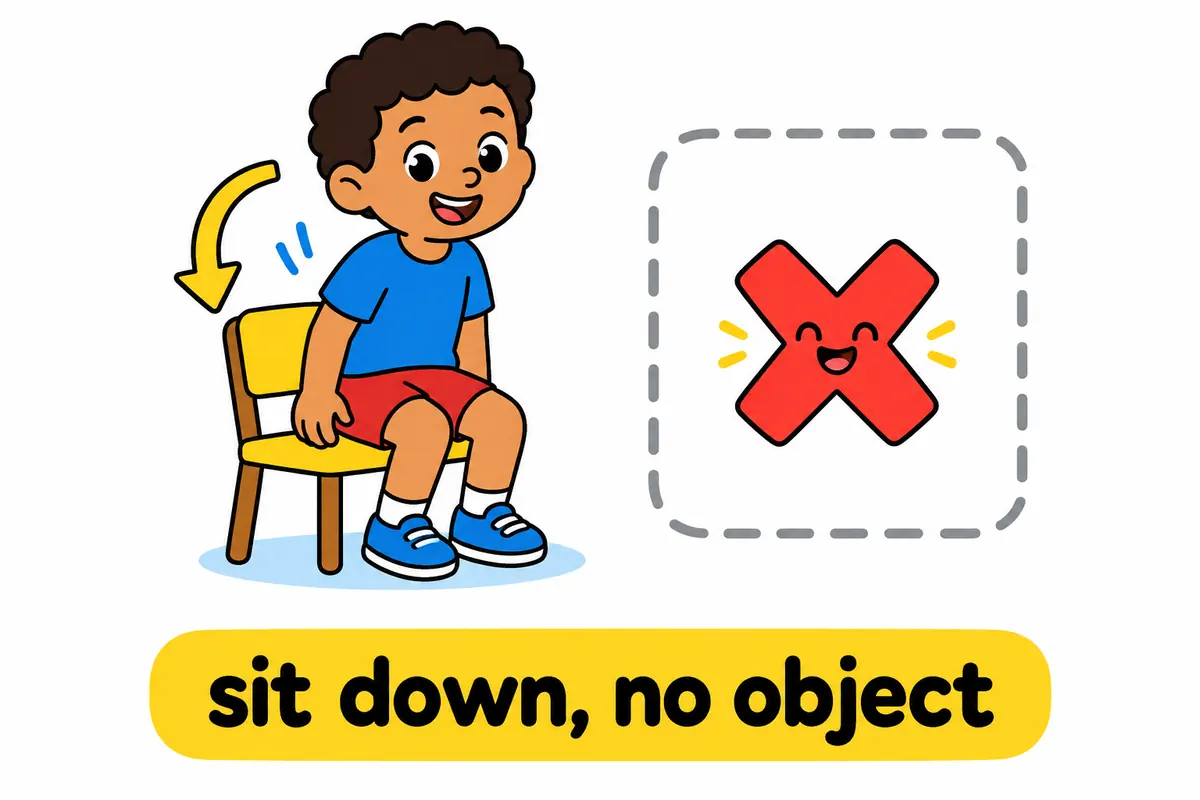
- The literal pattern is intransitive: a person sits down, with no object needed.
- The noun and adjective form is hyphenated, as in a sit-down meal.
- Typical subjects are people, and the place is named with in, on or at.
- The commonest error is writing seat down, which confuses sit with the verb to seat.
What does sit down mean?
Sit down is a phrasal verb meaning to lower yourself onto a seat, and it also names a short meeting held for a serious discussion, usually written sit-down. The Cambridge entry for sit down records the verb and the noun. The literal sense is physical and the noun sense is social, which is why the same words appear in a classroom and a boardroom.
| Sense | Plain meaning | Example sentence |
|---|---|---|
| Move to a seat | Lower the body onto a chair or the ground | Please sit down before the film starts. |
| Hold a serious talk | Meet to discuss something important | She sat down with the manager on Friday. |
| A planned gathering | A meeting, meal or protest, written sit-down | Staff held a sit-down over the new shifts. |
One limitation matters. Sit down describes the act of taking a seat, not the state of being seated: once a person is comfortable you say they are sitting, not that they sit down. For the state, use the progressive or the adjective seated.
How do you use sit down in a sentence?
Sit down is intransitive in its main sense, so no object follows it: the child sat down. It becomes separable only in the rare transitive use sit someone down, where a teacher or parent seats a person for a talk. The particle down stays next to the verb in the plain use, so sit the child down is acceptable but sit down the child is not.
| Pattern | Example | What it signals |
|---|---|---|
| subject + sit down | Please sit down. | The core intransitive pattern with no object. |
| sit down + to + activity | We sat down to dinner. | Names what the group gathered to do. |
| sit down + with + person | She sat down with the manager. | The serious-talk sense, always with with. |
| sit + person + down | The coach sat the squad down. | Transitive and separable; the object splits the verb. |
| sit-down + noun | They held a sit-down meeting. | Hyphenated attributive form before a noun. |
The separator test settles most questions: if a person is being placed, the object goes between sit and down, as in sit the class down.
To stand up is the opposite movement, while to lounge is to sit down in a sprawling way and to settle is to find a comfortable position once seated. To seat someone is to place them, which is why seat and sit differ, and back down shares the particle but means to withdraw a demand.
Sit down in a sentence: examples across contexts
Sit down shifts from a classroom instruction to a boardroom arrangement. Each sentence below shows which sense is active and how the particle behaves.
| Context | Example sentence | Why this works |
|---|---|---|
| Classroom | The teacher asked the class to sit down before the quiz. | A direct instruction uses the plain intransitive form. |
| Restaurant | We sat down at a corner table and ordered soup. | The at-phrase names the place, not an object. |
| Workplace | The director sat down with the interns to hear their concerns. | The with-phrase marks the serious-talk sense. |
| News report | Protesters held a sit-down outside the town hall. | The hyphenated noun names a planned gathering. |
| Conversation | Sit down and tell me what happened. | The bare imperative is the most common spoken use. |
| Health writing | The nurse asked him to sit down before taking his blood pressure. | A polite instruction suits clinical prose. |
| Sports report | The coach sat the players down for a frank talk. | The separable form places the object between verb and particle. |
| Home | They sat down to a quiet family dinner. | The to-phrase names the shared activity. |
Only the sports row splits the verb; every other sentence keeps sit and down together, which is the default a learner should copy.
Sit down vs sit up
Sit down and squat both lower the body, but only sit down ends in a seat, and sit up moves the opposite way. The two phrasal verbs are easy to mix when giving instructions.
| Attribute | sit down | sit up |
|---|---|---|
| Core meaning | Lower onto a seat | Raise the torso from a slouch |
| Body direction | Downward, to a chair or floor | Upward, straightening the back |
| Second sense | A formal meeting or a planned gathering | Staying awake late, or a sudden alertness |
| Typical use | Inviting or instructing someone to take a seat | Correcting posture or describing bedtime |
| Example | Please sit down and rest. | Sit up straight during the interview. |
Verdict: choose sit down to take a seat and sit up to straighten or stay awake; they describe opposite movements.
Word forms and grammar of sit down
Sit is irregular, so the past is sat rather than sitted. The table lists the forms a learner needs, including the hyphenated attributive form used before a noun.
| Form | Part of speech | Example |
|---|---|---|
| sit down | verb, base form | May I sit down here? |
| sits down | verb, third person singular | He sits down at the same desk each day. |
| sat down | verb, past tense and participle | They sat down by the fire. |
| sitting down | verb, present participle | She is sitting down for a moment. |
| sit-down | hyphenated noun or adjective | We had a sit-down lunch. |
| seated | adjective, a different word | The guests were seated by the window. |
Use seated for the state after sitting, and sit down for the action: guests are seated, then they sit down.
Common mistakes with sit down
- Incorrect:
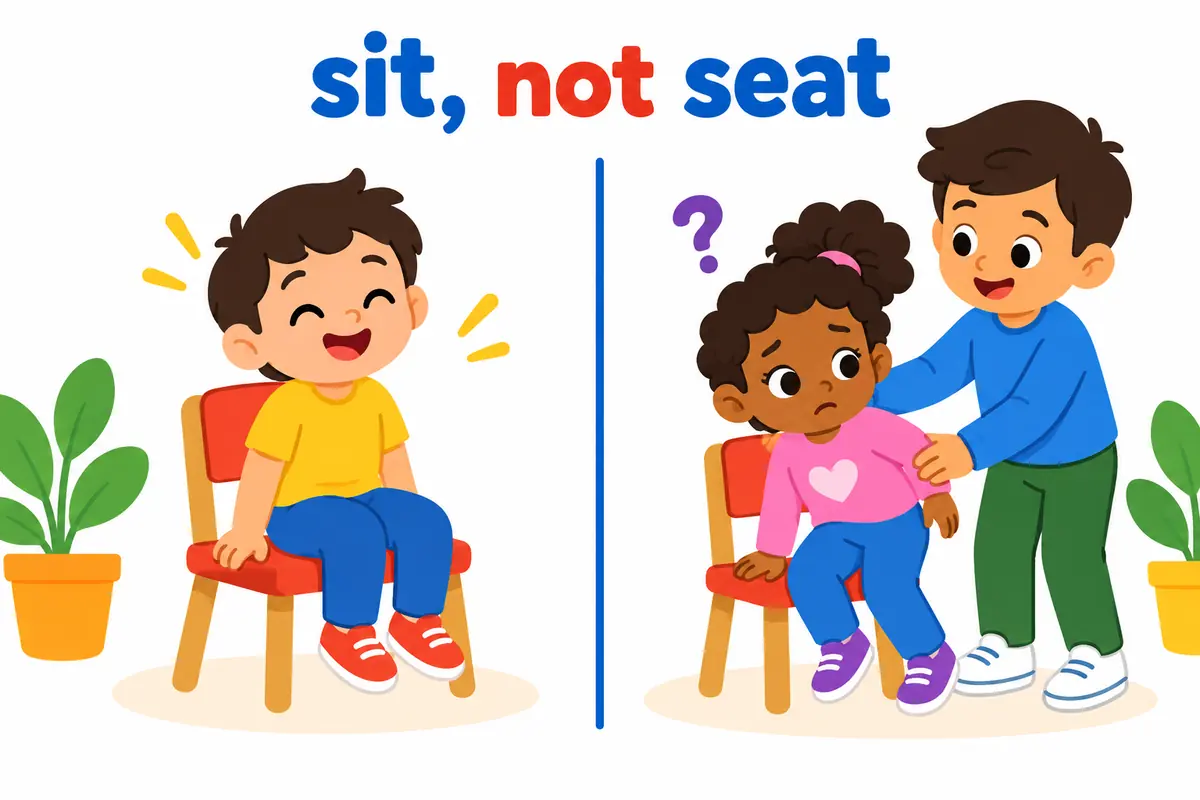
Please seat down.Correct: Please sit down. Rule: Seat is transitive and means to place someone; sit is what a person does. - Incorrect:
He sat down on chair.Correct: He sat down on the chair. Rule: A singular countable noun needs a determiner. - Incorrect:
We had a sit down meeting.Correct: We had a sit-down meeting. Rule: The attributive form before a noun is hyphenated. - Incorrect:
She sat down the child.Correct: She sat the child down. Rule: In the rare transitive use the object splits the verb and particle. - Incorrect:
I sat down on the desk to work.Correct: I sat down at the desk to work. Rule: Use at for a work surface and on for a seat.
Practice using sit down
Work through the six items, then check the reasoning rather than only the answer.
- Fill the gap: The dentist asked me to ______ while the drill warmed up.
- Choose the better word: All guests were (sat / seated) before the toast.
- Correct the error: The coach sat down the whole team.
- Build a sentence: use sit down with about a student and a teacher.
- Spot the register: which belongs in a staff memo — We will hold a sit-down on Monday, or Sit down, we need to chat?
- Rewrite with the hyphen: They planned a meeting for the whole department. Use sit-down instead.
Answers
- sit down — the instruction uses the plain intransitive form with no object.
- seated — seated describes the state after sitting, which is what the passive needs.
- The coach sat the whole team down — the object goes between sit and down in this transitive use.
- Model answer: The student sat down with the teacher to review the essay.
- We will hold a sit-down on Monday — a memo uses the hyphenated noun, not a bare imperative.
- They planned a sit-down for the whole department — the attributive noun keeps its hyphen.
The bottom line
Use sit down in a sentence for the act of taking a seat, and use the hyphenated sit-down for a formal meeting or gathering. Two details decide the wording: the verb is intransitive in its main sense, so no object follows, and the past form is sat, never sitted. For the state after sitting, seated is the correct word.
Frequently asked questions about sit down
Is sit down one word or two?
As a verb it is always two words, sit down, as in please sit down. The hyphenated one-word form appears only as a noun or adjective, as in a sit-down protest or a sit-down meal. Choosing the wrong form is the most common written error.
What is a sit-down meeting?
A sit-down meeting is a short, serious discussion held with people seated face to face rather than standing. The phrase implies focus and a decision, as in the director called a sit-down with the team. It is the hyphenated noun use of sit down.
Is sit down transitive?
Sit down is normally intransitive, so no object follows: the child sat down. It becomes transitive only in the rarer use sit someone down, where the object goes between the verb and the particle, as in the coach sat the squad down for a talk.
What is the difference between sit down and sit up?
Sit down means to lower yourself onto a seat, while sit up means to straighten your back or stay awake. The movements are opposite: down toward a chair, up from a slouch. Both are intransitive phrasal verbs of posture, so neither takes an object.
Do you find yourself constantly on the go, rarely taking a moment to relax and sit down? The phrase “sit down” is a common expression used to politely invite someone to take a seat or to encourage them to calm down and listen.
It is a versatile phrase that can be used in a variety of contexts, from offering hospitality to someone entering a room, to calming a friend during a stressful time. Let’s explore the different ways this simple phrase can be used in everyday conversations.
7 Examples Of Sit Down Used In a Sentence For Kids
- Please sit down on the mat.
- Let’s all sit down in a circle.
- Can you please sit down quietly?
- It’s time to sit down for story time.
- Sit down and raise your hand to speak.
- Remember to sit down during class.
- Everyone, let’s sit down on our chairs.
14 Sentences with Sit Down Examples
- Sit down and make sure you have all the necessary materials before the lecture starts.
- Before the exam begins, make sure to sit down and review your notes.
- Sit down and discuss the project details with your group members.
- Remember to sit down and plan out your study schedule for the upcoming semester.
- As soon as you enter the classroom, sit down and get ready for the lesson.
- It’s important to sit down and brainstorm ideas for your upcoming assignment.
- Before the presentation starts, sit down and take deep breaths to calm your nerves.
- When the professor enters the room, make sure to sit down and pay attention.
- Before starting your research, sit down and gather all the necessary resources.
- As soon as the lecture ends, sit down and review your notes to reinforce your understanding.
- Sit down and double-check the due dates for your assignments and exams.
- During group discussions, make sure to sit down and actively participate in the conversation.
- Sit down and organize your study materials to maximize your productivity.
- Before heading to the library, sit down and create a list of the books you need to borrow.
How To Use Sit Down in Sentences?
To properly use the word Sit Down in a sentence, follow these simple guidelines:
-
Identify the appropriate context: Make sure the situation calls for someone to take a seated position before using the phrase Sit Down. This can include scenarios such as offering a guest a place to sit or instructing a child to take a seat.
-
Use the phrase: Once you have identified the right moment to use the term, verbally say “Sit Down” while making eye contact with the individual you are addressing. Keep your tone polite and neutral to convey your message effectively.
-
Provide direction (Optional): If necessary, you can accompany the phrase Sit Down with additional directions to guide the person to the specific location where you’d like them to sit. For example, you could say, “Sit Down on the chair by the window.”
-
Wait for compliance: After saying Sit Down, allow the individual a moment to understand your request and then follow through by sitting down. If the person does not comply, you may need to repeat your request or offer further assistance.
-
Ensure gratitude: Once the person has sat down, you can express your gratitude. For example, you can say, “Thank you for sitting down,” to acknowledge their compliance.
By following these steps, you can effectively use the phrase Sit Down in a sentence to convey your message clearly and politely.
Conclusion
In conclusion, incorporating “sit down” into sentences can enhance communication by emphasizing the act of taking a seat or relaxing in a particular environment. “Please sit down and make yourself comfortable” is a welcoming gesture often used to invite others to relax. Similarly, “Let’s sit down and talk” suggests a desire for a calm and focused conversation.
Using “sit down” in sentences helps set the tone for interaction, whether it be casual or formal. It can create a sense of ease and encourage a productive exchange of ideas. By incorporating this phrase into our language, we can effectively convey the message of sitting and engaging in a conversation or activity.