Skip over means to pass by something without stopping to deal with it, whether that is a paragraph, a detail or a difficult topic. To use skip over in a sentence, put the thing passed by directly after the verb: “The report skipped over the cost.” The verb is transitive, so skip over always needs an object.
Skip over at a glance
- Skip over is a transitive phrasal verb meaning to pass by something without dealing with it.
- A second, smaller sense describes moving lightly across a surface, as a stone skips over water.
- The common forms are skips over, skipped over and skipping over.
- The object sits after over, and the two words are never split.
- The commonest error is using skip over when the writer means gloss over, which adds a hidden intent to hide something.
What does skip over mean?
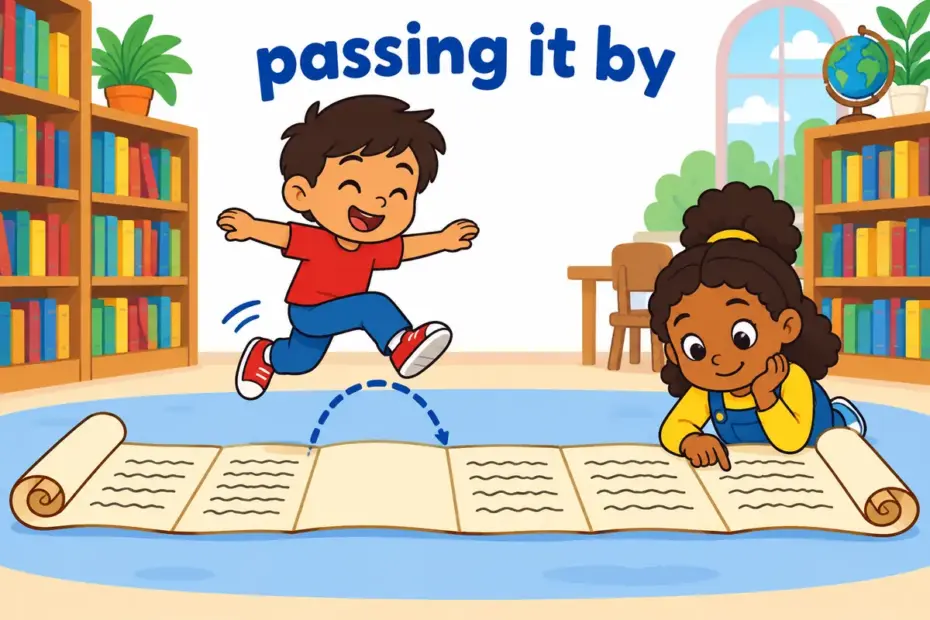
Skip over is a phrasal verb meaning to pass by something, usually quickly and without giving it full attention. The Cambridge entry for skip over covers the idea of leaving a subject or a stretch of text untouched, and the same verb appears in a physical sense for a flat stone that skips over the surface of a pond. The reading sense is the one learners meet most, as when a reader skips over a long list to reach the conclusion.
| Sense | Plain meaning | Example sentence |
|---|---|---|
| Omit in reading | Pass by part of a text without reading it fully | She skipped over the appendix and read the summary instead. |
| Neglect a topic | Avoid dealing with a subject or detail | The speaker skipped over the funding question entirely. |
| Move lightly across | Bounce or glide along a surface | A pebble skipped over the calm water three times. |
One limitation deserves stating. Skip over is not the same as ignore or omit: it implies movement past something that is still there for others to see. If a writer hides a fact on purpose, the right verb is overlook only when it is accidental, and gloss over when there is a reason to conceal it.
How do you use skip over in a sentence?
Skip over is inseparable and transitive in the reading sense: the object follows over and nothing sits between skip and the particle. The physical sense is intransitive and often takes across or along. Five patterns cover almost every real sentence.
| Pattern | Example | What it signals |
|---|---|---|
| skip over + text | Readers skip over dense tables of figures. | The object is a stretch of writing. |
| skip over + topic | The minutes skip over the dispute entirely. | A subject is left undiscussed. |
| skip over + to + place | Her eyes skipped over to the final line. | Movement of attention across a page. |
| skip over + surface (physical) | Flat stones skip over the lake in August. | A light bounce across a surface. |
| be skipped over | Her name was skipped over at the ceremony. | Passive, when the omission is the point. |
The object is essential, so a sentence such as the report skipped over leaves the reader asking what was missed. When the meaning is a careful full reading, use examine instead, because examine signals attention that skip over denies.
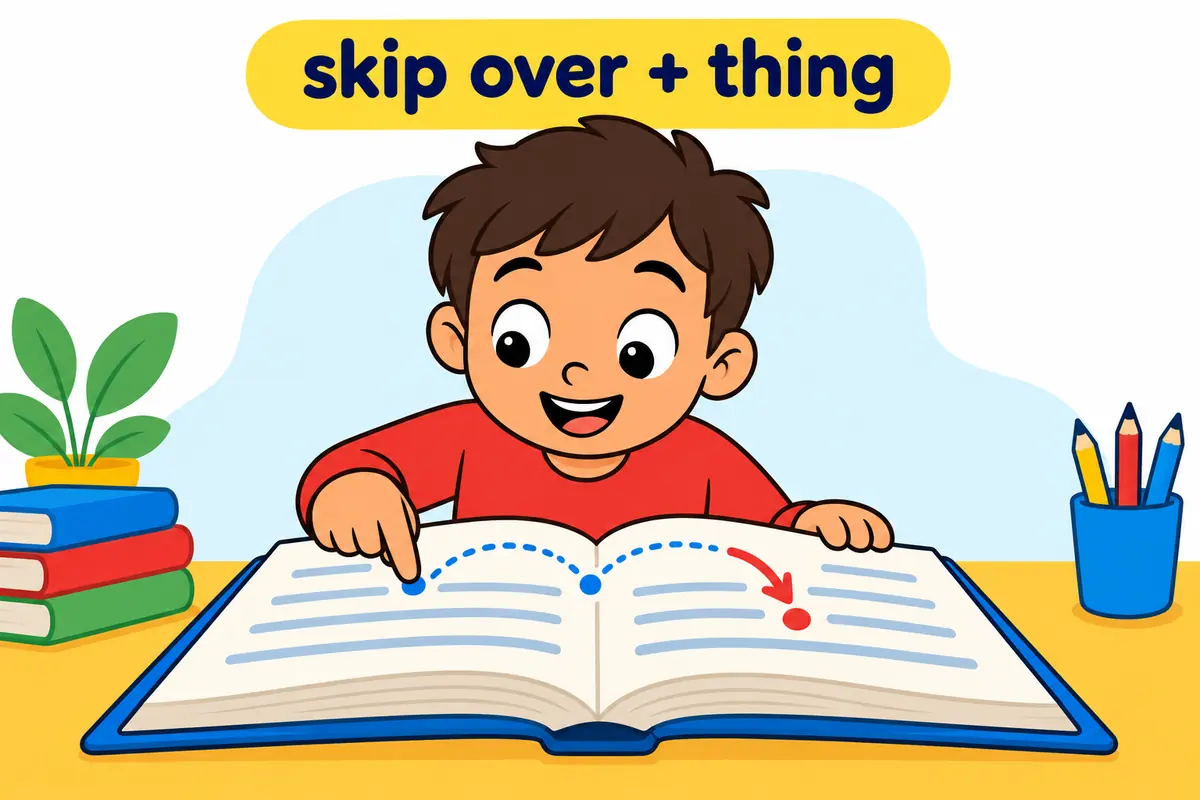
Skip over in a sentence: examples across contexts
Skip over changes register more than meaning, and the ten sentences below move from a classroom to an academic review. Each one names the object that was passed by, because the verb is meaningless without it.
| Context | Example sentence | Why this works |
|---|---|---|
| Classroom | Do not skip over the instructions before the experiment. | A direct instruction with a clear object. |
| Workplace email | Please do not skip over the safety notes in the handbook. | Polite and specific about the text. |
| News report | The summary skipped over the months before the recall. | Names a period left unexplained. |
| Editing | Proofreaders rarely skip over a repeated word. | A habit described with a concrete object. |
| Academic prose | The review skipped over two studies with opposite findings. | Precise about what was omitted. |
| Technical writing | Skip over this step only if the seal is already fitted. | A condition makes the omission safe. |
| Conversation | He skipped over the part about the missed deadline. | Everyday speech naming an awkward topic. |
| Sports report | Commentators skipped over the early mistakes in the second half. | Time and event are both named. |
| Narrative writing | The letter skipped over the years of silence. | The figurative sense creates a gap the reader feels. |
| Legal summary | The schedule skipped over one clause entirely. | A formal register with an exact object. |
Only the conversational example would feel at home in speech without change; the others show how the same verb carries a note of criticism in formal writing.
Register decides how much blame skip over carries. In a lesson plan, skip over a warm-up reads as a practical shortcut, because everyone understands that time is short. In a published report, the same verb suggests that something important was quietly avoided, and readers may ask what else was passed by. When the omission is defensible, English often adds an adverb such as briefly or deliberately to soften the judgement, as in the summary briefly skipped over the early disputes.
Skip over vs overlook
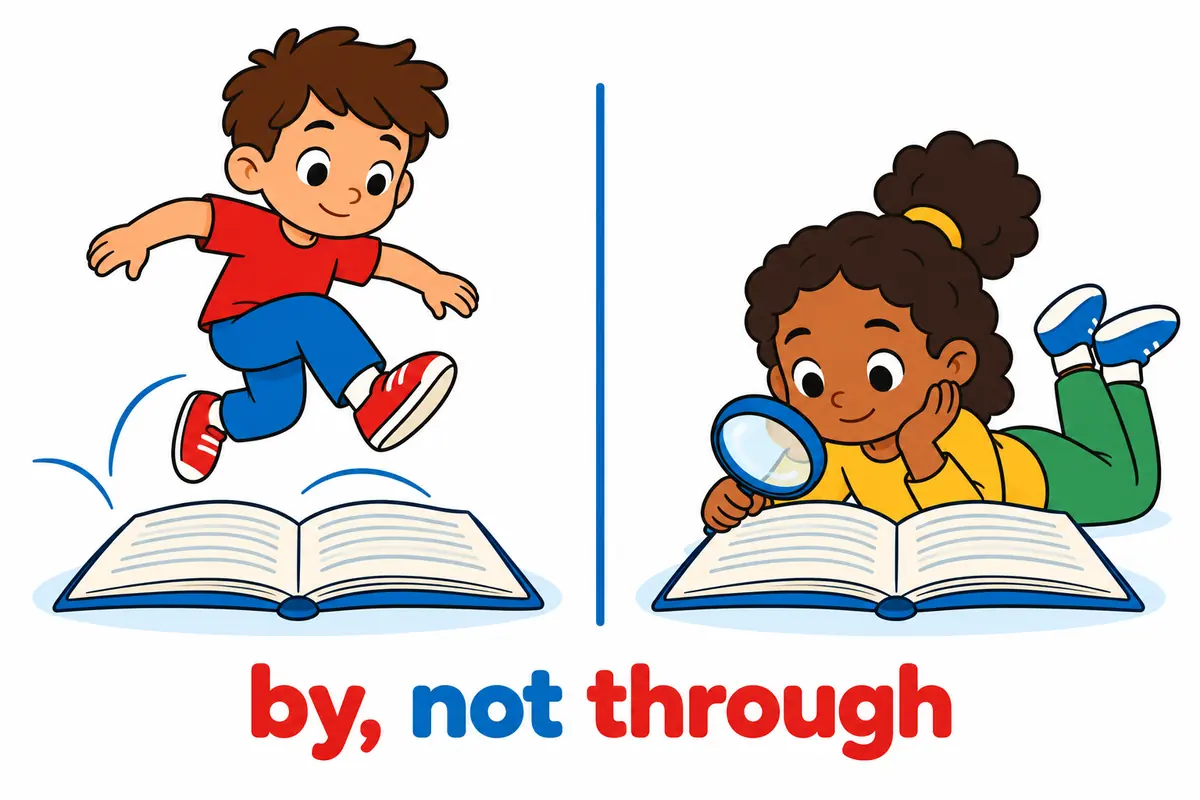
Skip over and overlook both describe missing something, and the difference is intention. Skip over suggests passing by on purpose or in haste; overlook suggests failing to notice, often by accident. The table keeps the two apart.
| Attribute | skip over | overlook |
|---|---|---|
| Intention | Passing by, often deliberately | Failing to notice, usually accidental |
| Typical object | Text, a topic, a detail | A detail, an error, a view |
| Blame | Implies a choice was made | Implies an oversight, not a choice |
| Physical sense | Possible, as with a stone on water | Means looking down over something |
| Register | Neutral, common in editing and reading | Neutral to formal |
Verdict: choose skip over when something was passed by and the choice is visible, and overlook when the miss was unintentional.
Word forms and grammar of skip over
Skip over inflects through its base verb and stays two words in every tense. The related omit is the stiff synonym writers reach for in reports when skip over sounds too casual.
| Form | Part of speech | Example |
|---|---|---|
| skip over | phrasal verb, base form | Reviewers skip over familiar arguments. |
| skips over | phrasal verb, third person singular | The camera skips over the crowd each second. |
| skipped over | phrasal verb, past and past participle | The lecture skipped over the early history. |
| skipping over | phrasal verb, present participle | He was skipping over the fine print. |
| skip | verb, base form, no particle | We can skip the next chapter. |
| skip-over | attributive form, rare and hyphenated | A skip-over link lets readers jump the menu. |
The base verb skip takes an object on its own, so skip a chapter and skip over a chapter both work; the particle adds the feeling of passing across rather than simply leaving out. The premodifier skip-over keeps a hyphen.
Common mistakes with skip over
- Incorrect:
The report skipped over.Correct: The report skipped over the funding gap. Rule: Skip over is transitive, so the thing passed by must appear as its object. - Incorrect:
She skipped the appendix over.Correct: She skipped over the appendix. Rule: The verb is inseparable, so the object follows the whole unit. - Incorrect:
He skipped over the mistake by accident.Correct: He overlooked the mistake by accident. Rule: Accidental misses take overlook; skip over implies a choice to pass by. - Incorrect:
They skipped over to mention the delay.Correct: They neglected to mention the delay. Rule: Skip over to places attention, so it cannot introduce an infinitive of omission. - Incorrect:
The minutes were skipped over the dispute.Correct: The minutes skipped over the dispute. Rule: The passive does not fit an active omission made by the minutes themselves.
Practice using skip over
Work through the six items, then check the reasoning rather than only the answer.
- Fill the gap: Careless readers ______ the very line that explains the rule.
- Choose the better word: The clerk (skipped over / overlooked) the missing signature by mistake.
- Correct the error: The summary skipped over of the final findings.
- Build a sentence: use skip over about a teacher passing by a hard question in a lesson.
- Spot the register: which belongs in an academic review – the review skips over two key studies, or the review just totally skips them?
- Rewrite with a synonym: The article left out the background. Use skip over instead.
Answers
- skip over – the line is the object that readers pass by.
- overlooked – the mistake was accidental, which rules out skip over.
- The summary skipped over the final findings – the object follows the particle with no of.
- Model answer: The teacher skipped over the hardest question and promised to return to it.
- The review skips over two key studies – an academic review avoids just and totally.
- The article skipped over the background – the object follows the whole unit.
The bottom line
Use skip over in a sentence when a reader, a report or a speaker passes by something without dealing with it, and always name the thing that was passed by. Two details settle most cases: the verb is transitive and inseparable, so the object follows over, and the choice it implies is deliberate, which is why accidental misses need overlook. For the opposite idea, address the point directly instead.
Frequently asked questions about skip over
Is skip over one word or two?
Skip over is written as two words when it works as a verb, as in editors skip over repeated phrases. Only the rare attributive form skip-over takes a hyphen, as in a skip-over link on a web page. The verb itself is always kept open, matching other phrasal verbs of the same shape.
Does skip over need an object?
Yes. In the main reading and topic sense, skip over is transitive, so the thing passed by must follow the verb. The report skipped over is incomplete until you add the subject that was missed. Only the physical sense, as in stones skip over the water, behaves differently with a place phrase.
What is the difference between skip over and overlook?
Skip over means passing by something, often on purpose or in haste, so a choice is visible. Overlook means failing to notice something, usually by accident. A hurried editor skips over a paragraph, while a tired proofreader overlooks a typo that was never seen at all.
Can skip over mean to read quickly?
Yes, in practice. When a reader skips over a section, the eyes move across the text without full attention, which is close to skimming. The two differ in intent: skip over stresses leaving content unread, while skim stresses reading it quickly for the general sense.