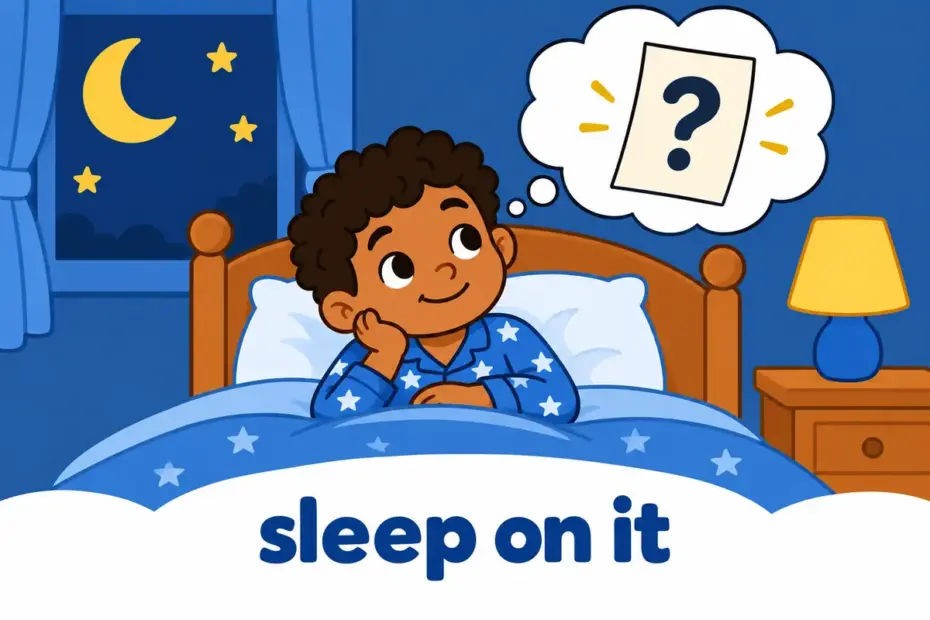
Sleep on means to delay a decision until the next day so you can think it over. To use sleep on in a sentence, name the decision after on: “Let me sleep on it.” The verb is inseparable, so the pronoun it stays attached to on and cannot move.
Sleep on at a glance
- Sleep on is an inseparable phrasal verb; its forms are sleep on, sleeps on, slept on and sleeping on.
- The dominant pattern is sleep on + it / a decision / an offer, with the pronoun it by far the most common.
- It belongs to neutral spoken English and appears often in business emails and friendly advice.
- Common collocations include sleep on it, sleep on the offer, sleep on the idea and sleep on a problem.
- The commonest learner error is separating the verb, as in sleep it on.
What does sleep on mean?
Sleep on is a phrasal verb meaning to wait until the next day before deciding, so that a night of rest can settle the choice. The Cambridge entry for sleep on records the idiom sleep on it, and the literal sense also exists: a person can sleep on a sofa or a mattress, meaning simply to rest on that surface. One honest limitation matters here: sleep on does not mean forget, ignore or reject. It keeps the decision open, and the speaker is expected to return an answer soon.
| Sense | Plain meaning | Example sentence |
|---|---|---|
| Delay a decision | Wait a night before deciding | I will sleep on your offer and reply tomorrow. |
| Rest on a surface | Lie and sleep on something | The puppy sleeps on an old blanket. |
| Keep thinking over | Give a matter more time | She is sleeping on the problem before she answers. |
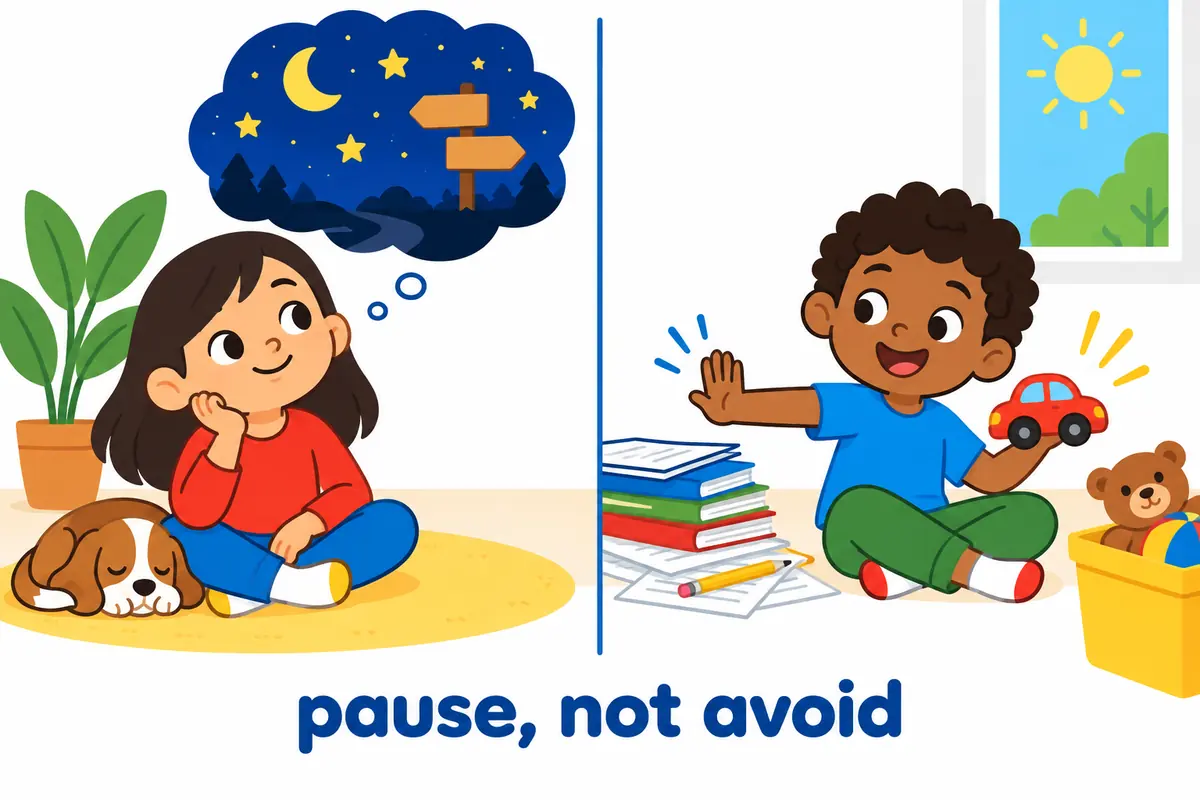
The idiom is unusually fixed in everyday use: sleep on it covers almost every decision, and the full noun version appears mainly when the speaker wants to name the matter for the record. That is why a promise to sleep on something is understood as a commitment to answer, not as a way of avoiding the question.
How do you use sleep on in a sentence?
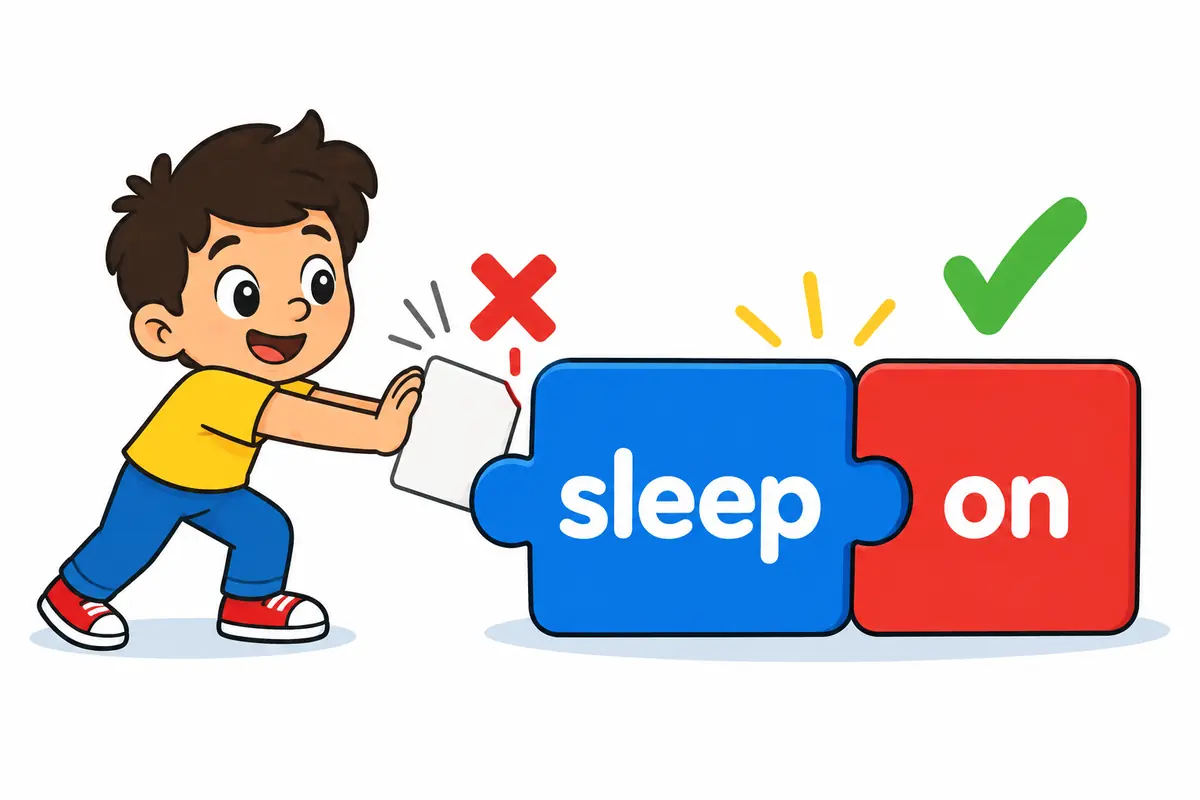
Sleep on is a prepositional phrasal verb, so the particle on is not movable and an object must follow it. The subject is the person who does the thinking.
| Pattern | Example | What it signals |
|---|---|---|
| sleep on + it | Let me sleep on it. | The most common idiom, with the decision understood. |
| sleep on + the + noun | They slept on the offer for a night. | Names the specific matter under consideration. |
| sleep on + a + noun | I need to sleep on a decision this big. | Emphasises the weight of the choice. |
| auxiliary + sleep on + it | You should sleep on it before calling back. | Gives advice to another person. |
| be + sleeping on + it | She is still sleeping on it. | The delay is currently in progress. |
Separability is the key: the pronoun must follow on, so sleep it on is impossible. In the literal sense the pattern is the same, which is why the puppy sleeps on the blanket and not the puppy sleeps the blanket on. When the decision is already clear from context, the pronoun it carries the whole matter and the sentence needs no further object.
Sleep on in a sentence: examples across contexts
| Context | Example sentence | Why this works |
|---|---|---|
| Conversation | That is a big price; let me sleep on it. | The pronoun carries the whole decision. |
| Business email | I would like to sleep on the proposal and respond on Monday. | Sets a polite deadline for the answer. |
| Family talk | We told the children we would sleep on the idea of a puppy. | Shows a decision shared by two people. |
| Job offer | She slept on the contract before signing anything. | Signals careful review rather than refusal. |
| Academic writing | Researchers should not sleep on unexpected results. | Urges deliberation before publishing. |
| Coaching advice | If you are angry, sleep on it before you reply. | Links the pause to emotional control. |
| Customer service | Take the quote home and sleep on it tonight. | Invites a calm, unhurried choice. |
| Literal rest | The cat sleeps on the warm windowsill. | Uses the same words in their physical sense. |
| News feature | The board decided to sleep on the merger vote. | Frames a delay as a formal step. |
| Team meeting | Can we sleep on the budget cut until Friday? | Turns a hard request into a shared pause. |
| Legal advising | The client chose to sleep on the settlement. | Shows a measured decision inside a long process. |
A buyer who needs a little time may consider the offer carefully; a board that merely wants to look unhurried shelves it. Because the idiom names a pause rather than a refusal, it sits comfortably in negotiation, where it softens a request for more time without committing either side.
Sleep on vs postpone and procrastinate
These three all describe putting something off, but they differ in length, intention and tone.
| Feature | Sleep on | Postpone | Procrastinate |
|---|---|---|---|
| Core meaning | Delay a decision for a night | Move an event or decision to a later date | Keep avoiding a task out of reluctance |
| Typical length | One night, sometimes a day | Any agreed period | Open-ended |
| Intention | To decide soon and decide well | To schedule something properly | No plan to start |
| Tone | Calm and responsible | Neutral and administrative | Negative and self-critical |
| Object | Usually it or a decision | A meeting, a decision or an event | None; the verb stands alone |
| Example | I will sleep on it. | They postponed the launch to June. | He procrastinated all afternoon. |
Choose sleep on when a single night will settle a choice; use defer to move it to another date, ponder when you mean think deeply, and avoid procrastinate unless the delay is the problem you want to name. Sleeping on a decision is a choice to decide better; postponing is a choice about timing; procrastinating is the absence of a choice at all.
Word forms and grammar of sleep on
| Form | Part of speech | Example |
|---|---|---|
| sleep on | base phrasal verb | I always sleep on big purchases. |
| sleeps on | third person singular | She sleeps on every offer before replying. |
| slept on | past tense and participle | We slept on it and said yes. |
| sleeping on | present participle | He is sleeping on the proposal. |
| sleep on it | fixed idiom | Let me sleep on it. |
| sleep it on | non-standard | Wrong: the pronoun cannot split the verb. |
The particle on is shared with many other phrasal verbs such as build on, but only sleep on means to pause before deciding, so the shared particle is not a guide to meaning. The past participle slept on is the form used after have, as in they have slept on it twice, and the progressive is normally reserved for a delay that is still happening.
Common mistakes with sleep on
Most errors come from treating this as a separable verb or from stretching its short time frame, so watch the pronoun and the length of the delay.
- Incorrect: Let me sleep on. Correct: Let me sleep on it. Rule: The preposition on needs an object.
- Incorrect: I will sleep it on. Correct: I will sleep on it. Rule: This phrasal verb is inseparable.
- Incorrect: We slept on about the offer. Correct: We slept on the offer. Rule: On takes the noun directly, with no extra preposition.
- Incorrect: He slept on the decision for six months. Correct: He put off the decision for six months. Rule: Sleep on implies a short, usually overnight, pause.
- Incorrect: She is sleeping on to answer. Correct: She is sleeping on the question. Rule: The object must be a noun phrase, not an infinitive.
Practice using sleep on
- Fill in the blank: The salary sounds fair, but I would like to __________ before signing.
- Fill in the blank: They __________ the merger vote and answered the next morning.
- Choose the better word: Please (sleep on it / procrastinate it) and tell me tomorrow.
- Correct the error: I will sleep it on and call you.
- Build a sentence: a teenager asking for one night before answering, using sleep on.
- Spot the register: Which sentence fits a polite work email? (a) I’ll sleep on it. (b) I’m putting it off.
- Correct the error: She slept on the offer, so she refused it.
Answers
- sleep on it — the fixed idiom fits a decision already mentioned.
- slept on — past tense matches the reply the next morning.
- sleep on it — procrastinate carries the wrong, negative meaning.
- I will sleep on it and call you — the verb stays joined.
- Let me sleep on it and give you my answer in the morning — the pronoun holds the decision.
- Sentence (a) — sleep on it is the polite, neutral choice.
- She slept on the offer but did not refuse it — sleeping on something delays a decision, it does not end one.
The bottom line
Sleep on means to hold a decision for a night so that a rested mind can settle it, and it stays inseparable: say sleep on it, never sleep it on. Use it for short, deliberate pauses rather than long delays, and keep it apart from procrastinate, which names avoidance rather than careful thought. The literal sense, resting on a surface, uses the same grammar and is distinguished only by context.
Frequently asked questions about sleep on
Is sleep on always about decisions?
No. The idiom sleep on it concerns decisions, but sleep on also has a plain physical sense, as in the dog sleeps on the mat. Context decides which one you mean: a delayed choice for the idiom, a resting surface for the literal reading, and both use identical grammar.
Can you say sleep on the decision?
Yes. A noun phrase such as the decision, the offer or the idea can follow on, and this is common when the matter has already been named. The pronoun it remains the most frequent object, but a full noun is perfectly correct when you want to be specific.
How long does sleep on it take?
Sleep on it suggests a pause of one night, or at most a day, before an answer. Using it for a delay of weeks sounds wrong because the phrase is tied to the idea of letting a single night settle the question; use postpone or defer for longer gaps.
Is sleep on polite in business writing?
Yes. In an email, saying you would like to sleep on a proposal reads as careful and respectful rather than evasive. It signals that the offer is being taken seriously, which is why it appears so often in replies about contracts, quotes and job offers.