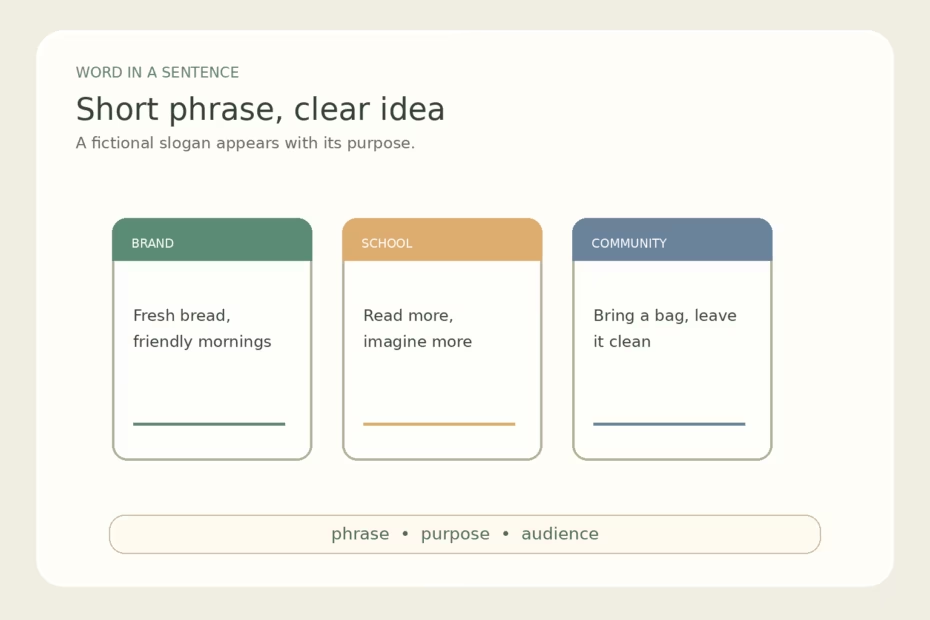
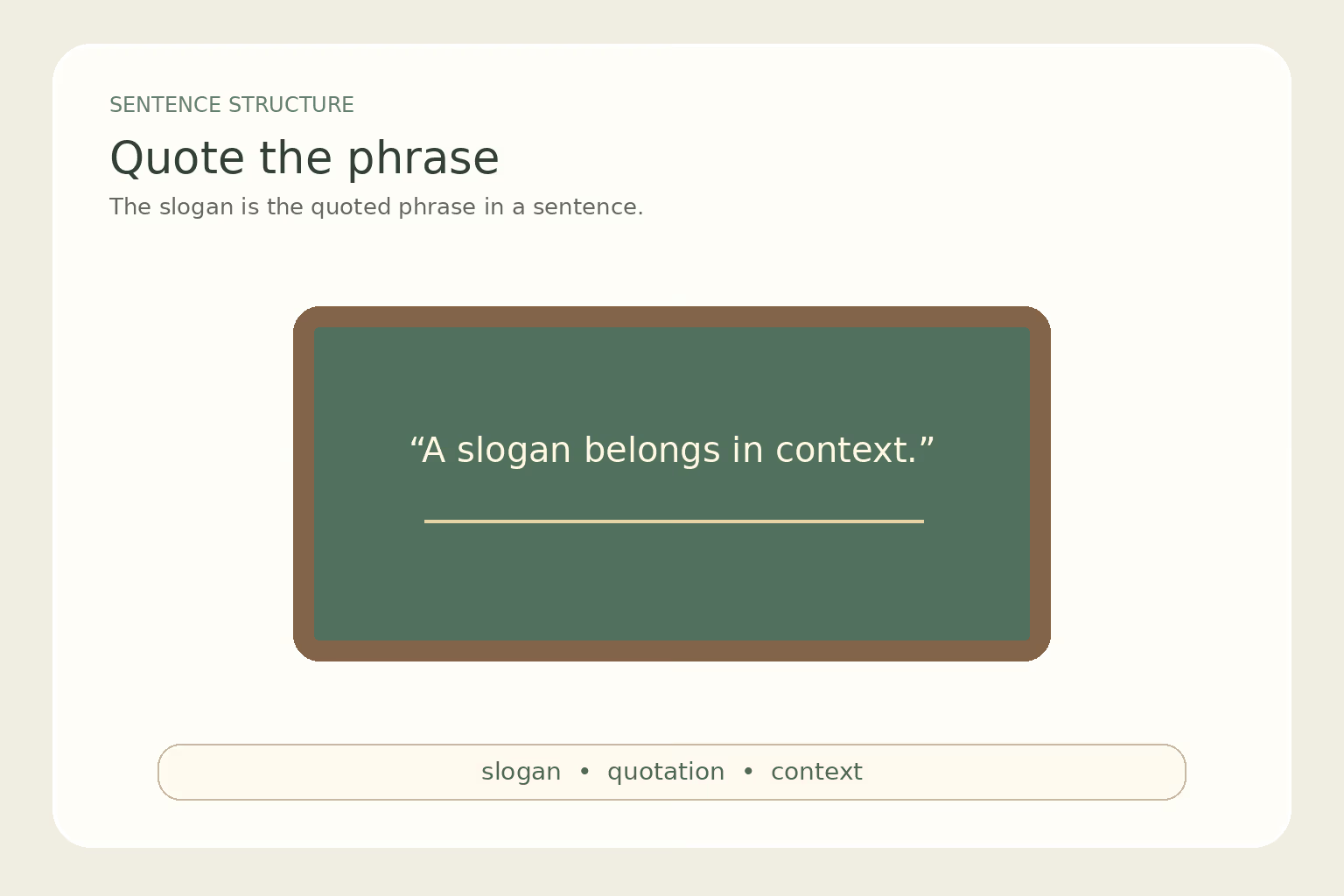
A slogan is a short, memorable word or phrase used to attract attention or express an idea. In a sentence, the word slogan is a noun: “The school’s new slogan appears on its welcome banner.” The phrase inside quotation marks is the slogan; the rest of the sentence explains where it is used.

How to use slogan in a sentence
Use slogan as a countable noun. It can be singular (“a slogan”), plural (“several slogans”), or possessive (“the campaign’s slogan”). Common patterns include a slogan for an organization or cause, the slogan reads followed by the words, and a slogan that describes a message:
- “The library created a slogan for its summer reading program: ‘Open a book, find a new world.’”
- “The neighborhood clean-up campaign’s slogan reads, ‘Small steps, cleaner streets.’”
- “They chose a slogan that invites new volunteers to join.”
- “The company tested two slogans before selecting one for the package.”
These examples use original, fictional phrases. When quoting a slogan, set off its exact words with quotation marks and keep punctuation clear. The slogan itself may be a fragment rather than a complete sentence; your surrounding sentence still needs a subject and verb.
Slogan, motto, tagline, or catchphrase?
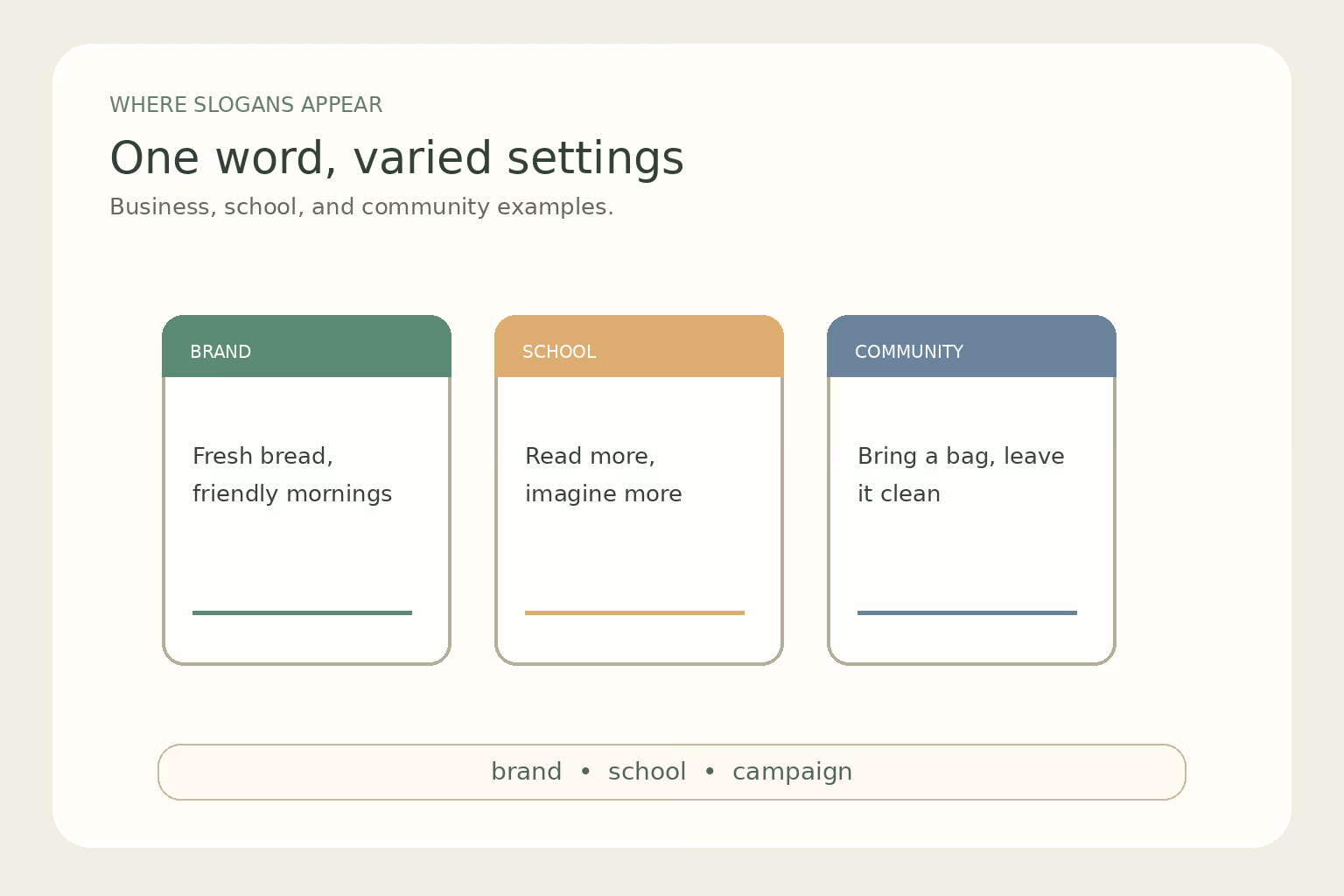
These terms overlap, and usage depends on context. A slogan often aims to make an advertising or campaign message memorable. A motto more often states a guiding belief or principle, such as a school’s rule for how it wants students to treat one another. A tagline is commonly a short line associated with a brand or promotion, and dictionaries also use it as a near-synonym for slogan. A catchphrase is a memorable expression repeated by a person, character, or group; it does not have to advertise anything.
Choose the word that best fits the role in your example. “The club’s motto is ‘Leave the trail better than you found it’” presents a guiding principle. “The campaign’s slogan asks residents to ‘Bring a bag, leave the park clean’” presents a public message. Neither label is fixed in every situation, so use context to make your meaning clear.
What makes an example sentence clear?
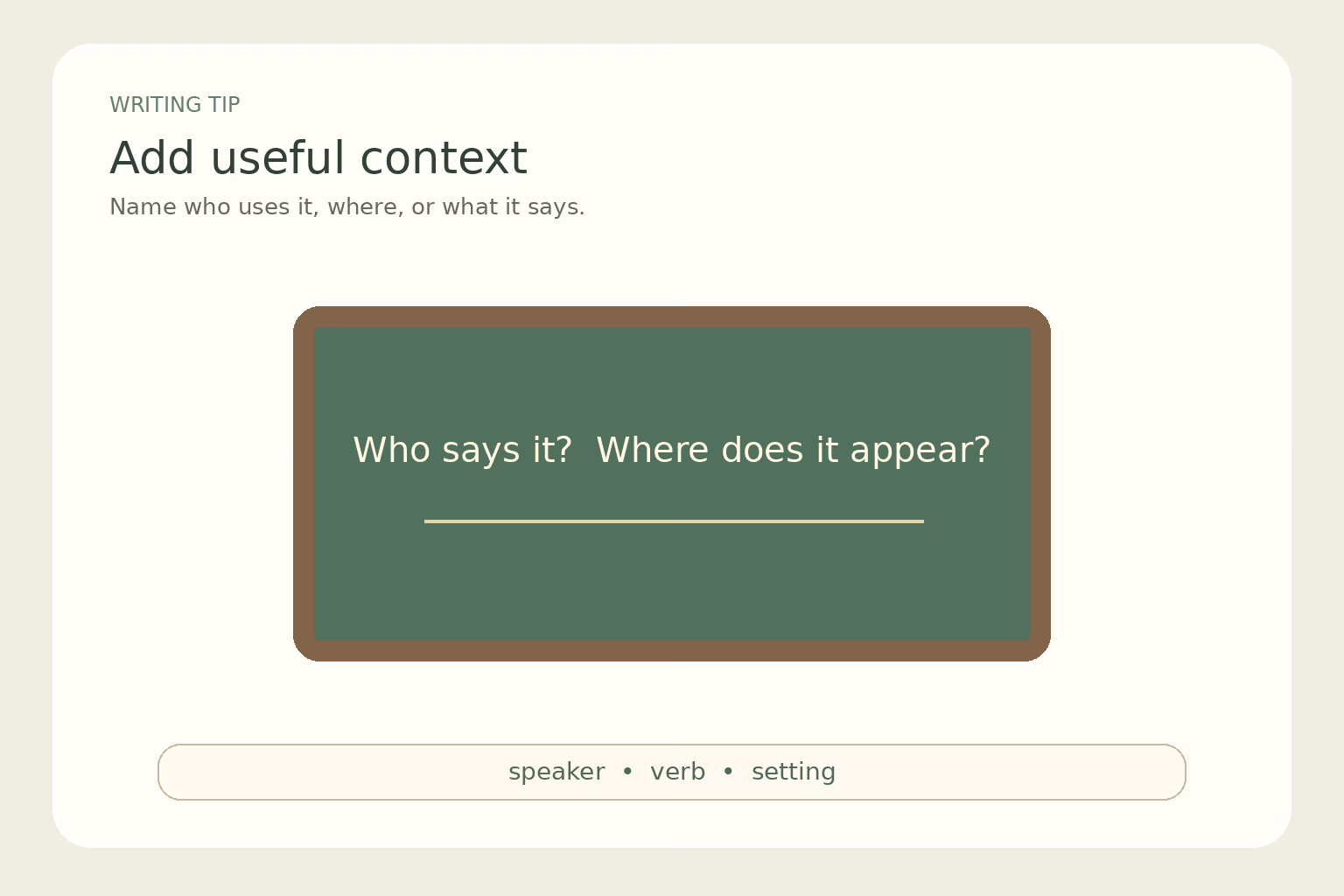
A useful sentence tells readers whose slogan it is, where it appears, or what idea it communicates. “The slogan was catchy” gives an opinion but little context. “The bakery printed its new slogan, ‘Fresh bread, friendly mornings,’ on paper bags” identifies the speaker, the words, and where customers see them.
For your own sentence, try this pattern: person or group + verb + slogan + context. Verbs such as created, adopted, printed, displayed, repeated, and revised show what is happening. Avoid calling a phrase effective or successful unless you explain the reason; “easy to remember” or “states the campaign’s goal” is more specific.
Quick reminder
Slogan names the phrase, not the organization or the product. Write “The slogan appears on the box,” or “The slogan promotes the new product.” This keeps the word’s role in the sentence clear.
Have you ever wondered how a simple phrase can leave a lasting impact? A slogan is a concise and memorable motto or phrase that encapsulates the essence of a brand, campaign, or idea. It is designed to be catchy, easy to remember, and effectively communicate a message to the target audience.
Slogans are powerful tools used in advertising, marketing, and even politics to create brand recognition and promote a particular cause or product. They are often repeated in various promotional materials and help to differentiate a brand from its competitors. The best slogans are those that resonate with the audience and leave a lasting impression.
7 Examples Of Slogan Used In a Sentence For Kids
- Play, learn, and grow with our colorful playground.
- Kindness is our mantra, let’s spread love every day.
- Come to school with a smile, it’s the key to a happy day!
- Reading is exciting, explore new worlds every day.
- Be brave, be kind, be you – that’s our golden rule.
- Healthy food, happy mood – it’s cool to eat your fruits.
- Learning is fun, come join the adventure every day.
14 Sentences with Slogan Examples
- College life is fast-paced and exciting, so remember the slogan “Work hard, play harder!”
- When faced with challenging exams, stay motivated with the slogan “Study smart, achieve more.”
- Joining a student organization? Embrace the slogan “Diversity is our strength.”
- Feeling stressed about assignments? Keep calm and trust the slogan “One step at a time.”
- Planning a campus event? Make it memorable with the slogan “Unity in diversity.”
- Struggling to balance academics and social life? Remember the slogan “Prioritize, organize, succeed.”
- Want to stand out in a competitive job market? Live by the slogan “Be proactive, not reactive.”
- Looking for inspiration to chase your dreams? Follow the slogan “Dream big, work hard.”
- Thinking of starting a business? Stay driven with the slogan “Innovate, disrupt, succeed.”
- Ready to explore new opportunities? Embrace the slogan “Challenge convention, embrace change.”
- Want to make a difference in society? Believe in the slogan “Service above self.”
- Feeling overwhelmed by choices? Simplify your decision-making with the slogan “Quality over quantity.”
- Striving for personal growth? Stay committed to the slogan “Learn, unlearn, relearn.”
- Building a network of friends and mentors? Live by the slogan “Connect, collaborate, thrive.”
How To Use Slogan in Sentences?
To use the word “Slogan” in a sentence, consider the following guide:
-
Understanding the Word: A slogan is a memorable phrase used in advertising or for political purposes. It is typically short, easy to remember, and aimed at conveying a message or theme.
-
Placement in a Sentence: When incorporating the word slogan into a sentence, ensure it fits contextually. For example, “The company’s slogan ‘Just Do It’ has become iconic in the world of marketing.”
-
Beginning a Sentence: You can start a sentence with the word “Slogan” by providing clarity on what the slogan represents. For instance, “Slogan writing requires creativity and a deep understanding of the brand.”
-
Using Proper Punctuation: Remember to punctuate the sentence correctly when using the word slogan. An example would be, “She came up with an inspiring slogan for the campaign, ‘Together we can make a difference!'”
-
Relevance in Communication: Always ensure that the slogan aligns with the message you want to convey in your sentence. This will help in making your sentence more impactful and clear.
-
Practice: The best way to become comfortable using the word slogan in sentences is through practice. Try incorporating it into different sentences to improve your fluency and understanding of how to use it effectively.
Conclusion
In conclusion, slogans are catchy phrases or mottos used in marketing campaigns to promote products or ideas. They aim to leave a lasting impression on consumers and create brand recognition. Examples of sentences with slogans include “Just do it” by Nike, “Finger lickin’ good” by KFC, and “Have it your way” by Burger King. These slogans demonstrate the power of succinct and memorable messaging in influencing consumer behavior and shaping brand identity. Overall, slogans play a crucial role in effectively conveying a brand’s message and values, making them an essential tool in advertising and marketing strategies.


