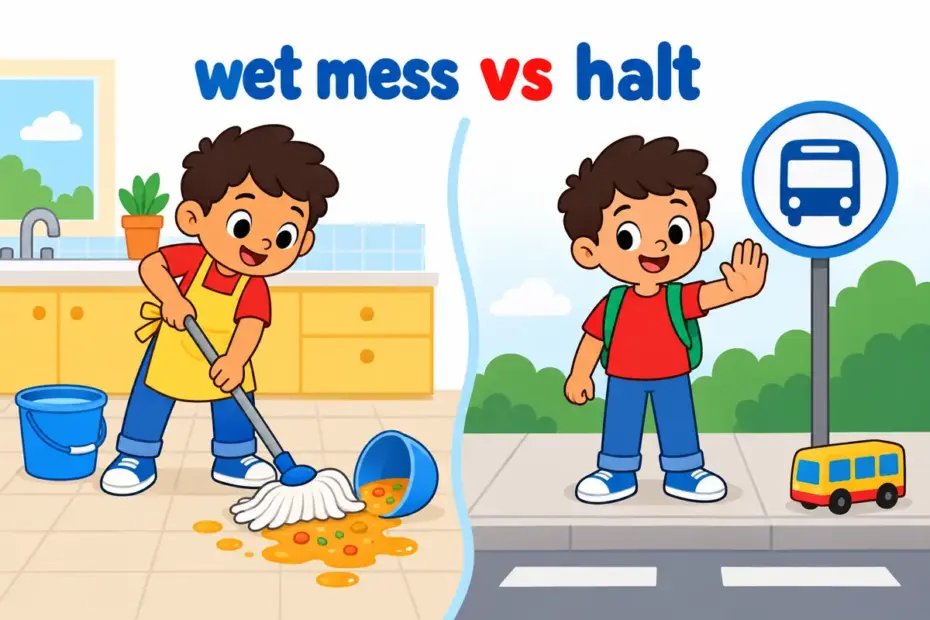
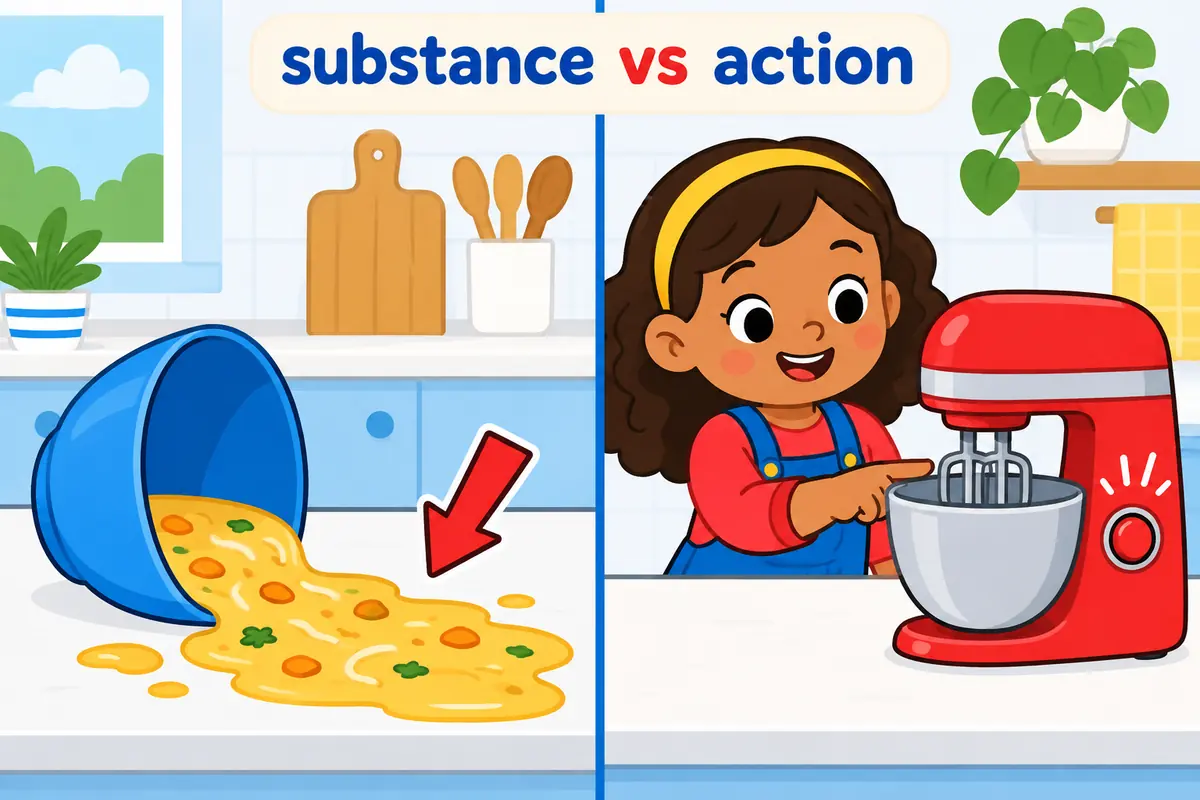
Slop vs stop look almost identical on the page, but they are different words: choose slop for spilled liquid, pig feed or mass-produced low-quality content, and choose stop to mean halting movement or action. Neither substitutes for the other, because one names a messy substance and the other is a command to cease.
Slop vs stop at a glance
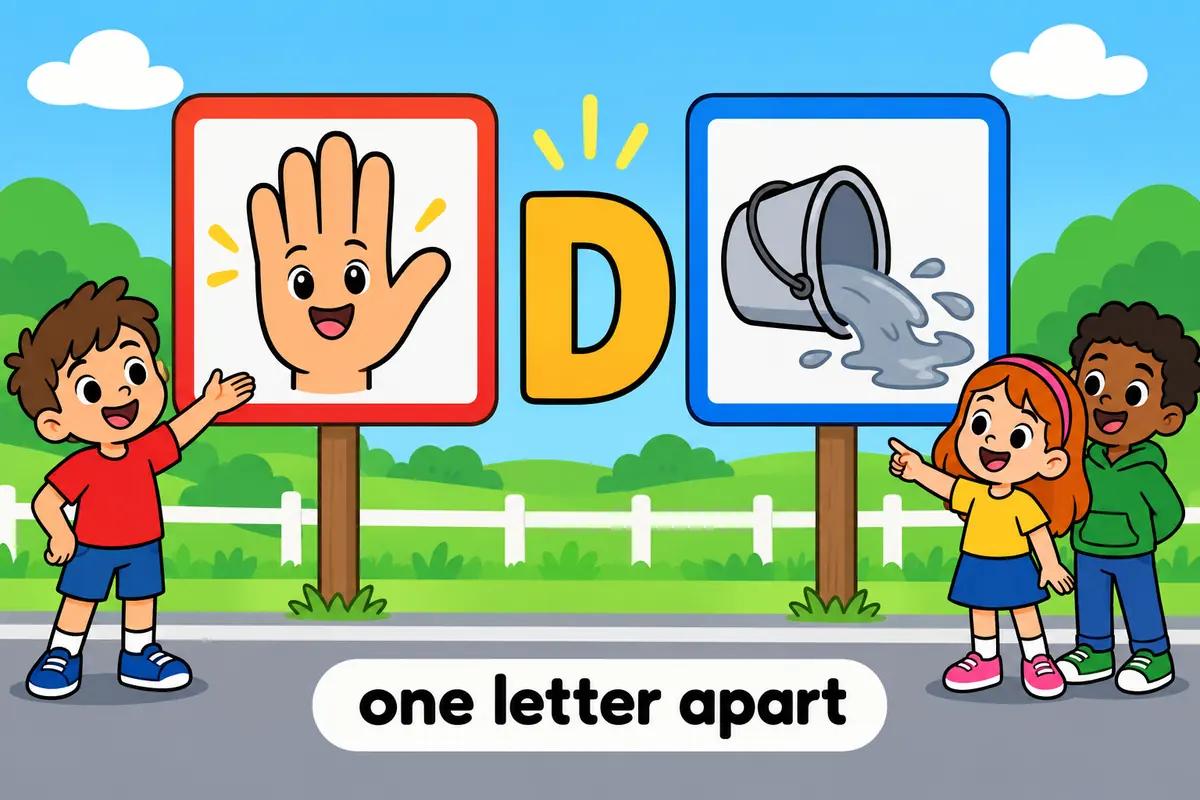
- Slop and stop differ at one letter, l against t, and share no meaning.
- Slop is a noun first and a verb second, naming wet waste or careless spilling.
- Stop is a verb first and a noun second, naming the end of movement or a pause point.
- Slop is informal and usually critical; stop is neutral enough for signs and manuals.
- The commonest error is typing one where the other belongs, so the subject decides.
What does slop mean, and what does stop mean?
Slop is a noun or verb centred on wet mess, while stop is a verb or noun centred on ending movement or action. The Cambridge entry for slop records the liquid-waste sense and the careless-spilling verb, and the Merriam-Webster entry for stop records both the verb and the noun. In a formal document, writers often cease production rather than stop it, and a machine that halts is said to stop a machine without any sense of mess.
| Sense | Plain meaning | Example sentence |
|---|---|---|
| slop (noun) | Kitchen waste or watery food, often fed to pigs | The farmer poured the slop into the trough. |
| slop (noun, informal) | Mass-produced, low-quality content | The feed was full of AI slop. |
| slop (verb) | To spill or splash a liquid carelessly | He slopped tea across the saucer. |
| stop (verb) | To cease moving or acting | The shuttle stopped at the gate. |
| stop (verb) | To prevent or block something | Crews stopped the leak before dawn. |
| stop (noun) | A halt, or a place where a vehicle pauses | The next stop is Market Street. |
One limitation is worth stating plainly. Slop is never a polite word for food, so a review that calls a dish slop is an insult rather than a description. Stop, by contrast, is so neutral that it appears on road signs, in technical manuals and in casual talk alike, and it carries no judgement at all.
Slop vs stop: the master comparison
The table below weighs the two words against the criteria that decide most real sentences. Every cell names a concrete value, because slop and stop are not degrees of one meaning; they occupy separate territories. Nothing is shared beyond the letters s, o and p.
| Attribute | slop | stop |
|---|---|---|
| Core meaning | Wet waste, spilled matter or low-quality content | The ending of movement, action or supply |
| Part of speech | Noun first, verb second | Verb first, noun second |
| Typical subject | Food, liquid, pigs, generated content | Vehicles, machines, people, leaks |
| Register | Informal and usually critical | Neutral, usable in any register |
| Common collocation | kitchen slop, AI slop, slop the pigs | bus stop, stop sign, stop working |
| Spelling shape | Begins s-l- | Begins s-t- |
Verdict: reach for slop only when the subject is a wet mess or worthless material, and reach for stop whenever something ceases; the shared spelling is a coincidence, not a family resemblance.
Which should you use?
| Situation | Choose | Reason |
|---|---|---|
| Writing about wasted food | slop | The noun names the waste itself. |
| Describing a vehicle or machine halting | stop | The verb is the standard word for ceasing motion. |
| Reviewing generated text or art | slop | The informal noun now labels low-quality mass output. |
| Giving an instruction to end an action | stop | stop plus a noun or gerund is the natural command. |
| Talking about a place to leave a bus | stop | The noun is the fixed term for the pause point. |
Every situation above turns on meaning rather than preference, so the choice is usually obvious once the subject is named. A writer who checks whether the sentence is about a substance or about a motion will rarely pick the wrong word.
How do you use slop and stop in a sentence?
Slop behaves like a mass noun when it names waste and like a regular verb when it names spilling, while stop takes an object, a gerund or a prepositional phrase. When the intended meaning is simply to end a process, a writer may halt a process or use stop directly. The patterns below cover almost every sentence you will meet with either word.
| Pattern | Example | What it signals |
|---|---|---|
| slop as a mass noun | The slop froze in the trough overnight. | Names an uncountable wet waste. |
| slop + object + onto/over | He slopped gravy onto the tablecloth. | Careless spilling by a person. |
| slop over or into | Water slopped over the rim of the pail. | Liquid moving messily on its own. |
| stop + object | Stop the drill before changing the bit. | Ending an action or a machine. |
| stop + -ing | She stopped talking when the bell rang. | Ceasing an activity already underway. |
| stop at or to | The line stops at Central and goes no further. | Pausing at a place or a limit. |
The contrast is sharp in grammar as well as meaning: slop rarely takes a that-clause, while stop plus a gerund is one of the commonest patterns in English. Learners who notice that difference stop confusing the two almost at once.
Slop and stop in a sentence: examples across contexts
The choice between the two words changes with the subject rather than with the formality of the writing. The nine sentences below keep the same short words while moving from a farmyard to a technology report, and each one shows which sense is doing the work.
| Context | Example sentence | Why this works |
|---|---|---|
| Kitchen | She slopped soup across the counter. | The verb paints a clumsy, liquid accident. |
| Farm | The farmer carried the slop to the pigs. | The mass noun names animal feed. |
| Technology report | Reviewers dismissed the flood of AI slop. | The informal noun labels low-quality output. |
| Bus journey | Get off at the third stop. | The noun names a fixed pause point. |
| Driving lesson | Stop at the red line. | The verb gives a direct instruction. |
| Classroom | Ink slopped onto the open page. | A small spill a reader can picture. |
| Sports report | The referee stopped play for two minutes. | The verb ends an ongoing activity. |
| Workplace email | We must stop the leak before Friday. | The verb takes a concrete object. |
| Restaurant review | The stew arrived as grey slop. | The noun carries clear criticism. |
Only the last sentence uses slop about food served to a guest, which shows how sharp the word is. Where a liquid merely moves, a writer can also slosh over the edge, and if a person knocks a glass over they spill a drink; both are gentler than slop because neither suggests waste.
Word forms and grammar of slop and stop
Both verbs double the final consonant before -ed and -ing, so slopped and stopped obey the same spelling rule. The table lists each form with its part of speech, including the plural noun slops, which most learners never meet.
| Form | Part of speech | Example |
|---|---|---|
| slop | noun, base form | The swill was thick slop. |
| slops | noun, plural | The deckhands emptied the slops overboard. |
| slop | verb, base form | Do not slop the paint. |
| slopped | verb, past and past participle | He slopped water down his shirt. |
| slopping | verb, present participle | The bucket was slopping as she walked. |
| stop | verb, base form | Stop the engine. |
| stopped | verb, past and past participle | The rain stopped at noon. |
| stopping | verb, present participle | They are stopping the service in June. |
| stops | verb, third person and noun plural | The bus stops twice here. |
The one letter that separates the two words never changes inside a form: slopped keeps the l and stopped keeps the t, which is the quickest way to check a draft. To keep something going afterwards, English uses continue a journey, the direct opposite of stop.
Common mistakes with slop and stop
- Incorrect:
Please slop the car at the corner.Correct: Please stop the car at the corner. Rule: Stop is the verb for halting; slop means to spill or to feed pigs. - Incorrect:
He stopped the milk on the table.Correct: He slopped the milk on the table. Rule: A liquid being spilled takes slop, not stop. - Incorrect:
The bus slopped at the station.Correct: The bus stopped at the station. Rule: Vehicles stop; they do not slop, because there is no liquid involved. - Incorrect:
I will slop working at six.Correct: I will stop working at six. Rule: Stop plus a gerund marks the end of an activity. - Incorrect:
Do not stop your food on the floor.Correct: Do not slop your food on the floor. Rule: Stop protects something from harm; slop makes the mess.
Practice using slop and stop
Work through the six items, then check the reasoning rather than only the answer key.
- Fill the gap: The bucket ______ as the child ran down the lane. (slop or stop)
- Choose the better word: Please (slop / stop) shouting before the teacher comes in.
- Correct the error: The tractor slopped at the gate while the driver checked the load.
- Build a sentence: use slop as a noun about feeding animals on a farm.
- Spot the register: which belongs in a road manual — stop the engine at once, or slop the engine?
- Rewrite with the other word: The machine halted at ten o’clock. Replace halted with a form of stop.
Answers
- slopped — the bucket is spilling liquid as it moves.
- stop — the sentence ends an activity, which is the job of stop.
- The tractor stopped at the gate — a vehicle halts, it does not slop.
- Model answer: The farmer tipped the slop into the pig trough after supper.
- Stop the engine at once — a manual needs the neutral verb, not the messy one.
- The machine stopped at ten o’clock — stopped is the past form of stop.
The bottom line
Slop vs stop is a spelling trap rather than a vocabulary puzzle: slop names wet waste, careless spilling or worthless generated material, and stop names the ending of movement or action. The two rules that decide almost every sentence are simple, because a substance takes slop and a motion takes stop. A process that concludes instead simply ends an activity, and neither word ever becomes a synonym for the other.
Frequently asked questions about slop vs stop
Is slop a formal word?
No. Slop belongs to informal and often critical writing, where it names kitchen waste, watery food or worthless generated material. A formal report would say waste or by-product instead. The verb is slightly more neutral than the noun, but it still suggests carelessness rather than an accident nobody could avoid.
Can stop be a noun as well as a verb?
Yes. Stop works as a verb meaning to cease or to block, and as a noun meaning a halt or a place where a vehicle pauses. The noun is fixed in transport, as in bus stop and the next stop, and in phrases such as come to a stop. Both uses are neutral.
What does AI slop mean?
AI slop is an informal, critical term for mass-produced text, images or video generated cheaply by artificial intelligence and published without care. It extends the word slop from wet waste to worthless material, so the insult is deliberate. The phrase became common in technology writing rather than in formal English.
Why do people confuse slop and stop?
The two words differ by a single letter, l against t, and both are short and common, so typing and reading errors are easy. They also share the same vowel and ending, which makes them look like a matched pair. Their meanings are unrelated, so the confusion is a spelling trap rather than a vocabulary problem.