Sneak out means to leave a place quietly and secretly so that nobody notices you going. To use sneak out in a sentence, put the place after out: “She sneaked out of the meeting”, and add a reason if it helps, as in “We sneaked out to watch the parade”.
Sneak out at a glance
- Sneak out is an intransitive phrasal verb: someone sneaks out, and no object follows out.
- It takes of before the place, as in sneak out of the house, or to before a purpose.
- A transitive sense exists for objects: sneak the letter out or sneak out the letter.
- The past tense is sneaked in careful writing and snuck in informal speech.
- The commonest error is leaving out of before the place, as in sneak out the room.
What does sneak out mean?
Sneak out is a phrasal verb meaning to leave a place quietly and secretly, usually to avoid being seen or stopped. The Cambridge entry for sneak out gives the basic leaving sense, and two closely related uses sit beside it: carrying something out unseen, and slipping away from a duty.
| Sense | Plain meaning | Example sentence |
|---|---|---|
| Leave secretly | Go out unnoticed | Maya sneaked out of rehearsal before the last song. |
| Carry out unseen | Take an object out without being seen | He sneaked the note out of the office. |
| Escape a duty | Avoid a task by leaving quietly | She tried to sneak out of tidying the classroom. |
One limitation matters. Sneak out always carries the idea of avoiding notice, so it is wrong for a normal exit. Walking out of a room happily is leaving, not sneaking out. When the point is simply that someone departed, escape or leave is the plainer verb, and sneaking adds the secrecy.
How do you use sneak out in a sentence?
The particle carries the meaning, so its position is the whole grammar of this verb. The five patterns below separate the intransitive, non-separable uses from the transitive, separable one.
| Pattern | Example | What it signals |
|---|---|---|
| sneak out | The cat sneaked out through the window. | Intransitive and fixed; nothing goes between sneak and out. |
| sneak out of + place | We sneaked out of the hall once the speeches began. | The of phrase names where the person left from. |
| sneak out to + verb | They sneaked out to buy ice cream. | States the secret purpose of leaving. |
| sneak out of + gerund | He sneaked out of washing the dishes. | Means avoid a duty, not a room. |
| sneak + object + out / sneak out + object | She sneaked the key out, or she sneaked out the key. | Only the carrying sense splits, so the object may go either side of out. |
The rule for learners is simple: with a person as the subject, sneak out is inseparable and takes no object. Add an object and the verb becomes separable, exactly like other particle verbs such as back out, where the object can sit before or after the particle.
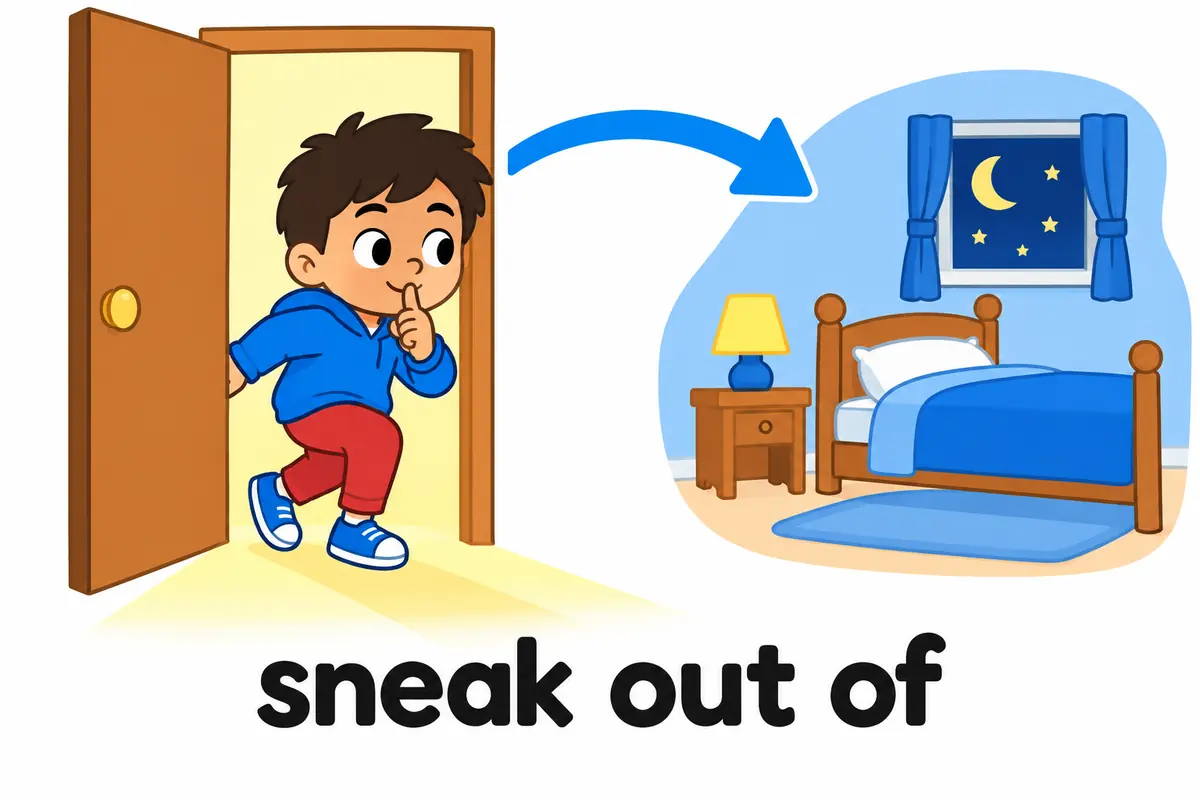
Sneak out in a sentence: examples across contexts
Sneak out shifts easily from childhood mischief to professional discretion. The nine sentences below keep the same phrasal verb while moving from a bedtime story to a security report.
| Context | Example sentence | Why this works |
|---|---|---|
| Bedtime story | The puppy sneaked out of the basket while the family slept. | A gentle, concrete scene a child can picture. |
| Classroom | Two pupils sneaked out of the hall during assembly. | The of phrase names the place and keeps the verb intransitive. |
| Teen diary | I sneaked out to meet my friends at the corner. | The to phrase gives the hidden purpose. |
| Workplace email | He sneaked out of the budget meeting before the vote. | Neutral reporting of a quiet exit. |
| News report | The suspect sneaked out of the building through a service door. | Names the route, as reporting expects. |
| Security memo | An outsider had sneaked the documents out overnight. | Uses the separable carrying sense with an object. |
| Sports writing | The substitute sneaked out of the tunnel and onto the pitch. | Adds the sense of moving unseen. |
| Animal story | A fox sneaked out of the hedge and crossed the lane. | The subject is an animal, a natural fit for the verb. |
| Conversation | I sneaked out of doing the washing-up by claiming homework. | The gerund shows the avoid-a-duty sense. |
Sneak out vs slip out
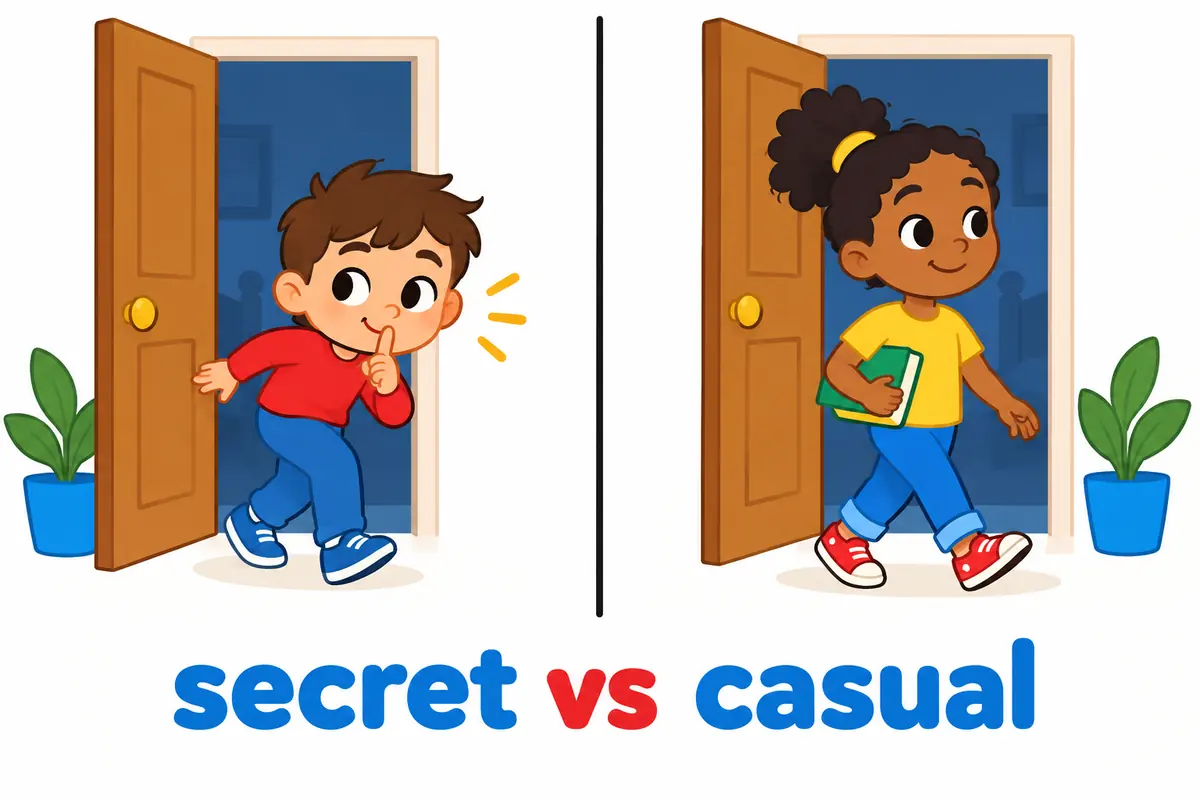
Sneak out and slip out both describe a quiet exit, and the difference is intention. Sneak out implies deliberately avoiding notice, sometimes against a rule; slip out implies leaving smoothly, often without having planned to go. Both take of before a place, but only sneak out takes the carrying sense.
| Attribute | sneak out | slip out |
|---|---|---|
| Core idea | Leave secretly, avoiding notice | Leave quietly and smoothly |
| Implied intent | Deliberate, often rule-breaking | Unplanned or casual |
| Transitive sense | Sneak the letter out | Rare, mainly for slips of paper |
| Typical subject | People, pets and animals | People, and things that glide |
| Register | Informal to neutral | Informal to literary |
| Example | We sneaked out before the head teacher returned. | She slipped out while the choir was still singing. |
Verdict: choose sneak out when the exit is secret and deliberate, and slip out when the leaving is simply quick and unobtrusive.
Word forms and grammar of sneak out
The base form never changes inside the phrase, but the verb inflects, and the past tense has two accepted shapes. The table also lists the split position that learners most often get wrong.
| Form | Part of speech | Example |
|---|---|---|
| sneak out | base form | They sneak out after lights-out. |
| sneaked out | past, standard | She sneaked out of the party early. |
| snuck out | past, informal | He snuck out to watch the match. |
| sneaking out | present participle | You are sneaking out again, aren’t you? |
| sneak the note out | separable transitive | She sneaked the note out in her sleeve. |
| sneak out the note | separable transitive | She sneaked out the note in her sleeve. |
| sneak out the room | non-standard | Wrong; use sneak out of the room. |
Both sneaked and snuck are used today, and each sounds natural in a different place: snuck in conversation and stories, sneaked in news and formal writing. The adverb is not needed, since out already marks the direction, so creep and slink are the words to reach for when the motion itself is the focus.
Common mistakes with sneak out
- Incorrect:
She sneaked out the party at nine.Correct: She sneaked out of the party at nine. Rule: The place needs of after out; out cannot introduce a building on its own. - Incorrect:
They sneaked out from the house.Correct: They sneaked out of the house. Rule: The fixed collocation is out of, not out from. - Incorrect:
He sneaked out of do his chores.Correct: He sneaked out of doing his chores. Rule: The avoid-a-duty sense takes the of plus an -ing form. - Incorrect:
We sneaked the box out of quietly.Correct: We sneaked the box out quietly. Rule: An adverb cannot sit between out and its of phrase; keep the particle group intact. - Incorrect:
The cat sneaked the out door.Correct: The cat sneaked out the door. Rule: With no object, sneak and out are a single unit and stay together.
Practice using sneak out
Work through the six items, then read the reasons in the answer list rather than checking only the key.
- Fill the gap: The children tried to ______ of the museum before closing time.
- Choose the better word: She (sneaked / slipped) out to answer her phone, meaning only that she left quietly.
- Correct the error: He sneaked out from his room after midnight.
- Build a sentence: use sneak the key out about a brother borrowing a key without asking.
- Spot the register: which belongs in a news report — the guard sneaked out, or the guard snuck out?
- Rewrite with the gerund: The intern avoided the long meeting by leaving early. Use sneak out of instead.
Answers
- sneak out — the intransitive phrase takes the place with of after out.
- slipped — there is no secret or rule-breaking, so slip out fits better.
- He sneaked out of his room after midnight — the collocation is out of, not out from.
- Model answer: Ben sneaked the key out of the drawer while the house was quiet.
- The guard sneaked out — news writing prefers the standard past form sneaked.
- The intern sneaked out of attending the long meeting — of plus an -ing form marks the avoided duty.
The bottom line
Use sneak out in a sentence when someone leaves a place secretly and wants to avoid being seen, and keep the of phrase after out. The two details that settle most sentences are that the verb is intransitive unless it is carrying an object, so an object can never sit between sneak and out in the basic sense, and that the past form is sneaked in careful prose. Plain, open leaving calls for slip out instead.
Frequently asked questions about sneak out
Is it sneaked or snuck?
Both are correct. Sneaked is the older, standard past form and appears in news, reports and school writing, while snuck is common in speech, diaries and fiction in North America. Choose sneaked for formal work and snuck when you want a relaxed, spoken tone. Either way, the rest of the phrase stays the same.
Is sneak out one word or two?
It is always written as two words. Sneak is the verb and out is the particle that changes the meaning, so they stay separate even though they act as one unit. The only variation is the transitive carrying sense, where an object may slip between them, as in sneak the note out, and that still keeps two words.
What is the difference between sneak out and sneak out of?
Sneak out stands alone and states that someone left secretly, as in the cat sneaked out. Adding of introduces the place the person left from, as in the cat sneaked out of the room. The of phrase is optional when the place is obvious, but learners should include it whenever a building or event is named.
Can you sneak an object out?
Yes. When sneak out carries an object, it becomes a separable phrasal verb, so the note may go before or after out: she sneaked the note out, or she sneaked out the note. This carrying sense is always transitive and always implies taking something unseen. Without an object, the phrase is intransitive and stays fixed.
Ever dreamed of pulling off a daring escape in the dead of night? To sneak out is to leave a place without being noticed, typically with the intention of going somewhere secret or forbidden. Many individuals, especially teenagers, use this tactic to have a bit of fun or adventure.
Whether it’s to attend a party past curfew or simply to explore the outdoors under the stars, sneaking out can bring an exhilarating rush of adrenaline. It requires careful planning and execution to avoid detection, making it a thrilling challenge for those brave enough to attempt it.
7 Examples Of Sneak Out Used In a Sentence For Kids
- Sneak out of the house when no one is looking.
- It’s fun to sneak out to play with friends.
- Sometimes animals sneak out of their homes.
- Be careful when you sneak out, don’t get caught.
- Let’s sneak out and explore the garden together.
- Birds sneak out of their nests to fly in the sky.
- Remember to be quiet when you sneak out.
14 Sentences with Sneak Out Examples
- Sneak out late at night to grab a quick snack from the street food stalls.
- Need to sneak out during class to meet your friends in the canteen.
- Planning to sneak out to attend a friend’s birthday party on the other side of town.
- Sneak out of the hostel to catch the early morning train for a weekend getaway.
- Waiting for the right moment to sneak out and watch a late-night movie at the cinema.
- Decided to sneak out to explore the city’s nightlife with your classmates.
- Managed to sneak out without getting caught by the hostel warden for a midnight stroll.
- Risking getting caught to sneak out and join the protest happening on campus.
- Figured out a way to sneak out and attend a concert happening in the city.
- Started a secret group chat to coordinate the plan to sneak out for a road trip.
- Successfully managed to sneak out of a boring lecture to play a game of cricket.
- Feeling rebellious and tempted to sneak out to visit the nearby amusement park.
- Made a pact with your roommates to sneak out for a study break at the local cafe.
- Coming up with a creative distraction to sneak out and enjoy a peaceful walk in the campus garden.
How To Use Sneak Out in Sentences?
To use Sneak Out in a sentence, simply follow these steps:
-
Choose the appropriate context for the phrase Sneak Out. This phrase is commonly used to describe leaving a place quietly or secretly, especially without others knowing.
-
Think of a situation where someone is discreetly leaving a location without anyone noticing. For example, “I had to sneak out of the party early so I wouldn’t have to say goodbye to everyone.”
-
Insert the phrase Sneak Out into your sentence at the appropriate place. Ensure that it fits seamlessly into the context of your sentence.
-
Consider the tone and level of formality of your sentence. Sneak Out is more commonly used in informal settings, so keep this in mind when crafting your sentence.
-
Practice using the phrase Sneak Out in different sentences to become more comfortable with incorporating it into your vocabulary. This will help you become more confident in using it naturally in conversations.
Overall, incorporating Sneak Out into your vocabulary can add a fun and intriguing element to your storytelling or conversations. Just remember to use it in the right context to convey the intended meaning effectively.
Conclusion
In summary, the act of “sneaking out” involves leaving a place or situation without being noticed or detected. This behavior is often associated with slipping away discreetly, as in “He tried to sneak out of the party without attracting any attention.” Whether it’s teenagers sneaking out of their homes at night or employees sneaking out early from work, the phrase implies a sense of secrecy or stealth.
“Sneaking out” typically conveys a sense of mischief or evasion, and is often done to avoid consequences or responsibilities. From movie scenes where characters sneak out of a building undetected to real-life scenarios where individuals sneak out of meetings, the term carries a connotation of slyness and underhandedness.


