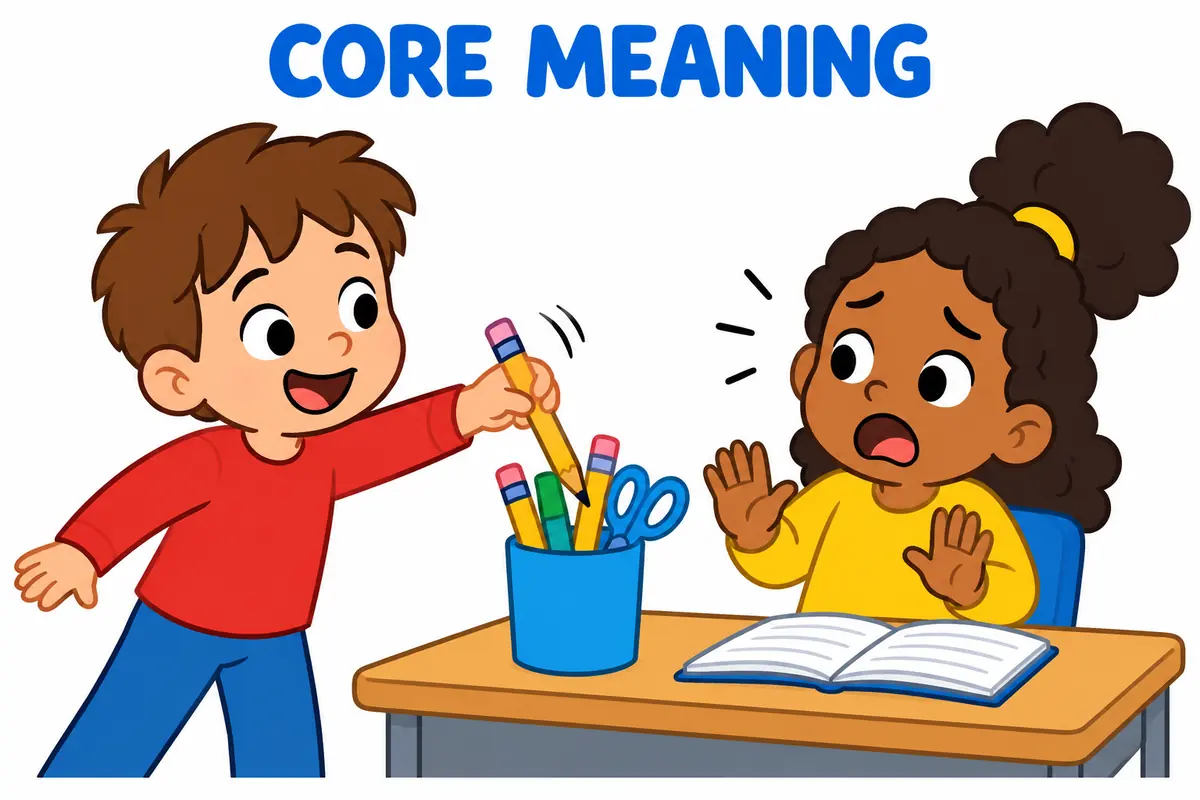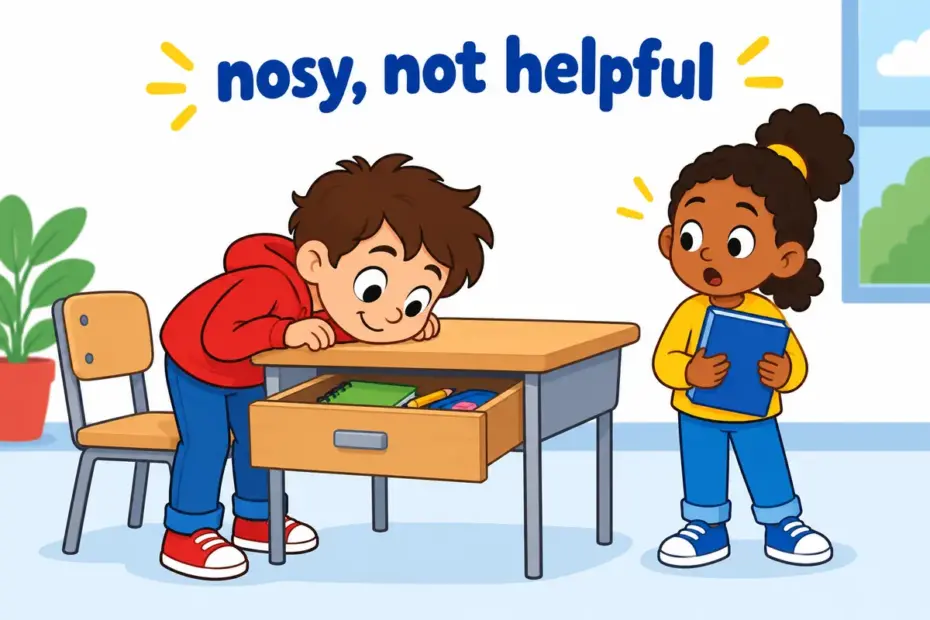
Snoop around means to search a place while prying into business that is not yours, and snoop around in a sentence never takes a direct object. The verb is intransitive, so the private space follows a preposition: she snooped around in his desk while he was out.
Snoop around at a glance
- Snoop around is an intransitive phrasal verb meaning to search and pry.
- Its forms are snoops around, snooped around and snooping around.
- The particle stays fixed: you cannot say snoop the room around.
- The private space follows in, around or through, never a direct object.
- The word is disapproving, so it accuses the person of being nosy.
- Snooping may be harmless curiosity or a serious invasion of privacy.
What does snoop around mean?
Snoop around is an intransitive phrasal verb meaning to move through a place looking for information you were not invited to have. The Cambridge entry for snoop around gives the prying sense as the main one, and the word always carries a note of disapproval, even when the search is mild.
| Sense | Plain meaning | Example sentence |
|---|---|---|
| Physical prying | Search a place while looking at private things | He snooped around the office after everyone left. |
| Information prying | Look for private facts about someone | Reporters snooped around for weeks before the story ran. |
| Mild curiosity | Wander and look at things out of nosiness | The children snooped around the empty classroom. |
One limitation is worth stating plainly. Snoop around is not a neutral word for searching. A police officer with a warrant does not snoop around, and a scientist does not snoop around a lab. If the searching is legitimate, use search, inspect or examine, and save snoop around for prying.
Snoop around overlaps with pry and nose, and the three differ mainly in focus. Pry suggests forcing information out of a thing or a person, often with effort. Nose around is close in meaning but milder and a little old-fashioned. Snoop around is the most common of the three in everyday speech, and it fits a search of a place rather than a question put to a person.
How do you use snoop around in a sentence?
Snoop around is intransitive and inseparable, which means the object you might expect after a transitive verb has to become a prepositional phrase. The particle out can never be moved to the end of the phrase, and a direct object placed straight after around is always wrong. Five patterns cover normal use.
| Pattern | Example | What it signals |
|---|---|---|
| snoop around | Stop snooping around. | The plain intransitive use with no stated place. |
| snoop around + in/through + place | She snooped around in his desk. | The private space as a prepositional phrase. |
| snoop around + for + thing | They snooped around for the missing file. | The thing being sought. |
| snoop around + on + person | He snooped around on his flatmate. | The person whose privacy is invaded, often digital. |
| be caught snooping around | She was caught snooping around the staff room. | The passive captures the moment of discovery. |
Because the verb is inseparable, the informal spelling snoop a place around is never correct. Related phrasal verbs with the same particle behave differently, and hang around is a useful comparison because it is equally intransitive but entirely innocent.
Because the verb is intransitive, learners whose first language uses a transitive verb for searching often produce the illegal order. The safest test is to ask whether the words after the verb form a prepositional phrase. If they begin with in, through, for or on, the sentence is on solid ground; if a bare noun follows around, the pattern has broken.

Snoop around in a sentence: examples across contexts
Snoop around keeps its disapproving tone in every register, from a playground to a newsroom. The ten sentences below vary the place, the preposition and the level of seriousness while keeping the same phrasal verb.
| Context | Example sentence | Why this works |
|---|---|---|
| Conversation | I caught my brother snooping around my room again. | The -ing form follows caught naturally. |
| Family | Stop snooping around and knock next time. | The imperative shows mild annoyance. |
| Workplace | Someone snooped around the manager’s files after hours. | Names the private space and the time. |
| News report | Officials were accused of snooping around for leaks. | The for phrase names what was sought. |
| School | The head found two pupils snooping around the staff room. | The place follows around without a direct object. |
| Digital privacy | The app snoops around inside your contacts. | The digital sense uses inside rather than in. |
| Mystery story | A stranger had been snooping around the old house for days. | The past perfect shows repeated, secret action. |
| Celebrity writing | Photographers snooped around the hotel for a single photo. | Shows the press sense and the for phrase. |
| Landlord and tenant | The tenant complained that the landlord snooped around her flat. | A serious privacy complaint in plain terms. |
| Humour | Our cat snoops around every bag that enters the kitchen. | A playful non-human subject keeps the tone light. |
The phrase after around is doing real work in each row: it tells the reader whose privacy is at stake. When the searching is open and permitted, look around is the honest verb, and the difference is entirely about permission.
Notice how often the sentence names the owner of the private space. His desk, her flat and the manager’s files all tell the reader whose boundary was crossed, and that detail is what turns a plain description into an accusation.
Snoop around vs look around
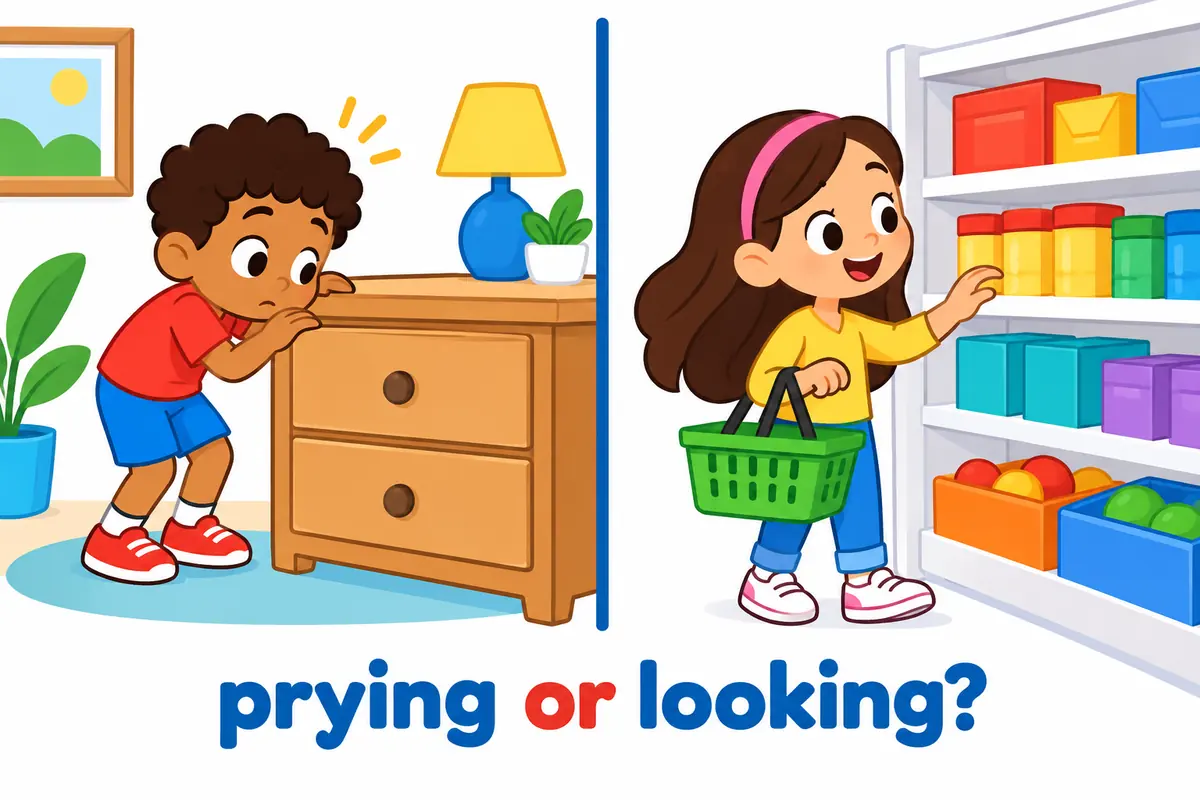
Snoop around and look around describe almost the same movement and mean very different things. One is neutral looking, the other is uninvited prying, so the choice tells the reader whether the searching was acceptable.
| Attribute | snoop around | look around |
|---|---|---|
| Core meaning | Search while prying into private matters | Direct your eyes around a place |
| Permission | None; the search is uninvited | Usually allowed or neutral |
| Transitivity | Intransitive | Intransitive or transitive |
| Tone | Disapproving | Neutral |
| Typical subject | A nosy person, a reporter, an app | A visitor, a shopper, a newcomer |
| Example | He snooped around her diary. | He looked around the new office. |
Verdict: choose look around for ordinary, permitted scanning, and keep snoop around for prying that the speaker wants to criticise. A visitor looks around a house; a trespasser snoops around it.
The difference is permission, not movement. Two people can walk through the same room making the same turns, and only one is snooping, because only one was invited. That is why the choice of verb is really a judgement about the person, and why formal writing reserves it for criticism.
Word forms and grammar of snoop around
Only snoop inflects; the particle around never changes, and the verb has no passive object because it is intransitive. Snoop also works as a noun for the person who does it. The same particle runs through many phrasal verbs, including get around, fool around and turn around, each with its own meaning.
| Form | Part of speech | Example |
|---|---|---|
| snoop around | phrasal verb, base | They snoop around the shared kitchen. |
| snoops around | phrasal verb, third person | He snoops around whenever she is out. |
| snooped around | phrasal verb, past | We snooped around the attic for an hour. |
| snooping around | phrasal verb, -ing | Snooping around the archive got him into trouble. |
| snoop | noun | Her neighbour is a notorious snoop. |
| snooped arounded | non-standard | Incorrect: They snooped arounded the office. |
| snoop the room around | non-standard | Incorrect: She snooped the room around. |
Common mistakes with snoop around
- Incorrect:
She snooped the room around.Correct: She snooped around the room. Rule: Snoop around is inseparable, so the particle stays put. - Incorrect:
He snooped around his sister.Correct: He snooped around on his sister. Rule: The person whose privacy is invaded needs the preposition on. - Incorrect:
They snooped the files around.Correct: They snooped around the files. Rule: The phrase after around is a place, not a direct object. - Incorrect:
They snooped arounded the office.Correct: They snooped around the office. Rule: Only snoop inflects, never the particle. - Incorrect:
The police snooped around the suspect’s flat.Correct: The police searched the suspect’s flat. Rule: Snoop around implies prying, so it misdescribes official searching.
Practice using snoop around
Work through the seven items, then read the reason with each answer.
- Fill the gap: The children were told not to ______ around the gifts before the party.
- Choose the better word: The new tenant (looked around / snooped around) the empty flat before signing.
- Correct the error: Someone snooped the cupboard around last night.
- Build a sentence: use snoop around in about a classmate and a desk.
- Spot the register: which belongs in a complaint email — a delivery driver looked around the porch, or a stranger snooped around the porch?
- Add the right preposition: He snooped around ______ his roommate’s laptop.
- Rewrite in the passive: They caught Mia while she was snooping around the office.
Answers
- snoop — the base form completes the infinitive after not to.
- looked around — the viewing is permitted, so the neutral verb is right.
- Someone snooped around the cupboard last night — the particle cannot be moved.
- Model answer: A classmate snooped around in my desk while I was at lunch.
- A stranger snooped around the porch — the complaint criticises prying, not looking.
- on — the person whose privacy is invaded follows on.
- Mia was caught snooping around the office — the passive keeps caught and the -ing form.
The bottom line
Use snoop around in a sentence when someone searches a place while prying into private matters, and keep the verb intransitive. The two deciding points are that the particle is fixed, so snoop the room around is impossible, and that the verb is never neutral, so it should not describe official searches. Where the looking is ordinary and permitted, push around shares the particle but not the meaning, and look around is the plain alternative.
Frequently asked questions about snoop around
Is snoop around separable?
No. Snoop around is inseparable, so the particle always stays with the verb. You can say snooped around the office, but never snooped the office around. Because the verb is also intransitive, the place is always a prepositional phrase rather than a direct object.
What preposition goes after snoop around?
It depends on what follows. Use in or inside for a place, through for a set of things, for the thing being sought, and on for the person whose privacy is invaded. Snooping around on a colleague is a serious complaint, while snooping around for a file is milder.
Is snoop around rude?
It is disapproving rather than openly rude. Calling an action snooping says the search was not invited and the searcher was nosy, which is a criticism. That is why the word fits a complaint or a scolding but not a description of police work or a permitted inspection.
Can snoop around be used as a noun?
The phrasal verb cannot, but the bare verb snoop can. A snoop is a person who pries into other people’s business, and snooping is the activity itself. So a neighbour who snoops around is a snoop, and the habit is called snooping rather than snooping around.