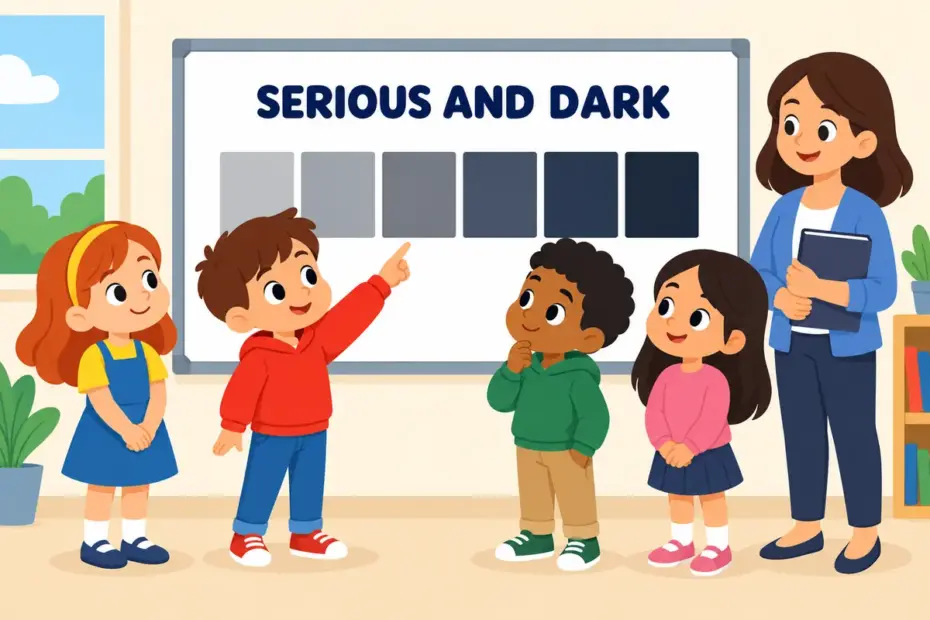
Somber describes something dark in colour or serious and grave in mood. To use somber in a sentence, decide which sense you mean, then attach it to a noun such as mood, colour, occasion or expression: “A somber mood settled over the hall.” The adjective rarely stands alone and almost always modifies a thing or a feeling.
Somber at a glance
- Somber is an adjective; its other forms are somberly (adverb) and somberness (noun).
- It carries two senses: dark or dull in colour, and grave or solemn in mood.
- The usual nouns are mood, tone, occasion, expression, colour and news.
- Somber belongs to written, formal and journalistic English rather than casual talk.
- The commonest error is reaching for somber when plain words such as sad or low fit a person better.
What does somber mean?
Somber is an adjective meaning dark and dull in colour, or serious and grave in mood. The Cambridge entry for somber and the Merriam-Webster entry both record the two senses, and the difference shows in practice: one describes what the eye sees, the other what an occasion feels like.
| Sense | Plain meaning | Example sentence |
|---|---|---|
| Dark in colour | Dull and dim, without brightness | The hall was painted in somber greys. |
| Grave in mood | Serious and solemn, without joy | A somber silence followed the verdict. |
One limitation matters here. Somber is not a synonym for sad. A crowd can be somber out of respect rather than grief, and a shade of paint can be somber with no feeling attached at all. When the sense is personal unhappiness, melancholy or low is the more exact choice.
How do you use somber in a sentence?
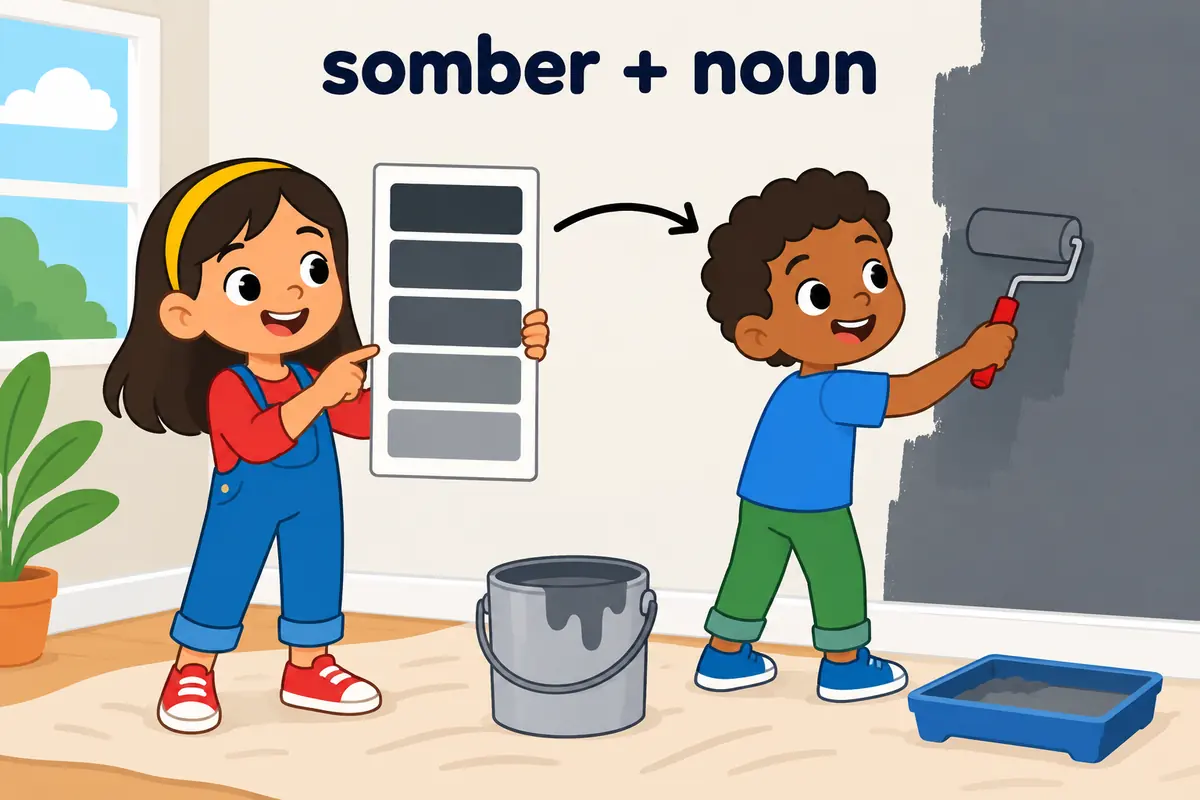
Place somber directly before the noun it describes, and let that noun carry the sense. The five patterns below cover almost every real sentence, from a weather report to a funeral notice, and each one shows what the adjective signals.
| Pattern | Example | What it signals |
|---|---|---|
| somber + mood or tone | A somber tone ran through the report. | Modifies an atmosphere rather than a person. |
| somber + occasion or event | It was a somber ceremony. | Marks a formal event treated with respect. |
| somber + colour or shade | She chose a somber navy for the coat. | The colour sense, dull and dark. |
| somber + expression or face | His expression stayed somber all evening. | Describes a visible manner, not secret grief. |
| remain or stay somber | Markets remained somber after the news. | Links the mood to a continuing situation. |
Somber in a sentence: examples across contexts
Somber changes little in meaning but a great deal in company. The nine sentences below keep the same adjective while moving from a classroom to a newspaper, and each one names the noun doing the work.
| Context | Example sentence | Why this works |
|---|---|---|
| Classroom | The class grew somber when the teacher read the letter. | The mood has a clear, visible cause. |
| Workplace email | The team shared a somber update on the factory closure. | Formal register with a serious subject. |
| News report | A somber crowd gathered outside the courthouse. | Describes a group with one shared feeling. |
| Weather writing | Somber clouds hung over the valley all morning. | Uses the colour sense, dark and heavy. |
| Art review | The painter favoured somber browns and deep greens. | Names specific shades rather than a mood. |
| Conversation | We were somber for a while after the phone call. | The one setting that allows everyday speech. |
| Academic prose | The chapter takes a somber view of the settlement. | Describes the tone of an argument. |
| Sports report | A somber manager answered questions after the defeat. | Pairs the adjective with a person’s manner. |
| Funeral notice | Family and friends gathered in somber dress. | A fixed collocation for formal occasions. |
Only the conversation example feels loose enough for speech. In every other setting the adjective is doing quiet work that keeps an emotional scene dignified rather than dramatic.
Somber vs gloomy
Somber and gloomy overlap in weather writing and are not interchangeable. Gloomy means dark and depressing, often with no relief in sight, while somber keeps a note of respect or gravity. Dreary is a third option for dull, tiring conditions.
| Attribute | somber | gloomy |
|---|---|---|
| Core meaning | Dark in colour or grave in mood | Dark and depressing |
| Typical subject | Occasions, moods, colours, expressions | Weather, forecasts, rooms, people |
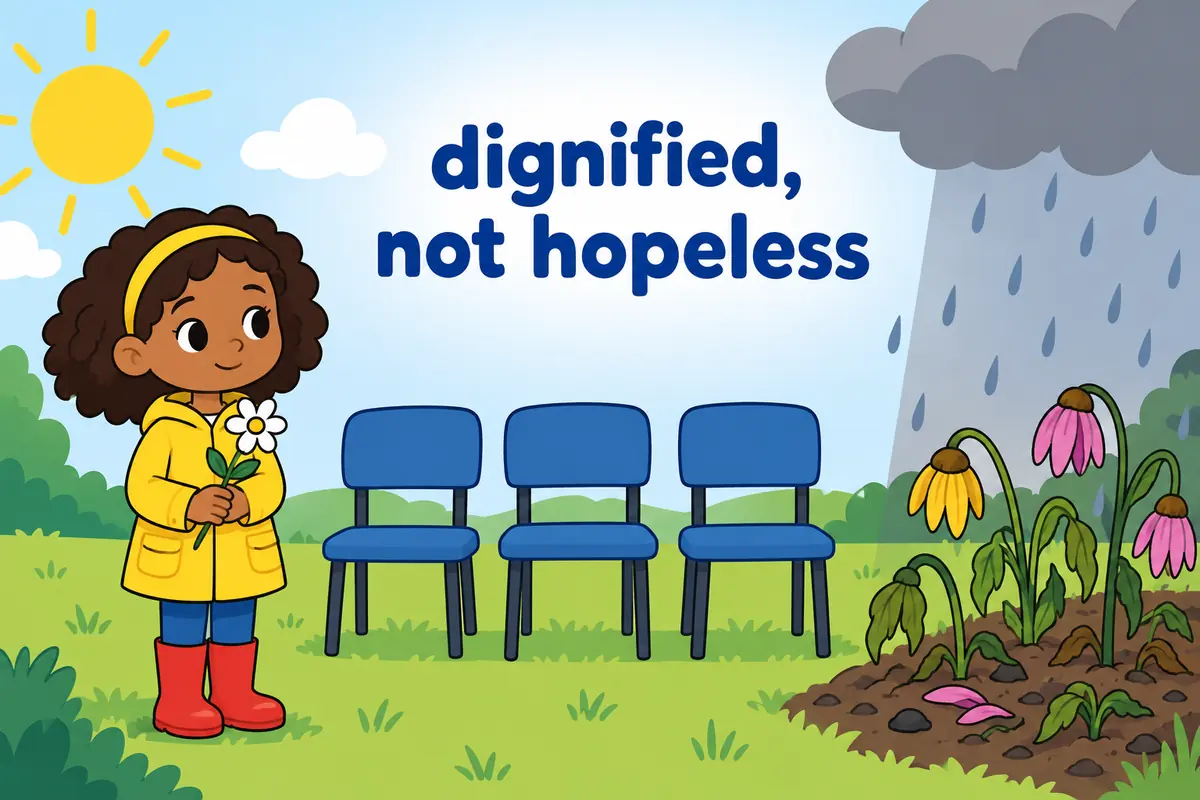
| What it implies | Dignity and self-control | Hopelessness and low spirits |
| Emotional temperature | Controlled and cool | Heavy and drained |
| Register | Formal and journalistic | Neutral, common in speech |
Verdict: choose somber for dignified seriousness and gloomy when the darkness feels oppressive and without hope.
Word forms and grammar of somber
Somber inflects with more and most rather than an ending, and its adverb and noun are both common in careful writing. The table also lists the form learners build by mistake.
| Form | Part of speech | Example |
|---|---|---|
| somber | adjective | A somber mood filled the room. |
| somberly | adverb | She spoke somberly about the loss. |
| somberness | noun | The somberness of the occasion surprised him. |
| more somber, most somber | comparative and superlative | The second half was more somber than the first. |
| somberer | comparative – non-standard | Use more somber instead of somberer. |
| sombre | adjective – British spelling | The British press wrote sombre. |
Common mistakes with somber
- Incorrect:
He felt very somber after his team lost.Correct: He looked somber after his team lost. Rule: Somber describes a visible mood or manner; for private sadness use low or downcast. - Incorrect:
The party was somber and everyone laughed.Correct: The party was somber and very quiet. Rule: Somber means grave or solemn, so it cannot sit beside celebration. - Incorrect:
They waited in a somberly silence.Correct: They waited in a somber silence. Rule: Somberly is an adverb and cannot modify a noun such as silence. - Incorrect:
Her somber was obvious.Correct: Her somberness was obvious. Rule: The noun is somberness; somber is only the adjective.
Practice using somber
Work through the six items, then read the reasoning rather than only the key.
- Fill the gap: A ______ mood spread through the staff room after the announcement.
- Choose the better word: With rain forecast all week, the sky looked (somber / gloomy).
- Correct the error: The choir sang in a somberly tone.
- Build a sentence: use the phrase somber occasion about a school assembly.
- Spot the register: which belongs in a news report – A somber crowd gathered downtown, or Everyone was pretty somber?
- Rewrite with the adverb: The principal spoke in a somber way. Use somberly instead.
Answers
- somber – it modifies mood, the noun that carries the grave sense.
- gloomy – the endless rain is depressing and without relief, which is gloomy rather than dignified.
- The choir sang in a somber tone – somberly cannot modify the noun tone, so the adjective is needed.
- Model answer: The assembly was a somber occasion as the head teacher read the memorial notice.
- A somber crowd gathered downtown – a report keeps the formal register and avoids pretty as an intensifier.
- The principal spoke somberly about the term ahead – the adverb describes how the speaking was done.
The bottom line
Use somber in a sentence when you need a dark colour or a dignified, serious mood, and place it directly before the noun it describes. The two facts that settle most sentences are that somber carries respect rather than despair, and that it attaches to a mood, colour or occasion instead of a private feeling. When the darkness feels hopeless, serious and gloomy are the plainer alternatives.
Frequently asked questions about somber
Is somber a negative word?
Somber sits in the middle. It signals seriousness and respect, which is appropriate at a memorial or on a formal occasion, so it is not simply negative. It becomes the wrong choice only when the feeling is outright despair, where gloomy or hopeless carries the weight you want.
Can somber describe a person?
It can describe how a person looks or behaves rather than how they feel inside. A somber manager is visibly serious. For inner sadness, writers prefer low, downcast or sad, because those words report a private state that somber only implies from the outside.
What is the difference between somber and solemn?
Both words point to gravity, and solemn leans further towards ritual and ceremony. A solemn vow, oath or promise belongs to formal duty, while somber usually describes mood, colour or atmosphere. A courtroom may be solemn by design and somber because of what just happened.
How do you spell somber in British English?
British English writes sombre, matching words such as theatre and centre, while American English writes somber. The pronunciation and meaning do not change. Editors keep the spelling consistent within one document, so do not mix somber and sombre in the same page.
“Somber” is an adjective that describes a serious, solemn, and melancholy mood or atmosphere. It conveys a sense of gloom or introspection, often associated with feelings of sadness, grief, or seriousness.
When a situation, place, or person is described as somber, it suggests a lack of brightness, cheer, or liveliness. This word is commonly used to characterize settings like funerals, memorial services, or moments of reflection.
7 Examples Of Somber Used In a Sentence For Kids
- The somber clouds covered the sky.
- The somber music made us feel sad.
- The somber elephant walked slowly.
- The somber colors made the painting look dull.
- The somber owl hooted in the night.
- The somber old man wore dark clothes.
- The somber room had no light.
14 Sentences with Somber Examples
- Somber faces filled the classroom as the professor announced the cancellation of the upcoming field trip.
- As the rainy season approached, the weather turned somber and gloomy, making it difficult for students to stay motivated.
- The news of the sudden passing of a beloved faculty member cast a somber mood over the entire campus.
- The sight of empty library shelves during exam week left a somber feeling among students desperately searching for reference books.
- The campus auditorium was filled with somber silence as the guest speaker shared a poignant story of overcoming adversity.
- The realization of failing grades brought a somber atmosphere to the end-of-semester celebrations.
- A somber silence fell over the lecture hall as a student bravely shared their personal struggles with mental health.
- The graduation ceremony was tinged with a somber note as students said farewell to the campus they called home for the past few years.
- The campus memorial service was a somber reminder of the importance of cherishing every moment with loved ones.
- The student council meeting took on a somber tone as members discussed the impact of budget cuts on extracurricular activities.
- The university’s annual memorial walk brought together students in a somber yet supportive atmosphere to honor those who had passed away.
- The dimly lit study room exuded a somber vibe as students prepared for their final exams in the late hours of the night.
- The aftermath of a campus protest left a somber feeling of division among students with differing viewpoints.
- The news of a global crisis spreading rapidly left students with a somber realization of the uncertain times ahead.
How To Use Somber in Sentences?
Somber is used to describe a situation or atmosphere that is sad, serious, or reflective. When using the word somber in a sentence, it’s important to consider the context in which it fits best.
For example: “The atmosphere in the room was incredibly somber as everyone mourned the loss of their friend.” In this sentence, the word somber is used to convey the feeling of sadness and seriousness in the room.
Another way to use somber in a sentence is: “The movie had a somber ending, leaving the audience feeling reflective and melancholic.” Here, somber is used to describe the tone and mood of the ending of the movie.
It’s important to note that somber is typically used to describe emotions or situations that are subdued, serious, or grave. Avoid using somber to describe situations that are lighthearted or cheerful, as it may not accurately convey the intended meaning.
To effectively use somber in a sentence, consider the emotions and atmosphere you are trying to describe. Utilize the word in situations that evoke feelings of sadness, seriousness, or reflection to ensure clear and accurate communication.
Conclusion
In conclusion, the collection of sentences with “somber” paint a picture of gloom, melancholy, and solemnity. Through these examples, we see how the word is used to evoke a mood that is heavy with sadness or seriousness. The sentences convey emotions such as sorrow, reflection, and a sense of foreboding, reminding us of life’s darker moments.
Overall, the somber sentences showcase the versatility of the word in capturing a wide range of sentiments and atmospheres. Whether describing a somber moment in nature, a somber reality in society, or a somber mood in personal experiences, the word effectively conveys a tone of seriousness and melancholy that resonates with readers on a deep emotional level.


