
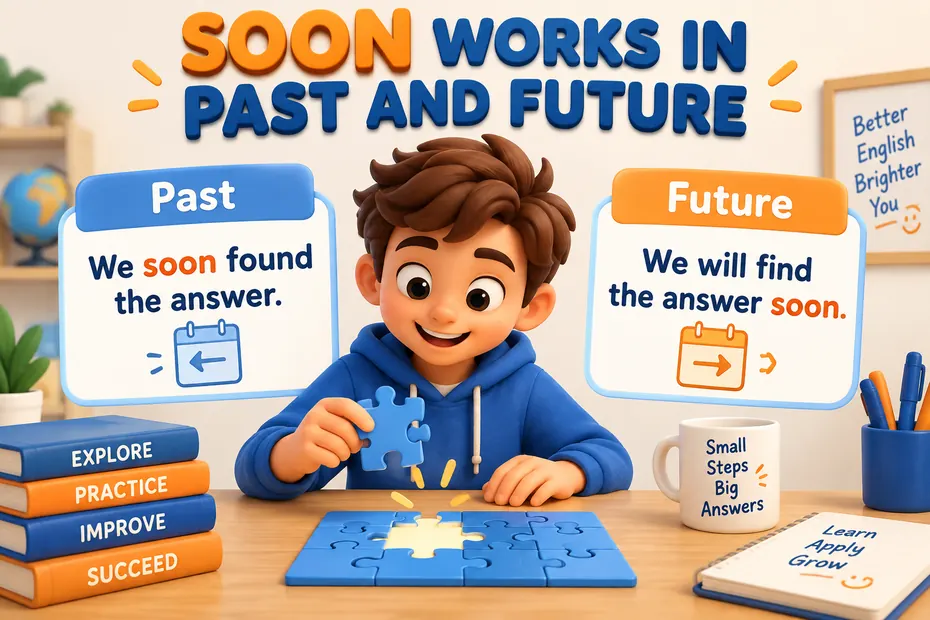
Soon in a sentence: “The bus will arrive soon.” Soon is an adverb meaning before long or after a short interval. It does not give an exact number of minutes, and it can describe a future event or a short delay in the past: “We soon found the answer.”
- Soon is an adverb, not a verb tense.
- It can appear at the beginning, middle, or end of a sentence.
- Its comparative and superlative forms are sooner and soonest.
- A comma after introductory soon is not automatically required.
- Use a date or time when the reader needs a precise deadline.
How do you use soon in a sentence?
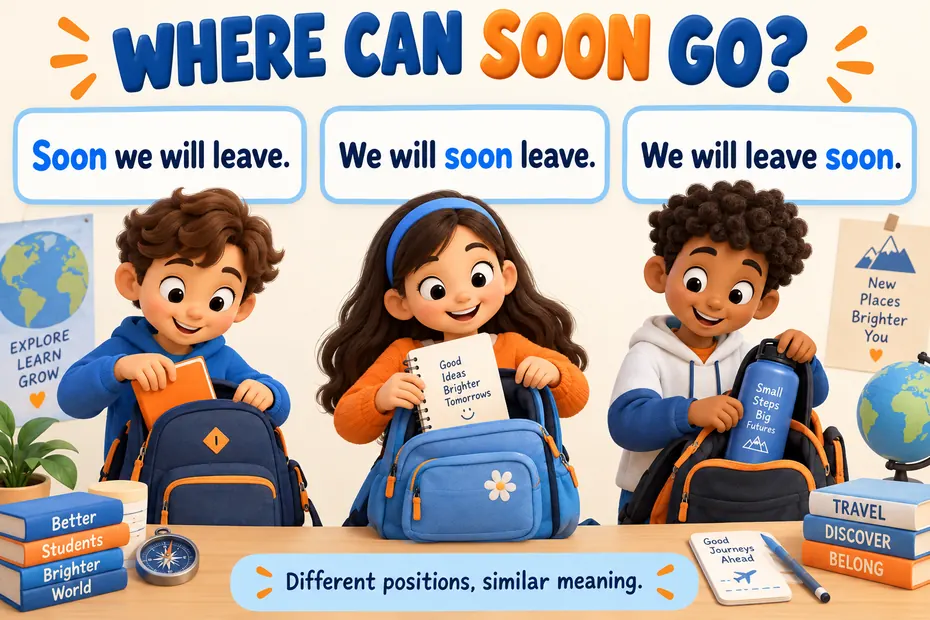
Place soon near the action whose timing you are describing. “We will leave soon” is a straightforward pattern for conversation. “We will soon leave” is also natural, while “Soon we will leave” puts the time idea first.
Merriam-Webster’s soon entry identifies the word as an adverb and includes meanings involving a short interval, promptness, and preference. For beginners, start with the short-interval meaning before introducing idiomatic expressions such as just as soon.
| Position or form | Example | Comment |
|---|---|---|
| End | The lesson will start soon. | Easy everyday pattern |
| Before a main verb | We soon understood the rules. | Works with a past event |
| After an auxiliary | The lesson will soon start. | Natural middle position |
| Beginning | Soon the room grew quiet. | Emphasizes the short interval |
| Comparative | Can you arrive sooner? | Earlier than the expected time |
| Question | How soon can you reply? | Asks about the delay |
Avoid awkward placement inside a long verb phrase. The older example “We will be soon arriving” is understandable, but “We will soon be arriving” or “We will arrive soon” is smoother. The shorter version is particularly useful when the lesson focuses on the target word.
Clear soon sentence examples for different situations
Use examples that reveal what will happen or what happened after a short time. The word can express anticipation without forcing an exact deadline.
- My friend will visit soon.
- Lunch will be ready soon.
- Soon we will return to the classroom.
- The flowers will open soon.
- I hope to hear from you soon.
- The children soon learned the song.
- We soon noticed a missing page.
- The station reopened soon after the repairs.
- Please reply soon so that we can finish the plan.
- She arrived sooner than we expected.
- The soonest appointment available is Thursday.
- How soon will the library reopen?
The past examples correct the impression that soon always refers to the future. In “The children soon learned the song,” the learning happened in the past after a relatively short interval. The verb learned supplies the tense; soon supplies information about timing.
What is the difference between soon and as soon as?
Soon describes a short interval; as soon as connects one event with another. “I will call soon” leaves the timing relative to now. “I will call as soon as the meeting ends” identifies an event that triggers the call.
In a normal future time clause, use the present form after as soon as: “I will email you as soon as I arrive,” rather than “as soon as I will arrive.” The British Council’s guide to will explains this pattern for future references after time conjunctions.
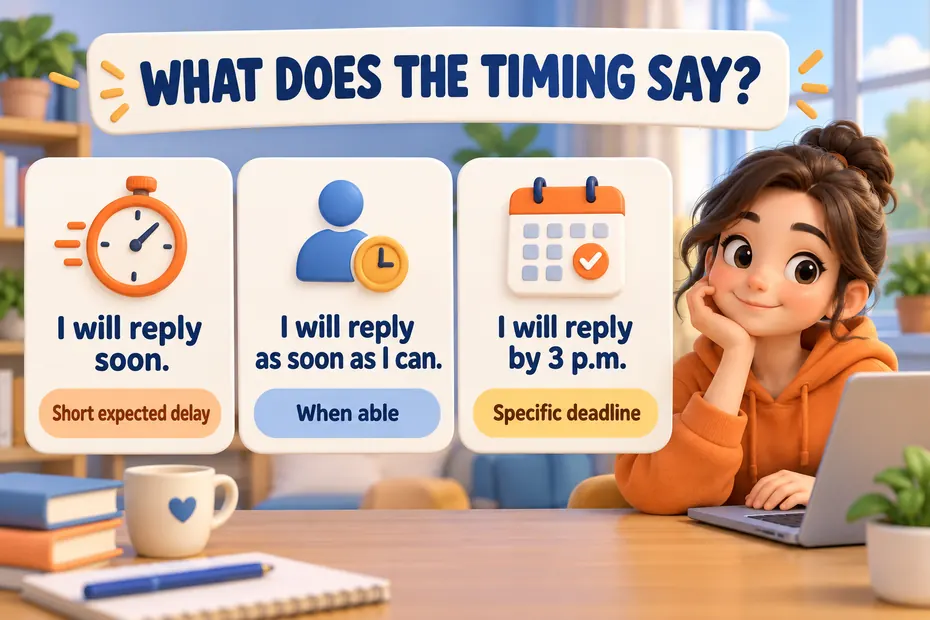
Compare three promises: “I will reply soon,” “I will reply as soon as I can,” and “I will reply by 3 p.m.” The first indicates a short expected delay. The second adds a practical limit: the speaker’s ability to respond. The third gives a measurable deadline, which is more useful when someone must plan around the answer.
Does soon need a comma, and how precise is it?
A short introductory soon does not always need a comma. “Soon we reached the village” reads naturally without one. “Soon, we reached the village” can also be used to create a pause or emphasis. The older advice below makes the comma sound compulsory; that is too rigid.
At the end of a simple clause, leave the adverb attached to the action: “We will return soon.” Writing “We will return, soon” introduces an unusual pause and is rarely necessary in a basic exercise. If two full clauses follow one another, punctuation must handle the clauses independently of the adverb.
Soon is relative to context. A meal that will be ready soon suggests a different practical wait from a building that will open soon. Neither statement supplies a guaranteed duration. For appointments, assignments, and delivery commitments, add a date or a stated time instead of expecting the reader to guess.
Frequently asked questions
Is soon the same as immediately?
No. Immediately normally means without delay; soon allows a short interval. “Leave immediately” is stronger than “Leave soon.” Choose the word that matches the intended instruction, and give an exact time if a misunderstanding about the delay would affect someone’s plans.
Can soon appear in a negative sentence?
Yes. “The shop will not reopen soon” says that a reopening is not expected after a short interval. “The shop will reopen soon” says the opposite. “It cannot reopen soon enough” is an idiomatic expression of eagerness, so it should not be interpreted as the same negative prediction.
What does too soon mean?
Too soon means earlier than is suitable or desirable: “We ended the rehearsal too soon.” The judgment comes from too, which signals an excessive degree. Compare “The rehearsal ended soon,” which merely describes timing, with “too soon,” which evaluates that timing.
Can I say see you soon?
Yes. “See you soon” is a common conversational farewell expressing an expectation or hope of meeting before long. It is acceptable as a short conversational expression even though the subject and auxiliary are omitted. For a scheduled meeting, “See you on Friday” communicates a more specific plan.

“An example sentence with ‘soon’ illustrates the notion of imminent or impending action. When ‘soon’ is used, it often signifies a close timeframe or quick occurrence.”
“Its versatile usage can be found in various contexts, conveying the idea of something happening shortly or in the immediate future. Let’s explore how ‘soon’ enhances the clarity and urgency of our communication.”
7 Examples Of Soon Used In a Sentence For Kids
- Soon I will go to school with my friends.
- My birthday is coming soon and I’m excited!
- We will have a holiday soon for Diwali.
- Soon it will be time for lunch at school.
- My mom will pick me up from school soon.
- Soon we will play in the playground.
- Soon I will learn new words in class.
14 Sentences with Soon Examples
- Soon you will have to start preparing for your final exams.
- Make sure to submit your assignment soon to avoid late penalties.
- The semester break will be here soon, so make the most of your time.
- The deadline for course registration is coming up soon, so don’t forget to enroll in your classes.
- You’ll need to start applying for internships soon to secure a placement.
- The campus festival is happening soon, so get ready for some fun events.
- Remember to renew your library books soon to avoid fines.
- Your graduation day will be here soon, so start planning for the big day.
- You’ll be starting your new semester soon, so get your books and stationery ready.
- The college trip is approaching soon, so make sure you have packed all the essentials.
- Don’t procrastinate; start working on your project soon to ensure you meet the deadline.
- The campus recruitment drive will be happening soon, so update your resume and practice your interview skills.
- The results for your mid-term exams will be out soon, so be prepared to receive feedback on your performance.
- Prepare a study schedule soon to manage your time effectively and avoid last-minute cramming.
How To Use Soon in Sentences?
Soon is used to indicate that something will take place in the near future. When using Soon in a sentence, you can position it at the beginning or middle of the sentence. For example:
- We will be soon arriving at the destination.
- Soon, it will be time to go home.
Remember to use a comma after Soon if it is placed at the beginning of a sentence. Additionally, you can also use Soon with other words to provide more context or clarity to your sentence. For instance:
- We are soon going to start our project.
- Soon, we will finish our homework.
When using Soon in writing, it is important to consider the tone and context of your sentence. Soon can convey a sense of immediacy or anticipation, depending on how it is used. It is also important to ensure that the timing of the event or action you are referring to is close in the future to avoid confusion.
By incorporating Soon into your sentences, you can effectively convey the timing of events or actions in a clear and concise manner. With practice, you will become more comfortable using Soon in your writing to indicate that something is about to happen in the near future.
Conclusion
In conclusion, the examples of sentences using the keyword “soon” illustrate the concept of temporal proximity. Each sentence demonstrates a sense of impending action or occurrence in the near future. From plans to meet a friend for dinner to finishing a project before a deadline, the word “soon” conveys a sense of immediacy and anticipation. By using this keyword, speakers can effectively communicate their intentions and expectations with clarity and conciseness.
In everyday conversation and written communication, incorporating “soon” into sentences helps to establish a timeframe and manage expectations. Whether it’s making plans, setting deadlines, or simply expressing a promise to follow up, the word “soon” serves as a useful tool for indicating a forthcoming event or action. Its versatile usage allows for a wide range of contexts, making it a valuable addition to one’s vocabulary for clear and effective communication.


