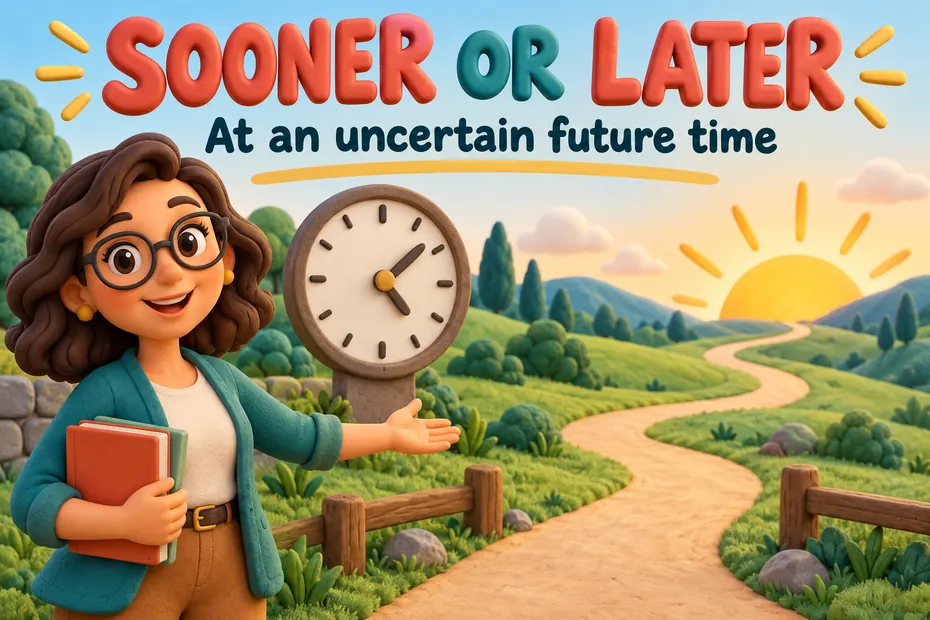
How do you use sooner or later in a sentence?
Sooner or later means at an uncertain future time, often with the expectation that something will eventually happen. Write “Sooner or later, we will find the answer” or “We will find the answer sooner or later.” The phrase describes timing without giving a date; it does not mean that something will happen soon.
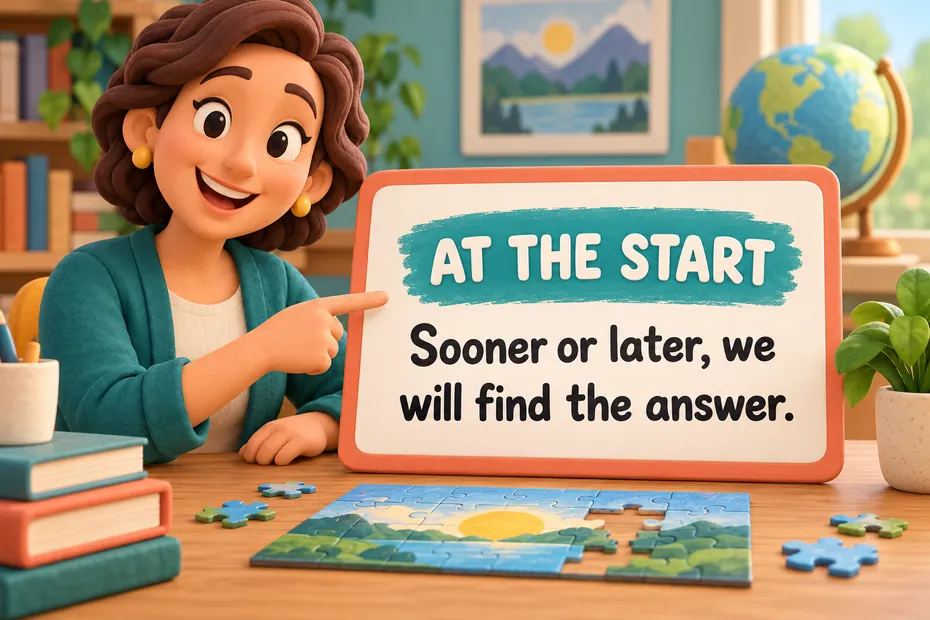
What does sooner or later actually imply?
The expression leaves the time open. A speaker usually presents the event as expected or inevitable, but the phrase itself does not prove that the prediction is correct. “Sooner or later, the missing key will turn up” expresses confidence. Whether the key actually appears is a separate matter. Merriam-Webster lists the expression as an adverb referring to an uncertain future time.
Use it when timing is uncertain and that uncertainty matters. “Sooner or later, we will need a larger storage room” is a prediction. “We need a larger storage room by Monday” is a deadline. The two statements may concern the same problem, but only the second tells someone when to act.
Where can sooner or later go?
| Position or purpose | Original example | Usage note |
|---|---|---|
| At the beginning | Sooner or later, the team will solve the puzzle. | The phrase frames the whole prediction |
| At the end | The team will solve the puzzle sooner or later. | A natural, conversational position |
| After a modal verb | The team will sooner or later solve the puzzle. | Correct, though often less smooth than end placement |
| With a necessity | We will have to replace this chair sooner or later. | An eventual need rather than a specific deadline |
| In reported expectation | She knew that sooner or later someone would ask. | A future event viewed from a past viewpoint |
| With possibility | We might need the spare room sooner or later. | Might makes the event uncertain as well as its timing |
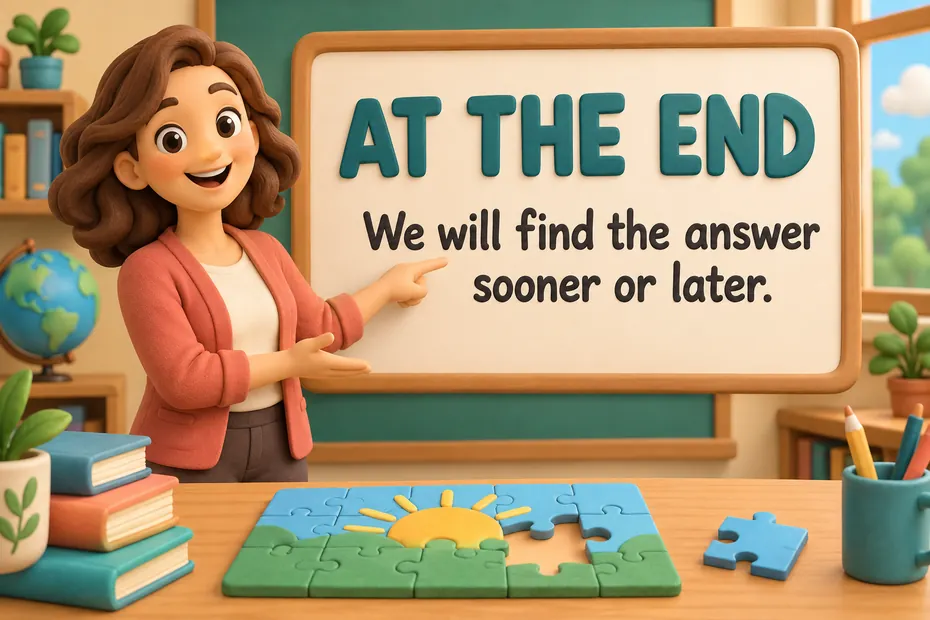
Does sooner or later need commas?
A comma after an opening “Sooner or later” is a clear, readable default: “Sooner or later, someone will notice.” The earlier guide below presents that as an absolute requirement. In practice, a short introductory adverbial can sometimes appear without a comma; following a consistent style matters. The comma is especially useful when it makes the opening boundary easier to see.
At the end of a straightforward sentence, a comma is normally unnecessary: “Someone will notice sooner or later.” In the middle, the phrase can be integrated into the sentence without commas: “Someone will sooner or later notice the missing label.” If you deliberately make it an interruption, paired commas are possible: “Someone will, sooner or later, notice the missing label.” Do not add only one comma around an interruption.
Compare the punctuation with the spoken rhythm. The integrated version moves directly through the phrase. The paired-comma version invites a pause on each side and gives it more emphasis. For a simple learner example, beginning or end placement is usually the easiest choice.
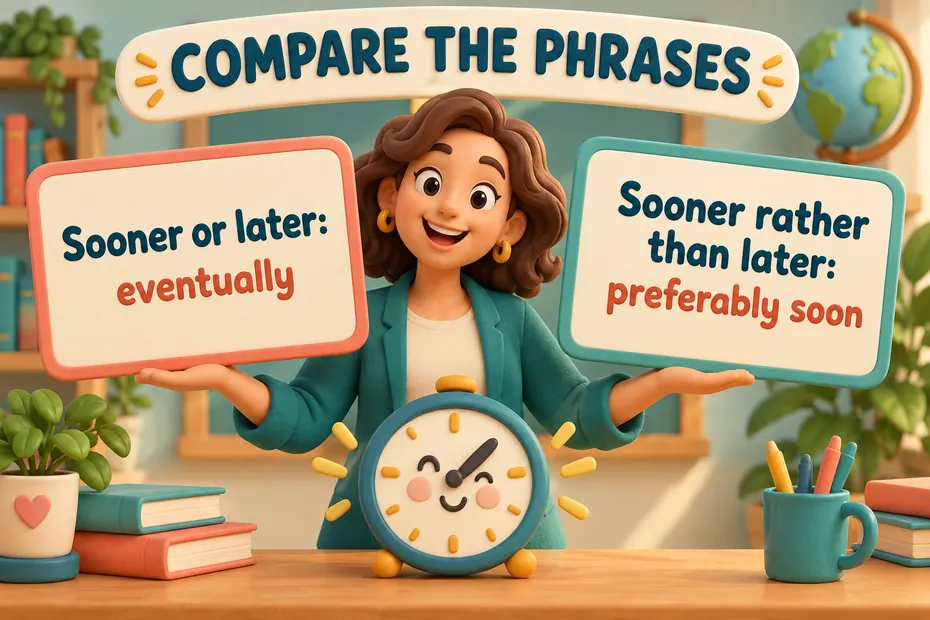
Sooner or later versus sooner rather than later
Sooner or later means eventually, with no exact time. Sooner rather than later favors or expects an earlier time instead of a delayed one. Merriam-Webster explains the second expression in terms of acting without excessive delay. They are related in wording, but substituting one for the other changes the message.
“Please review the draft sooner or later” sounds vague and may allow a long wait. “Please review the draft sooner rather than later” communicates a preference for prompt action. If you need a firm commitment, “Please review the draft by noon on Friday” gives the clearest instruction. Neither idiom supplies a deadline by itself.
Examples for reassurance, warnings, and everyday predictions
For reassurance, write “With practice, you will feel more comfortable sooner or later.” For a warning, write “Sooner or later, someone will question those missing receipts.” For a neutral prediction, write “The old printer will need replacement sooner or later.” The basic time meaning stays the same; the situation and wording provide the tone.
Be careful about predictions that involve another person’s feelings, health, or success. “You will succeed sooner or later” expresses encouragement, not a guarantee. If uncertainty needs to remain explicit, use “may” or “might,” or explain the conditions: “With regular practice, your performance may improve over time.” Choose the statement you can support rather than relying on the idiom to make it certain.
Frequently asked questions
Does sooner or later mean soon?
No. It means eventually at an unspecified future time. Use “soon” when you mean a relatively short wait, and give a date when an exact time is important.
Can sooner or later end a sentence?
Yes. “We will finish sooner or later” is natural English. The phrase does not have to appear before the action, despite the simplified placement advice in the older article below.
Is sooner or later formal or informal?
It is widely understood in ordinary conversation and writing. In a formal schedule or assignment, an exact time is often more useful because the expression leaves the timing unspecified.
Can I use it when talking about the past?
Yes, when describing an expectation held in the past: “He knew the truth would emerge sooner or later.” The emergence was future relative to what he knew at that moment.
Sources and usage notes
Definitions and the comparison were checked against Merriam-Webster: sooner or later and Merriam-Webster: sooner rather than later. Examples and punctuation explanations are original teaching material. The earlier article remains below.
Have you ever found yourself putting off a task, only to realize that it needs to be done sooner or later? The phrase “sooner or later” encapsulates the idea that something will eventually happen or need to be addressed, even if it is delayed.
This common expression is used to convey the inevitability of an event or action occurring at some point in the future, emphasizing the importance of taking care of responsibilities in a timely manner.
7 Examples Of Sooner Or Later Used In a Sentence For Kids
- Sooner or later, the sun will rise in the morning.
- The rain will stop sooner or later.
- Sooner or later, the flowers will bloom in the garden.
- We will reach our destination sooner or later.
- Sooner or later, the birds will come back to their nests.
- You will learn to write your name correctly sooner or later.
- Sooner or later, you will get better at drawing.
14 Sentences with Sooner Or Later Examples
- Sooner or later, you will have to start studying for your final exams.
- Make a schedule for your assignments because sooner or later they will start piling up.
- Sooner or later, you will have to decide on a major for your college degree.
- Start networking with your classmates because sooner or later you might need their help.
- Attend career fairs and workshops because sooner or later you will be looking for a job.
- Sooner or later, you will have to start thinking about post-graduation plans.
- Join extracurricular activities now because sooner or later they will help you build valuable skills.
- Save money for emergencies because sooner or later unexpected expenses will come up.
- Don’t procrastinate on your projects because sooner or later the deadlines will catch up to you.
- Sooner or later, you will have to start preparing for entrance exams if you plan to pursue higher studies.
- Take care of your mental health because sooner or later the stress of academics will take a toll on you.
- Don’t skip classes because sooner or later you will regret missing out on important lectures.
- Get involved in volunteer work because sooner or later it will help you gain valuable experience.
- Start building a professional network now because sooner or later it will open doors for career opportunities.
How To Use Sooner Or Later in Sentences?
Sooner Or Later is a commonly used phrase in English that refers to something that will eventually happen, but the exact timing is uncertain. You can use this phrase when discussing future events, predictions, or expectations.
To use Sooner Or Later in a sentence, simply place the phrase before the action or event that you believe will happen eventually. For example:
– “I know sooner or later I will have to clean my room.”
– “She will sooner or later realize the truth.”
– “We need to address this issue sooner or later.”
Remember to use a comma after the phrase Sooner Or Later when it is placed at the beginning of a sentence. If it is used in the middle of a sentence, it does not need a comma before or after.
It’s important to note that Sooner Or Later implies that the action or event is inevitable, but it does not provide a specific timeline. This phrase is versatile and can be used in various contexts, so feel free to use it whenever you want to convey the idea of something happening eventually. Practice using Sooner Or Later in your conversations to become more comfortable with this common English expression.
Conclusion
In conclusion, the phrase “sooner or later” is commonly used to imply that something will eventually happen, even if the exact timing is uncertain. It is often used to convey the idea that events are inevitable and cannot be avoided indefinitely. Examples of sentences using this phrase include “Sooner or later, you will have to face the consequences of your actions” and “She knows that sooner or later, she will have to make a decision.”
By invoking the inevitability of time passing and events unfolding, the phrase “sooner or later” serves as a reminder of the transient nature of life and the necessity of addressing issues as they arise. It signifies the idea that delays or avoidance tactics are temporary, and ultimately, one must confront or deal with the matter at hand.



