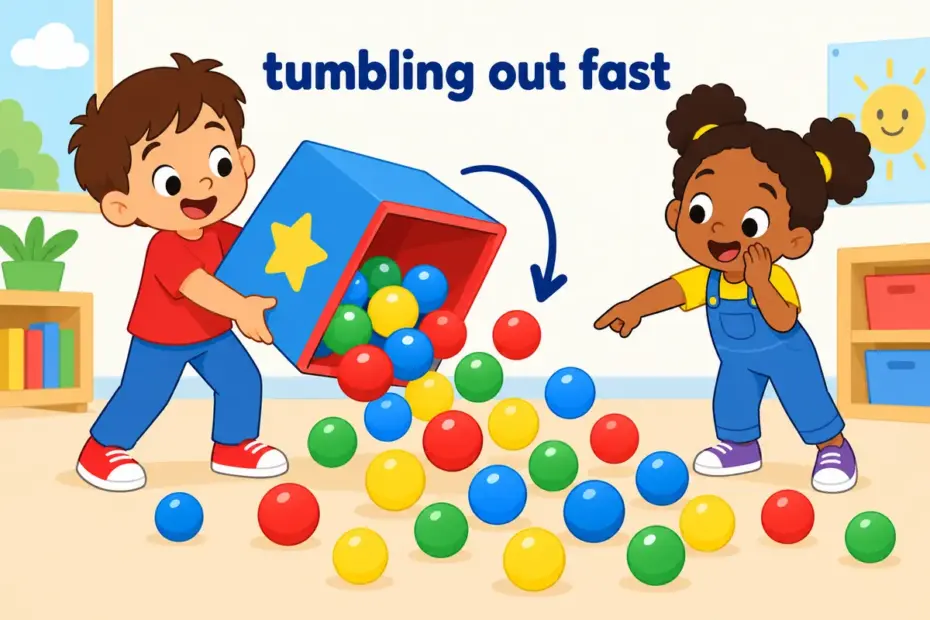
Spill out means to flow or tumble out of a container, room or crowd, usually fast and in quantity. To use spill out in a sentence, put the source before the verb and describe what escapes: “Coins spilled out across the floor.” The verb is intransitive in that pattern, so nothing receives the action.
Spill out at a glance
- Spill out is an intransitive phrasal verb meaning to flow or tumble out of a container, room or crowd.
- Its base verb is spill, and the common forms are spills out, spilled out and spilling out.
- The subject is whatever escapes, while the source follows with of, from, out of or into.
- Spill out suits news, narrative and descriptive writing more than formal reports.
- The commonest error is using spill out where spill over belongs, since the two describe different directions.
What does spill out mean?
Spill out is an intransitive phrasal verb meaning to flow, fall or pour out of a place, especially quickly and in quantity. The Cambridge entry for spill out separates the physical sense, loose items or liquid leaving a container, from the sense of people streaming out of a building. Nothing is acted upon, so the sentence never needs a direct object: the crowd spills out, and the water spills out.
| Sense | Plain meaning | Example sentence |
|---|---|---|
| Physical flow | Liquid or loose items leave a container | The beans spilled out of the torn sack. |
| Crowd movement | People stream out of a place | Fans spilled out of the stadium at the final whistle. |
| Information or emotion | Words or feelings become visible suddenly | The whole story spilled out before she could stop it. |
One limitation is worth stating plainly. Spill out describes movement away from a source, so it cannot replace contain, which says the contents stayed inside. When liquid leaves slowly in a steady line rather than suddenly, pour out is the more precise choice, because spill out keeps the idea of a stumble or an accident.
How do you use spill out in a sentence?
Spill out is inseparable and intransitive. You cannot drop an object between spill and out, and no direct object follows the verb, because the thing that escapes is the subject. A source phrase with of, from or into usually follows. Five patterns cover almost every real sentence.
| Pattern | Example | What it signals |
|---|---|---|
| subject + spill out + of + source | Water spilled out of the cracked jug. | The container is named as the origin. |
| subject + spill out + into + place | Cheering pupils spilled out into the yard. | Direction and destination. |
| subject + spill out + onto + surface | Sand spilled out onto the path. | The surface receiving the contents. |
| subject + spill out + adverb | The coins spilled out everywhere. | Extent, with no destination named. |
| subject + spill out (figurative) | Her worries spilled out in the meeting. | An inner state becomes visible. |
Because the verb takes no object, a phrase such as spill out the water is not standard; the water belongs in the subject slot instead. When a true object is needed, use the base verb spill on its own, as in she spilled the water.
Spill out in a sentence: examples across contexts
Spill out changes register rather than meaning. The nine sentences below keep the same verb while moving from a classroom to a flood report, and each one names the source the contents leave.
| Context | Example sentence | Why this works |
|---|---|---|
| Classroom | Pencil shavings spilled out when the sharpener tipped over. | A concrete object supplies a picture a child can see. |
| Workplace email | Please check the tray before the documents spill out onto the floor. | A polite instruction keeps the intransitive pattern. |
| News report | Commuters spilled out of the stalled train and walked along the track. | Names a group and an official-sounding reason. |
| Narrative writing | Every secret she had kept spilled out in one long sentence. | The figurative sense drives the scene forward. |
| Weather report | Meltwater spilled out of the reservoir and closed the lower road. | Water as subject suits the measured tone. |
| Sports commentary | Substitutes spilled out of the dugout to celebrate the late goal. | Captures sudden movement in a small space. |
| Technical writing | If the seal fails, coolant can spill out around the joint. | States a condition and a consequence. |
| Academic prose | Refugees spilled out of the camp after the curfew was lifted. | Uses a dated event as the source. |
| Conversation | The shopping spilled out of the bag all over the bus. | Everyday vocabulary keeps the sentence alive. |
Only the last sentence would sound natural in speech without adjustment, which is the clearest clue that spill out belongs to description rather than argument.
Spill out vs spill over
Spill out and spill over describe different directions and different results. Spill out moves contents out through an opening, while spill over crosses a rim or boundary, often with unwanted effects. The table keeps the two apart.
| Attribute | spill out | spill over |
|---|---|---|
| Direction | Out through an opening | Across a rim or boundary |
| Typical subject | Loose items, liquid, a crowd | Liquid, numbers, trouble, emotion |
| Needs a container | Usually named with of or from | Usually named as the thing being crossed |
| Figurative use | Secrets and feelings becoming visible | Effects spreading into another area |
| Register | Neutral and descriptive | Neutral, common in analysis |
Verdict: choose spill out when contents leave a container or a crowd pours through a door, and spill over when something crosses a limit and affects what lies beyond it.
Word forms and grammar of spill out
Spill out inflects through its base verb, and the phrasal verb stays open in every tense. The one-word relative gush is useful when the flow is strong and continuous rather than accidental.
| Form | Part of speech | Example |
|---|---|---|
| spill out | phrasal verb, base form | Sparks spill out whenever the grinder bites. |
| spills out | phrasal verb, third person singular | Grain spills out of the hopper during loading. |
| spilled out | phrasal verb, past and past participle | Rainwater spilled out over the gutter. |
| spilling out | phrasal verb, present participle | Shoppers were spilling out of every doorway. |
| spillover | noun, one word, different meaning | The spillover from the rally blocked two streets. |
| spill-over | attributive form, usually hyphenated | They measured the spill-over effect on nearby shops. |
Note the spelling split: the verb stays two words, while the noun spillover closes up and the adjective spill-over takes a hyphen. Writing the verb as one word is a frequent learner error even though it never appears on a sign.
Common mistakes with spill out
- Incorrect:
The milk spilled out the jug.Correct: The milk spilled out of the jug. Rule: Name the source with of, from or out of; the bare noun alone leaves the direction unclear. - Incorrect:
She spilled out the sand on the path.Correct: She spilled the sand on the path. Rule: Spill out is intransitive, so use the base verb spill when a direct object is needed. - Incorrect:
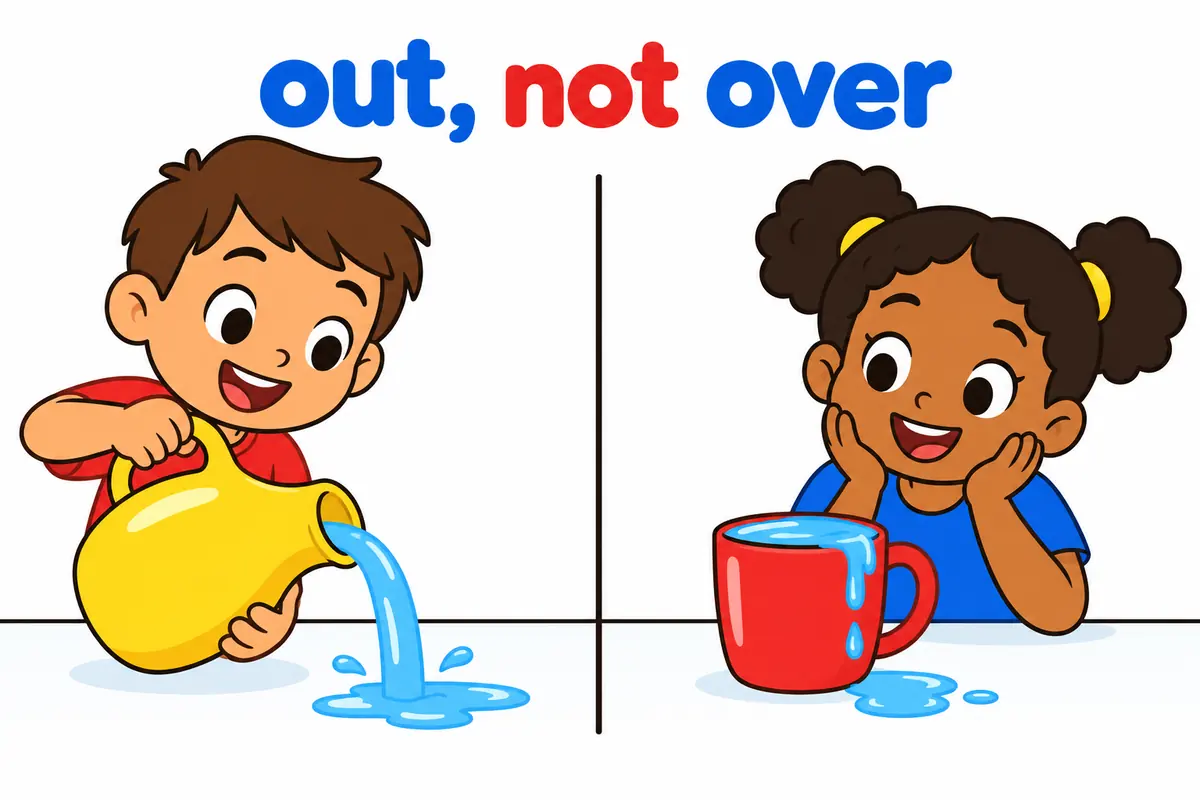
Water spilled out over the rim.Correct: Water spilled over the rim. Rule: Crossing a rim is spill over; spill out needs an opening, not an edge. - Incorrect:
The stadium spilled out of fans.Correct: Fans spilled out of the stadium. Rule: The thing that escapes is the subject, and the place it leaves follows the verb. - Incorrect:
The sack was spilled out by the child.Correct: The beans spilled out when the child dropped the sack. Rule: An intransitive phrasal verb has no passive, so rebuild the sentence around the escaping contents.
Practice using spill out
Work through the six items, then check the reasoning rather than only the answer.
- Fill the gap: Beads ______ of the broken necklace and rolled under the sofa.
- Choose the better word: During the storm the river (spilled over / spilled out) its banks and flooded the lane.
- Correct the error: He spilled out the cereal across the table.
- Build a sentence: use spill out about a bus full of children at the end of a trip.
- Spot the register: which belongs in a safety notice – coolant can spill out around the joint, or the coolant totally spilt everywhere?
- Rewrite without an object: The jar was tipped, so the jam came out. Use spill out instead.
Answers
- spilled out – the beads are the subject and of the broken necklace names the source.
- spilled over – a river crosses its banks, which is a boundary rather than an opening.
- He spilled the cereal across the table – spill out cannot take a direct object, so drop out.
- Model answer: The children spilled out of the coach as soon as the doors opened.
- Coolant can spill out around the joint – a notice avoids totally and keeps the neutral register.
- The jam spilled out of the tipped jar – the contents become the subject with of naming the source.
The bottom line
Use spill out in a sentence when you want to show contents, a crowd or a feeling leaving a source quickly, and keep the escaping thing as the subject. Two details settle most cases: the verb is intransitive, so the source can only follow with of or from, and it stays two words in every tense. Reserve spill over for anything that crosses a rim or limit, and reach for the base verb overflow when the flow is gradual and exceeds capacity.
Frequently asked questions about spill out
Is spill out one word or two?
Spill out is written as two words when it works as a verb, as in the fans spilled out at the final whistle. Only the noun spillover and the adjective spill-over join up. Keeping the verb open is the spelling point learners most often miss when they write quickly.
Does spill out take a direct object?
No. Spill out is intransitive, so the thing that escapes is the subject rather than the object. Write the water spilled out, never the jug spilled out the water. When a direct object is needed, drop out and use the base verb spill, as in she spilled the water.
Can spill out describe people?
Yes. Spill out often describes a crowd leaving a place in large numbers, as in pupils spilled out of the hall at three o’clock. The image matches the one used for liquid leaving a container, so the verb suits any group that surges through an opening into the open air.
Is spill out formal or informal?
Spill out sits in neutral, descriptive writing and in speech. News reports and stories use it freely, while formal reports usually prefer a plainer phrase such as flowed out or was released. The figurative use for secrets and emotions appears far more in conversation than in official documents.
Have you ever struggled to express your emotions or thoughts clearly? When words seem to jumble in your mind and fail to spill out as you’d like, it can be frustrating.
“Spill out” is a phrasal verb that depicts the act of your thoughts or emotions overflowing from your mind or heart, often making it challenging to articulate them effectively. This common expression can be used to describe various situations where something bursts forth uncontrollably.
7 Examples Of Spill Out Used In a Sentence For Kids
- Spill out the water from the glass carefully.
- Be careful not to spill out the marbles on the floor.
- Let’s spill out the colored pencils on the table.
- Don’t spill out the paint on your clothes while painting.
- Can you spill out the blocks into the box?
- It’s important not to spill out the milk from the bottle.
- Remember to spill out the toys back into the toy box after playing.
14 Sentences with Spill Out Examples
- Spill out all your ideas and thoughts during brainstorming sessions.
- Make sure you don’t spill out any important information during group study sessions.
- Spill out your creativity during project presentations.
- Don’t spill out your drink on your notes while studying in the library.
- It’s important to spill out your emotions and seek help when feeling overwhelmed.
- Spill out your opinions and participate actively in class discussions.
- Be careful not to spill out your lunch on your classmates during breaks.
- Spill out your doubts and questions during doubt-clearing sessions with professors.
- Avoid spilling out your personal problems in a public setting.
- Spill out your energy in extracurricular activities and sports.
- It’s okay to spill out your frustrations in a healthy and constructive way.
- Spill out your enthusiasm and passion for your academics during presentations.
- Remember to spill out your belongings strategically in your dorm room to maximize space.
- Spill out your laughter and joy during social gatherings and events.
How To Use Spill Out in Sentences?
To use Spill Out in a sentence, start by identifying the main concept or idea you want to convey. Think of a moment, feeling, or situation that you want to describe. For example, you could use Spill Out to convey a feeling of overwhelming emotions or a sense of chaos.
Next, think of a few keywords that capture the essence of what you want to communicate. These keywords will help you generate a sentence using Spill Out. For instance, you might choose words like “sadness,” “tears,” and “heartache” to describe a moment of grief spilling out.
Once you have your keywords, assemble them into a sentence using the format “Subject + verb + object.” For example, you could write, “Her tears began to spill out uncontrollably, expressing the depth of her sadness.”
Remember that using Spill Out is all about conveying a sense of overflow or abundance. It’s a powerful way to capture intense emotions or vivid imagery in your writing. Experiment with different combinations of words and phrases to find the perfect sentence that conveys the emotion or scene you have in mind.
Practice using Spill Out in various sentences to hone your skills and express yourself more creatively. Soon you will become adept at using this technique to add depth and richness to your writing.
Conclusion
In conclusion, when we say sentences with “spill out,” we are referring to instances where words or emotions are expressed freely and without inhibition. These sentences exemplify the act of sharing thoughts or feelings openly and candidly, often in a way that shows a lack of control or containment. “Spill out” conveys a sense of overflow, where words or emotions cannot be contained and come gushing forth.
Whether used metaphorically to describe someone’s outpouring of emotions or literally to depict a mess made by liquid or objects, sentences with “spill out” highlight the idea of something bursting forth uncontrollably. They illustrate a sense of release, where thoughts or feelings flow freely and abundantly, leaving little room for restraint.


