Spirit away means to carry someone off secretly, quietly and often mysteriously, and spirit away in a sentence is most common in the passive. The verb is transitive and separable, so you say the guards spirited the witness away, or the witness was spirited away before dawn.
Spirit Away at a glance
- Spirit away is a transitive phrasal verb meaning to carry someone off secretly.
- Its forms are spirits away, spirited away and spiriting away.
- It is separable, and a pronoun object must sit in the middle: spirit her away.
- The passive is the most common pattern in news and fiction.
- The mood is secretive and often sinister, not cheerful.
- Spirit here means to carry off, not a ghost or a soul.
What does spirit away mean?
Spirit away is a transitive phrasal verb meaning to carry a person or thing off secretly, quickly and usually without explanation. The Cambridge entry for spirit away records the secret-removal sense, and the word keeps a trace of the magical, as though the person vanished rather than walked.
| Sense | Plain meaning | Example sentence |
|---|---|---|
| Secret removal | Take someone away quietly and without explanation | Guards spirited the witness away before dawn. |
| Magical taking | Carry off as if by magic | In the story a whirlwind spirits the children away. |
| Figurative removal | Take an object away discreetly | Aides spirited the documents away before questions began. |
One limitation is worth stating plainly. Spirit away is not a synonym for rescue or release, and it is not a neutral word for moving someone. It implies secrecy and often suggests that the removal was not agreed, which is why reporters use it when a person disappears from public view.
The verb overlaps with snatch and seize, and the difference is the manner of the taking. Snatch stresses speed and a grab, while seize stresses control. Spirit away stresses quietness and mystery, and it can describe a removal that leaves no struggle at all. Where a removal is legitimate and open, remove is the plain verb.
How do you use spirit away in a sentence?
Spirit away is transitive and separable. A full noun object may follow the particle, but a pronoun must sit between the verb and away, so spirit her away is correct and spirit away her is not. The passive is so common that learners should treat was spirited away as the default pattern. Five patterns cover normal use.
| Pattern | Example | What it signals |
|---|---|---|
| spirit + object + away | The manager spirited the young player away. | The standard split order with a noun. |
| spirit + pronoun + away | They spirited her away at midnight. | A pronoun can only go in the middle. |
| spirit + away + object | Someone spirited away the letters. | The particle first, with a full noun. |
| be spirited away | The painting was spirited away to a private vault. | The passive, the commonest news pattern. |
| spirit + object + away + to/from | He spirited the child away to the coast. | Adds the direction of the removal. |
Because the passive is so frequent, the phrase was spirited away often reads as a complete report on its own, with the agent left out. That missing agent suits the meaning: nobody knows who did it, which is the point of the word. The related abduct keeps a person in the sentence as the subject, while spirit away pushes the person into the background.

Spirit away in a sentence: examples across contexts
Spirit away keeps its secretive tone in every register. The ten sentences below move from a fairy tale to a news report and a museum notice, and each keeps the removal quiet.
| Context | Example sentence | Why this works |
|---|---|---|
| Fairy tale | A friendly giant spirited the children away to a cloud castle. | The magical sense fits an invented world. |
| News report | The witness was spirited away before reporters arrived. | The passive hides the agent, as the story requires. |
| Mystery story | Someone had spirited away the only key overnight. | The past perfect shows a completed secret act. |
| Museum note | The painting was spirited away during the war and never returned. | A vague agent suits an unknown removal. |
| Workplace | The director spirited the new recruit away for a private talk. | A mild, non-threatening use of the phrase. |
| Sports writing | The club spirited its star signing away from a rival’s offer. | The figurative sense, moving a person quietly. |
| Diary | They spirited me away to the seaside for a surprise. | The pronoun sits between verb and particle. |
| Politics | Aides were accused of spiriting documents away from the archive. | The -ing form reports an ongoing accusation. |
| Film review | The heroine is spirited away in the first ten minutes. | The passive sets up the whole plot. |
| Conversation | The babysitter spirited the twins away for ice cream. | A playful, harmless use among friends. |
Only the magical row is literally impossible; every other row uses the phrase to say that a person or thing left a place quietly and without a public trace. Where the removal is forceful and visible, snatch is the blunter verb.
Spirit away vs whisk away
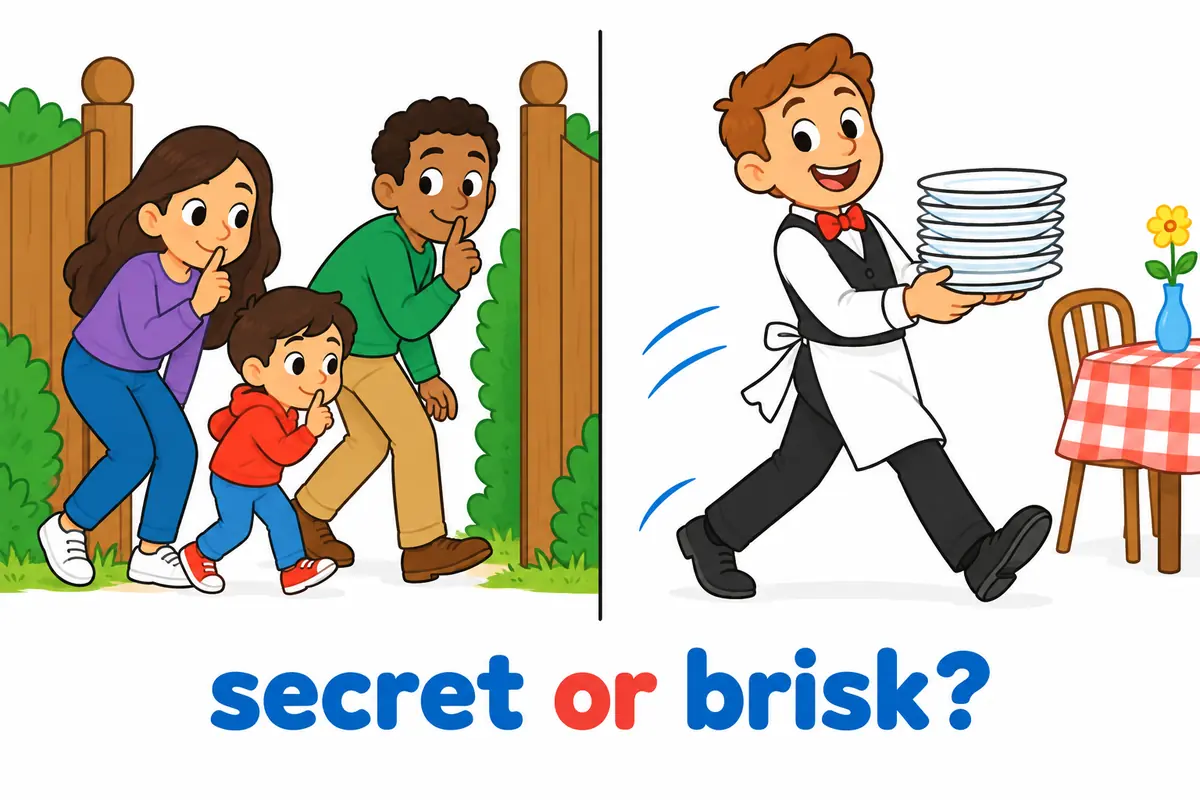
Spirit away and whisk away both describe a quick removal, and they carry very different moods. One is secretive and can be sinister; the other is brisk, cheerful and often used of objects or of helpful haste.
| Attribute | spirit away | whisk away |
|---|---|---|
| Core meaning | Carry off secretly and mysteriously | Move away quickly and smoothly |
| Mood | Secretive, often sinister | Brisk, neutral or cheerful |
| Typical object | A person, usually | A person or a thing |
| Implies consent | Often not | Usually not relevant |
| Register | Journalistic and literary | Everyday and light |
| Example | The witness was spirited away. | She whisked the plates away. |
Verdict: choose spirit away when the removal is quiet and unexplained, and choose whisk away when it is quick, smooth and harmless. A magician spirits a volunteer away; a waiter whisks the crumbs away.
The two also differ in who can be the subject. Whisk away takes almost any busy subject, from a host to a gust of wind, while spirit away usually needs an agent capable of planning, which is why the passive suits it so well.
Word forms and grammar of spirit away
Only the verb spirit inflects, and the particle away never changes, so spirit awayed is not English. The verb also has a second, unrelated use meaning to encourage or to carry a mood, and the noun spirit has its own family of words. The same root appears in spirits and spiritual, though neither shares the meaning of spirit away.
| Form | Part of speech | Example |
|---|---|---|
| spirit away | phrasal verb, base | They plan to spirit him away tonight. |
| spirits away | phrasal verb, third person | The housekeeper spirits the letters away. |
| spirited away | phrasal verb, past and passive | The child was spirited away at noon. |
| spiriting away | phrasal verb, -ing | Spiriting witnesses away is illegal. |
| spirit | verb, other sense | The crowd spirited the team on. |
| spirit awayed | non-standard | Incorrect: They spirit awayed the boxes. |
Common mistakes with spirit away
- Incorrect:
They spirited away her.Correct: They spirited her away. Rule: A pronoun object must sit between spirit and away. - Incorrect:
He spirit awayed the papers.Correct: He spirited the papers away. Rule: Only the verb inflects, and it forms spirited, not awayed. - Incorrect:
The witness spirited away before dawn.Correct: The witness was spirited away before dawn. Rule: Spirit away is transitive, so the person cannot be the subject unless the sentence is passive. - Incorrect:
The team rescued the climbers and spirited them away to safety.Correct: The team rescued the climbers and took them to safety. Rule: Spirit away implies secrecy, so it misdescribes an open rescue. - Incorrect:
The spirits spirited the child away.Correct: The strangers spirited the child away. Rule: Spirit away uses the verb spirit, not the noun for ghosts.
Practice using spirit away
Work through the seven items, then read the reason with each answer.
- Fill the gap: The guards ______ the witness away before the hearing.
- Choose the better word: The host (spirited away / whisked away) the empty cups at the end of the meal.
- Correct the error: Someone spirited away it during the night.
- Build a sentence: use be spirited away about a missing painting.
- Spot the register: which belongs in a news report — the documents were spirited away, or the documents were awayed?
- Reorder the words: away / the child / spirited / to the coast.
- Choose the better word: The lifeguard (spirited / rescued) the swimmer in full view of the beach.
Answers
- spirited — the past tense matches the past-tense narrative.
- whisked away — the cheerful clearing of cups suits the neutral verb.
- Someone spirited it away during the night — the pronoun must sit in the middle.
- Model answer: The painting was spirited away before the auction began.
- The documents were spirited away — awayed is not a word.
- They spirited the child away to the coast — the object comes before the particle.
- rescued — the rescue was open and public, so spirit away does not fit.
The bottom line
Use spirit away in a sentence when someone or something is taken off secretly, quietly and without explanation, and expect the passive in most reports. The two deciding points are that the verb is transitive and separable, so a pronoun belongs in the middle, and that it suggests secrecy rather than force, which separates it from snatch and kidnap. For an open, legitimate removal, rescue or remove is the honest choice.
Frequently asked questions about spirit away
Is it spirit away or spirited away?
Both are correct, in different roles. Spirit away is the base form, as in they will spirit him away tonight. Spirited away is the past and the passive, as in he was spirited away at dawn. The passive is far more common because the agent is usually unknown or deliberately hidden.
Is spirit away always about magic?
No. The magical sense is common in fairy tales, where a whirlwind or a giant carries someone off. In news and everyday writing the phrase simply means a quiet, unexplained removal. The magic survives only as a mood, so even a plain sentence sounds faintly mysterious.
Can spirit away be used for objects?
Yes. Documents, paintings and keys can all be spirited away, which means they were taken quietly and nobody saw who did it. The phrase works for any valuable or revealing object, and it often appears in reports about missing files or disappeared artworks.
Does spirit away imply force?
It implies secrecy rather than force. A person who is spirited away may go without a struggle, which is why the word suits a quiet disappearance rather than a violent grab. For open force, use kidnap or abduct, and keep spirit away for the removal that leaves no witness.