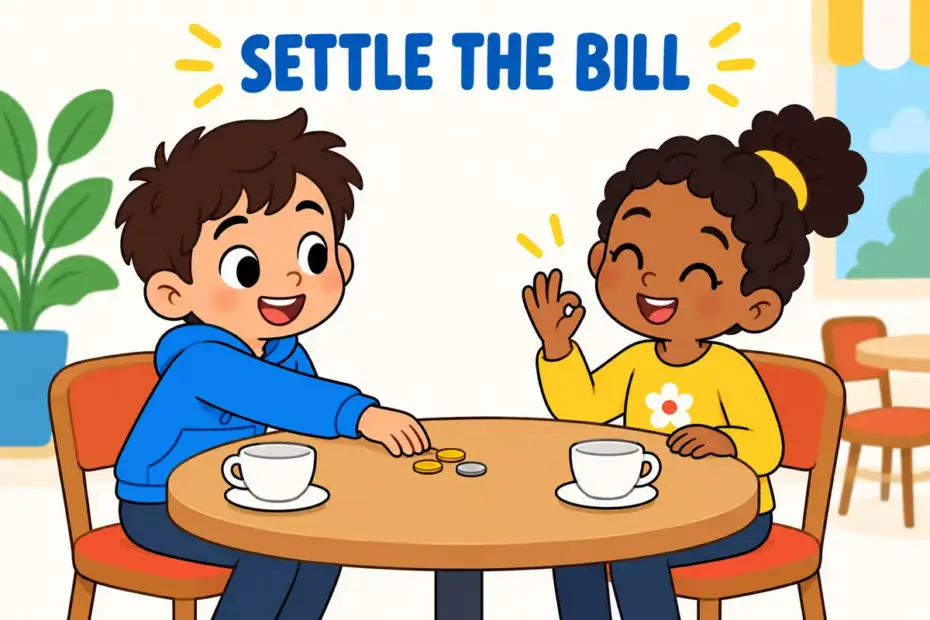
Square up means either to settle a debt or to prepare to face someone, and the preposition tells the two apart. To use square up in a sentence, decide whether money or a confrontation is involved: “I will square up with you on Friday.”
Square up at a glance
- Square up is a phrasal verb with two main senses: settle a debt, and prepare to fight or confront.
- The payment sense takes with, or the object may sit between verb and particle: square it up.
- The confrontation sense is intransitive and takes to or with.
- It is informal to neutral, and the payment sense is common in British speech.
- The commonest error is using square off when no contest is starting.
What does square up mean?
Square up is a phrasal verb meaning to pay what you owe, or to take up a position ready to fight or face something difficult. The Cambridge entry for square up records both the settle-a-debt sense and the confront sense, and the two behave differently in grammar, which the sense table makes clear.
| Sense | Plain meaning | Example sentence |
|---|---|---|
| Settle a debt | Pay what you owe someone | I will square up with the plumber tomorrow. |
| Settle an account | Bring a balance to zero | The clerk squared up the till at closing. |
| Prepare to fight | Take a fighting stance | The two boxers squared up in the centre. |
| Confront a problem | Face something difficult squarely | The council must square up to the housing shortage. |
| Make square | Align the edges of something | She squared up the tiles before gluing them. |
One limitation keeps the two senses apart. Square up never means to prepare in general. A student revising for an exam does not square up for it, and a traveller packing a bag does not square up; the word needs either a debt or an opponent. For paying a shared cost, the near-synonym settle up behaves almost the same way, and where two records must be brought into agreement, reconcile is the formal choice.
How do you use square up in a sentence?
Choose the sense first, then the preposition, because the payment and confrontation senses take different grammar. Five patterns cover most sentences in speech, sport and office writing.
| Pattern | Example | What it signals |
|---|---|---|
| square up with + person | I will square up with you next week. | Intransitive payment sense; with introduces the person. |
| square up + object | The waiter squared up the bill. | Transitive settle sense, bringing a balance to zero. |
| square it or that up | We can square it up later. | Separable form, with the object between verb and particle. |
| square up to + person or problem | She squared up to her critic. | Confrontation sense, facing someone or something. |
| square up (no object) | The players squared up. | Mutual, intransitive sense of preparing to fight. |
Separability is the detail learners miss. The payment sense is separable, so square it up is correct and slightly more casual than square up the account, while the confrontation sense never separates, which makes square up him wrong. The particle also stays with the verb in the passive, as in the account was finally squared up.
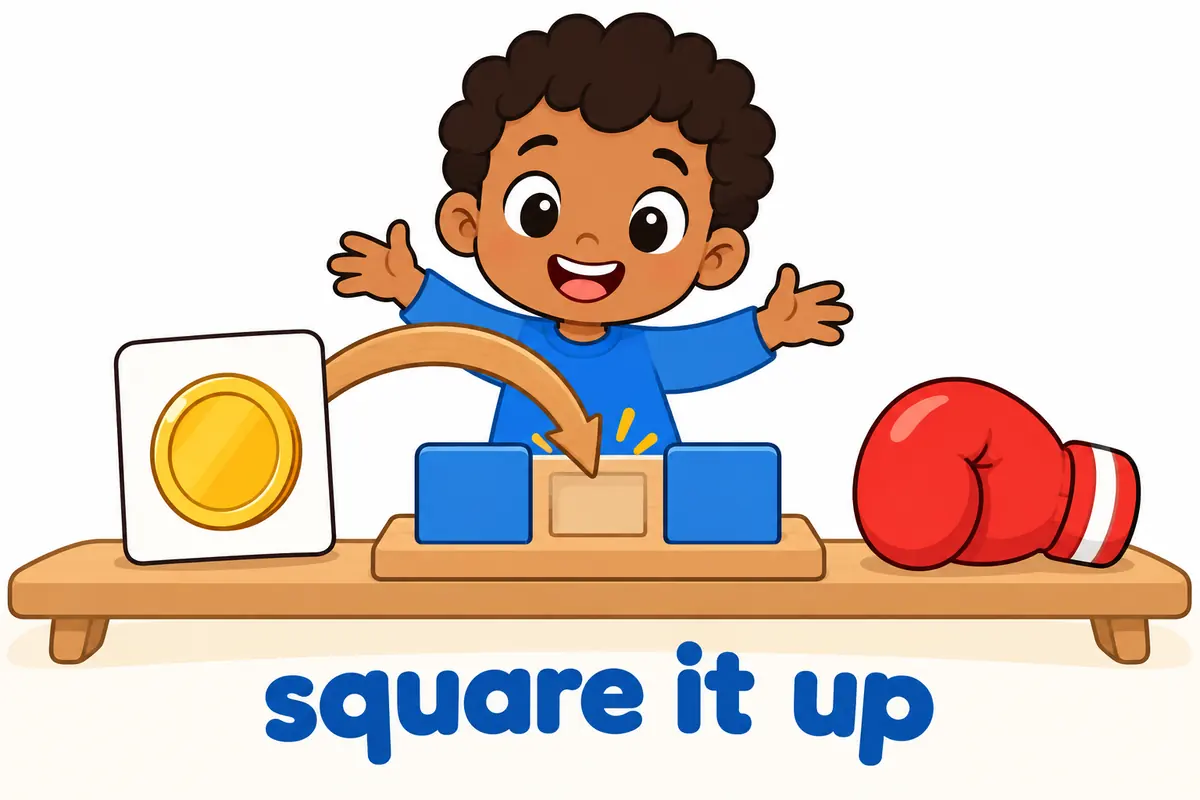
Square up in a sentence: examples across contexts
The sense shifts with the setting, from a cafe bill to a boxing ring, but the word never loses the idea of making things even or facing them directly. Each sentence below shows which sense is at work.
| Context | Example sentence | Why this works |
|---|---|---|
| Classroom | The class squared up their chairs after assembly. | Uses the literal align sense in a school setting. |
| Workplace email | Please square up the travel receipts before the end of the month. | The transitive settle sense in a polite instruction. |
| Cafe conversation | I will square up with you for the coffee next time. | The intransitive payment sense, with with before the person. |
| Sports report | The two finalists squared up at the centre of the court. | The confrontation sense, intransitive and with no object. |
| News report | The mayor squared up to the criticism at the press conference. | Uses square up to for facing a challenge, not a person. |
| Accounting | The clerk squared up the ledger at the close of business. | The transitive settle sense inside a formal record. |
| Everyday problem | It is time to square up to the leaking roof. | Facing a difficult task rather than an opponent. |
| Boxing commentary | They squared up the moment the bell rang. | The prepare-to-fight sense, mutual and intransitive. |
| Reflection | We can square it up once the invoice arrives. | The separable form, object between verb and particle. |
Only two sentences use the confrontation sense, and both take to or stand alone; the rest settle something, which is the sense a learner meets first.
Square up vs square off
Square up and square off are easy to mix because they share the base verb. Square off means to begin a contest or argument, usually between two sides, while square up can also mean to settle a debt. An account is squared up, never squared off, and a fighter confronts an opponent with either phrase depending on whether the contest has begun.
| Attribute | square up | square off |
|---|---|---|
| Core idea | Settle a debt, or face someone | Begin a contest or argument |
| Payment sense | Yes: square up the bill | No use at all |
| Number of parties | One person facing a debt or problem | Two sides meeting each other |
| Usual prepositions | with, to | against, for |
| Register | Informal to neutral | Sporting and journalistic |
| Implies a start | Not necessarily | Yes, the contest is beginning |
Verdict: choose square up to settle money or to brace yourself, and square off when two rivals are about to begin.
Word forms and grammar of square up
Square up inflects on the verb and keeps the particle throughout. The past and participle form squared is the one that also appears as a plain adjective elsewhere.
| Form | Part of speech | Example |
|---|---|---|
| square up | base phrasal verb | I need to square up with the garage. |
| squares up | third person singular | She squares up the accounts every Friday. |
| squared up | past and past participle | They squared up to the challenge. |
| squaring up | present participle | The rivals were squaring up when the bell rang. |
| square it up | separable form | Send the invoice and we will square it up. |
Common mistakes with square up
- Incorrect:
I will square up you tomorrow.Correct: I will square up with you tomorrow. Rule: The payment sense needs with before the person. - Incorrect:
He squared up himself for the interview.Correct: He prepared himself for the interview. Rule: Square up means settle a debt or face a contest, not make general preparations. - Incorrect:
The two teams squared off up before the final.Correct: The two teams squared up before the final. Rule: Use square up or square off, never both particles together. - Incorrect:
Can you square up to the bill?Correct: Can you square up the bill? Rule: Use to only for facing a person or problem, not for settling money. - Incorrect:
She squared up with the difficult decision.Correct: She squared up to the difficult decision. Rule: Facing a challenge takes to, while settling an account takes with.
Practice using square up
Six items cover the two senses, the prepositions and the separable form, and every answer gives the reason, not only the key.
- Fill the gap: I will ______ with you for the tickets after lunch.
- Choose the better word: The two captains (squared up / squared off) as the whistle blew.
- Correct the error: Please square up with the electricity bill today.
- Build a sentence: use square it up about a shared taxi fare.
- Spot the register: which fits a cafe, I will square up with you later, or I shall render the account square?
- Rewrite as a question: The manager squared up the till. Ask whether the till was squared up.
Answers
- square up: the payment sense takes with before the person.
- squared off: two rivals beginning a contest square off, while square up is used for debts or facing someone.
- Please square up the electricity bill today: to marks a person or problem, not a bill, so the direct object is correct.
- Model answer: You paid for the taxi, so I will square it up at the weekend.
- I will square up with you later: the casual separable verb fits speech, not a formal phrase.
- Was the till squared up by the manager? In the passive the particle stays with the verb after squared.
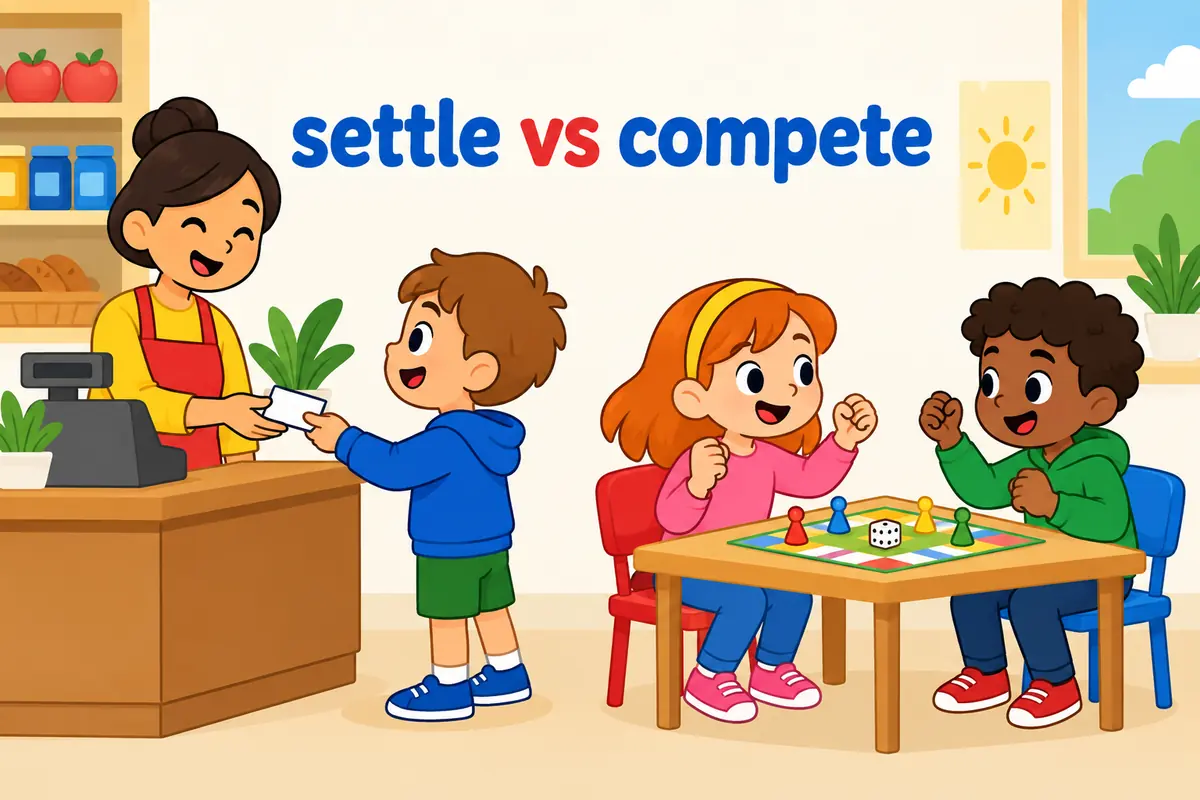
The bottom line
Use square up in a sentence when a debt is being settled or when someone braces to face a person or problem, and let the preposition decide the sense. The two decisions that settle most sentences are whether money is involved, which brings with or a direct object, and whether the action is mutual, which makes the verb intransitive. When two rivals begin a contest, square off is the sharper phrase.
Frequently asked questions about square up
Does square up mean to pay or to fight?
Square up means both, and the grammar separates them. With a person and the preposition with, it means to pay a shared or owed amount, as in I will square up with you. With to, or standing alone, it means to face someone or a problem.
Is square up a separable phrasal verb?
In the payment sense it is separable, so the object may sit between the verb and the particle: square it up. The confrontation sense is intransitive and never separates, so square up him is wrong. Check which sense you mean before you move the object.
What is the difference between square up and square off?
Square up can mean to settle a debt or to brace for something, while square off means to begin a contest or argument between two sides. You square up an account but you never square off an account, so the payment sense is the clearest test.
Is square up used in British English?
The payment sense of square up is common in British and Australian speech, where settle up is its close relative. American speakers understand it but often prefer to settle up or to pay someone back, especially in informal conversation about shared costs.
Do you ever find yourself needing to confront someone or settle a dispute? The term “square up” is a colloquial expression often used in informal language to describe facing someone directly about an issue or challenge. It typically involves addressing a situation head-on and coming to a resolution.
When someone is told to “square up,” it usually implies that they need to confront the situation, take responsibility, or make amends for their actions. This expression is commonly used in casual conversations among friends or in confrontational contexts where individuals need to address an unresolved issue with someone else.
7 Examples Of Square Up Used In a Sentence For Kids
- Let’s square up our books neatly on the table.
- Can you help me square up the blocks in a line?
- We need to square up our crayons before coloring.
- Don’t forget to square up the puzzle pieces after playing.
- Let’s all square up our bags before going home.
- It’s important to square up the toys after playing with them.
- Remember to square up your chairs before leaving the classroom.
14 Sentences with Square Up Examples
- Square up before the match starts to show your opponent that you’re ready.
- Let’s square up our notes and compare to make sure we didn’t miss any important details.
- Square up with your study group so everyone is on the same page before the presentation.
- We should square up on the project deadlines to avoid any last-minute rush.
- It’s important to square up with your roommate about the house rules to avoid conflicts later on.
- Before the exam, make sure to square up your doubts with the professor.
- The best way to resolve any issues is to square up with your friends and discuss openly.
- Remember to square up with your study partners to finalize the topics for the upcoming test.
- Square up with your classmates to form study groups for a better understanding of the subject.
- It’s time to square up with your peers and exchange ideas for the upcoming college event.
- Don’t forget to square up with your roommates about dividing chores to maintain a harmonious living environment.
- Before the debate, it’s essential to square up with your team members to strategize and allocate roles.
- To make the most of the study session, square up with your friends and share your insights on the topic.
- Before submitting the group project, make sure to square up with your teammates to review the final draft.
How To Use Square Up in Sentences?
Square Up is a user-friendly platform that allows individuals and businesses to process payments quickly and securely. To use Square Up, you will first need to create an account by signing up on their website or downloading the mobile app. Once you have registered, you can begin adding your banking information to link your account for processing transactions.
To accept payments with Square Up, you can either key in the card information manually or use their card reader for in-person transactions. The card reader plugs into your mobile device and allows you to swipe cards for easy processing. For online transactions, you can generate invoices or set up a payment link to send to your customers.
Square Up also offers various tools for managing your business, such as tracking sales, creating reports, and analyzing customer data. Additionally, you can set up different payment methods, including contactless payments like Apple Pay and Google Pay.
In summary, Square Up is a versatile platform that simplifies the process of accepting payments both in person and online. By following these simple steps, you can quickly set up your account and start processing transactions efficiently.
Conclusion
In summary, sentences with the phrase “square up” typically refer to settling a debt or disagreement, aligning something correctly, or preparing for a confrontation. This phrase is often used colloquially to mean getting things in order or resolving a situation. Whether it’s ensuring equality in a financial transaction, straightening something out, or confronting an issue head-on, “square up” conveys a sense of finality and resolution.
Overall, “square up” serves as a straightforward and versatile expression in English language, conveying the notion of balancing accounts or situations. By using this phrase, individuals can communicate the idea of addressing an issue directly or ensuring that things are in proper order. Whether in a casual conversation or a more serious context, sentences with “square up” are clear and concise in conveying the intention of resolving or preparing for a particular matter.


