Stand for means to represent or symbolize something, to tolerate behaviour, or to be a candidate in an election. To use stand for in a sentence, keep the phrase together and place the meaning after for: “The letters stand for a long name.” The particle never moves, so the phrase is inseparable.
Stand for at a glance
- Stand for is an inseparable phrasal verb formed from the base verb stand and the particle for.
- It has three main senses: represent or symbolize, tolerate, and be a candidate for office.
- The usual subjects are letters, a symbol, a flag, a person or a policy.
- Stand for appears in reference, formal and political writing as well as everyday speech.
- The commonest error is confusing it with stand by, which means to support or stay ready.
What does stand for mean?
Stand for is a phrasal verb meaning to be a symbol or abbreviation of something, to accept or tolerate something, or to offer oneself as a candidate. The Cambridge entry for stand for lists all three senses, and they rarely overlap. Where the meaning is simply what a word denotes, represent an idea and symbolize hope are close synonyms, while stand for is the phrase that also covers tolerance and candidacy.
| Sense | Plain meaning | Example sentence |
|---|---|---|
| Represent or symbolize | Be a symbol, initial or code of something | The red rose stands for love in many poems. |
| Tolerate | Accept behaviour, usually in a negative sentence | The head teacher will not stand for bullying. |
| Be a candidate | Offer oneself for election to a post | She stood for mayor last spring. |
| Uphold a principle | Support a value or set of beliefs | The paper says it stands for honest reporting. |
The tolerance sense is the one to handle with care. It lives almost always in the negative, as in I will not stand for that, so a positive sentence such as I stand for late arrivals sounds baffling. The word means tolerate, not enjoy, and the negation is what signals it.
How do you use stand for in a sentence?
The phrase is inseparable, so the object always follows for and the meaning depends on the subject. Letters and symbols represent; a person tolerates or runs for office. The five patterns below keep the senses apart.
| Pattern | Example | What it signals |
|---|---|---|
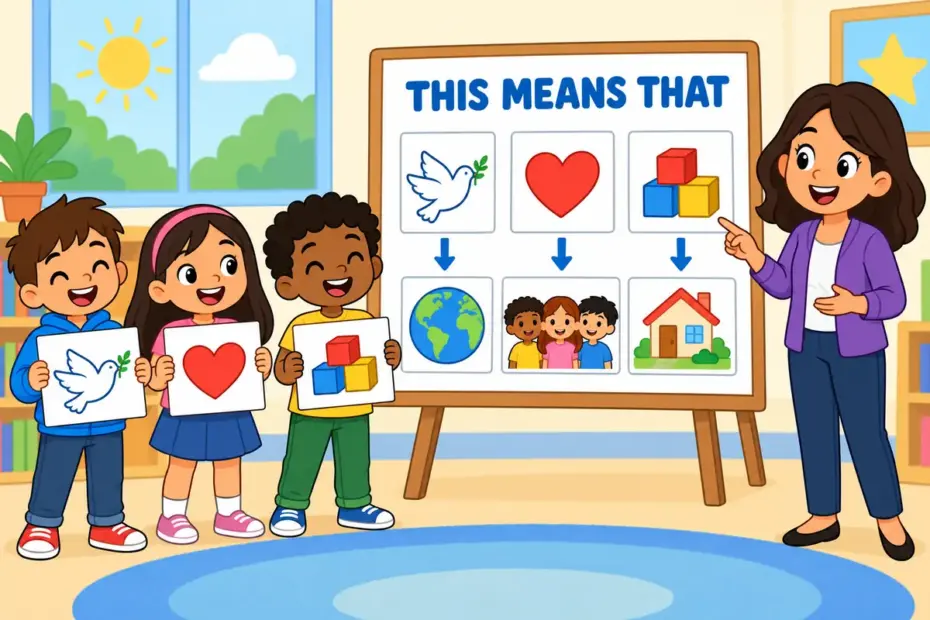
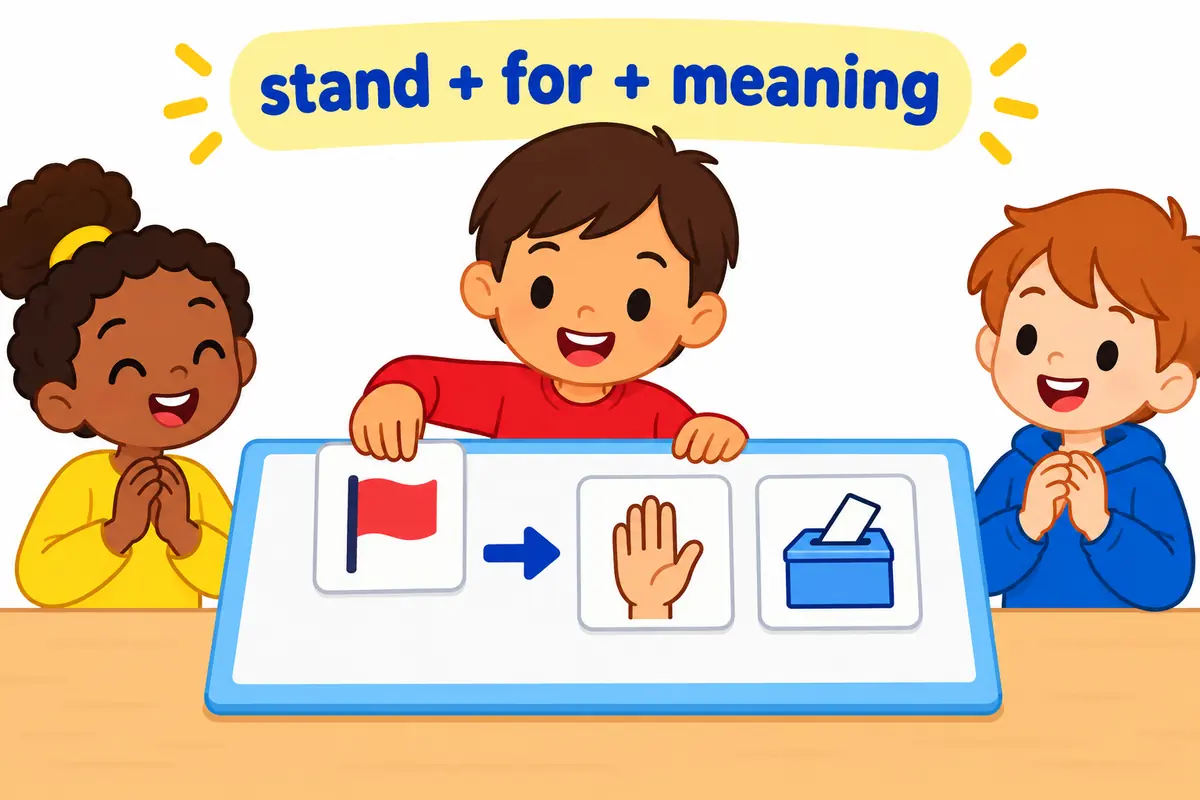
| symbol + stand for + meaning | The dove stands for peace. | Representation, the commonest pattern. |
| not + stand for + noun | We do not stand for rudeness. | Tolerance, and it needs the negative. |
| person + stand for + office | He is standing for the council. | Candidacy in an election. |
| group + stand for + principle | The union stands for fair pay. | A shared value the group defends. |
| what does + X + stand for? | What does this code stand for? | The question form that asks for a meaning. |
In logic, computing and shorthand, denote a value is the technical counterpart, and it stays neutral where stand for can sound political or emotional.
Stand for in a sentence: examples across contexts
The ten sentences below move the phrase from a classroom alphabet to an election night, and each one shows which sense is in play.
| Context | Example sentence | Why this works |
|---|---|---|
| Classroom | The letter S stands for the beginning of the word summer. | Plain representation with a clear referent. |
| Reference writing | In the chart, the blue square stands for rainfall. | A key defines the symbol, which is standard practice. |
| Poetry | The empty chair stands for everyone who did not return. | Symbolic sense used in literary reading. |
| Workplace talk | The manager will not stand for missed deadlines. | The negative unlocks the tolerate sense. |
| Parent to child | I will not stand for that language at the table. | Spoken, firm and clearly negative. |
| News report | She is standing for the city council in May. | Candidacy reported in the present progressive. |
| Manifesto | The party stands for lower taxes and fewer rules. | A group declares the values it defends. |
| Sports desk | Three players stood for the players’ union election. | Candidacy inside a small organisation. |
| Academic prose | In this model, one unit stands for a thousand tonnes. | A defined scale rather than a symbol of emotion. |
| Conversation | What do those initials stand for? | The spoken question form asking for a meaning. |
Six of the ten sentences use the represent sense, which is why a reader who only knows one meaning still reads most of the page correctly. The tolerance sense appears only in negatives, and candidacy only with a post or an election named.
Stand for vs stand by
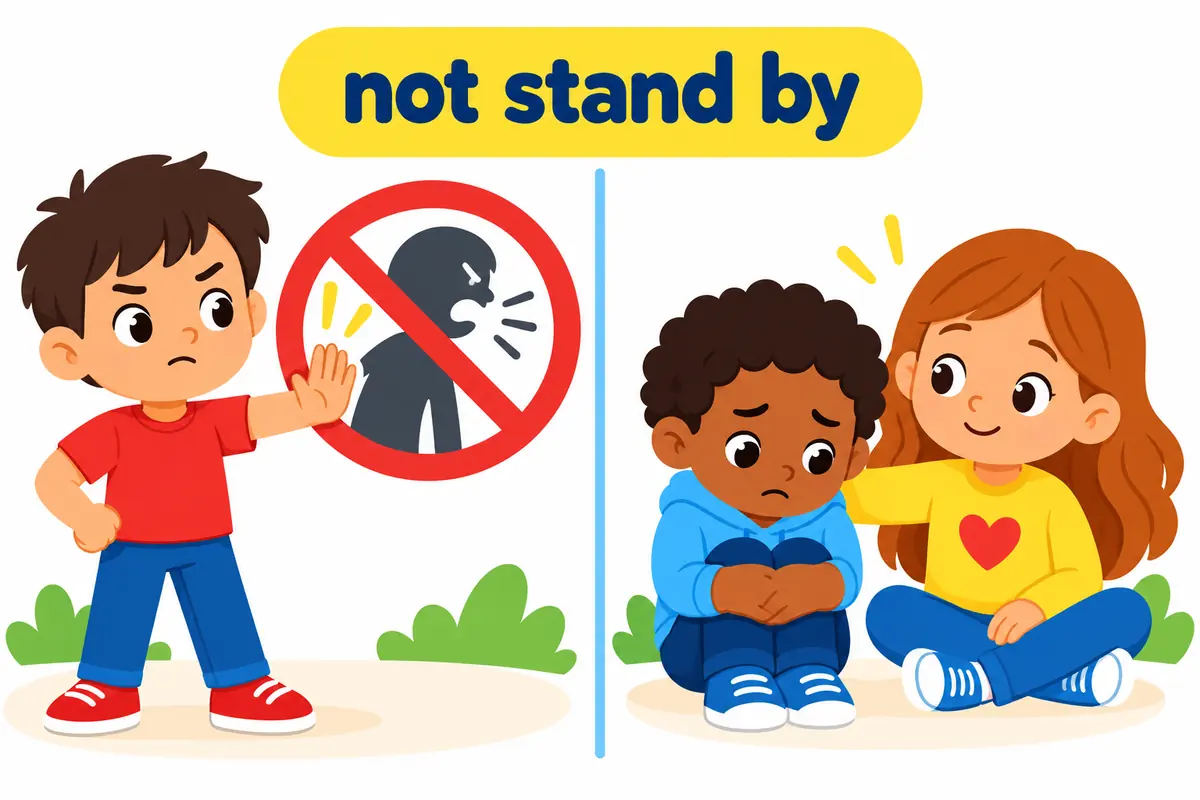
The two are confused because both can describe loyalty, but the particle changes the job. Stand for represents or tolerates; stand by supports somebody or stays ready.
| Attribute | stand for | stand by |
|---|---|---|
| Core meaning | Represent, tolerate or run for office | Support a person or remain ready |
| Typical object | A symbol, a value or behaviour | A friend, a promise or a decision |
| Usual subject | A symbol, a group or a candidate | A person or a loyal colleague |
| Negative form | Common, for tolerance | Rare |
| Register | Reference, formal and political writing | Neutral to formal |
Verdict: use stand for to name what something means or whether you will accept it, and stand by to show loyalty or readiness. Where the intended sense is to argue against something, oppose a plan is the direct verb, and it needs no particle to make the meaning clear.
Stand for in elections and unions
The candidacy sense is a fixed part of political and workplace English, and it works with a post, a seat or a committee rather than with a policy.
| Expression | Example | What it signals |
|---|---|---|
| stand for election | She will stand for election in the autumn. | The formal campaign announcement. |
| stand for a seat | He is standing for a seat on the board. | A named place to be won. |
| stand for the council | Two neighbours stood for the council. | Runs for a body, not a policy. |
| stand for re-election | The mayor stood for re-election last year. | A bid for a further term. |
| stand for the leadership | Three ministers stood for the leadership. | Contests a top internal post. |
One trap is the word order: a candidate stands for a post, but a value stands for nothing; a party may stand for free speech because it supports the value, not because it is a candidate. Keep the post in one sense and the symbol in the other.
Word forms and grammar of stand for
Stand is irregular, so its past tense is stood, not standed. The phrase stays inseparable in every form, and the table also shows the related phrase that often gets mixed in.
| Form | Part of speech | Example |
|---|---|---|
| stand for | base phrase | These symbols stand for three ideas. |
| stands for | third person singular | The letter stands for a name. |
| stood for | past and past participle | The dove stood for peace on the old flag. |
| standing for | present participle | She is standing for the council. |
| stand in | different phrase | He will stand in for a colleague who is ill. |
Keep the tolerance phrase apart from tolerate noise in formal writing: tolerate sounds calmer, while the negative stand for carries a firm refusal.
Common mistakes with stand for
- Incorrect:
I stand for late work.Correct: I will not stand for late work. Rule: The tolerate sense lives in the negative; without not, the sentence means something else. - Incorrect:
She stands by mayor in the next election.Correct: She stands for mayor in the next election. Rule: Candidacy uses stand for, not stand by. - Incorrect:
The rose stands with love.Correct: The rose stands for love. Rule: Representation takes the particle for, never with. - Incorrect:
He standed for the council last year.Correct: He stood for the council last year. Rule: Stand is irregular; the past tense is stood. - Incorrect:
The letters for a name stand.Correct: The letters stand for a name. Rule: The phrase is inseparable, so for stays attached to stand.
Practice using stand for
Work through the seven items, then read the answers for the reason as well as the word.
- Fill the gap: In this diagram, the circle ______ a full year.
- Choose the better word: The coach will not (stand for / stand by) lateness at training.
- Correct the error: He standed for the school board in September.
- Build a sentence: use stand for about an election to a club committee.
- Spot the register: which belongs in a party manifesto — The party stands for fair wages, or The party is into fair wages?
- Rewrite with a negative: I tolerate cheating in no way at all.
- Choose the better word: When the storm hit, the neighbours (stood for / stood by) the flooded family.
Answers
- stands for — the circle is a symbol representing a year, so for is fixed after the verb.
- stand for — the tolerate sense fits the negative and the firm refusal.
- He stood for the school board in September — stand is irregular, so the past is stood.
- Model answer: Two parents will stand for the committee at the summer meeting.
- The party stands for fair wages — a manifesto uses the formal phrase, not the loose is into.
- I will not stand for cheating — the negative turns tolerate into a clear refusal.
- stood by — loyalty and support take stand by, not stand for.
The bottom line
Use stand for in a sentence to say what something represents, to refuse to tolerate behaviour in a negative sentence, or to describe a candidate running for office. Two details decide the tricky ones: the phrase is inseparable, so for never leaves the verb, and the tolerate sense almost always needs not. Where the meaning is what a word simply means, mean a great deal is the plainer verb and it needs no particle at all.
Frequently asked questions about stand for
Is stand for one word or two?
Stand for is two words, because for is a particle that belongs with the verb. It never becomes a single word, and the pair stays together in every sentence. The object always follows the whole phrase rather than slipping between the parts.
Why do people say I will not stand for it?
That sentence uses the tolerate sense, and the negative is what makes it work. I will not stand for it means I will not accept it. Without the not, stand for means represent, so the negative is doing essential work rather than adding emphasis.
Can stand for mean to be a candidate?
Yes. In political and workplace English, stand for means to offer oneself for election to a post, as in she stood for mayor. The object is a job or a seat, not a policy, which keeps this sense separate from representation and tolerance.
What is the difference between stand for and stand up for?
Stand for means represent or tolerate, while stand up for means to defend a person or cause against opposition. A symbol stands for a value, but a friend stands up for a colleague under attack. The extra word up adds the idea of active defence.