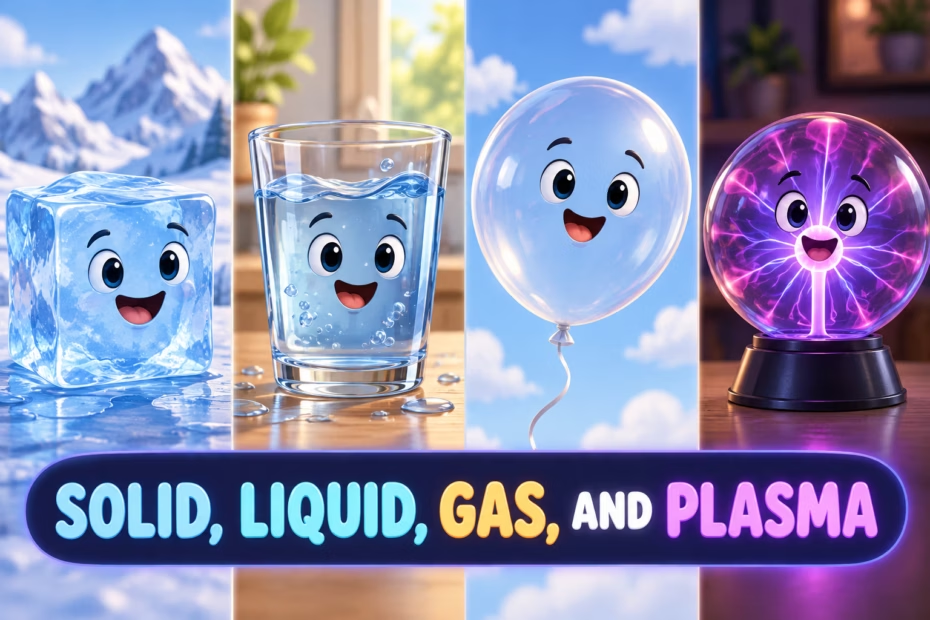
The phrase state of matter names the physical form of a material, such as solid, liquid, or gas. It is an ordinary noun phrase, so write it in lowercase in a sentence unless it begins the sentence or appears in a title. For example: “Ice is a solid state of matter.”

How do you use “state of matter” in a sentence?
Use a state of matter when naming one form, and states of matter when comparing more than one. Then give a clear example: “Ice is water in the solid state; liquid water flows, and water vapor is a gas.” In ordinary writing, the phrase does not need title case: write “the state of matter,” not “the State Of Matter,” unless those words begin a sentence or belong in a heading.
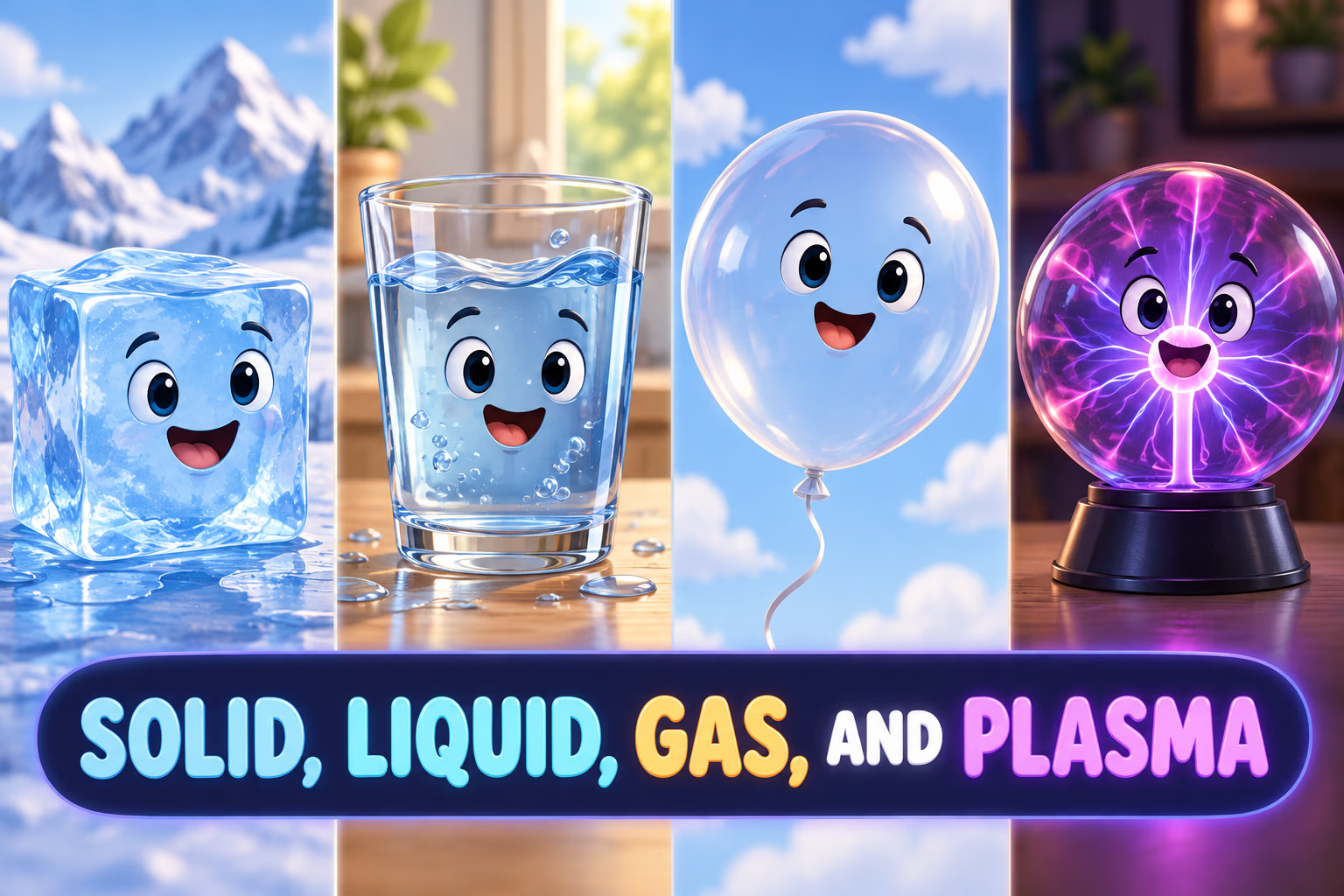
The three states encountered most often in basic science are solid, liquid, and gas. A solid keeps a definite shape and volume; a liquid keeps a volume but takes the shape of its container; a gas spreads to fill its container. These are broad descriptions of the common states, not a claim that all matter belongs to only three categories.

Plasma is another commonly discussed state: it contains electrically charged particles and is found in examples such as lightning and stars. Scientists also study less familiar states under special conditions. NASA describes Bose–Einstein condensates formed at temperatures near absolute zero, so avoid presenting solid, liquid, and gas as the only possible states.

Is visible steam the gas state of water?
Water vapor is water in the gas state and is invisible. The white plume people often call steam is visible because water vapor has cooled and condensed into tiny liquid droplets. A careful example is “Invisible water vapor condensed into a visible mist,” rather than saying the white mist itself is water vapor. Likewise, many familiar gases are invisible, but invisibility is not the definition of a gas.

A substance can change state when conditions such as temperature or pressure change. For example, ice melts into liquid water as it warms; the exact conditions for a phase change depend on pressure as well as temperature. In a sentence, name the substance and the change so the example is easy to understand.
Sources: OpenStax Chemistry 2e, “Phases and Classification of Matter”; NASA Science, “The Fifth State of Matter”; U.S. Geological Survey, “Colorful plumes—can we see volcanic gases?”.
Source note: The original examples below are preserved as published. Its capitalization instructions are not standard sentence case: write state of matter in lowercase except at the start of a sentence or in a title. Its “gas is invisible” and visible “steam” examples are simplified: water vapor is invisible gas, while the familiar white plume is condensed liquid droplets. Solid, liquid, and gas are common introductory states, not an exhaustive list.
Have you ever wondered about the different states of matter? In the field of science, a state of matter refers to one of the distinct forms that different phases of matter can take on based on their physical properties.
These states of matter include solids, liquids, and gases, each characterized by unique structural and behavioral attributes. Understanding the properties and behaviors of each state of matter is fundamental in grasping various scientific concepts and phenomena.
7 Examples Of State Of Matter Used In a Sentence For Kids
- Solid is a state of matter that is hard and keeps its shape.
- Liquid is a state of matter that can flow and takes the shape of its container.
- Gas is a state of matter that is invisible and can fill any space.
- Ice is an example of a solid state of matter.
- Water is an example of a liquid state of matter.
- Steam is an example of a gas state of matter.
- We can see different states of matter around us every day.
14 Sentences with State Of Matter Examples
- Solid state of matter is characterized by particles that are closely packed together and have a fixed shape.
- Chemistry students often study the properties and behaviors of different states of matter in their labs.
- Understanding the different properties of state of matter is essential for students pursuing a degree in physics.
- The transition from one state of matter to another can be influenced by factors such as temperature and pressure.
- When discussing the concept of state of matter, it is important to consider how the particles are arranged and interact with each other.
- Liquid state of matter is characterized by particles that are close together but can move past one another.
- College students may conduct experiments to observe changes in state of matter under various conditions.
- The physics department offers courses that delve into the complexities of state of matter and its impact on the world around us.
- Gaseous state of matter is unique in that its particles are spaced far apart and move freely.
- Students who excel in understanding the behavior of state of matter may consider pursuing a career in research or academia.
- The study of state of matter is crucial for applications in fields such as engineering and materials science.
- By manipulating temperature and pressure, it is possible to alter the state of matter of a substance.
- Some students find the study of state of matter challenging but rewarding as they deepen their understanding of the physical world.
- The examination of solid, liquid, and gaseous states of matter allows students to explore the fundamental principles of chemistry and physics.
How To Use State Of Matter in Sentences?
State Of Matter is a phrase used to describe the physical form that a substance is in, whether it is a solid, liquid, or gas. When using this term in a sentence, it is important to capitalize each word in the phrase.
For example: “Water can exist in three different State Of Matter: solid ice, liquid water, or gaseous steam.”
To correctly use State Of Matter in a sentence, first identify the substance you are referring to and the physical form it is currently in. Then, use the phrase as a noun in the sentence, typically at the beginning for clarity. You can provide examples such as “The State Of Matter of carbon dioxide depends on the temperature and pressure.”
Avoid using the phrase in a way that might cause confusion, such as “The state of matter of ice is solid,” as the phrase should always be capitalized.
By following these guidelines, you can effectively communicate the physical form of a substance using the term State Of Matter in your sentences. With practice, you will become more comfortable incorporating this phrase into your writing to accurately describe different physical states of substances.
Conclusion
In conclusion, the concept of state of matter refers to the physical forms that substances can exist in, which include solid, liquid, and gas. Understanding the states of matter is crucial in explaining the behaviors and properties of different materials. For example, ice is a solid state of water, while steam is the gaseous state of water. Additionally, when a substance undergoes a phase change, such as melting or evaporation, it transitions from one state of matter to another.
By recognizing the characteristics and transitions between states of matter, scientists are able to explain various phenomena, from the boiling of water to the formation of clouds in the sky. This fundamental concept plays a vital role in fields such as chemistry, physics, and meteorology, providing a framework for understanding the physical world around us.


