Stick on means to attach something to a surface using glue or another adhesive, and the phrase is separable, so the object can sit between the two parts. You use stick on in a sentence by naming the thing and the surface: “Stick a label on the box.” The verb is also common in the fixed adjective stick-on.
Stick on at a glance
- Stick on is a separable phrasal verb; its forms are sticks on, stuck on and sticking on.
- Its core sense is to fix something to a surface with an adhesive.
- A second, informal sense, be stuck on, means to be very fond of someone or something.
- The hyphenated form stick-on works as an adjective or a noun, as in a stick-on badge.
- The commonest error is confusing stick on with stick to, which means to keep firmly to something.
What does stick on mean?
Stick on is a phrasal verb meaning to attach an object to a surface with glue, tape or another adhesive. The Cambridge entry for stick on records the attaching sense, and the word carries the further idea that the join stays on the surface rather than passing through it. Where a permanent mechanical join is meant, fasten and attach are the precise verbs, because they do not assume glue.
| Sense | Plain meaning | Example sentence |
|---|---|---|
| Attach with adhesive | Fix something onto a surface | She stuck the poster on the window. |
| Remain attached | Keep sticking without help | The patch stuck on through the whole wash. |
| Be very fond of | Like someone or something a lot, informally | They are stuck on their new puppy. |
| stick-on, compound | A thing that sticks on by itself | He wore a stick-on name badge. |
One limitation is worth stating plainly. Stick on suits labels, stickers, patches, posters and stamps, and it sounds wrong for structural work such as joining two planks, where the join is not on a surface. It also keeps a light, practical tone, so a formal document about a permanent bond prefers bond or adhere.
How do you use stick on in a sentence?
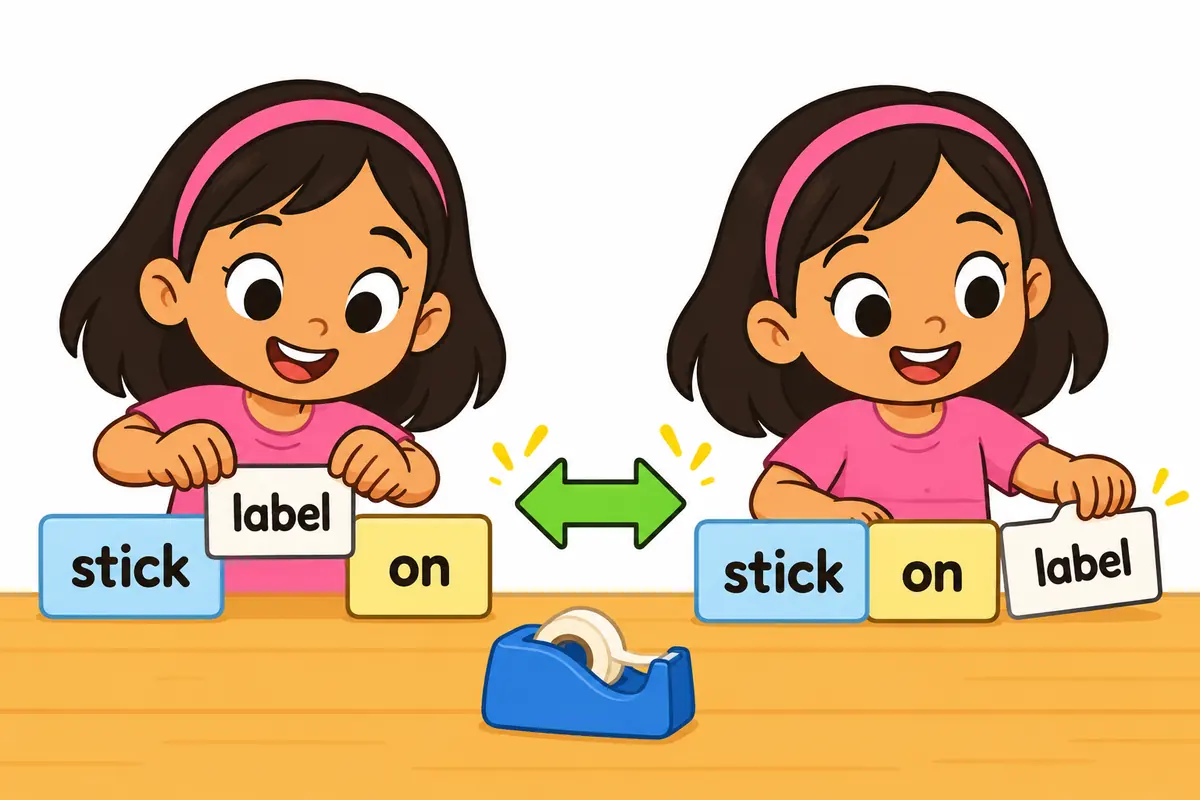
Stick on is transitive and separable, so a noun object may sit either side of the particle. A pronoun object must sit between the two parts, giving stick it on rather than stick on it.
| Pattern | Example | What it signals |
|---|---|---|
| stick + object + on + surface | He stuck the poster on the wall. | The full separable pattern with a named surface. |
| stick on + object | Stick on a stamp before posting. | The particle first, with the object after it. |
| subject + stick on | The decal stuck on in the rain. | Intransitive use, meaning it remained attached. |
| be stuck on + person or thing | She is stuck on that old song. | The informal fondness sense, not adhesion. |
| stick-on + noun | A stick-on label peeled away. | The hyphenated compound adjective in attributive position. |
The choice between the two orders is a matter of rhythm and emphasis. When the surface is already clear from context, the object follows on naturally; when the surface itself is the point, it comes last, after on.
The glue itself need not be strong: a small dab holds a stamp for years.
The two orders are not equally common in every setting. Instructions usually lead with the verb and place the surface last, because the reader already knows the object, while descriptions freely put the object first when the surface is the news. A quick check is to read the sentence aloud: the version that keeps the new information last is the one writers prefer.
Stick on in a sentence: examples across contexts
The phrase lives wherever paper meets a surface, from a classroom to a post room, and its informal fondness sense belongs to conversation. These ten sentences show the range.
| Context | Example sentence | Why this works |
|---|---|---|
| Classroom | Stick the new words on the word wall. | A clear instruction with object and surface both stated. |
| Post room | She stuck on three stamps before the collection. | Particle-first order when the object is short. |
| Home | He stuck the photo on the fridge door. | The everyday sense with a familiar surface. |
| Manufacturing | Workers stick on the safety labels by hand. | Adapts the phrase to a production routine. |
| Scrapbooking | I stick on the tickets once the ink has dried. | The first person keeps a hobby tone. |
| Informal speech | They are completely stuck on their new puppy. | The fondness sense, marked by the adverb. |
| Product writing | A stick-on mirror makes the locker easy to check. | The hyphenated adjective before a noun. |
| Instructional | Stick the patch on the inside of the jacket. | Names the precise surface and position. |
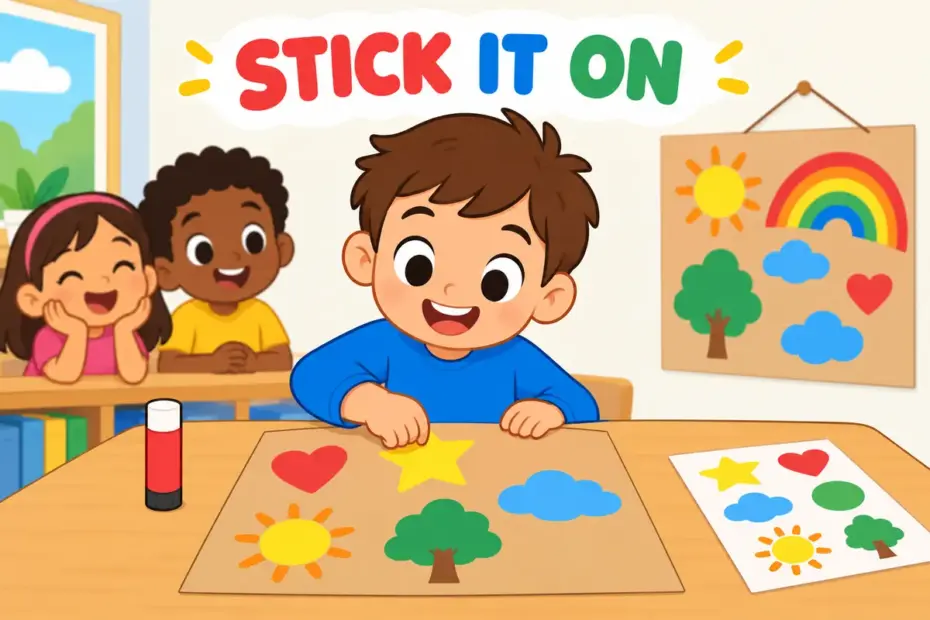
| Children’s writing | We stuck on leaves to make a hedgehog picture. | A craft activity with a concrete object. |
| Everyday writing | The glue was so old nothing stuck on at all. | The intransitive sense of remaining attached. |
| Fabric craft | We stuck the badge on the blazer with fabric glue. | Names the surface and the adhesive for a school uniform. |
| Labelling | Stick on the barcode before the parcel is sealed. | Particle-first order for a routine dispatch step. |
The intransitive row marks a real difference: with no object the sentence reports whether the adhesive held, rather than instructing anyone to attach anything.
Stick on vs stick to and attach
Stick on is confused with three near neighbours, and the first shares both the base verb and the particle family. adhere is the formal word for a bond that holds, while attach simply means to join without saying how.
| Attribute | stick on | stick to | attach |
|---|---|---|---|
| Core job | Fix something onto a surface | Keep firmly to a rule or plan | Join one thing to another |
| Needs a surface | Yes, physical | No, often abstract | Often yes, but any method |
| Implies adhesive | Yes | No | No |
| Typical object | A label, stamp, poster, patch | A promise, a diet, a plan | A file, a lead, a part |
| Register | Neutral and practical | Neutral, often figurative | Neutral to formal |
Verdict: choose stick on for anything pressed onto a surface with glue, stick to for holding to a rule or route, and attach when the method of joining does not matter.
Word forms and grammar of stick on
Stick on inflects through the irregular verb stick, and the past participle doubles as part of a separate idiom. The table also lists the spelling change that turns the phrase into a single describing word.
| Form | Part of speech | Example |
|---|---|---|
| stick on | phrasal verb, base | We stick on the labels by hand. |
| sticks on | verb, third person singular | She sticks on a new stamp each day. |
| stuck on | verb, past and past participle | He stuck on the final sticker. |
| sticking on | verb, present participle | They are sticking on the last posters now. |
| stuck on | idiom, informal | He is stuck on that band. |
| stick-on | adjective and noun | A stick-on badge, or a pack of stick-ons. |
The hyphen is the tell: used before a noun, or as a noun itself, the phrase is written stick-on. Used as a verb, it stays two words, which is why nothing detach-shaped can be called a stickon.
Common mistakes with stick on
- Incorrect:
Stick on it the envelope.Correct: Stick it on the envelope. Rule: A pronoun object must sit between the verb and the particle. - Incorrect:
She stuck a sticker.Correct: She stuck a sticker on her case. Rule: The verb is transitive here, and the surface normally follows on. - Incorrect:
Please stick the poster to the wall with glue.Correct: Please stick the poster on the wall with glue. Rule: Stick on names the adhesive surface sense, which is stronger than stick to here. - Incorrect:
He stuckon the label.Correct: He stuck on the label. Rule: As a verb the phrase is always two separate words. - Incorrect:
They glued the two beams on.Correct: They glued the two beams together. Rule: Stick on is for a surface, not for joining two pieces on edge.
Practice using stick on
Work through the six items, then read the reason beside each answer.
- Fill the gap: ______ the finished drawing on the board.
- Choose the better phrase: We must (stick on / stick to) the plan until Friday.
- Correct the error: She stuck on it her notebook.
- Build a sentence: use stick-on as an adjective about a name badge.
- Spot the register: which suits an instruction sheet — stick the label on the jar, or affix the label?
- Rewrite with a pronoun: Attach the stamp on the envelope. Use stick on and a pronoun.
Answers
- Stick — the base verb opens the separable instruction, with the object following.
- stick to — holding to a plan is stick to, while stick on needs a surface.
- She stuck it on her notebook — the pronoun goes between verb and particle.
- Model answer: Every visitor wore a stick-on name badge.
- Stick the label on the jar — the plain verb suits a friendly instruction sheet.
- Stick it on the envelope — the pronoun must sit before the particle.
The bottom line
Use stick on in a sentence for pressing a label, stamp or patch onto a surface with glue, and keep the object either before or after on, since the phrase is separable. The two details that decide most sentences are these: a pronoun object always sits between stick and on, and stick to is a different phrase meaning to hold firmly to a rule or plan. Where the join is permanent rather than surface-level, apply or attach is the more exact verb.
A useful test is to ask what the phrase holds. If the answer is paper, a surface or a fabric, stick on is right; if the answer is a rule, a route or a belief, the sentence needs stick to. The different prepositions signal the different worlds even before the sentence is finished.
Frequently asked questions about stick on
What does stick on mean?
Stick on means to attach something to a surface with glue, tape or another adhesive, as in stick the label on the box. A second, informal sense, be stuck on, means to be very fond of someone or something. The intransitive use simply reports that something remained attached, as in the patch stuck on all day.
Is stick on separable?
Yes. Stick on is a separable phrasal verb, so a noun object can go either side of the particle: stick the label on or stick on the label. A pronoun object must go in the middle, giving stick it on and never stick on it. That movement is the clearest test of a true phrasal verb.
What is the difference between stick on and stick to?
Stick on is physical and needs a surface, as in stick the stamp on the envelope. Stick to usually points at a rule, route or habit that somebody keeps, as in stick to the plan. The shared base verb is the trap, because the particle changes the meaning from attaching a thing to holding to an idea.
Is stick-on one word or two?
As a verb it is always two words, as in stick on a label. As an adjective before a noun, or as a noun itself, it takes a hyphen and becomes stick-on, as in a stick-on badge or a pack of stick-ons. The hyphen marks the shift from action to thing.