
Stipulate is a transitive verb meaning to demand or state something as a condition of an agreement. To use stipulate in a sentence, give the condition a clear clause: “The lease stipulates that tenants pay for repairs.” The verb belongs to contracts and formal rules, not to casual requests.
Stipulate at a glance
- Stipulate is a verb; its forms are stipulates, stipulated, stipulating and stipulation.
- The usual pattern is stipulate that plus a full clause, or stipulate a noun such as a condition.
- It appears in contracts, rules, tenders and formal agreements.
- Common collocations are stipulate that, as stipulated, stipulate a condition and the contract stipulates.
- The commonest error is dropping that and leaving a bare clause after the verb.
What does stipulate mean?
Stipulate is a transitive verb meaning to require or specify something as a condition that must be met. The Cambridge entry for stipulate records both the demand sense and the state-clearly sense, and in practice they meet: a condition demanded is a condition stated.
| Sense | Plain meaning | Example sentence |
|---|---|---|
| Demand as a condition | Make something a requirement of a deal | The buyer stipulated a full survey. |
| State clearly | Set a term down precisely | The rules stipulate a thirty-day notice period. |
| Specify in an agreement | Name an exact term in writing | The grant stipulates how the funds may be spent. |
One limitation is worth stating plainly. Stipulate is not a fancy word for say or mention. It commits somebody to a condition, so it is wrong in a sentence that merely reports a fact. If nothing is being required, use state or note instead.
How do you use stipulate in a sentence?
Put the person or document as the subject, then the condition it fixes. The clause pattern needs that before the verb, while the noun pattern puts a condition, a term or a figure straight after stipulate. Where the meaning is only to state precisely, specify is the plainer verb.
| Pattern | Example | What it signals |
|---|---|---|
| stipulate that + clause | The contract stipulates that payment is due in May. | The fullest and most common pattern. |
| stipulate + noun | Both sides stipulated a twelve-month term. | Names the required item directly. |
| document + stipulates + clause | The guideline stipulates who may sign. | A rule fixes a condition on others. |
| as stipulated | Deliver the goods as stipulated in writing. | Refers back to a term already set. |
| be stipulated | A deposit was stipulated in the agreement. | Passive, keeping the term in focus. |
For a condition phrased as a general demand rather than a written term, require is the more natural word, because stipulate implies a formal agreement.
Stipulate in a sentence: examples across contexts
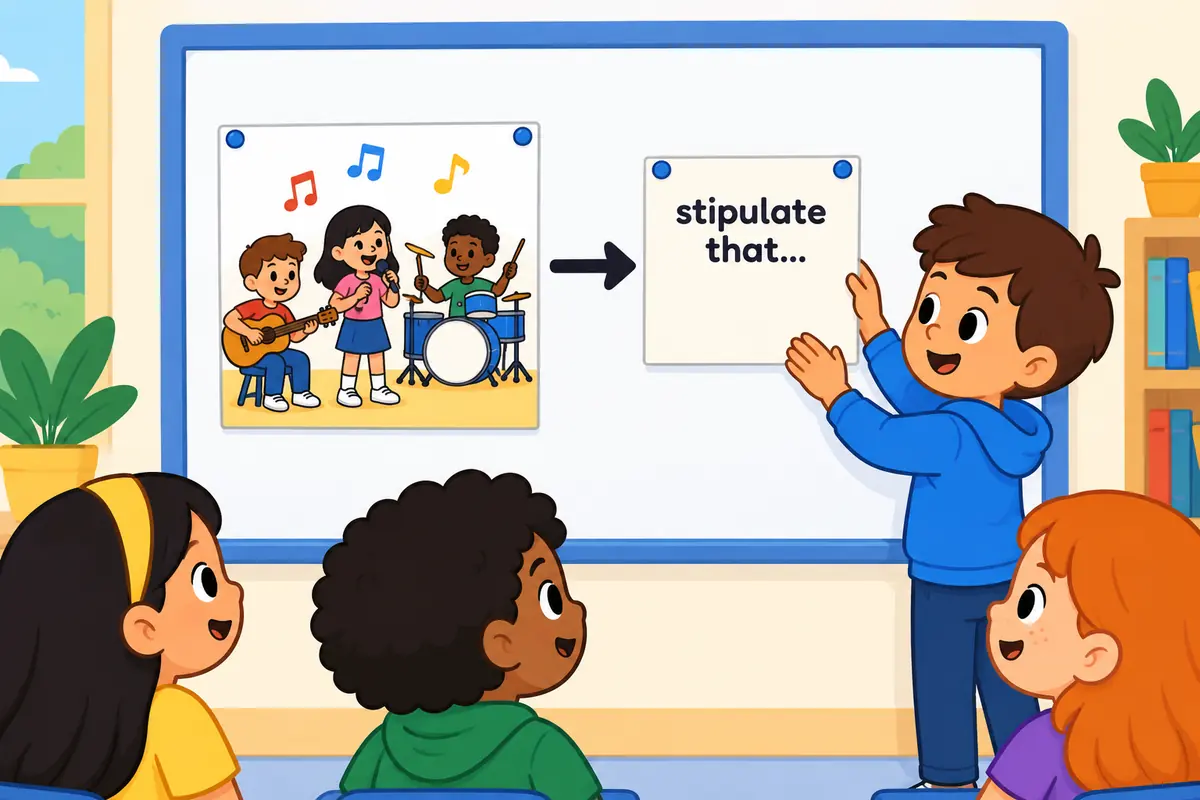
Stipulate thrives wherever terms are fixed in advance. The nine sentences below move from a classroom club to a legal judgment, and each one names the condition set.
| Context | Example sentence | Why this works |
|---|---|---|
| Classroom | The club rules stipulate that every member brings a book. | A simple, concrete condition a child can picture. |
| Workplace email | The brief stipulates a two-week review before launch. | Names the deadline as the binding term. |
| News report | The deal stipulates that the plant stays open for five years. | A long condition stated as a clause. |
| Legal writing | The lease stipulates a ninety-day break clause. | The noun pattern, typical of contracts. |
| Government tender | Tenderers must stipulate their delivery dates in writing. | Makes the applicant set the terms. |
| Academic writing | The protocol stipulated a double-blind review. | A method fixed in advance of the study. |
| Insurance | The policy stipulates that valuables be listed separately. | A condition the holder must satisfy. |
| Conversation | We stipulated no phones at dinner, and it stuck. | Formal verb used lightly for a household rule. |
| Historical writing | The treaty stipulated the return of the occupied ports. | The condition sense applied to diplomacy. |
The fixed subject is always an authority, a document or the parties themselves. Stipulate reports a condition that binds somebody, never an idle remark.
Stipulate vs specify
Stipulate and specify are close, and the difference is obligation. Stipulate sets a term that must be met; specify only states a detail exactly.
| Attribute | stipulate | specify |
|---|---|---|
| Core job | Fix a condition on somebody | State a detail precisely |
| Obligation | Always creates one | None by itself |
| Typical subject | A contract, rule or party | Anyone giving instructions |
| Usual object | A condition, term or requirement | A colour, size, time or figure |
| Register | Formal and legal | Neutral to technical |
| What it implies | Agreement is conditional | Information is exact |
Verdict: choose specify when you merely make something exact, and stipulate when the exact thing becomes a binding condition.
Word forms and grammar of stipulate
Stipulate inflects as a regular verb, and its noun stipulation names the condition itself. Note the that-clause, because dropping that is the error learners make most.
| Form | Part of speech | Example |
|---|---|---|
| stipulate | verb, base form | The parties will stipulate a delivery date. |
| stipulates | verb, third person singular | The clause stipulates full insurance. |
| stipulated | verb, past and past participle | The court stipulated that costs be shared. |
| stipulating | verb, present participle | The board is stipulating a new deadline. |
| stipulation | noun | The stipulation appears on page four. |
| stipulated | adjective | Meet the stipulated standard or lose the grant. |
| stipulatory | non-standard, avoid | The usual adjective is stipulated, not stipulatory. |
Where the sense is to lay down an obligation on someone, mandate is the stronger relative, though mandate usually comes from an authority rather than a bargain.
Common mistakes with stipulate
- Incorrect:
The lease stipulates tenants pay for repairs.Correct: The lease stipulates that tenants pay for repairs. Rule: The that-clause keeps the condition clear; dropping that reads as a run-on. - Incorrect:
The guide stipulates about the closing date.Correct: The guide stipulates the closing date. Rule: Stipulate is transitive and takes a direct object, not about. - Incorrect:
She stipulated me to leave early.Correct: She stipulated that I leave early. Rule: The verb does not take an object plus an infinitive. - Incorrect:
The report stipulated the weather was warm.Correct: The report stated that the weather was warm. Rule: A mere fact is not a condition, so stipulate is the wrong word. - Incorrect:
It was stipulated by the rules to arrive early.Correct: The rules stipulated that we arrive early. Rule: Keep the authority as the subject. Compare insist, which presses a demand rather than fixing a term.
Practice using stipulate
Work through the six items, then check the reasoning with each answer.
- Fill the gap: The agreement ______ that all tools be returned by Friday.
- Choose the better word: The ticket rules (stipulate / mention) that bags must be labelled.
- Correct the error: The contract stipulates the deposit is refundable.
- Build a sentence: use stipulate that about a school trip that requires a signed form.
- Spot the register: which belongs in a tenancy agreement — the landlord stipulates a month’s notice, or the landlord says you have to tell him a month before?
- Rewrite with the noun: The rules stipulate a helmet. Use stipulation instead.
Answers
- stipulates — the agreement fixes the condition that follows.
- stipulate — the rule makes labelling a binding condition, not a passing remark.
- The contract stipulates that the deposit is refundable — the clause needs that.
- Model answer: The rules stipulate that every pupil return a signed form.
- The landlord stipulates a month’s notice — the agreement avoids the loose spoken phrasing.
- The rules impose a stipulation that helmets be worn.
The bottom line
Use stipulate in a sentence when an agreement, rule or party fixes a condition that others must meet, and follow it with that plus a clause. Two nuances decide most cases: the verb creates an obligation rather than merely reporting a fact, and it belongs to formal writing. Where the aim is only to make a detail exact, condition or specify is the simpler choice.
Frequently asked questions about stipulate
What does stipulate mean in a contract?
In a contract, stipulate means to set a condition that both parties must honour. A clause that stipulates a notice period or a payment date creates a binding term, and breaking it has consequences. This is stronger than a plain description of what the parties intend to do.
Is stipulate followed by that or a gerund?
The standard pattern is stipulate that plus a full clause, as in the rules stipulate that helmets be worn. A noun phrase also works, as in the rules stipulate a helmet. A gerund after the verb, as in stipulate wearing a helmet, sounds awkward and is best avoided.
What is the difference between stipulate and specify?
Specify means to state something exactly, such as a colour or a date, and it creates no obligation. Stipulate means to make that exact thing a required condition of an agreement. Every stipulated term is specified, but many specified details are never made conditions at all.
Can stipulate be used in everyday speech?
It can, but it sounds formal. A family might say we stipulated no phones at dinner for a light, mock-legal effect. In ordinary conversation, people usually say we agreed, we required or the rule is, and save stipulate for documents and formal dealings.
Have you ever encountered the word “stipulate” and wondered what it meant? To stipulate is to specify a condition or requirement that must be met in order for something to be considered valid or to proceed.
When someone stipulates, they are setting forth specific terms or conditions that need to be followed. This word is commonly used in legal contexts, contracts, and agreements where parties outline terms that must be adhered to for the agreement to be enforced.
7 Examples Of Stipulate Used In a Sentence For Kids
- Stipulate means to establish a rule or requirement.
- When we play games, we should stipulate the rules at the beginning.
- It is important to stipulate our expectations to avoid misunderstandings.
- Let’s stipulate that we take turns when sharing toys with friends.
- Can you stipulate the number of cookies each one can have at the party?
- Remember to stipulate where you want to keep your toys after playing with them.
- As a class, let’s stipulate to be kind and respectful to each other.
14 Sentences with Stipulate Examples
- Stipulate the submission deadline for your assignments to avoid any last-minute rush.
- Make sure to stipulate the word count requirement for your essays before starting the writing process.
- It is important to stipulate the format and font size for your project report to meet the academic standards.
- Before group discussions, always stipulate the topic to be covered to ensure productive and focused conversations.
- During presentations, clearly stipulate the key points you will be discussing to keep your audience engaged.
- Stipulate the number of references required for your research paper to support your arguments effectively.
- Ensure to stipulate the citation style to be used in your academic papers to maintain consistency.
- When working on group projects, stipulate the roles and responsibilities of each team member for better coordination.
- Before exams, review the syllabus carefully to stipulate the specific chapters and topics to be covered.
- Collaborate with classmates to stipulate study sessions to prepare effectively for upcoming tests.
- Attend orientation sessions to stipulate the academic requirements and expectations set by the college.
- Develop a study schedule to stipulate specific times for revision and exam preparation.
- Utilize online platforms to stipulate study groups for sharing resources and discussing complex topics.
- Set clear goals for each semester to stipulate academic achievements and personal growth.
How To Use Stipulate in Sentences?
Stipulate
When using the word stipulate in a sentence, it is important to remember that it is a verb that means to specify or demand something as part of an agreement. Here is a simple guide on how to correctly use stipulate in a sentence:
-
Identify the conditions: Begin by identifying the conditions that need to be specified or demanded in the sentence. This can be a requirement, rule, or provision that is essential to the agreement.
-
Use “stipulate” in the sentence: Once you have identified the conditions, incorporate the word stipulate into the sentence in the appropriate context. For example: “The contract stipulates that all payments must be made by the end of the month.”
-
Provide clarity: Make sure that the use of stipulate adds clarity to the sentence and clearly communicates the specified or demanded condition.
-
Check for accuracy: Before finalizing the sentence, double-check that the use of stipulate accurately reflects the intention of specifying or demanding a condition in the agreement.
By following these simple steps, you can effectively use stipulate in a sentence to convey specific requirements or demands in an agreement.
Conclusion
In conclusion, stipulate is a term commonly used in legal contexts to establish specific conditions or requirements within agreements or contracts. It is often used to clearly outline expectations and obligations for all parties involved. For example, “The contract stipulates that payment must be made in full within 30 days of invoicing.”
By including stipulations in a document or agreement, all parties can have a clear understanding of their responsibilities and can help prevent misunderstandings or disputes in the future. It provides a framework for compliance and accountability, ensuring that each party upholds their end of the deal as stipulated.


