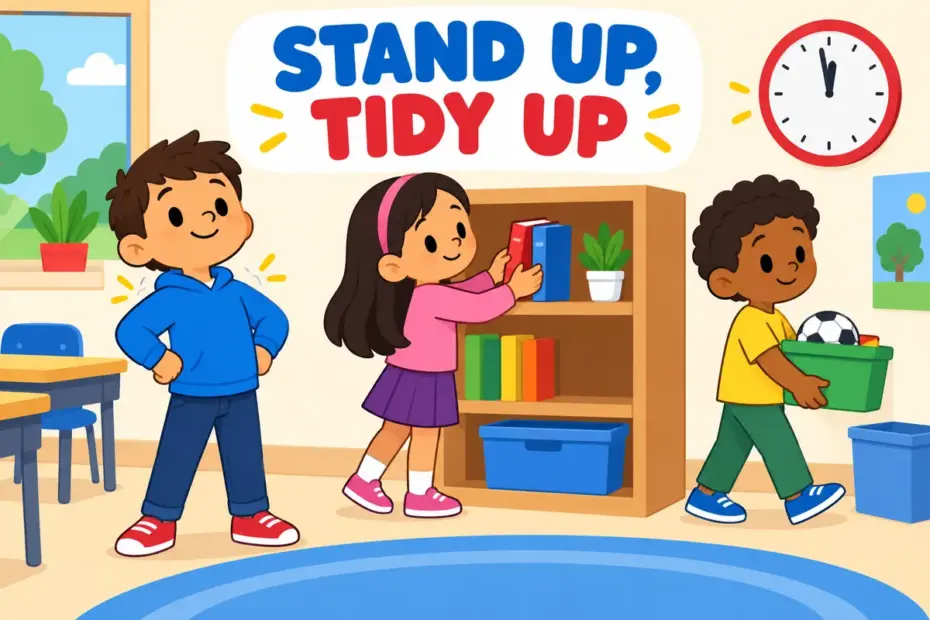
Straighten up means to move into an upright position or to put a place back in order; to use straighten up in a sentence, name the person or the room that changes: “He straightened up when the head teacher walked past.” The phrasal verb is separable only in its tidying sense.
Straighten up at a glance
- Straighten up is a phrasal verb with two main senses: adopt good posture, and make a place or a person tidy.
- Its forms are straightens up, straightened up and straightening up.
- The posture sense is intransitive, as in he straightened up.
- The tidying sense is transitive and separable: straighten the room up, or straighten up the room.
- Register is neutral, so it fits spoken instructions and written reports alike.
- The commonest error is adding a reflexive pronoun to a posture command; say sit up straight, not straighten up yourself.
What does straighten up mean?
Straighten up is a phrasal verb meaning to move into an upright position, or to make a place tidy or a person behave better. The Cambridge entry for straighten up groups the posture and tidying senses, which behave differently in grammar, so the sense you choose decides the shape of the sentence.
| Sense | Plain meaning | Example sentence |
|---|---|---|
| Posture | Move the body upright | He straightened up after the long drive. |
| Tidy a place | Put things back in order | The children straightened up the art corner. |
| Reform a person | Begin to behave better | The team straightened up once the coach set rules. |
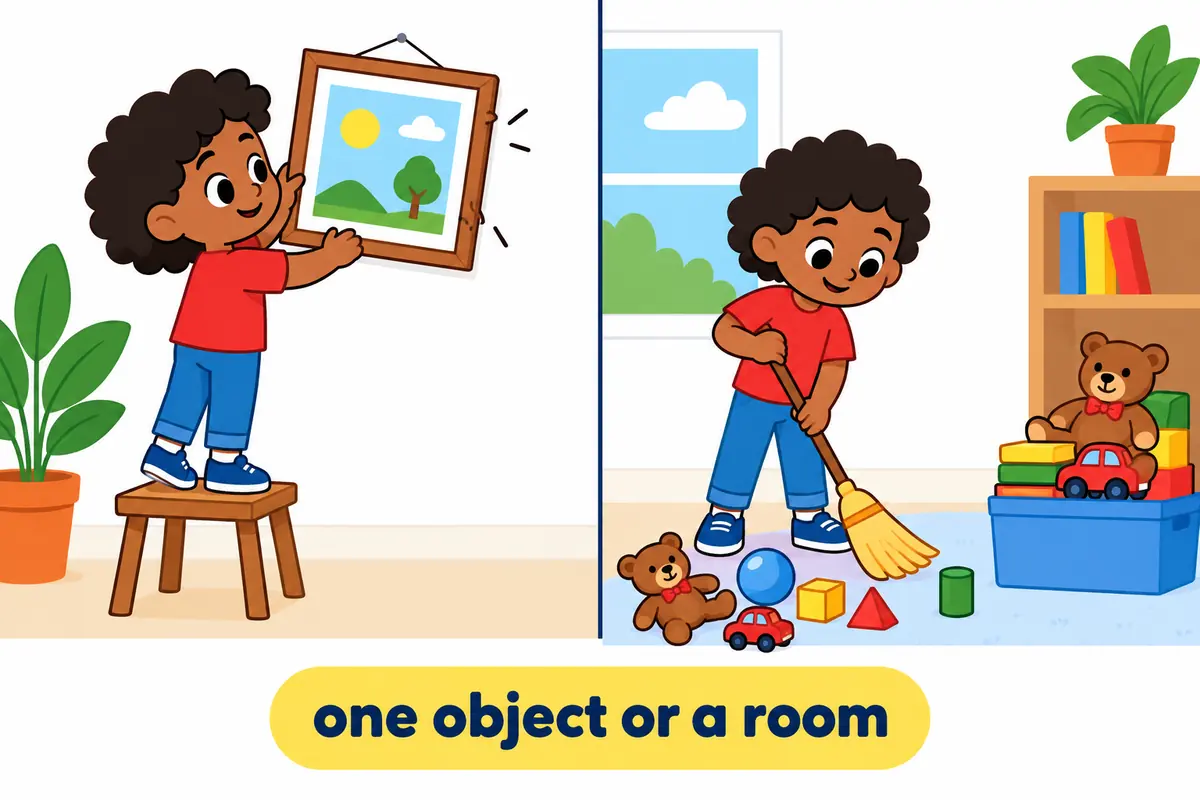
One limitation is worth stating. Straighten up is the wrong choice for a single crooked object: a tilted picture frame is straightened, not straightened up, because the phrasal verb implies restoring order to a whole place or person. It also says nothing about speed, effort or permanence.
How do you use straighten up in a sentence?
The two senses split the grammar cleanly. The posture sense takes no object, while the tidying sense takes one and is separable, so the object may sit between the verb and the particle.
| Pattern | Example | What it signals |
|---|---|---|
| straighten up (no object) | She straightened up when the doctor entered. | A posture change; nothing receives the action. |
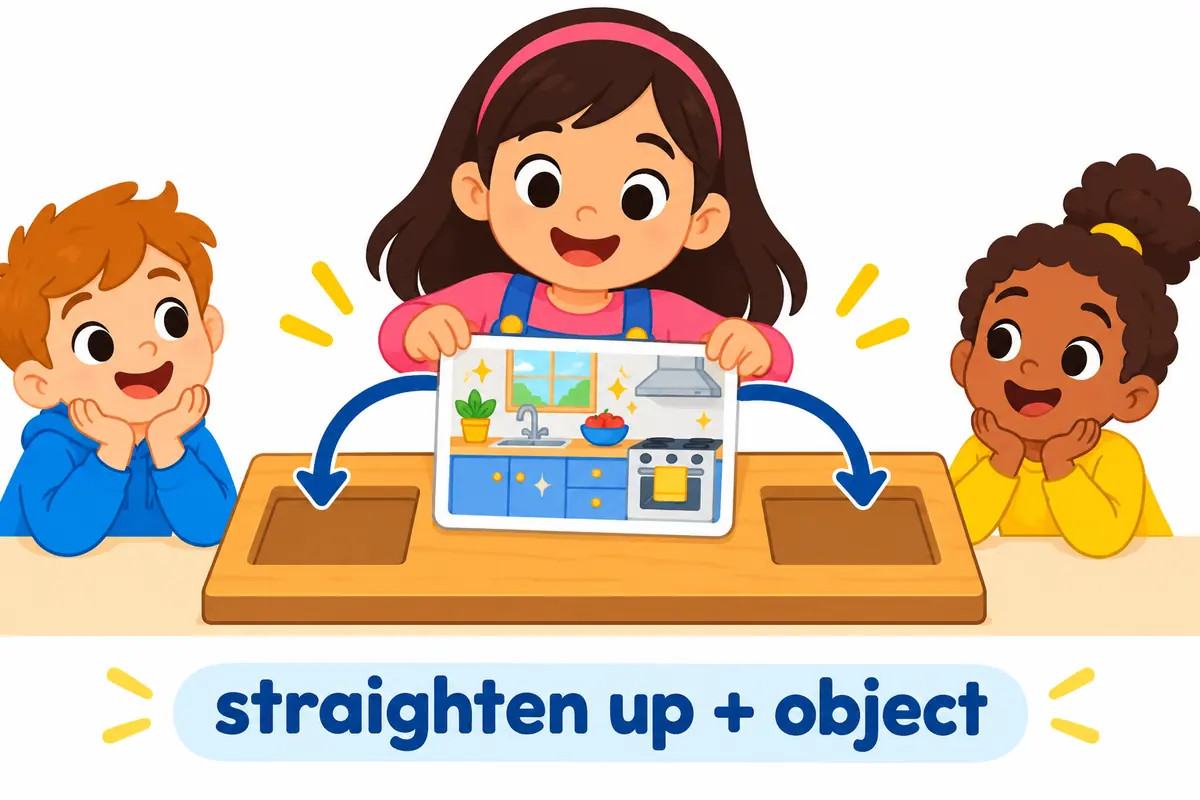
| straighten up + place | We straightened up the kitchen before guests arrived. | Tidying; the object follows the particle. |
| straighten + place + up | We straightened the kitchen up before guests arrived. | Separability: the object can split the verb and the particle. |
| straighten + person + up | A warning straightened the new boy up. | Behaviour sense; the person is the object. |
| straighten up, particle stranded | That messy shelf is easy to straighten up. | The particle may end the clause when the object is understood. |
For setting a room to rights, adjust the shelves and straighten up overlap, but adjust is the better fit when only one item moves.
Straighten up in a sentence: examples across contexts
Straighten up changes register more than it changes meaning. The nine sentences below keep the same phrasal verb while moving from a classroom to a care report.
| Context | Example sentence | Why this works |
|---|---|---|
| Classroom | The class straightened up the reading corner before the bell. | Names a shared space and the moment the tidy ends. |
| Workplace email | We straightened up the meeting room before the client arrived. | Ordinary office tidying in a polite written register. |
| News report | Residents straightened up the square after the festival. | A public space and a clear sequence of events. |
| Sports commentary | The striker straightened up and struck the ball cleanly. | The posture sense describes a decisive movement. |
| Home conversation | Just straighten up your room before dinner. | A spoken instruction, with the object after up. |
| Care report | The patient straightened up slowly after weeks in bed. | Posture sense with an adverb of manner. |
| Report on behaviour | The patrol straightened up after the new sergeant arrived. | The reform sense applied to a group. |
| Retail | Staff straightened up the display between customers. | Tidying a small commercial space. |
| Formal writing | Volunteers straightened up the hall once the vote ended. | A civic action in an impersonal report. |
Straighten up vs spruce up
Straighten up and spruce up a room both improve a space, but they promise different things.
| Attribute | straighten up | spruce up |
|---|---|---|
| Core job | Restore order or posture | Improve appearance smartly |
| Scope | Everyday tidying or standing | Dressing up, decorating, refreshing |
| Typical object | A room, a child, a team | An outfit, a garden, a hall |
| Register | Neutral, spoken and written | Slightly informal and cheerful |
| Implies | Things were out of place | Things looked plain or dull |
Verdict: choose straighten up when order or posture is the point, and choose spruce up when the goal is to make something look more attractive.
Word forms and grammar of straighten up
Straighten up follows the regular pattern of its base verb, and the forms below cover every tense a learner needs.
| Form | Part of speech | Example |
|---|---|---|
| straighten up | phrasal verb, base form | Please straighten up before the photo. |
| straightens up | third person singular | He straightens up whenever a visitor arrives. |
| straightened up | past and past participle | The pupils straightened up the corridor. |
| straightening up | present participle | She is straightening up the front desk. |
| straighten | base verb, no particle | Straighten the photo on the wall. |
| straighten-up | noun, non-standard | Do not write a straighten-up; use the noun tidy-up. |
Where the same root appears without the particle, keep the sense narrow. For a tidy desk rather than a tidy room, organize the papers is more precise than straighten up.
Common mistakes with straighten up
- Incorrect:
Please straighten up yourself before the assembly.Correct: Please straighten up before the assembly. Rule: The posture sense is intransitive, so it takes no reflexive object. - Incorrect:
He straightened up the crooked picture.Correct: He straightened the crooked picture. Rule: For one crooked object use straighten; straighten up implies restoring a whole place. - Incorrect:
The room was straighten up by the volunteers.Correct: The room was straightened up by the volunteers. Rule: After be, the past participle is required. - Incorrect:
The team straighten up after the new coach arrived.Correct: The team straightened up after the new coach arrived. Rule: A finished past event takes the past form, even with a plural subject. - Incorrect:
We straightened up the chairs the tables and the floor.Correct: We straightened up the chairs, the tables and the floor. Rule: Use commas in a list; the verb does not replace punctuation.
Practice using straighten up
The six exercises mix gap-filling, error repair and register choices. Check the reasoning in the answer list, not only the key.
- Fill the gap: The child ______ when his name was called.
- Fill the gap: We ______ the storeroom before the inspection.
- Choose the better word: The volunteers (straightened / straightened up) the crooked signpost.
- Correct the error: The hall was straighten up after the dance.
- Build a sentence: use straighten up + place about a shared kitchen at the end of a shift.
- Spot the register: which belongs in an email to a manager — we straightened up the meeting room, or we totally straightened up?
Answers
- straightened up — the posture sense, intransitive and in the past tense.
- straightened up — tidying a place; the object may also move before up.
- straightened — a single crooked object takes straighten, not straighten up.
- The hall was straightened up after the dance — after was, use the past participle.
- Model answer: We straightened up the shared kitchen before the night shift ended.
- We straightened up the meeting room — the report keeps a neutral register and avoids totally.
The bottom line
Use straighten up in a sentence when the topic is posture or restoring order, and decide the sense before you choose the grammar. Two points settle most sentences: the posture sense takes no object, while the tidying sense is separable, so straighten the room up and straighten up the room are both correct. For a single crooked item, drop the particle and straighten the frame instead.
Frequently asked questions about straighten up
Does straighten up mean standing or tidying?
Both, depending on the sense. In the posture sense the verb takes no object, as in he straightened up after tying his shoe. In the tidying sense it takes an object, as in she straightened up the desk. The surrounding nouns, not the word itself, tell a reader which sense you mean, so name the person or the place clearly.
Is straighten up separable?
Yes, but only in the tidying sense. You may write straighten up the room or straighten the room up, because the object can sit between the verb and the particle. The posture sense has no object to move, so it never splits. When the object is understood, the particle can also strand at the end of the clause.
Is straighten up formal or informal?
The phrasal verb is neutral and belongs to both speech and writing. A teacher says straighten up to a class, and a report can say residents straightened up the square. It is less formal than restore order but more natural than the verb arrange in a spoken instruction, so match it to the situation.
How is straighten up different from straighten out?
Straighten out deals with confusion or difficulty, so you straighten out a problem, a misunderstanding or someone’s finances. Straighten up deals with posture or physical order. The shared base verb hides the split, so check the particle: out points to a muddle, while up points to something upright or tidy.
Have you ever been asked to straighten up your room before guests arrive? To straighten up means to tidy or organize a space, making it neater and more presentable. This can include tasks like putting things back in their proper place, clearing clutter, and overall improving the appearance of a room.
Whether it’s your living room, workspace, or even just your desk, straightening up can help create a more inviting and organized environment. It’s a simple yet effective way to make a space look better and function more efficiently. Let’s explore the concept of straightening up and how it can benefit various areas of your life.
7 Examples Of Straighten Up Used In a Sentence For Kids
- Straighten up your books on the shelf.
- Please straighten up your toys on the floor.
- Let’s straighten up the pencils in the pencil box.
- It’s time to straighten up our classroom.
- Can you help me straighten up the crayons?
- Remember to straighten up your desk before leaving.
- We should all straighten up our chairs after class.
14 Sentences with Straighten Up Examples
- Straighten up your notes before the exam.
- Remember to straighten up your room before your parents visit you in the hostel.
- Make sure to straighten up your backpack before heading to class.
- It’s important to straighten up your study schedule for finals week.
- Don’t forget to straighten up your desk for a productive study session.
- Take a few minutes to straighten up your wardrobe before selecting an outfit for the day.
- Straighten up your posture while sitting in class to avoid back pain.
- Before a presentation, make sure to straighten up your PowerPoint slides.
- It’s a good idea to straighten up your group project responsibilities with your team members.
- Remember to straighten up your sleep schedule for better focus during lectures.
- Straighten up your budget to manage your expenses effectively during the semester.
- Take a break to straighten up your thoughts and relax during a hectic study session.
- It’s crucial to straighten up your priorities to stay on track with your academic goals.
- Start the day off right by straightening up your morning routine for a productive day ahead.
How To Use Straighten Up in Sentences?
Straighten Up is a phrasal verb that is used to describe the action of making something neat or tidy. It is often used when referring to correcting or fixing something in order to improve its appearance or alignment.
To use Straighten Up in a sentence, follow these steps. First, identify the object or area that needs to be made neat or tidy. For example, “I need to Straighten Up my desk before I can start working.”
Next, include the action of making the object or area neat or tidy. This could involve rearranging items, organizing them, or simply putting them back in their proper place. For instance, “I need to Straighten Up my room before my friends come over.”
Remember to always use the phrase “Straighten Up” with an object or area that needs improvement or organization. This will help convey the message that you are working on making things neat or tidy.
In conclusion, using Straighten Up in a sentence is a simple way to communicate that you are tidying up or fixing something. By following these steps and practicing with different objects or areas, you will master the use of this phrasal verb in no time.
Conclusion
In conclusion, by using sentences with “straighten up,” the act of tidying, organizing, or improving one’s posture can be emphasized. Whether it’s a physical task like straightening up a room or standing up straight to appear more confident, this phrase conveys a message of rectifying or improving a situation. “Straighten up” serves as a versatile expression that can apply to various everyday scenarios where a change or adjustment is needed.
By incorporating sentences with “straighten up” into our vocabulary, we are reminded of the importance of maintaining order and structure in both our physical environment and our personal demeanor. This simple yet impactful phrase encourages us to take action, make improvements, and strive for betterment in different aspects of our lives.