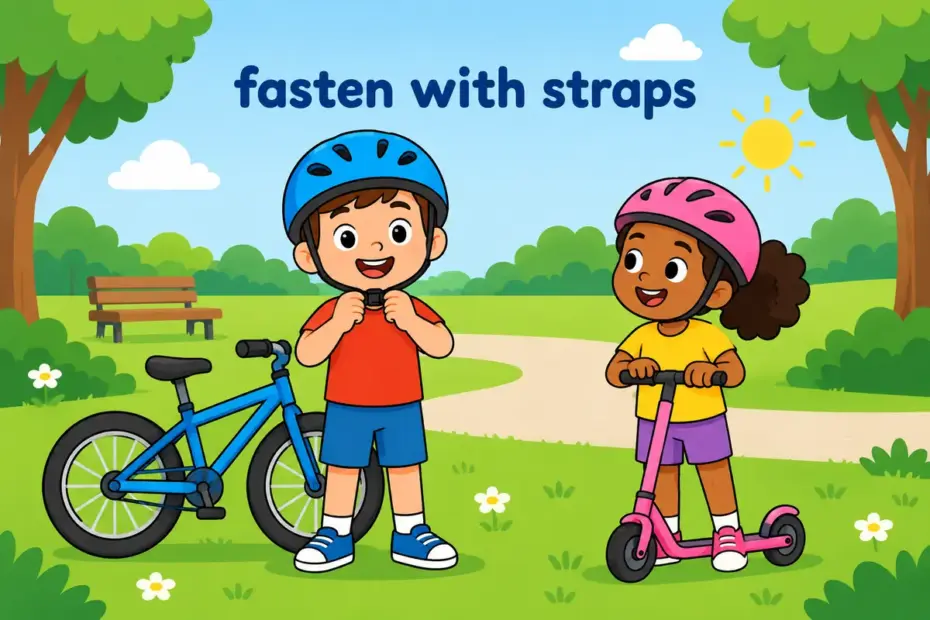
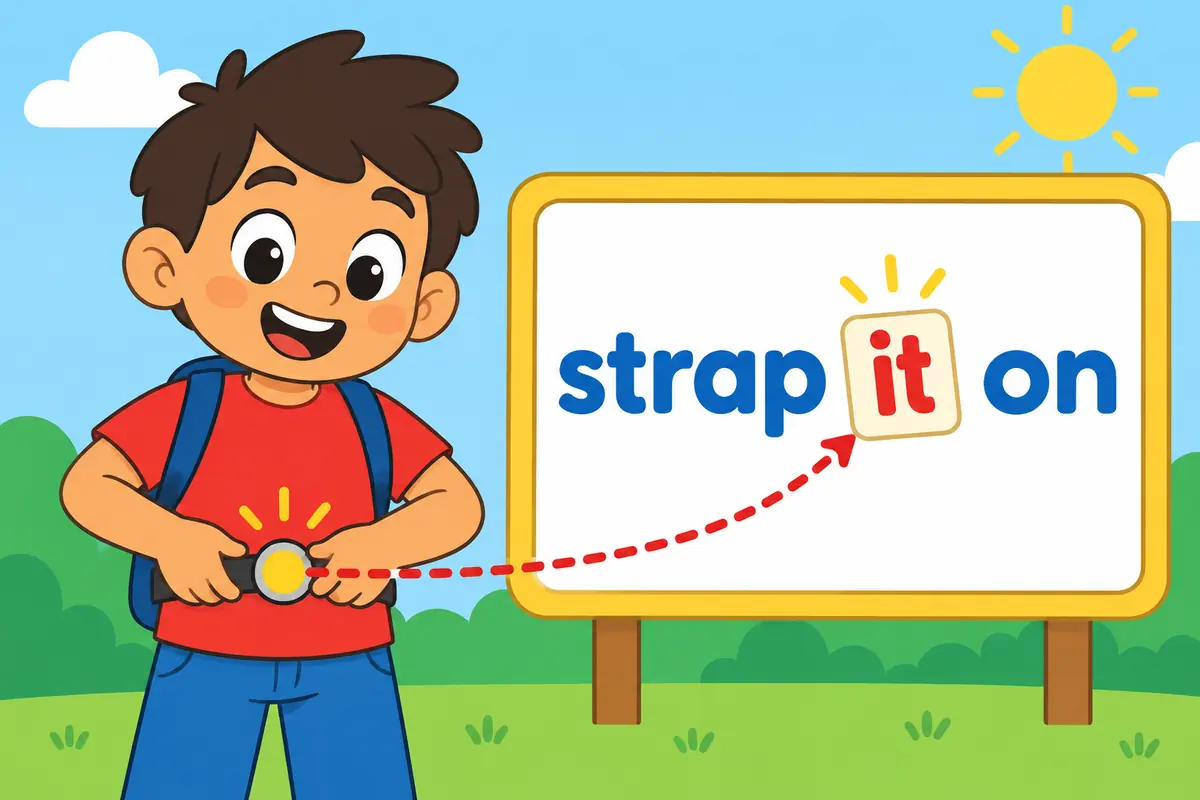
Strap on means to fasten something in place using straps. To use strap on in a sentence, name the object and the person or body part: “Strap on your helmet before you ride.” The verb is transitive, and because it is separable a pronoun goes between: strap it on.
Strap on at a glance
- Strap on is a transitive phrasal verb meaning to fasten something in place with straps.
- Its forms are straps on, strapped on and strapping on.
- It is separable: strap on a helmet, strap a helmet on, or strap it on.
- The phrase belongs to everyday, sport and safety writing.
- The commonest error is putting a pronoun after the particle, as in strap on it.
What does strap on mean?
Strap on is a transitive phrasal verb meaning to fasten something in place with straps, or to fit a piece of equipment by securing its straps. The Cambridge entry for strap on gives the fasten sense, and it is the one every sentence below uses.
| Sense | Plain meaning | Example sentence |
|---|---|---|
| Fasten clothing or kit | Close the straps of something you wear | Strap on your boots before the hike. |
| Fit equipment | Attach a device by its straps | He strapped on the head torch. |
| Secure a load | Hold cargo down with tensioned straps | They strapped the boxes on the roof rack. |
One limit is worth stating. Strap on is physical: it means fastening with straps, so it does not fit a hat that simply rests on the head, and it implies deliberate, careful fastening rather than a clip you snap shut without thinking. When nothing is strapped, attach a bell to the handlebar and put on are the plainer and more accurate verbs. A second point separates the senses: the fasten sense takes a personal subject who does the work, while the fit-equipment sense often keeps the device as the object of attention, as in he strapped on the head torch and checked the beam.
How do you use strap on in a sentence?
The verb is transitive, so it always needs an object, and it is separable, so the particle on may follow that object. The one fixed rule is that a pronoun must sit between strap and on, as in strap it on.
| Pattern | Example | What it signals |
|---|---|---|
| strap on + noun | She strapped on her skates. | The phrase stays together, the commonest order. |
| strap + noun + on | She strapped her skates on. | The particle separates past a full noun object. |
| strap + pronoun + on | She strapped them on. | A pronoun must sit between the verb and the particle. |
| be strapped on | The crate was strapped on tightly. | Passive voice; the particle stays after the participle. |
| strap + noun + on + to | He strapped the case on to the rack. | Names where the object is fastened, not only that it is. |
Separability is the whole grammar of this verb, and the passive is where learners hear the strand most clearly: the crate was strapped on keeps on after the participle. Notice that the preposition on belongs to the verb rather than to the object, which is why strap on your boots needs no second on. Speakers who want the opposite action reach for the related particle in bring on and find it transitive too, though the meaning is quite different.
Strap on in a sentence: examples across contexts
Strap on changes register more than it changes meaning. The nine sentences below keep the same phrase while moving from a school trip to a warehouse, and each one names the object being fastened.
| Context | Example sentence | Why this works |
|---|---|---|
| School trip | Strap on your backpack before the coach leaves. | An imperative gives direct, practical instruction. |
| Cycling safety | Always strap on a helmet, even for a short ride. | A safety habit takes the plain present tense. |
| Sports coaching | The skater strapped on her blades and stepped onto the ice. | The past tense narrates a sequence of actions. |
| Warehouse | Workers strapped the pallets on before the van moved. | A load secured with straps suits the literal sense. |
| Camping | We strapped the tent on the roof and checked each buckle. | A concrete object and a checking step sound practical. |
| News report | Rescuers strapped the stretcher on the sled. | Passive-adjacent reporting keeps the action clear. |
| Workplace safety | Strap on your goggles before you start the drill. | Names the required item and the moment to use it. |
| Travel writing | He strapped a small bag on the carrier and set off. | A light narrative tone suits the separable form. |
| Conversation | Just strap it on and we can go. | The pronoun between verb and particle sounds spoken. |
| Boating | The crew strapped the outboard motor on before launch. | A piece of equipment and a specific moment keep it concrete. |
Every row names a real strap. That is the test for this verb: if the object fastens with straps or buckles, strap on fits, and if it does not, put on is the honest choice.
Strap on vs put on, fasten and buckle
Strap on overlaps with three verbs and is interchangeable with none of them. Put on is the general verb for dressing; fasten a seatbelt stresses closing a mechanism; buckle a shoe names the buckle rather than the straps.
| Attribute | strap on | put on | fasten |
|---|---|---|---|
| Core job | Fasten something using its straps | Dress in or place on generally | Close or secure a mechanism |
| Needs straps | Yes, always | No | No, though often a buckle or button |
| Typical object | Helmet, skates, backpack, load | Hat, coat, gloves, shoes | Seatbelt, button, zip, lid |
| Separable | Yes, strap it on | Yes, put it on | Usually not in this sense |
| Register | Practical and safety-minded | Neutral and everyday | Neutral and precise |
Verdict: use put on for anything you wear, fasten or buckle for the closing action, and strap on only when straps or webbing are what hold the object in place.
Word forms and grammar of strap on
Strap on inflects on strap, while the particle never changes shape. The table also lists the separations careful writers avoid, and the unrelated verb detach the panel is its natural opposite.
| Form | Part of speech | Example |
|---|---|---|
| strap on | verb, base form | Please strap on your boots. |
| straps on | verb, third person singular | She straps on her helmet every time. |
| strapped on | verb, past and past participle | He strapped on the head torch. |
| strapping on | verb, present participle | They are strapping on their pads. |
| strapped on to | verb with a place phrase | The bag was strapped on to the carrier. |
| strap on it | non-standard word order | Do not write strap on it; write strap it on. |
Common mistakes with strap on
- Incorrect:
Please strap on it before we go.Correct: Please strap it on before we go. Rule: A pronoun must sit between the verb and the particle. - Incorrect:
She strapped on her helmet on.Correct: She strapped on her helmet. Rule: The particle appears once, and the object needs no extra on. - Incorrect:
He strap on his skates.Correct: He straps on his skates. Rule: The third person singular adds -s to strap. - Incorrect:
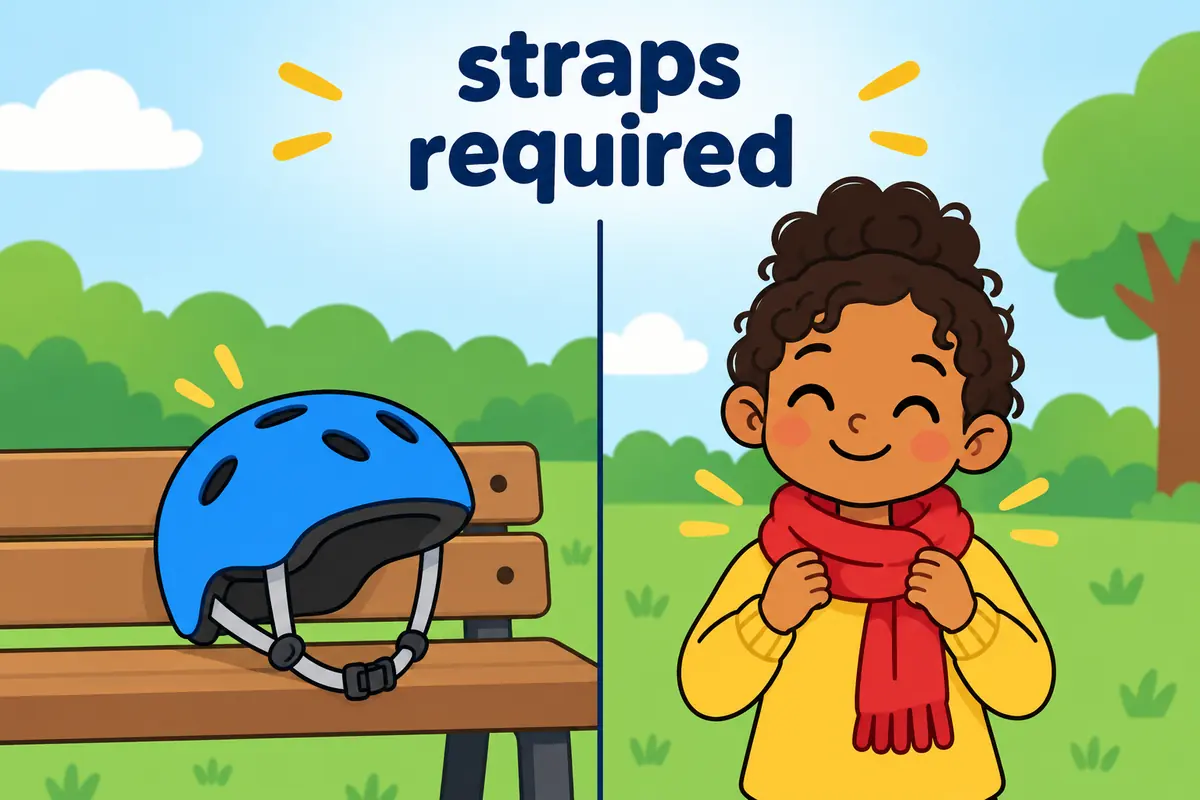
Strap on your scarf.Correct: Put on your scarf. Rule: A scarf has no straps, so put on is the accurate verb. - Incorrect:
The crate was strap on by the driver.Correct: The crate was strapped on by the driver. Rule: The passive keeps on after the past participle.
Practice using strap on
Work through the six items, then check the reasoning rather than only the answer.
- Fill the gap: Remember to ______ your goggles before the experiment.
- Choose the better verb: You (strap on / put on) a helmet, but you usually (strap on / put on) a woolly hat.
- Correct the error: He strapped on his backpack on.
- Build a sentence: use strap it on about a life jacket on a boat trip.
- Spot the register: which belongs in a safety notice — strap on your helmet before you ride, or throw your helmet on, whatever?
- Rewrite in the passive: The crew strapped the crate on. Change it to the passive voice.
- Choose the plainer verb: Strap on your raincoat. The coat has no straps, so which verb is accurate?
Answers
- strap on — the goggles fasten with a strap, and the imperative names the moment.
- strap on, then put on — a helmet has a strap, a woolly hat does not.
- He strapped on his backpack — the particle appears once and no extra on is needed.
- Model answer: The instructor told each child to strap it on before stepping onto the deck.
- Strap on your helmet before you ride — a safety notice is direct and measured.
- The crate was strapped on by the crew — the passive keeps on after the participle.
- Put on — with no strap to close, the general verb is the accurate one.
The bottom line
Use strap on in a sentence when an object fastens with straps, and keep the object close because the verb is transitive and separable. The two points that settle most sentences are these: a pronoun must sit inside the phrase as strap it on, and the passive keeps the particle after the participle. Where there are no straps to close, secure a load and put on are the more precise choices.
Frequently asked questions about strap on
Is strap on one word or two?
As a verb it is two words, strap on, and it inflects on strap alone: she straps on, they strapped on. Written as a single hyphenated word, strap-on is a separate noun with an unrelated meaning, so keep the two words apart whenever you mean to fasten something with straps.
Is strap on separable?
Yes. The particle on may follow a full noun object, as in strap a helmet on, or a pronoun, which must sit between the verb and the particle: strap it on. In the passive the particle stays after the participle, as in the crate was strapped on. All three orders are standard English.
What is the difference between strap on and put on?
Put on is the general verb for anything you wear, from a coat to a hat. Strap on is narrower and insists on straps or webbing that hold the object in place, so a helmet or a backpack is strapped on while a scarf is simply put on. If you cannot name a strap, put on is the honest choice.
Can you say strapped on in the passive?
Yes, and the passive is common in instructions and reports: the crate was strapped on before the van moved. The particle stays after the participle, and the agent appears with by, as in the boxes were strapped on by two workers. The active form simply names the person first.