
Strategy in a Sentence: Meaning & Examples
Strategy in a sentence means using strategy as a noun for a plan or approach used to reach a goal. A clear example names the person or group, the strategy, and the purpose: “The team chose a strategy for reducing delays.” The word can refer to a broad plan or a particular way of handling a task.

What does “strategy” mean?
Strategy is a noun. Cambridge Dictionary gives two closely related senses: a detailed plan for achieving success in a field or situation, and a way of doing something or dealing with a problem. In everyday sentences, it usually answers “What plan or approach will help?” It does not mean the goal itself, nor is it usually a single isolated action. Cambridge Dictionary: strategy.
- Goal: what someone wants to achieve.
- Strategy: the overall plan or approach for pursuing it.
- Tactic or step: one specific action used as part of that approach.
For example, a class’s goal might be to improve reading fluency. Its strategy could be short daily partner-reading sessions; taking turns reading aloud is one step within that strategy. The distinction is useful, though people sometimes use strategy loosely for a single method.

Sentence patterns with “strategy”
These common patterns make it easier to use the word naturally. Because strategy is countable in many uses, use a strategy for one plan and strategies for more than one.
| Pattern | Example | Use |
|---|---|---|
| a strategy for + noun or gerund | “We need a strategy for the next round.” “Her strategy for saving time is to prepare materials early.” |
Names the topic or purpose. |
| a strategy to + verb | “The library created a strategy to welcome new readers.” | States an intended action or result. |
| use/adopt/develop a strategy | “They developed a strategy for sharing the work.” | Describes creating or putting a plan into practice. |
| strategy of + gerund | “The shop’s strategy of offering repairs attracted more customers.” | Highlights the approach being taken. |
| the strategy worked/failed | “Our first strategy failed, so we tested another.” | Evaluates a plan in context. |
| strategic + noun | “The council made a strategic decision about the route.” | Uses the related adjective, not the noun. |
Both “a strategy for improving the schedule” and “a strategy to improve the schedule” are grammatical. The for pattern takes a noun or an -ing form; the to pattern takes the base form of a verb. Compare: “a strategy for reviewing notes” and “a strategy to review notes.”
How to write a complete example sentence
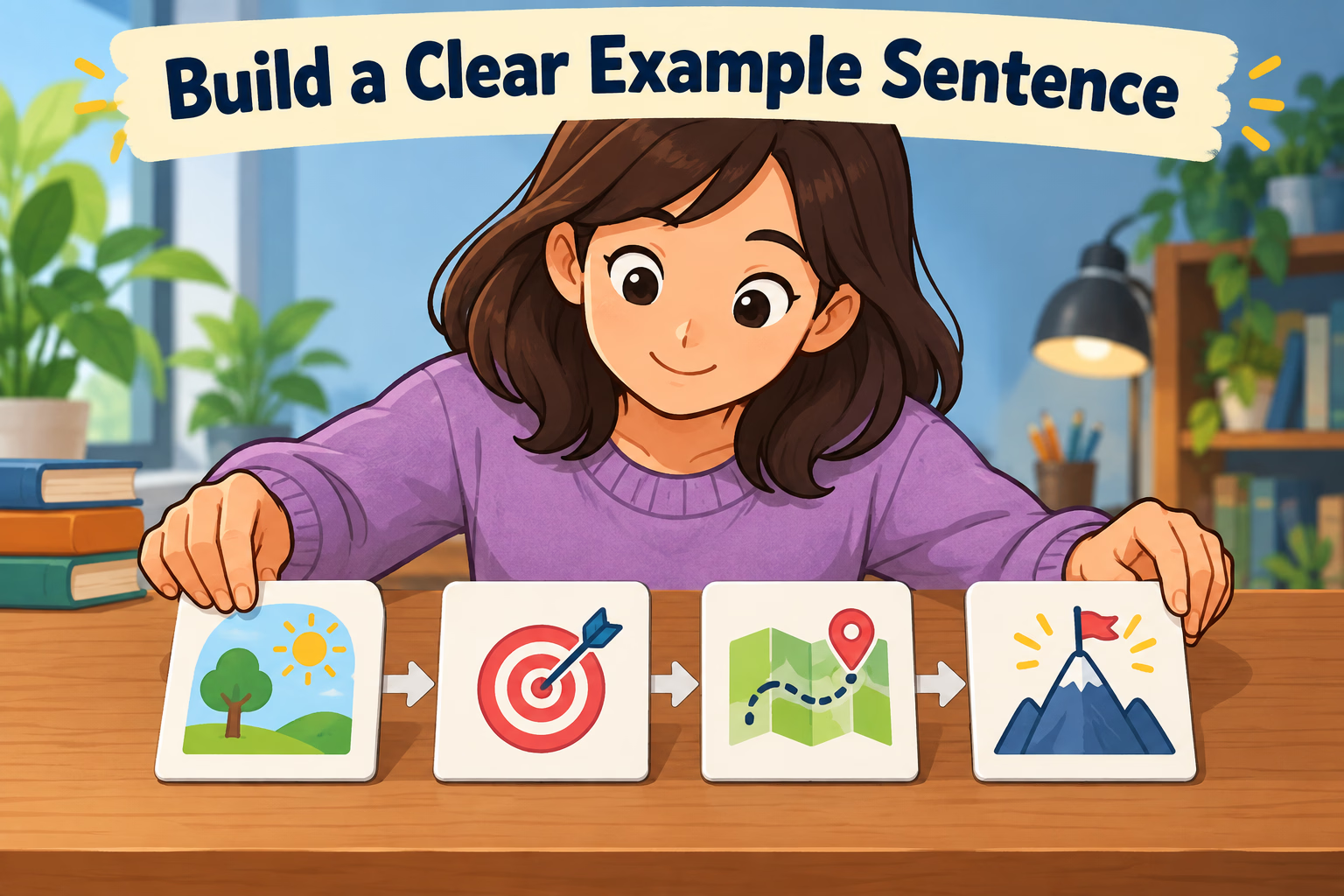
A useful example does more than insert the target word. It shows what the plan is for and gives enough context to understand it. Try this four-step method:
- Choose a setting: school, work, sports, a game, or a community project.
- Name a goal or challenge: what needs to happen or change?
- Add the strategy: use a natural phrase such as develop a strategy for or use a strategy to.
- Check the result: make sure the sentence is complete and the plan/action relationship is clear.
Draft: “Our strategy was good.”
Clearer: “Our strategy of assigning one reviewer to each section helped us finish the report before Friday.”
The second example identifies the approach and its context. Avoid claiming that a plan always guarantees success: “The strategy helped the team finish early” is more precise than “The strategy ensured success in every project.”
Strategy sentence examples for different situations
| Situation | Example sentence | What the strategy does |
|---|---|---|
| School | “Mina’s strategy for learning new vocabulary is to review five words each evening.” | Shows a repeatable study approach. |
| Team project | “Our strategy to divide the presentation into three topics gave each speaker a clear role.” | Connects a practical plan with coordination. |
| Sports | “The coach changed the team’s strategy after studying the other side’s defense.” | Shows a plan adjusted to new information. |
| Business | “The shop’s strategy of offering local delivery attracted nearby customers.” | Names the approach and a reported outcome. |
| Everyday problem | “A useful strategy for finding the missing key is to retrace the last few stops.” | Illustrates a method for handling a problem. |
| Children’s game | “Our strategy was to build the bridge together before the timer ran out.” | Uses simple language and a clear goal. |
| Community event | “The volunteers used a sign-up strategy to make sure each shift had enough helpers.” | Describes a plan for organizing people. |
| Personal goal | “His strategy for practicing piano was to play one short passage slowly, then increase the tempo.” | Gives a concrete series of steps. |
Grammar notes: article, plural, and related forms
- Singular: “a strategy,” “one strategy,” or “the strategy.” Because the word begins with a consonant sound, use a, not an.
- Plural: “strategies.” Change the final y to ies: “Several strategies were considered.”
- Verb patterns: “strategy for planning” and “strategy to plan” are both possible, with different grammar after the preposition or infinitive marker.
- Related adjective: strategic, as in “a strategic choice.” Strategically is the adverb: “They placed the signs strategically.”
- Capitalization: Write the common noun in lowercase except at the beginning of a sentence or in a title: “Their strategy changed.”
A complete written sentence typically contains at least one main clause and begins with a capital letter and ends with punctuation. A main clause can stand on its own; a dependent clause cannot. Purdue’s Writing Lab also groups sentence structures as simple, compound, complex, and compound-complex, based on how independent and dependent clauses combine. That structure variety lets writers choose how to connect a strategy with its reason, condition, or result. Purdue OWL: Sentence Structure, Variety, and Clarity; Cambridge Dictionary: sentence.
Common mistakes to avoid
- Confusing a strategy with a goal: “to win” is usually the goal; “practice a different opening move” is part of a strategy.
- Using an unnatural article: say “a strategy,” not “an strategy.”
- Mixing up the noun and adjective: “a strategy decision” is less natural than “a strategic decision” or “a decision about strategy.”
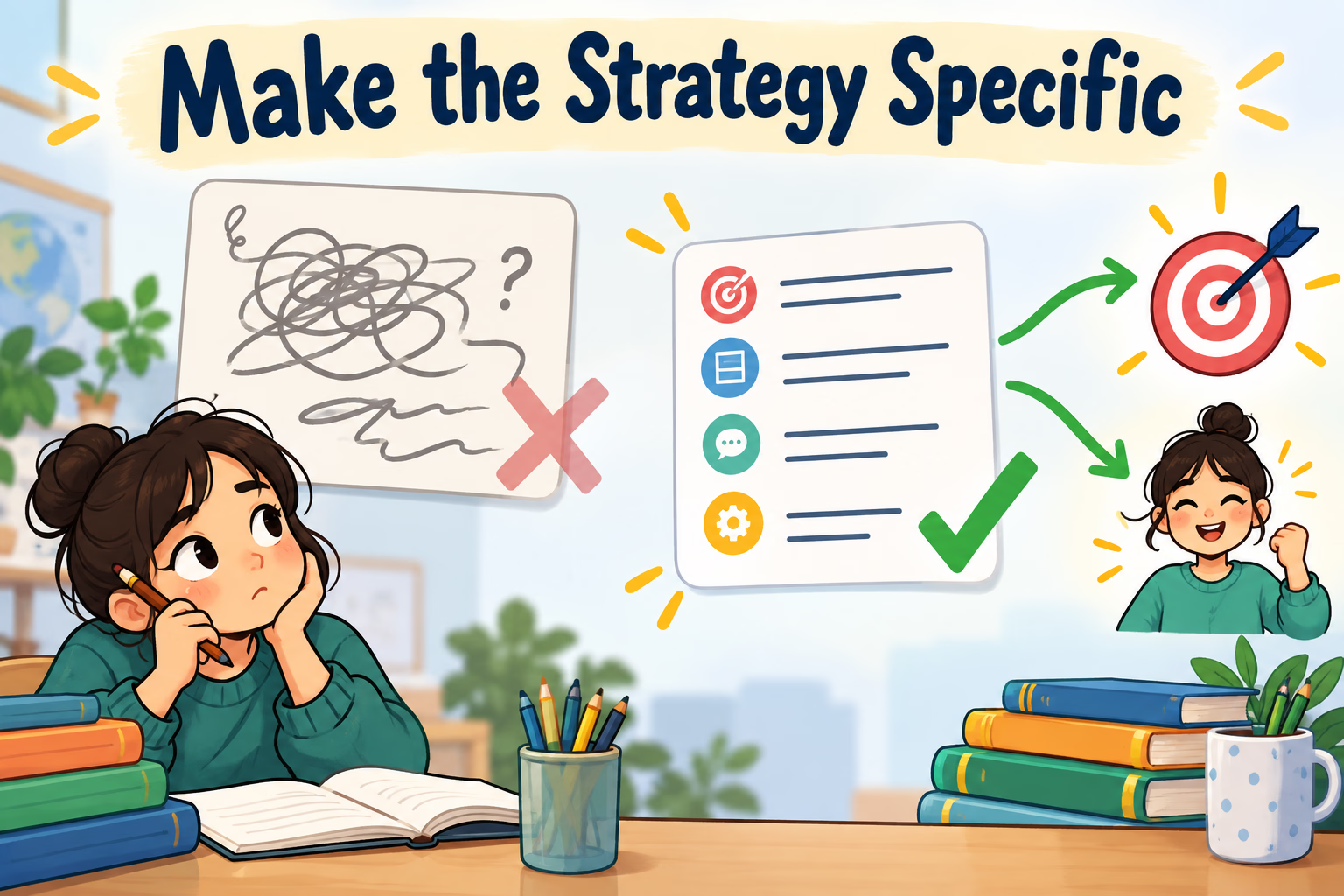
- Leaving the meaning vague: “We need a strategy” is grammatical, but adding the challenge or purpose makes the example informative.
- Overstating cause and effect: a strategy may help, support, or be intended to achieve an outcome; it does not guarantee the result.
Frequently asked questions
What is a simple sentence with “strategy”?
“Our strategy worked.” This is a short, complete example: strategy is the subject, and worked is the verb. For a more informative sentence, add the context: “Our strategy of practicing after school worked well for the team.”
Should I say “strategy for” or “strategy to”?
Both patterns are correct. Use strategy for before a noun or gerund (“a strategy for the event,” “a strategy for saving time”). Use strategy to before a base verb (“a strategy to reduce delays”).
What is the plural of “strategy”?
The plural is strategies. For example: “The group compared three strategies before choosing one.” The spelling changes from final y to ies.
Is “strategic” the same part of speech as “strategy”?
No. Strategy is a noun for a plan or approach. Strategic is an adjective that describes something related to a strategy or important to a plan, as in “a strategic decision.”
How can I make a strategy sentence more specific?
Name the goal, the approach, and the context. Instead of “She used a strategy,” write “She used a color-coded schedule as a strategy for keeping the group project on track.”
Conclusion
To use strategy in a sentence, treat it as a noun and show the plan or approach it names. Choose a natural pattern such as a strategy for or a strategy to, then add enough context to make the goal and method clear. A specific example sentence helps readers see how the word works in real communication.
Editorial note: The original article below is preserved exactly, including every example and its original wording. Some examples are broad or awkwardly phrased; the updated explanations and examples above clarify natural grammar and usage.

Do you want to enhance your writing skills by mastering the art of constructing impactful and coherent sentences? An example sentence with the word “strategy” can help illuminate the concept. In simpler terms, a sentence showcasing the word “strategy” demonstrates a deliberate plan or approach designed to achieve a specific goal or outcome.
Understanding how to use “strategy” in a sentence allows for effective communication and the ability to convey thoughtfully crafted ideas. By examining an example sentence with “strategy,” one can gain insight into the importance of carefully planning and implementing tactics to achieve success in writing and various aspects of life.
7 Examples Of Strategy Used In a Sentence For Kids
- Strategy is thinking about a plan before you start.
- When you play a game, it is good to have a strategy.
- You can make a strategy by talking with your friends.
- A strategy can help you solve problems.
- Let’s come up with a strategy together!
- Using a strategy can make things easier for you.
- Have fun making a strategy for your favorite game!
14 Sentences with Strategy Examples
- Developing a clear study schedule is a key strategy for staying on top of coursework in college.
- Utilizing mnemonic devices can be an effective strategy for remembering complex information for exams.
- Creating flashcards is a popular strategy among college students for quick revision before tests.
- Joining study groups can be a beneficial strategy for sharing knowledge and different perspectives on challenging topics.
- Setting specific, achievable goals for each study session is a smart strategy for maximizing productivity.
- Taking regular breaks while studying is an important strategy for maintaining focus and preventing burnout.
- Incorporating active learning techniques, such as teaching the material to a peer, can be a powerful strategy for understanding and retaining information.
- Utilizing online resources and educational apps is a modern strategy for enhancing learning beyond the classroom.
- Networking with professors and classmates can be a valuable strategy for building professional relationships and accessing academic support.
- Participating in extracurricular activities is a well-rounded strategy for developing skills and interests outside of academics.
- Seeking feedback from professors and mentors is a constructive strategy for improving academic performance and personal growth.
- Forming study alliances with like-minded classmates can be a collaborative strategy for sharing resources and study tips.
- Prioritizing assignments and deadlines is a crucial strategy for managing time effectively and avoiding last-minute stress.
- Reflecting on past successes and failures is a reflective strategy for identifying strengths and areas for improvement as a college student.
How To Use Strategy in Sentences?
To use Strategy in a sentence, start by identifying the main goal you want to achieve with your words. Think about what you want to communicate and the impact you want to make on your audience. Consider the context of the message and the emotions you want to evoke.
Next, select the right words and phrases that will help you achieve your goal. This may involve choosing words with specific connotations, using persuasive language, or structuring your sentence in a way that engages the reader.
After choosing your words, focus on the structure of your sentence. Make sure it flows smoothly and is easy to understand. Consider the length of your sentence and whether it effectively conveys your message.
Finally, review your sentence to ensure it effectively communicates your Strategy. Consider if there are any unnecessary words that can be removed to make your message more concise and impactful. Make sure your sentence is clear and coherent, with a logical flow of ideas.
By following these steps and practicing regularly, you can improve your ability to use Strategy in a sentence and become a more effective communicator. Remember to always consider your audience and the purpose of your message when crafting your sentences.
Conclusion
In conclusion, implementing a well-thought-out strategy is crucial for achieving success in various aspects of life. Whether it’s in business, sports, academics, or personal goals, having a clear plan of action can guide decision-making and increase the chances of reaching desired outcomes. By crafting purposeful sentences with strategy, individuals can effectively communicate their intentions, objectives, and methods for achieving success.
Strategic sentences play a pivotal role in conveying a systematic approach to problem-solving, decision-making, and goal-setting. They not only help in organizing thoughts and ideas but also serve as a roadmap towards success. Therefore, by utilizing strategic sentences in communication and planning, individuals can enhance their effectiveness, efficiency, and overall productivity in pursuing their objectives.


