String together means to connect separate things, words or events into one continuous series. To use string together in a sentence, name what is being joined and keep the pieces in order: “She strung three wins together.” The phrase is separable, so the object may sit between string and together or follow the whole phrase.
String together at a glance
- String together is a separable phrasal verb meaning to join separate parts into a series.
- Its forms are string, strings, strung and stringing, as in strung together.
- The object may come between the verb and the particle or after it.
- The phrase is neutral and common in sport, music, writing and everyday speech.
- The commonest errors are the past form stringed together and the preposition with.
What does string together mean?
String together means to join separate items into a connected series, whether the items are words, actions, results or scenes. The Cambridge entry for string together records the joined-in-a-series sense. The verb keeps the picture of beads on a thread, so the pieces stay distinct while forming one line, which is why the phrase suits runs of wins, chains of ideas and sentences built word by word.
| Sense | Plain meaning | Example sentence |
|---|---|---|
| Join words or sounds | Speak or write in a connected way | He could barely string a sentence together. |
| Achieve a run of results | Gain one after another without a break | The team strung together four clean wins. |
| Assemble from parts | Build a whole out of separate pieces | She strung the short scenes together into one film. |
One honest limitation belongs here. String together says something about sequence, not quality: a run of losses can be strung together just as easily as a run of wins. The phrase is also wrong when the pieces are being rebuilt from fragments rather than simply placed in order. Where the parts are damaged or incomplete, piece together is the more precise verb.
How do you use string together in a sentence?
String together is separable, which is the main grammatical decision. A short object usually goes between the verb and together, a long one usually follows the particle, and a pronoun must go between them. Six patterns cover the sentences you will actually meet.
| Pattern | Example | What it signals |
|---|---|---|
| string + object + together | He strung two good passes together. | Common with a short object; pronoun goes here too. |
| string together + object | They strung together a remarkable run. | Preferred when the object is long or carries new detail. |
| string + a sentence + together | The child could not string a sentence together. | Fixed idiom for speaking or writing coherently. |
| string together + a living, a story | She strings together a living from three jobs. | Builds a whole out of separate pieces. |
| be strung together | The episodes were strung together into one series. | Passive; the sequence, not the maker, is in view. |
| string + object + together + into | She strung the notes together into a melody. | Into names the single whole that results. |
The pronoun rule is the one learners miss: it is string them together, never string together them. With nouns, both positions are grammatical, and writers often choose the one that keeps the important words near the end of the sentence.
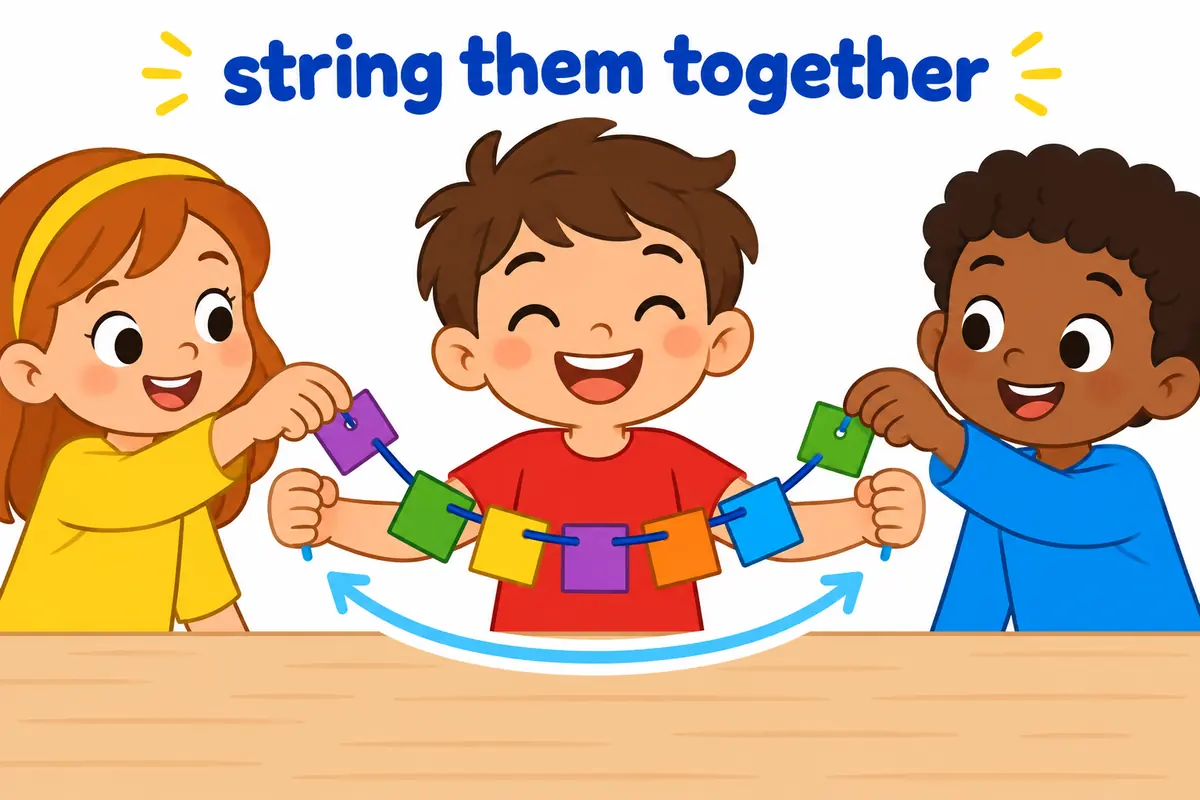
String together in a sentence: examples across contexts
The twelve sentences below move from a classroom to a sports desk and a music review, and each one keeps the pieces distinct while making them one sequence.
| Context | Example sentence | Why this works |
|---|---|---|
| Classroom | Try to string three clear points together before you stop. | A short object sits neatly between verb and particle. |
| Workplace email | We strung together six strong weeks before the dip. | A run of results is the natural business sense. |
| News report | The sprinter strung together three personal bests in a month. | Names the achievements in sequence. |
| Music review | The band strings together four quiet songs without a pause. | Treats tracks as beads on one short thread. |
| Sports commentary | They strung together ten passes before the shot went wide. | The pass count makes the sequence vivid. |
| Writing advice | If you cannot string a sentence together, start with a list. | The fixed idiom fits a sympathetic how-to. |
| Film writing | The director strung the rural scenes together into a slow poem. | Into names the whole the pieces become. |
| Conversation | I strung a few words together and hoped for the best. | The casual register the phrase belongs to. |
| Academic prose | The evidence is strung together with little visible argument. | A critical use of the passive to question the links. |
| Interview | She strung together an answer from three half-truths. | Implies the whole was built from loose parts. |
| Finance writing | The fund has strung together a decade of steady returns. | A long time span expressed as a single run. |
| Everyday explanation | He strung his excuses together so fast nobody could interrupt. | A slightly comic use for a stream of words. |
The pattern to notice is that the phrase comments on the joining, not the merit of the parts, which is why pull the team together is a different idea: it unites effort rather than listing one item after another.
String together vs piece together and cobble together
Three near-synonyms describe building a whole from parts, and each one implies a different method. The table separates them on the points that decide a sentence.
| Attribute | string together | piece together | cobble together |
|---|---|---|---|
| Core job | Place items in a sequence | Reconstruct from fragments | Assemble hastily from what is at hand |
| State of the parts | Whole and separate | Broken or scattered | Mismatched or makeshift |
| Speed | Neutral | Slow and careful | Quick and rough |
| Quality implied | No judgement on merit | Piecing back to the truth | Good enough, not polished |
| Typical objects | Wins, words, songs, scenes | Clues, accounts, a story | A meal, a plan, a shelter |
| Register | Neutral | Neutral to formal | Informal and slightly critical |
Verdict: choose string together for a clean sequence, piece together the fragments when the parts must be recovered, and cobble together a plan when the assembly is quick and improvised.
Word forms and grammar of string together
String together follows the strong verb string, so its past form is strung, not stringed. The table also lists the parts that stay fixed.
| Form | Part of speech | Example |
|---|---|---|
| string together | base phrase | Let us string the ideas together. |
| strings together | third person singular | She strings together a weekly podcast. |
| strung together | past and past participle | They strung together five straight wins. |
| stringing together | present participle | He is stringing together a strong season. |
| stringed together | non-standard past | Not used; write strung together instead. |
| strings | the same root as a noun | The strings of the puppet crossed in her hands. |
The noun stringency shares the root but means strictness, so it has no link to this phrase in meaning. Treat string together as one verb for grammar and you will not be tempted to add the wrong form of the particle.
Common mistakes with string together
- Incorrect:
They stringed together three wins.Correct: They strung together three wins. Rule: String is a strong verb; its past form is strung. - Incorrect:
He strung together with a few words.Correct: He strung a few words together. Rule: The phrase needs a direct object, not the preposition with. - Incorrect:
String together them before you stop.Correct: String them together before you stop. Rule: A pronoun must go between the verb and the particle. - Incorrect:
She could not string a sentence.Correct: She could not string a sentence together. Rule: The idiom for speaking coherently keeps together. - Incorrect:
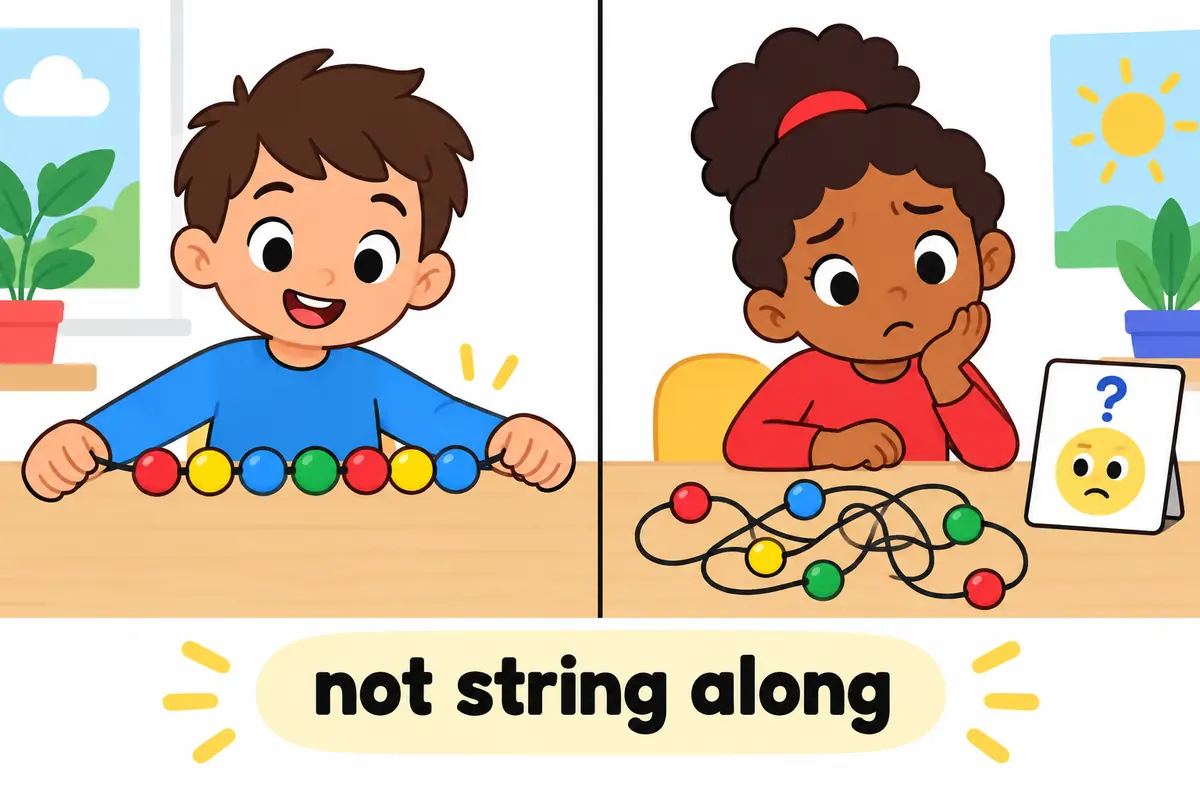
He strung her along together for weeks.Correct: He strung her along for weeks. Rule: string along means deceive and takes no together. - Incorrect:
The evidence was stringed into a case.Correct: The evidence was strung together into a case. Rule: The passive keeps the -u- past form strung.
Practice using string together
Work through the seven items, then read the reasons rather than only the answers.
- Fill the gap: The team ______ together six wins in a row.
- Choose the better word: Detectives (strung / pieced) the torn letters together to read the message.
- Correct the error: She stringed a few words together.
- Build a sentence: use string together about a run of good results at work.
- Spot the register: which suits a music review — the band strings together four quiet songs, or the band cobbles together four quiet songs?
- Fix the pronoun: He strung together them into one story.
- Rewrite in the passive: The editors strung the clips together into a trailer.
Answers
- strung — the past form of string is strung, not stringed.
- pieced — the letters were torn, so the careful reconstruction verb fits.
- She strung a few words together — string is a strong verb with the past strung.
- Model answer: We strung together four strong weeks before the holidays.
- The band strings together four quiet songs — cobbles would imply a hasty, careless assembly.
- He strung them together into one story — pronouns sit between the verb and the particle.
- The clips were strung together into a trailer — the passive keeps strung together unchanged.
The bottom line
Use string together in a sentence when separate words, results or scenes are placed in one continuous series, and let the object fall before or after together. The two facts that settle most sentences are these: the past form is strung, never stringed, and a pronoun must sit between the verb and the particle. Where the parts are broken and must be recovered, piece together is the word you want.
Frequently asked questions about string together
What does it mean to string a sentence together?
To string a sentence together means to speak or write in a connected, understandable way. It often appears in the negative, as in he could not string a sentence together, which suggests someone was too tired, nervous or unwell to form clear speech. The idiom uses the literal image of words placed in order like beads.
Is string together a separable phrasal verb?
Yes. The object may sit between string and together or follow the particle, so both string the ideas together and string together the ideas are correct. A pronoun, however, must go between them: string them together, never string together them. Long objects usually follow the particle because it reads more smoothly.
What is the past tense of string together?
The past tense and past participle are both strung together. String follows the pattern of sing and ring, so the earlier vowel changes. It is never stringed together, which is the regular-looking form that catches learners. So you write the team strung together four wins, not stringed.
What is the difference between string together and string along?
They look alike but mean very different things. String together means to join parts in a series, as in string together a few wins. String along means to deceive someone by pretending to share their plans, as in he strung her along for weeks. The particle, together or along, carries the whole difference.