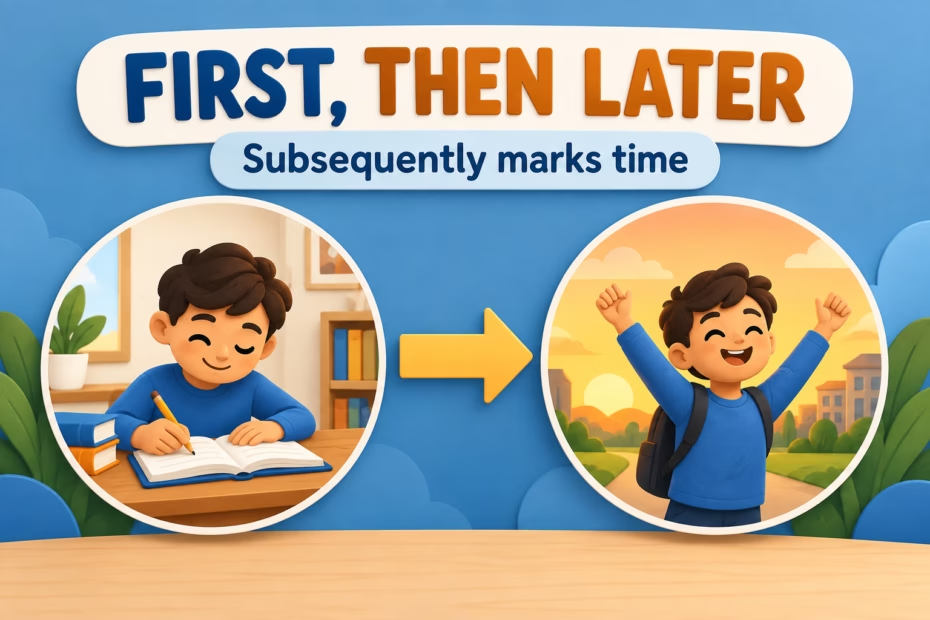
What does “subsequently” mean?
Subsequently is an adverb meaning “after something else” or “later.” It tells a reader that an event happened after an earlier event in the sequence being discussed. For example, “The panel reviewed the proposal and subsequently approved it” places approval after review.
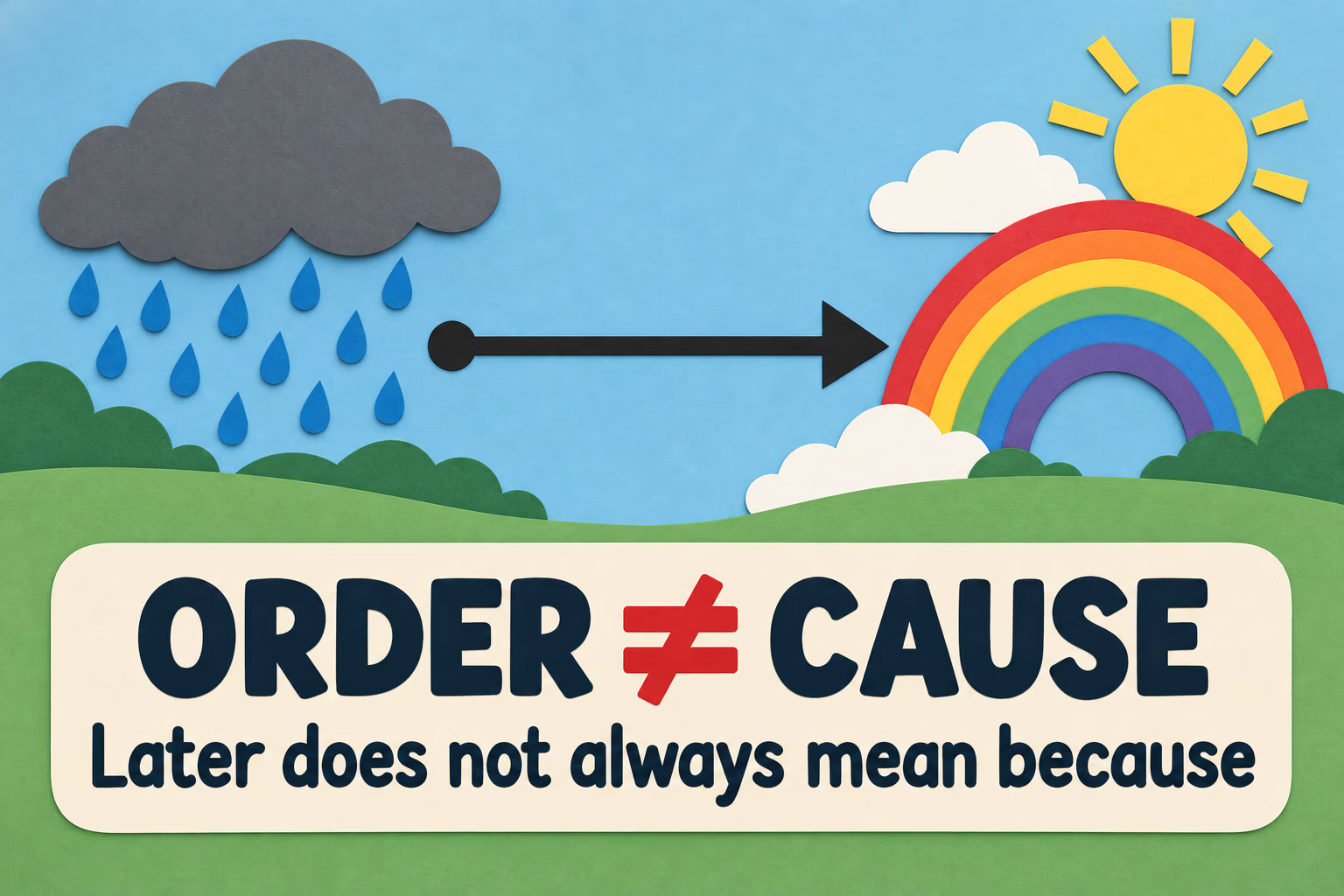
The word marks time order; it does not, by itself, prove that the first event caused the second. A committee might approve a proposal after reviewing it, but the sentence needs additional context to show whether the review caused the decision. If you mean cause, say so with a word or phrase such as because, as a result, or therefore.
How to use “subsequently” in a sentence
Use subsequently when the reader needs a clear link to an earlier point in time. The earlier event may be in the same sentence or in a sentence before it. Name that event when the sequence would otherwise be unclear.
- Same sentence: “Mina checked the figures and subsequently corrected the total.” The correction came later than the check.
- Earlier sentence: “The council requested a traffic study. Subsequently, it delayed the vote.” The opening adverb links the delay to the preceding timeline, without claiming that the study caused the delay.
- With a stated date: “The museum opened in May and subsequently added evening hours.” The second action followed the opening.
These are new examples, separate from the original examples preserved below:
- The lab repeated the measurement and subsequently published the corrected result.
- After the library extended its hours, students subsequently had more time to study there.
- The software update was installed; subsequently, the team checked that saved files still opened.
- Ravi submitted the form on Monday and subsequently received a confirmation email.
- The trail was inspected in spring. It was subsequently reopened after repairs were finished.
- The first rehearsal exposed a timing issue, which the director subsequently addressed.
Where does “subsequently” go?
As an adverb, subsequently can appear at the beginning, in the middle, or at the end of a clause. The most natural position depends on what you want to emphasize. Cambridge Grammar describes these front, mid, and end positions for adverbs generally; its dictionary entry defines subsequently as “after something else.”
| Position | Example | Punctuation |
|---|---|---|
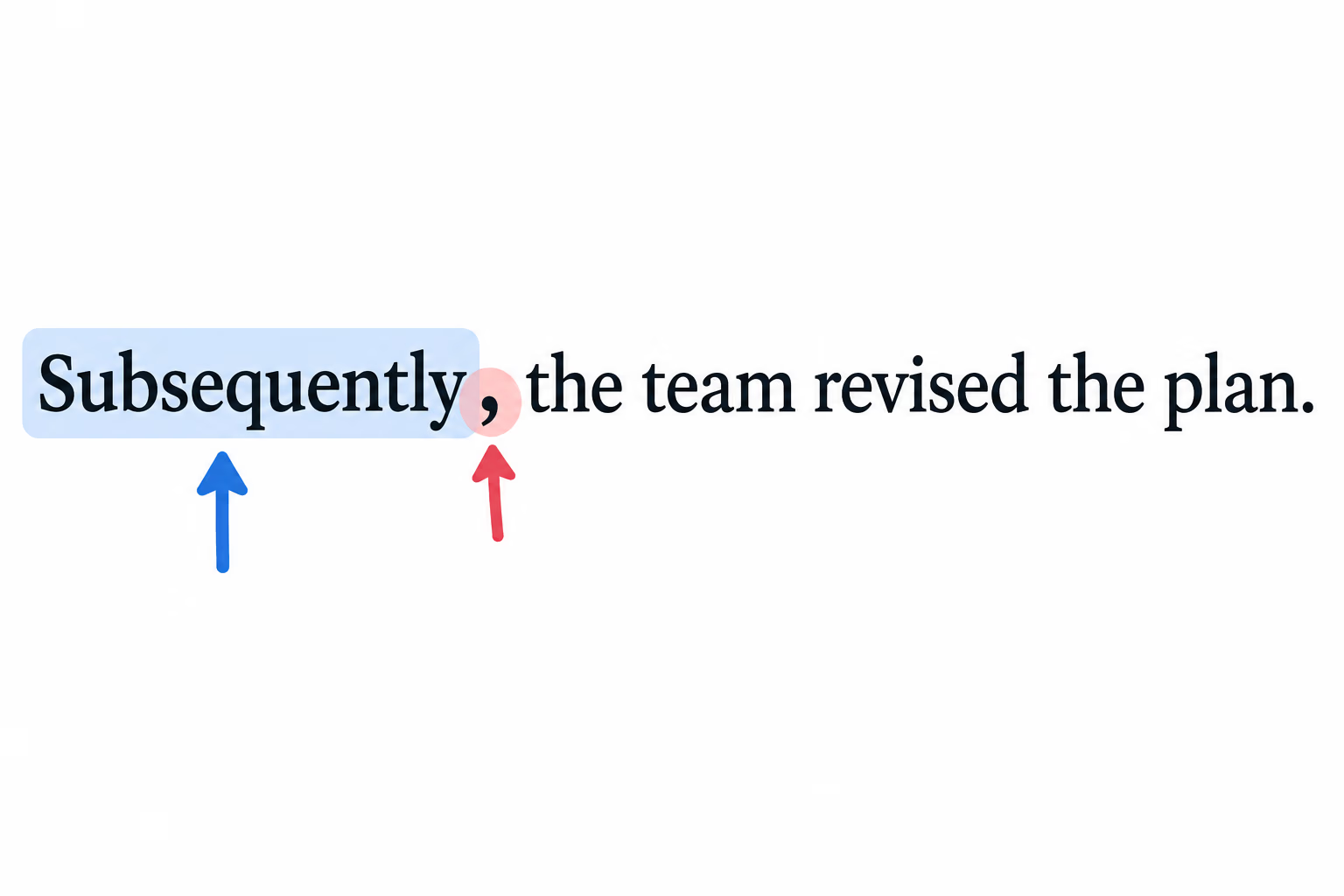
| Beginning | “Subsequently, the team revised the plan.” | A comma commonly follows the introductory adverb. |
| Middle | “The team subsequently revised the plan.” | No comma is needed around the adverb. |
| End | “The team revised the plan subsequently.” | No comma is normally needed before it. |
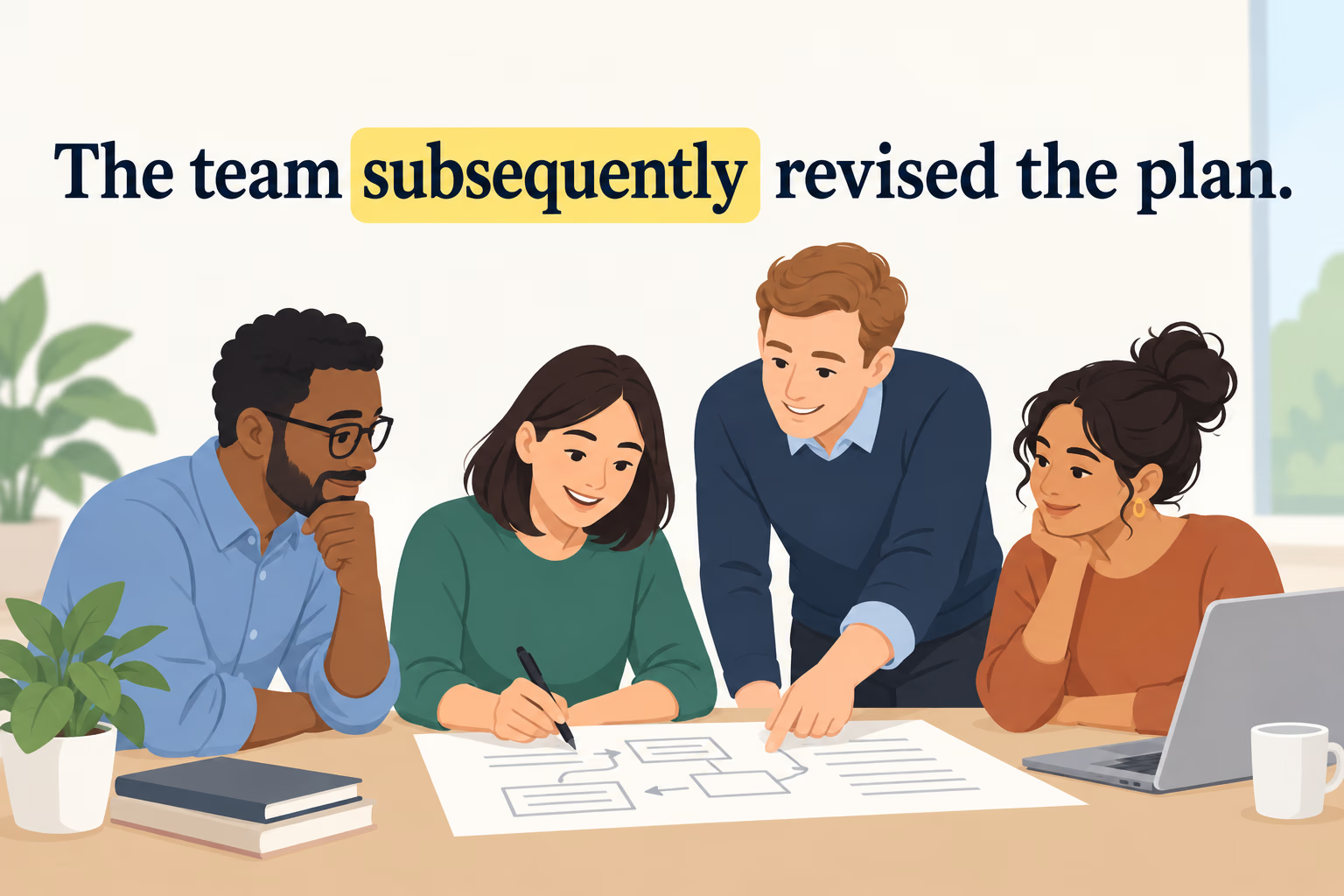
At the start of a sentence, a comma helps mark subsequently as an introductory transition: “Subsequently, the team revised the plan.” In mid position—“The team subsequently revised the plan”—it simply modifies the verb phrase and is not set off with commas. A final position is grammatical, though it may sound more formal or less natural than later or afterward.
Comma use when “subsequently” links two clauses
A comma alone cannot join two complete sentences. If the word introduces a second independent clause, connect the clauses with a semicolon or a coordinating conjunction:
- Semicolon: “The team reviewed the plan; subsequently, it revised the budget.”
- With a conjunction: “The team reviewed the plan and subsequently revised the budget.”
- Separate sentences: “The team reviewed the plan. Subsequently, it revised the budget.”
By contrast, a comma can separate an introductory word from the clause that follows it: “Subsequently, the team revised the budget.” In the original examples below, some sentences place a comma between two complete clauses before subsequently. Those lines remain here exactly as published in the source; use the patterns above when writing a new sentence.
“Subsequently” vs. “afterward,” “then,” and “subsequent”
| Word or phrase | Part of speech | Typical use | Example |
|---|---|---|---|
| subsequently | adverb | Formal or neutral reference to a later event | “The report was subsequently revised.” |
| afterward / afterwards | adverb | Everyday alternative meaning later | “They spoke afterward.” |
| then | adverb | Marks the next step, often in a sequence of instructions or events | “Check the total, then submit the form.” |
| subsequent | adjective | Describes a later noun | “A subsequent review found an error.” |
Use subsequently to modify an action or clause, and subsequent before a noun. “The subsequent meeting” is correct; “the subsequently meeting” is not. Afterward is often a plainer choice in conversation. Subsequently can suit reports, instructions, and formal explanations, but repeating it in every sentence can make prose sound stiff.
Common mistakes to avoid
- Implying cause from sequence alone: “The file was uploaded and subsequently the server slowed down” establishes order, not proof that the upload caused the slowdown. Use a causal connector only when the evidence supports it.
- Creating a comma splice: “The review ended, subsequently, the group voted” joins two independent clauses with a comma. Use a semicolon, add a conjunction, or make two sentences.
- Adding an unnecessary comma in mid position: Write “The group subsequently voted,” without commas around the adverb.
- Confusing the adjective and adverb: Use “a subsequent meeting,” but “the group met subsequently.”
- Using “subsequently to” before a noun: In ordinary modern usage, use subsequent to before a noun phrase (“subsequent to the meeting”) or the simpler after the meeting. Use subsequently as an adverb (“The group met subsequently”).
- Leaving the earlier event unstated: If readers cannot tell what came before, name the earlier action or choose a more direct time phrase.
Frequently asked questions
Does “subsequently” mean the same as “afterward”?
Both refer to something happening later. Subsequently is often more formal; afterward or afterwards is usually more conversational.
Should I put a comma after “subsequently”?
Often, when it begins a sentence as an introductory transition: “Subsequently, the records were checked.” No comma is usually needed when it appears between the subject and verb or at the end of a clause: “The records were subsequently checked.” Punctuation also depends on the sentence structure.
Does “subsequently” show cause and effect?
No. It shows that one event occurred later than another. A cause may be clear from surrounding facts, but the adverb itself does not establish causation.
Can “subsequently” start a sentence?
Yes. For example: “The archive was closed for repairs. Subsequently, researchers received access to a digital copy.” The adverb connects the new sentence to an earlier point in time.
Sources and usage note
Definitions and placement guidance were checked against the Cambridge English Dictionary entry for subsequently and Cambridge Grammar Today pages on adverb position, adverb functions, and adverb types. The new examples are original illustrations of the usage patterns explained above.
The full original article follows, including its examples and conclusion. Its wording is preserved exactly as the existing page had it; examples that use a comma between complete clauses are retained as part of that source text.
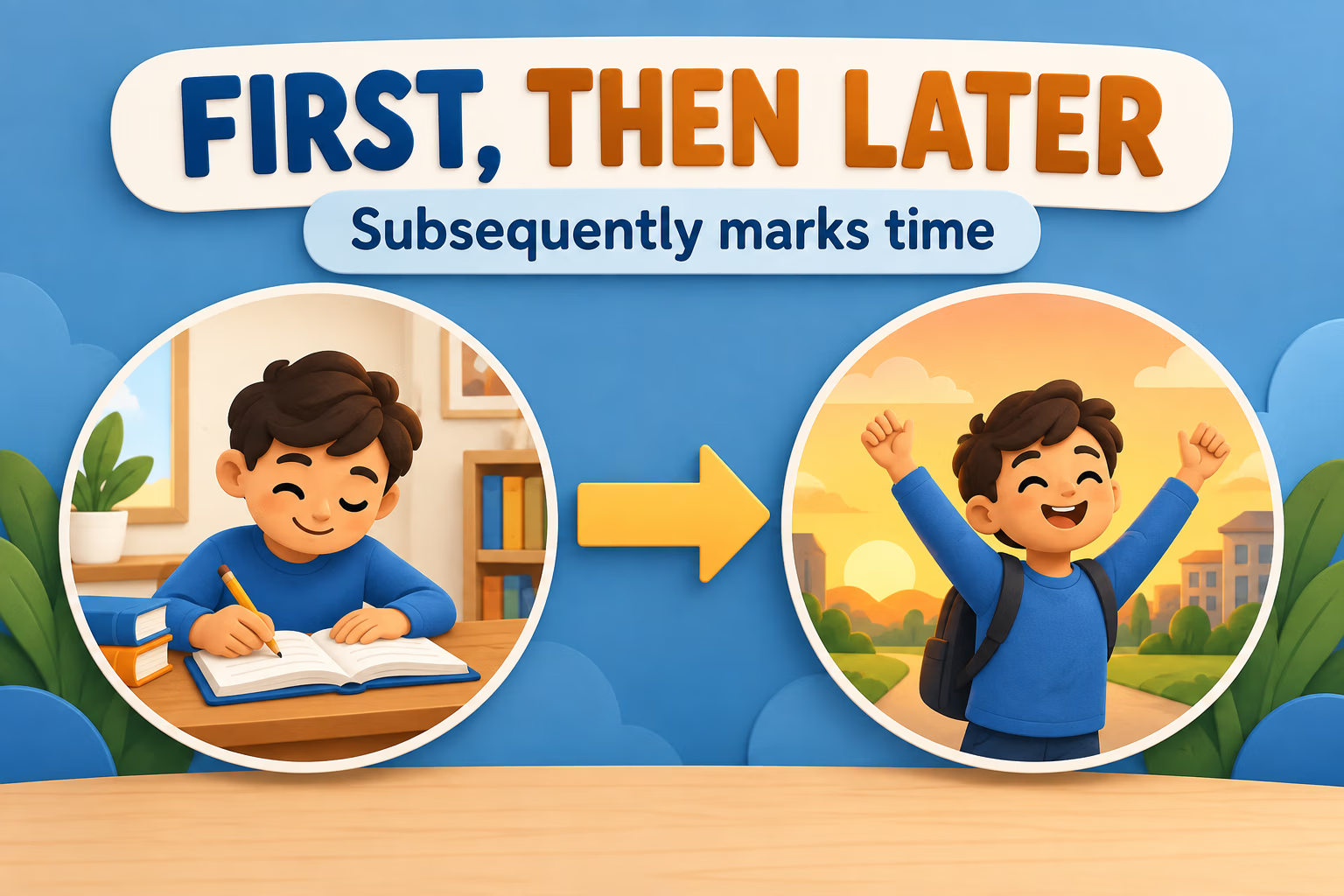

Have you ever struggled to connect different parts of your writing seamlessly? The word “subsequently” can be the key to linking ideas effectively in your sentences.
When you use the word “subsequently” in your writing, you are indicating a logical sequence or order of events. This transitional word helps in illustrating the cause-and-effect relationship between different actions or consequences, guiding your reader through the progression of your ideas.
7 Examples Of Subsequently Used In a Sentence For Kids
- I woke up late, subsequently missing the bus to school.
- It started raining heavily, subsequently making the roads muddy.
- She forgot her lunch at home, subsequently feeling hungry during break time.
- The teacher explained the lesson clearly, subsequently all the students understood it.
- He sharpened his pencil, subsequently starting his coloring assignment.
- The bell rang, subsequently signaling the end of the class.
- She finished her homework quickly, subsequently getting time to play with her friends.
14 Sentences with Subsequently Examples
- Subsequently, I joined the college debate team to improve my communication skills.
- I attended the workshop on resume writing and subsequently updated my CV.
- Subsequently, I started a study group with my classmates to help each other prepare for exams.
- After attending the career fair, I subsequently applied for several internships.
- I participated in the coding competition and subsequently improved my programming skills.
- Subsequently, I joined the photography club to explore my passion for photography.
- I attended the seminar on time management and subsequently devised a study schedule.
- After failing the exam, I sought guidance from my professors and subsequently improved my grades.
- Subsequently, I volunteered for a social cause to give back to the community.
- I attended the networking event and subsequently connected with professionals in my field of interest.
- After attending the career counseling session, I subsequently switched my major to align with my passion.
- Subsequently, I started a fitness regime to maintain a healthy lifestyle.
- I attended the workshop on stress management and subsequently incorporated meditation into my daily routine.
- After receiving feedback on my project, I subsequently revised it to meet the requirements.
How To Use Subsequently in Sentences?
Subsequently means afterward or later on in time. It is a transition word that is used to show the order of events. Here is a helpful guide on how to use “subsequently” in a sentence:
-
Subsequently, we went to the store to buy some groceries.
This sentence shows that after one event (an unspecified action before going to the store), the next action was going to the store.
-
She studied hard for her exams, and subsequently, she received a high grade.
In this sentence, “subsequently” indicates that after studying hard, the result was receiving a high grade.
-
The company reported a drop in profits, and subsequently, many employees were laid off.
Here, “subsequently” connects the drop in profits to the subsequent action of laying off employees.
-
The weather forecast predicted rain in the morning; subsequently, the outdoor event was moved indoors.
This sentence illustrates that due to the predicted rain, the decision to move the event indoors was made afterward.
Remember, when using “subsequently,” make sure there is a clear sequence of events and that the second action follows the first. By incorporating this transition word into your writing, you can clearly indicate the order of occurrences in a sentence or text.
Conclusion
In conclusion, the effective use of transition words like “subsequently” in sentences can improve the flow of written communication, making it easier for readers to follow the sequence of events or ideas presented. By using “subsequently” to indicate a chronological order or cause-effect relationship between events, writers can create a clear and cohesive structure in their writing.
Furthermore, the use of transition words like “subsequently” can enhance the overall coherence and readability of a piece of writing, helping to maintain the reader’s engagement and understanding. Whether organizing a narrative, argument, or explanation, incorporating words like “subsequently” can assist in structuring the content in a logical and comprehensible manner.


