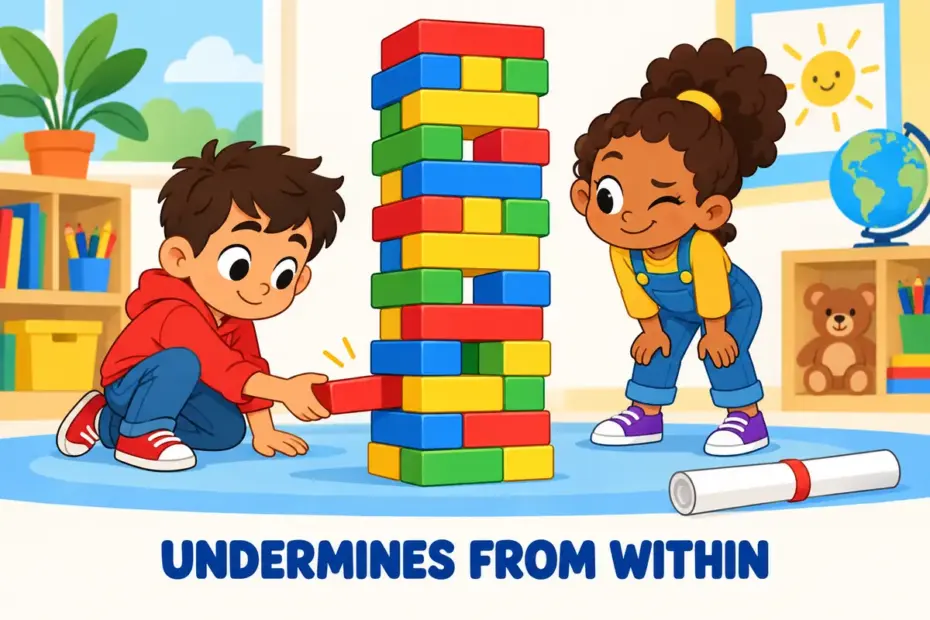
Subversive means intended to weaken or overthrow an established system from within. To use subversive in a sentence, connect it to the thing being undermined, as in a subversive pamphlet or a subversive reading of the law. The word carries a political charge, so it suits serious writing better than playful chat.
Subversive at a glance
- Subversive is an adjective and also a countable noun for a person who undermines a system.
- Its core sense is an attempt to weaken an authority or accepted order from inside.
- The typical pattern is subversive before a noun, as in subversive activity.
- The word belongs to political, legal and cultural criticism.
- The commonest error is using subversive for any disruption instead of a deliberate attack on a system.
What does subversive mean?
Subversive is an adjective meaning intended to undermine or overthrow an established system. The Cambridge Dictionary entry for subversive describes attempts to destroy the authority of a government, and the Merriam-Webster entry for subversive keeps the sense of working to overthrow something from within. Two shades matter. The first is political: a subversive group plots against a state. The second is cultural: a subversive joke quietly challenges a value an audience takes for granted. Subversive does not mean loud or violent, and it does not mean merely new. A reform that everyone welcomes is not subversive, because nothing is being undermined. When the attack is open and forceful, radical is often the more exact word, since it names deep change rather than the quiet erosion that subversive implies.
| Sense | Plain meaning | Example sentence |
|---|---|---|
| Weakening a system | Trying to undermine an authority or order | The pamphlet was banned as subversive. |
| Undermining beliefs | Challenging accepted ideas in a quiet way | Her subversive reading of the play unsettled the class. |
| Noun use | A person who tries to undermine a system | Officials labelled the editor a subversive. |
How do you use subversive in a sentence?
Subversive is usually attributive, sitting before the thing that undermines. The of-pattern and the noun use let you be more precise about what is attacked and who is doing it.
| Pattern | Example | What it signals |
|---|---|---|
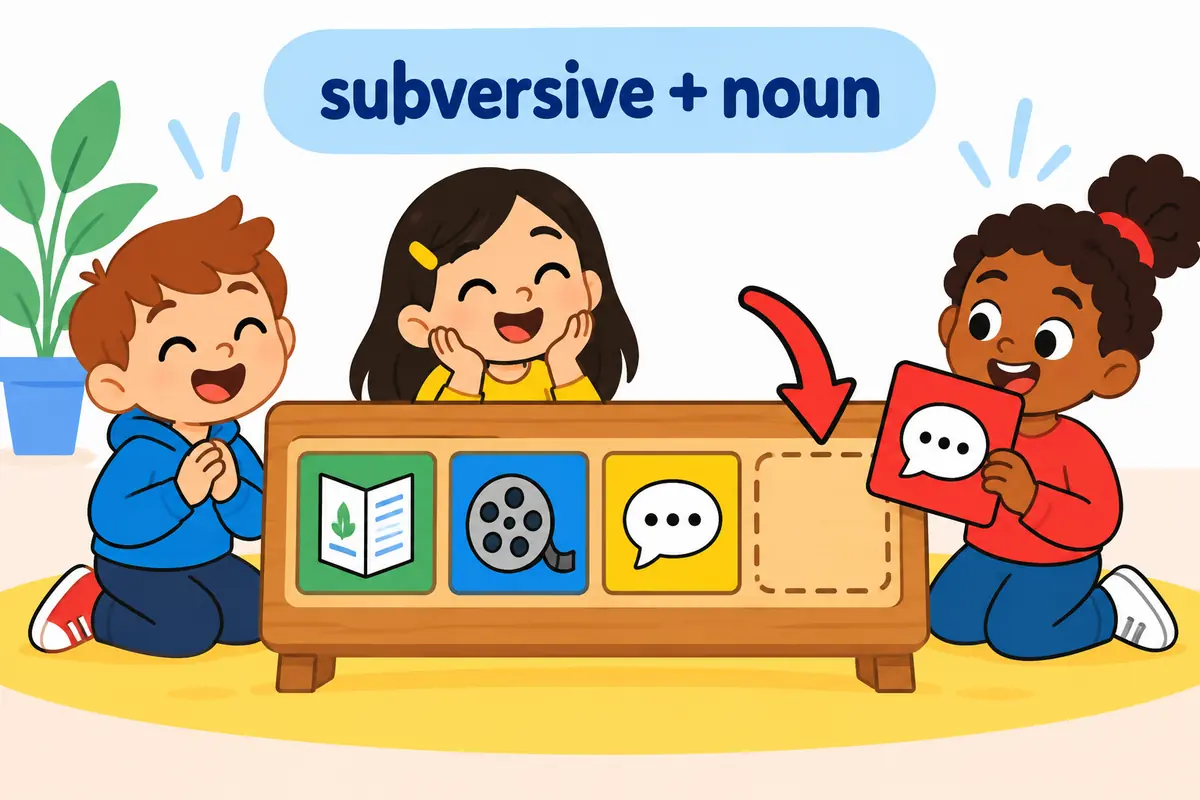
| subversive + noun | a subversive idea | The adjective labels the thing that undermines. |
| be + subversive | The song was quietly subversive. | The linking verb lets the adjective stand as a verdict. |
| subversive of + noun | a policy subversive of public trust | This formal pattern names what is undermined. |
| subversive + activity noun | subversive activity | A fixed phrase common in legal and official writing. |
| a subversive (noun) | They arrested a suspected subversive. | The same word doubles as a countable noun. |
Subversive in a sentence: examples across contexts
The word looks different depending on who is speaking. A teacher, a reporter and a lawyer each bend subversive to a particular purpose, and the reason column shows how.
| Context | Example sentence | Why this works |
|---|---|---|
| Classroom | The teacher called the poster quietly subversive of the school rules. | It names the rules as the target, not mere disobedience. |
| News report | Police accused the group of subversive activity. | Official reporting favours the fixed phrase subversive activity. |
| Film review | The comedy is subversive because it makes the audience cheer for the trickster. | It explains how art can undermine a value. |
| Workplace email | We should not treat every new idea as subversive. | The word warns against seeing ordinary change as a threat. |
| Academic writing | The novel offers a subversive reading of national history. | It signals a deliberate challenge to an accepted account. |
| Conversation | That joke was a bit subversive. | The linking-verb pattern keeps the judgement light. |
| Political speech | They described the reform as subversive of democratic order. | The of-pattern ties the accusation to a named principle. |
| Legal writing | The charge of subversive conspiracy was dropped. | Technical use keeps the word close to the statute. |
Subversive vs Disruptive
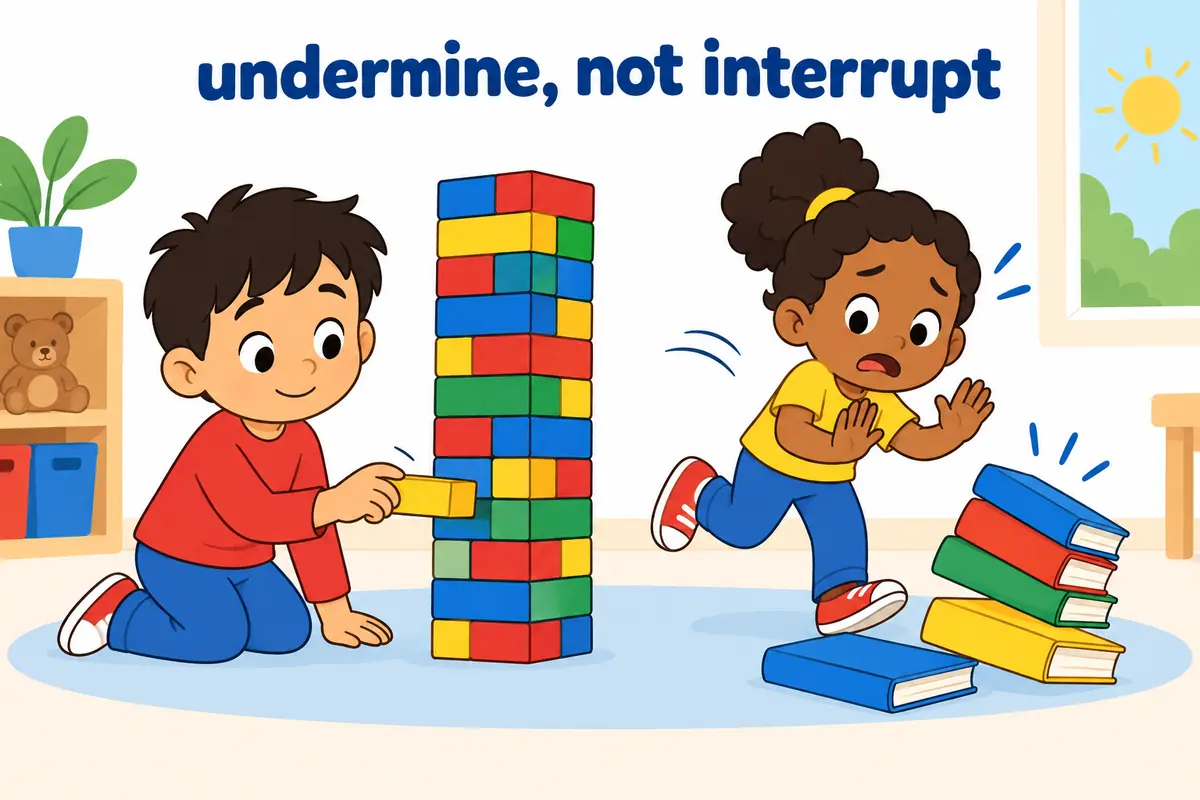
Subversive and disruptive are both negative, but they point in different directions. Subversive works against a system from within and usually carries intent; disruptive merely interrupts a process and is often accidental. Confusing them makes a mild delay sound like a plot.
| Attribute | Subversive | Disruptive |
|---|---|---|
| Core meaning | Intended to undermine an authority or system | Causing disorder or interruption |
| Direction | Works against a structure from within | Interrupts a process from outside |
| Intent | Usually deliberate and ideological | Often accidental or technical |
| Typical subject | idea, film, pamphlet, group | technology, pupil, storm, innovation |
| Register | Political and cultural criticism | Business, education, general |
| Example | a subversive cartoon that mocked the regime | a disruptive pupil who talked through the lesson |
Choose subversive when something quietly attacks a system and disruptive when it simply breaks the flow; a protest can be subversive, while a dropped call is merely disruptive, never subversive.
Word forms and grammar of subversive
The family keeps a clean split: subversive is the adjective and noun, subvert is the verb, and subversion names the act.
| Form | Part of speech | Example |
|---|---|---|
| subversive | adjective | a subversive pamphlet |
| subversive | noun | They jailed the subversive. |
| subversively | adverb | The play was subversively funny. |
| subversiveness | noun | the quiet subversiveness of the design |
| subversion | noun | the subversion of the old rules |
| subvert | verb | a bid to subvert the process |
Common mistakes with subversive
Each slip below confuses subversive with a weaker or stronger word. The rule explains why the original fails.
The new timetable was subversive because it arrived late.Correct: The new timetable was disruptive because it arrived late. Rule: lateness interrupts; only an attack on a system is subversive.He subversived the meeting.Correct: He subverted the meeting. Rule: the verb is subvert, not a back-formation from subversive.She was subversive with the rules.Correct: She was subversive of the rules. Rule: the formal pattern uses of, though quietly undermining the rules also works.The subversive weather ruined the picnic.Correct: The bad weather ruined the picnic. Rule: subversive describes deliberate undermining, never mere inconvenience.a subversion activityCorrect: subversive activity. Rule: the adjective is subversive and subversion is the noun.
Practice using subversive
Complete the items, then check each key against its reason.
- Fill in the blank: The novel was praised as ____ because it questioned the town’s founding story.
- Choose the better word: The storm was (subversive / disruptive) and closed the road for hours.
- Correct the error: They accused him of subversion activity.
- Build a sentence: use subversive plus of about a rule.
- Spot the register: Which belongs in a news report — “a subversive group” or “a trouble-making bunch”?
- Fill in the blank: The joke worked ____ by mocking the boss. (adverb)
Answers
- subversive — the novel quietly challenges an accepted story, which is the word’s core sense.
- disruptive — the storm interrupts travel, so subversive would wrongly suggest a deliberate attack.
- They accused him of subversive activity; subversion is the noun and subversive is the adjective needed before activity.
- Model answer: The rule was subversive of the club’s oldest tradition.
- “a subversive group” suits a formal report; the second phrase is too casual for a news bulletin.
- subversively — the adverb describes how the joke worked.
The bottom line
Subversive is an adjective for something that quietly attacks an established system, and the phrase subversive in a sentence usually places it before the thing doing the undermining, as in a subversive pamphlet. It is more specific than rebellious, because it names an effect on a system rather than a mood in a person. Choose disruptive when the trouble is only an interruption, and save subversive for a deliberate attempt to weaken authority.
Frequently asked questions about subversive
Can subversive be a noun?
Yes, subversive works as a countable noun for a person accused of undermining a system, as in the police watched the subversive. The noun use is common in legal and political writing and carries a heavy accusation. In everyday speech the adjective is far more frequent, so the noun can sound official.
Is subversive always about politics?
No. The strongest sense is political, but the word also describes art, humour and ideas that quietly challenge an accepted value. A subversive comedy undermines a belief rather than a government. The shared thread is an attack on an established order, not necessarily the state.
What is the opposite of subversive?
The closest opposites are loyal, orthodox and supportive, depending on what is being undermined. A loyal official supports the system; an orthodox view follows the accepted account. Because subversive implies an attack, its antonym must imply support or conformity rather than simple calm.
Is subversive formal or informal?
Subversive is formal and appears in journalism, law, academic writing and cultural criticism. In casual conversation it can sound dramatic, so speakers often say troublemaking instead. Use it when the idea of undermining an authority genuinely applies, and save it for writing that needs the precise charge of attacking an established order.
Have you ever come across a sentence with the word “subversive” and wondered what it truly means? In its essence, “subversive” refers to something that seeks to undermine or destabilize an established system or institution through challenging its norms or values.
This term is often used to describe actions, ideas, or individuals that aim to disrupt the status quo and provoke change by subverting conventional expectations or beliefs. Keep reading to explore various ways in which “subversive” can be utilized in different contexts and how it can impact society and culture.
7 Examples Of Subversive Used In a Sentence For Kids
- The squirrel acted subversive by stealing the bird’s food.
- The mischievous cat made a subversive plan to catch the mouse.
- The sneaky fox had a subversive idea to sneak into the hen house.
- The clever crow played a subversive trick on the owl.
- The adventurous rabbit had a subversive plan to explore the garden.
- The naughty monkey was caught being subversive by swinging on the vines.
- The playful puppy had a subversive scheme to dig up the garden.
14 Sentences with Subversive Examples
- The students organized a subversive protest against the university’s strict dress code policy.
- The discussion in the sociology class took a subversive turn when students began questioning societal norms.
- The student newspaper published a subversive article criticizing the administration’s lack of transparency.
- The film club screened a subversive documentary exposing government corruption.
- The literature professor encouraged students to explore subversive themes in their writing assignments.
- The debate club’s argument was considered subversive by some, as they challenged traditional beliefs.
- The student council proposed a subversive campaign to promote mental health awareness on campus.
- The art exhibition featured subversive installations challenging traditional notions of beauty.
- The economics professor’s lecture on income inequality was deemed subversive by conservative students.
- The music performance showcased subversive lyrics addressing social justice issues.
- The environmental club organized a subversive campaign to promote sustainable living practices.
- The student-led workshop on political activism was seen as subversive by some faculty members.
- The computer science project presented a subversive approach to addressing cybersecurity concerns.
- The student theater group’s production of a controversial play was criticized for its subversive content.
How To Use Subversive in Sentences?
To use Subversive in a sentence, follow these steps:
-
Understand the meaning: Subversive means seeking to undermine or overthrow established beliefs, customs, or institutions. It is often used to describe something that goes against the mainstream or challenges traditional norms.
-
Choose your context: Think about what you want to convey with the word Subversive in your sentence. It could be used to describe a person, an idea, an action, or a piece of art that defies conventions.
-
Construct your sentence: Start by introducing the subject that you find Subversive. For example, “The artist’s work was considered Subversive by many critics.”
-
Provide context or details: To give your sentence more depth, you can explain why the subject is Subversive. For instance, “Her paintings challenged societal norms and provoked thought on controversial issues.”
-
Practice using Subversive in different sentences to become more comfortable with its usage. Remember that clarity and context are key to effectively conveying the meaning of the word.
In summary, using Subversive in a sentence involves understanding its meaning, selecting an appropriate context, constructing the sentence, providing context or details, and practicing to improve your usage. Experiment with incorporating Subversive into your vocabulary to express ideas that challenge the status quo.
Conclusion
In conclusion, subversive sentences have the power to challenge societal norms, provoke critical thinking, and incite change. Whether through humor, irony, or outright defiance, these sentences aim to disrupt the status quo and question established authorities. By subverting expectations and exposing the contradictions present in our culture, they serve as a tool for rebellion and resistance.
Through clever wordplay, juxtaposition of ideas, and unconventional perspectives, subversive sentences challenge us to reconsider our assumptions and approach familiar subjects from new angles. They encourage us to think outside the box, question authority, and inspire us to imagine a world beyond the confines of the known. In a society that often values conformity, subversive sentences offer a refreshing departure from the ordinary and invite us to embrace the power of dissent and creative dissent.


