
Surmount means to overcome a difficulty or obstacle, and more literally to rise above or sit on top of something. To use surmount in a sentence, name the barrier as the object: “She surmounted every objection.” The verb is transitive and formal, so it suits reports and essays better than everyday talk.
Surmount at a glance
- Surmount is a transitive verb; its forms are surmounts, surmounted and surmounting.
- The main sense is to overcome a difficulty, obstacle or objection.
- A second sense means to be on top of, as in a dome surmounted by a statue.
- The verb is formal and belongs in reports, essays and historical writing.
- The commonest error is confusing surmount with surpass, which means to exceed.
What does surmount mean?
Surmount is a transitive verb meaning to overcome something difficult, such as an obstacle, a fear or an objection. The Cambridge entry for surmount records this sense alongside the physical one. The physical sense survives in the passive phrase surmounted by, where a feature sits on top of a structure.
| Sense | Plain meaning | Example sentence |
|---|---|---|
| Overcome | Deal successfully with a difficulty | The team surmounted every early setback. |
| Rise above | Get past a physical barrier | They surmounted the ridge before noon. |
| Topped by | Have something sitting on top, in the passive | The gate is surmounted by a stone arch. |
One limitation is worth stating plainly. Surmount is the wrong choice for a small everyday problem. A learner who surmounted a spelling test sounds absurd, because the verb implies a difficulty of real size; for minor issues, use get past or handle.
How do you use surmount in a sentence?
The barrier is always the object, and the passive form carries the physical sense. Five patterns cover almost every real sentence.
| Pattern | Example | What it signals |
|---|---|---|
| subject + surmount + obstacle | The climbers surmounted the final wall. | Transitive; the barrier is the object. |
| surmount + a difficulty | She surmounted a fear of public speaking. | Abstract obstacles work the same way. |
| be surmounted by + feature | The tower is surmounted by a golden dome. | Passive physical sense: topped by. |
| surmount + objection | The plan surmounted every objection. | Formal, common in reports. |
| adverb + surmount | The scheme successfully surmounted the review. | An adverb sits before or after the verb. |
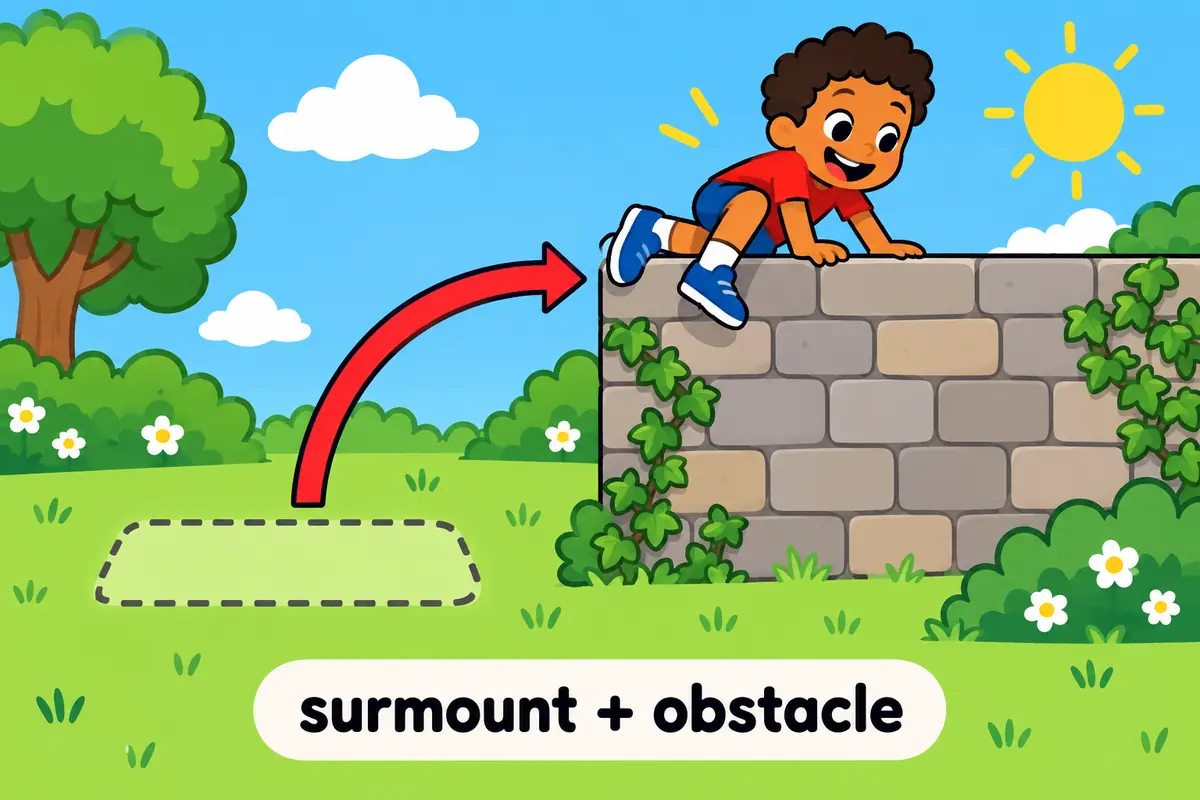
Naming the barrier is what keeps the sentence concrete, because a hurdle is the obstacle itself, the noun that surmount most often takes as its object.
Surmount in a sentence: examples across contexts
Surmount ranges from a classroom to a biography, and the object decides how formal it sounds. The nine sentences below move from a school test to a stone gateway, and each names the barrier that was beaten. A barrier is easier to conquer when it is named.
| Context | Example sentence | Why this works |
|---|---|---|
| Classroom | The class surmounted its fear of the science test. | A formal verb in a school context. |
| News report | The rescue team surmounted steep ice to reach the hut. | Physical and formal reporting. |
| Workplace email | We surmounted the supply delay by rerouting the order. | Formal project language. |
| Sports column | The champions surmounted a two-goal deficit. | The overcome sense in sport. |
| Academic prose | The study surmounted the usual problems of small samples. | Formal essay register. |
| History essay | Reformers surmounted fierce opposition in the senate. | Political obstacle in narration. |
| Architecture | The gateway is surmounted by a carved lion. | The passive topped-by sense. |
| Conversation | We finally surmounted the paperwork. | Slightly formal but usable in speech. |
| Biography | She surmounted poverty and prejudice to qualify. | Life obstacles in formal writing. |
The passive sense is the one to watch. When a building is surmounted by a dome, nothing has been overcome; the dome simply sits on top, which is why the passive is required.
Surmount vs overcome
Surmount and overcome overlap almost completely in meaning, and the choice comes down to size and register.
| Attribute | surmount | overcome |
|---|---|---|
| Core meaning | Overcome a large obstacle, often by effort | Deal with or defeat something |
| Register | Formal | Neutral |
| Obstacle size | Implies a barrier of real size | Any size |
| Usual object | Obstacles, objections, fears | Problems, difficulties, a rival |
| Physical sense | Yes, in the passive be surmounted by | No |
| Frequency | Uncommon outside formal writing | Very common |
Verdict: choose overcome for everyday problems in any register, and surmount only when the barrier is genuinely large and the tone is formal.
Word forms and grammar of surmount
Surmount inflects regularly and builds two useful adjectives, one positive and one negative. The past participle surmounted does double duty in the passive physical sense.
| Form | Part of speech | Example |
|---|---|---|
| surmount | base verb | They hope to surmount the delay. |
| surmounts | third-person singular | She surmounts each hurdle calmly. |
| surmounted | past and past participle | The crew surmounted the ridge; the pillar is surmounted by a bowl. |
| surmounting | present participle | Surmounting the last obstacle took a week. |
| surmountable | adjective | The remaining problems are surmountable. |
| insurmountable | adjective | The cost proved insurmountable. |
The negative adjective insurmountable is far more common than the positive surmountable, and it is the form most readers meet first. Both adjectives take the prefix un- only in the negative, never a separate not.
Common mistakes with surmount
- Incorrect:
The team surmounted.Correct: The team surmounted the setback. Rule: Surmount is transitive, so the obstacle must be stated. - Incorrect:
She surmounted to the summit.Correct: She surmounted the summit. Rule: Surmount takes a direct object, not to. - Incorrect:
The delay was very surmount.Correct: The delay was surmountable. Rule: Use the adjective surmountable, not the base verb. - Incorrect:
He surmounted that the budget was too small.Correct: He surmounted the budget problem. Rule: Surmount takes a noun phrase, never a that-clause. - Incorrect:
The tower is surmounting a dome.Correct: The tower is surmounted by a dome. Rule: The physical sense uses be surmounted by, not a progressive.
Practice using surmount
Work through the six items, then check the reasoning rather than only the answer.
- Fill the gap: The crew ______ every difficulty to reach the summit.
- Choose the better word: The repair bill was high but (surmountable / insurmountable).
- Correct the error: They surmounted to the highest wall.
- Build a sentence: use be surmounted by about a gateway and a clock.
- Spot the register: which fits an academic essay — the study surmounted the sampling problem, or the study got past the sampling problem?
- Rewrite with the noun phrase: He surmounted that the road was closed. Fix the object.
Answers
- surmounted — the difficulty is the direct object of the transitive verb.
- surmountable — the bill was high but could be overcome, so the positive adjective fits.
- They surmounted the highest wall — surmount takes a direct object, not a to-phrase.
- Model answer: The stone gateway is surmounted by a round clock that still keeps time.
- The study surmounted the sampling problem — the formal essay keeps the formal verb.
- He surmounted the road closure — surmount needs a noun phrase, and the clause becomes a noun.
The bottom line
Use surmount in a sentence when the object is a real obstacle and the writing is formal, and let the barrier sit directly after the verb. The two nuances that decide most sentences are these: surmount is transitive, so it always names what was overcome, and its passive form be surmounted by means topped by rather than defeated. Where the difficulty is small or the register is relaxed, overcome is the safer verb, while a side that gives in instead will succumb.
Frequently asked questions about surmount
What part of speech is surmount?
Surmount is a transitive verb, so it always takes a direct object such as an obstacle, a fear or an objection. It inflects regularly as surmounts, surmounted and surmounting. The related adjectives are surmountable and insurmountable, and the negative insurmountable is far more common than the positive form.
Can surmount mean to be on top of something?
Yes, though only in the passive phrase be surmounted by. A dome surmounted by a statue means the statue sits on top of the dome. This physical sense is common in architecture and descriptions of buildings, and it is completely different from the overcome sense, where something difficult is defeated.
Is surmount the same as surpass?
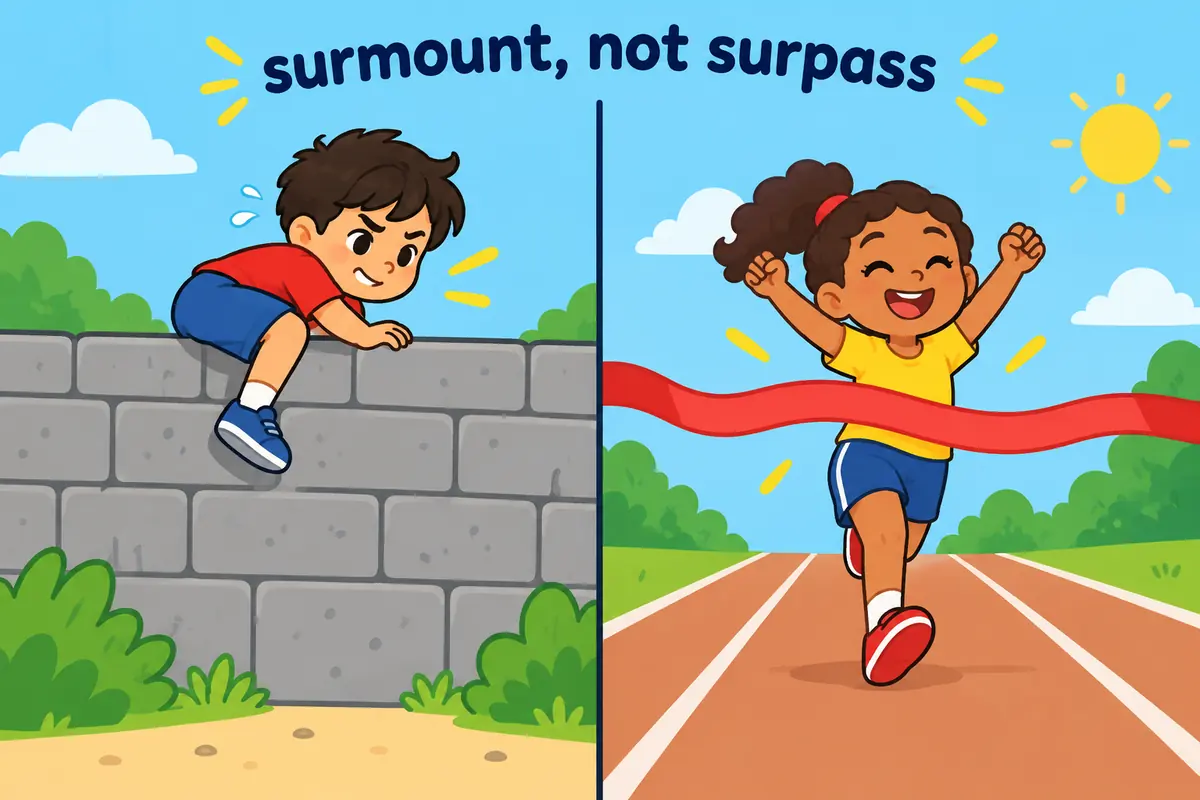
No. Surmount means to overcome a difficulty, while surpass means to go beyond or exceed something, as in sales surpassed the forecast. Surmount takes an obstacle as its object, and surpass takes a figure, a record or a rival. The two are easy to mix because both sound formal.
Does surmount take an object?
Yes. Surmount is transitive, so it needs a direct object naming what was overcome, as in she surmounted every objection. A sentence such as the team surmounted feels unfinished because the barrier is missing. For a noun clause, reword it, since surmount cannot be followed by that.
Surmount means to overcome a difficulty successfully or to stand above and top something. In “The team surmounted a setback,” it means overcome; in “A statue surmounted the column,” it means stood on top. The verb is formal, transitive, and usually takes a direct object.
Key facts at a glance
- Surmount has two common meanings: overcome a difficulty or be positioned above and top something.
- The verb is transitive: writers usually name the obstacle or object being surmounted.
- Common patterns include surmount a challenge and be surmounted by a statue.
- Surmount is more formal than get over and does not mean exactly the same as surpass.
What does surmount mean?
Surmount means to overcome a problem or difficulty, or to be on top of something tall. In “Maya surmounted her fear of public speaking,” she dealt successfully with a challenge. In “The arch was surmounted by a stone crest,” the crest sat at the top of the arch.
The first meaning is common in formal writing about obstacles, objections, or challenges. The second often appears in descriptions of buildings, monuments, and shapes. Context tells readers which sense is intended.
How do you use surmount in a sentence?
Use surmount with a direct object that names the obstacle or structure: “They surmounted the final hurdle,” or “A bronze figure surmounted the entrance.” In passive constructions, use be surmounted by plus the object on top: “The gate was surmounted by an iron ornament.”
| Pattern | Example | Meaning |
|---|---|---|
| surmount + challenge | She surmounted a difficult delay. | overcame |
| surmount + physical object | A cross surmounted the roof. | stood above |
| be surmounted by + noun | The pillar was surmounted by a lamp. | was topped by |

Which verb forms and synonyms are useful?
The main forms are surmount, surmounts, surmounted, and surmounting; the adjective surmountable means possible to overcome. Use overcome for a familiar, broad alternative, conquer for a more forceful tone, or top when the meaning is physical position.
Surpass usually means exceed or be better than something, so it is not a direct synonym in every sentence. A person may surpass a record but surmount an obstacle. Choosing the exact verb makes the relationship clearer.

When does surmount sound natural?
Surmount sounds natural in formal essays, reports, biographies, and architectural descriptions. It can make everyday speech sound elevated, so “overcome” or “get past” may be smoother in a casual conversation. Use the verb when its formal tone fits the audience and the object is clear.
A useful editing check is to ask whether the sentence describes a difficulty being overcome or a feature standing on top of something. If neither relation applies, another verb is probably more precise. The word also does not guarantee that every obstacle can be solved; describe the actual outcome rather than using it as a promise.
Frequently asked questions
What is a simple sentence with surmount?
“The hikers surmounted the steep ridge before sunset” is a simple sentence with surmounted meaning overcame or got past an obstacle. A physical example is “A stone lion surmounted the gate,” where the lion sat at the top. The object clarifies the intended meaning.
Is surmount a formal word?
Yes. Surmount is more formal than everyday choices such as overcome or get past. It fits essays, reports, biographies, and architectural description. In casual speech, choose a simpler verb unless the elevated tone is intentional and the sentence remains easy to understand.
What is the difference between surmount and surpass?
Surmount usually means overcome a challenge or sit on top of something; surpass means exceed a level, amount, or achievement. A runner can surpass a record, while a team can surmount an injury setback. Their meanings overlap only in limited contexts.
What does surmounted by mean?
Surmounted by means topped by or positioned above something. “The tower was surmounted by a weather vane” says the vane stood on the tower’s top. The phrase is often used in formal descriptions of buildings, monuments, crests, and other structures.
Conclusion
Use surmount when a person or group overcomes a named difficulty, or when an object sits on top of a structure. The verb’s formal tone suits careful writing; choose overcome, top, or surpass when those words state the relationship more precisely.
Have you ever found yourself facing a challenge that seemed insurmountable? The word “surmount” refers to overcoming a difficulty or obstacle, often by successfully navigating through it or finding a way to conquer it.
In everyday life, we encounter various obstacles that we must surmount, whether it be a daunting task at work, a personal hardship, or a difficult decision to make. Learning how to surmount obstacles can help us grow stronger, more resilient, and better prepared to handle whatever challenges come our way.
7 Examples Of Surmount Used In a Sentence For Kids
- You can surmount the hurdles with hard work.
- With practice, you can surmount any challenge.
- Let’s work together to surmount this problem.
- I believe you can surmount any difficulty.
- Remember to keep trying and you will surmount the obstacles.
- Use your problem-solving skills to surmount the task.
- Keep a positive attitude and you can surmount anything.
14 Sentences with Surmount Examples
- Surmount your fear of public speaking by joining a debate club on campus.
- Make a study schedule to surmount the challenge of balancing multiple assignments and exams.
- Surmount the language barrier by practicing English with your classmates and watching movies in English.
- Joining a study group can help you surmount difficult subjects like calculus or computer programming.
- Use time management techniques to help you surmount the challenge of procrastination and late submissions.
- Surmount the stress of exams by practicing mindfulness meditation and deep breathing exercises.
- Seek help from your professors or tutors to surmount any academic difficulties you may be facing.
- Joining a sports team or gym can help you surmount the challenge of sitting for long hours while studying.
- Surmount peer pressure by staying true to your values and making decisions that align with your goals.
- Take leadership roles in student organizations to surmount the challenge of shyness and social anxiety.
- Surmount financial obstacles by applying for scholarships, grants, and part-time jobs that can help cover your expenses.
- Surmount the feeling of homesickness by building a strong support system of friends and fellow students.
- Seek professional help from counselors or therapists to surmount mental health challenges like anxiety or depression.
- Develop effective study habits and techniques to help you surmount the challenge of information overload during exams.
How To Use Surmount in Sentences?
Surmount means to overcome a difficulty or obstacle.
To use Surmount in a sentence, follow these steps:
1. Identify a challenge or obstacle that you or someone else has faced. For example, “She needed to surmount her fear of public speaking.”
2. Insert Surmount into the sentence in the appropriate context. For instance, “With determination and practice, she was able to surmount her fear of public speaking and deliver a confident presentation.”
3. Make sure that Surmount is placed in a grammatically correct position within the sentence. It is usually used as a verb.
4. Check that the sentence conveys the meaning of overcoming a difficulty or obstacle successfully.
5. Reread the sentence to ensure clarity and coherence.
6. Practice using Surmount in different sentences to become more comfortable with its usage.
Remember, the key to mastering any new word is to practice using it regularly. By following these steps and incorporating Surmount into your vocabulary, you will be able to communicate effectively and confidently.
Conclusion
In conclusion, the examples of sentences with “surmount” illustrate the concept of overcoming challenges or obstacles. Whether it is a physical barrier, mental block, or societal constraint, the word “surmount” conveys the idea of conquering difficulties with determination and resilience. These sentences highlight the power of perseverance and the ability to rise above adversity through effort and courage.
By examining how “surmount” is used in sentences, we gain insight into the importance of facing obstacles head-on and not letting barriers hinder progress. It serves as a reminder that with the right mindset and action, even the most daunting challenges can be overcome. The examples provided showcase the transformative power of perseverance, urging us to approach difficulties with a positive attitude and a determination to surmount them.


