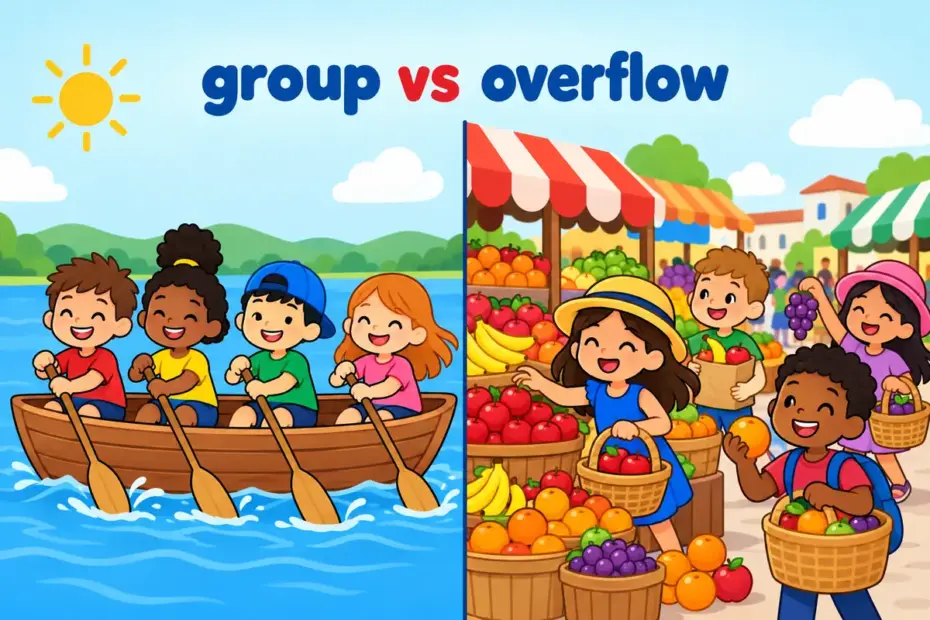
Team vs teem is the choice between a group that works together and a verb meaning to be full of something. Use team for the people or the act of joining forces, and teem when you mean swarming or overflowing, almost always in the pattern teem with. A rowing team practises at dawn; a market teems with shoppers on Saturday.
Team vs teem at a glance
- Team is a noun for a group and a verb for joining forces; teem is a verb meaning to be full of or swarm.
- Both are pronounced the same, which is why they are so often confused in writing.
- Team often takes up or with; teem almost always takes with.
- Team describes people or the act of uniting; teem describes a place or thing that overflows.
- Teem is the more formal and literary word, common in nature and travel writing.
- The commonest error is writing teaming with when the meaning is teeming with.
Team vs teem: the master comparison
The two words sound identical, so only the grammar and the meaning separate them. The table below scores both on the criteria that settle a real sentence.
| Attribute | team | teem |
|---|---|---|
| Part of speech | Noun and verb | Verb only |
| Pronunciation | teem | teem |
| Core meaning | A group, or to join together | To be full of, to swarm |
| Usual pattern | team up with, team with, a team of | teem with, be teeming with |
| Typical subject | People, players, colleagues | Places, markets, waters, crowds |
| Register | Neutral and everyday | Literary, nature and travel writing |
| Most common error | Using team for a crowd of things | Spelling it teaming with |
| Memory hook | Team has an a, as in a group | Teem has two e’s, as in a swarm of bees |
What do team and teem mean?
Team is a noun meaning a group of people who work or play together, and a verb meaning to join with others or to match items. The Cambridge entry for team covers both. Teem is a verb meaning to be full of moving things, and the Cambridge entry for teem ties it to the fixed pattern teem with. One word counts people, the other describes abundance.
| Word | Part of speech | Core meaning | Example sentence |
|---|---|---|---|
| team | noun | A group working together | The design team meets on Mondays. |
| team | verb | Join together or match | She teamed a linen jacket with old jeans. |
| teem | verb | Be full of moving things | The rock pool teems with tiny crabs. |
The dedicated team page explores the group sense on its own, and the teem page drills the with pattern in more detail.
One limitation is worth stating plainly. Teem is rarely used without with, and it never means to gather people into a group, which is team’s job. Team, for its part, cannot describe a place overflowing with things, so the two are not interchangeable in either direction. A quick test is to try the word up: if you can team up with a colleague, the noun or verb team is right, while a street teems with people and never teams up.
How do you use team and teem in a sentence?
Team works as a noun, as a verb with up or with, and in the phrase a team of. Teem works only as a verb, and it normally needs with to name what fills the place. If you can drop with and keep the sense, you probably want team instead.
| Pattern | Example | What it signals |
|---|---|---|
| a team of + noun | A team of nurses covered the night shift. | Names a working group. |
| team up with + person | We teamed up with the local choir. | Joining forces for a shared task. |
| team + object + with + object | He teamed a grey tie with a blue shirt. | Matching two things together. |
| teem with + noun | The harbour teems with small boats in summer. | A place full of moving things. |
| be teeming with + noun | The garden is teeming with bees. | Continuous, lively abundance. |
When the idea is simply plenty rather than swarming, the commoner words are abound and full of.
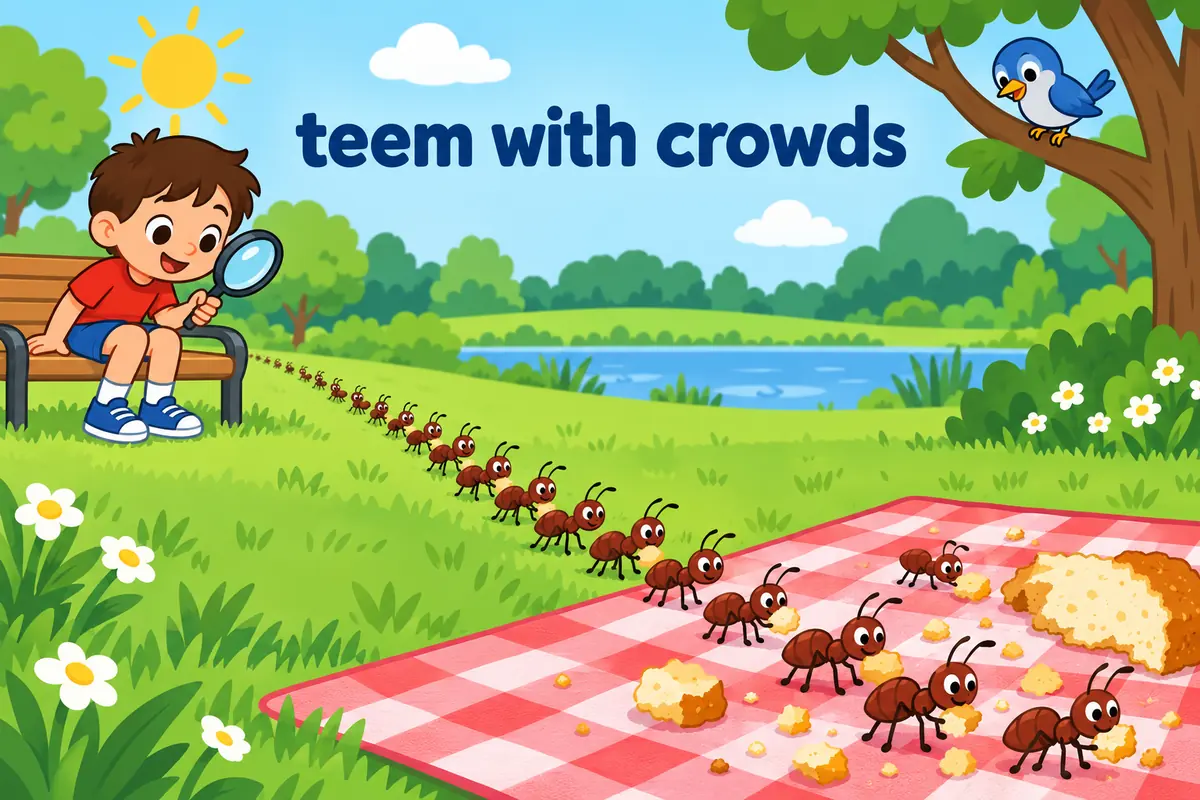
Team and teem in a sentence: examples across contexts
The ten sentences below keep the group sense and the abundance sense apart, so the contrast survives in every register.
| Context | Example sentence | Why this works |
|---|---|---|
| Sports writing | The team trains together every morning. | Team names the group directly. |
| Workplace email | I teamed up with the finance group on the audit. | Team as a verb needs up with. |
| Nature writing | The marsh teems with frogs after rain. | Teem with describes a place full of life. |
| News report | The square teemed with protesters by noon. | Teem paints a moving crowd filling a space. |
| Fashion writing | She teams bold prints with plain shoes. | Team as a verb can match two items. |
| Travel writing | The old quarter teems with tiny workshops. | Literary register suits teem. |
| Conversation | Our team is short of a goalkeeper. | Team as a noun stays everyday. |
| Academic prose | The reef teems with species found nowhere else. | Teem fits scientific description of abundance. |
| Marketing copy | The festival team has grown to forty people. | Team counts people, not things. |
| Historical writing | The docks once teemed with cargo ships. | Teem in the past tense describes a busy era. |
| Broadcasting | The studio teemed with technicians before the live show. | A workplace full of moving people suits teem. |
| Cooking | The kitchen teams two cooks on every station. | Team as a verb can pair people as well as things. |
Which should you use?
Decide first whether the subject is people or abundance, then check the pattern. The table maps five common situations to a firm recommendation.
| Situation | Better word | Why |
|---|---|---|
| Naming the people on a project | team | A countable group of people is the noun team. |
| Saying a market is packed with shoppers | teem | The place is full of moving people, so teem with fits. |
| Joining forces with another group | team | The verb team up with expresses the partnership. |
| Describing a river full of fish | teem | Abundance in a place is the core sense of teem. |
| Matching a jacket with trousers | team | The matching sense belongs to the verb team. |
Verdict: choose team when people or matching are involved, and teem when a place overflows. If the word with can follow, you almost certainly want teem; if the word up can follow, you almost certainly want team.
Word forms and grammar of team and teem
Both words inflect regularly, and the spelling difference is the trap: the -ing form of teem is teeming, not teaming. The table flags the form learners build by mistake.
| Form | Part of speech | Example |
|---|---|---|
| team | noun, singular | One team can change a season. |
| teams | noun, plural or verb third person | Both teams agreed to replay. |
| teamed | verb, past | They teamed up for the charity run. |
| teaming | verb, present participle | She is teaming with a new partner. |
| teem | verb, base | The ponds teem with insect life. |
| teeming | verb, present participle | The beach was teeming with children. |
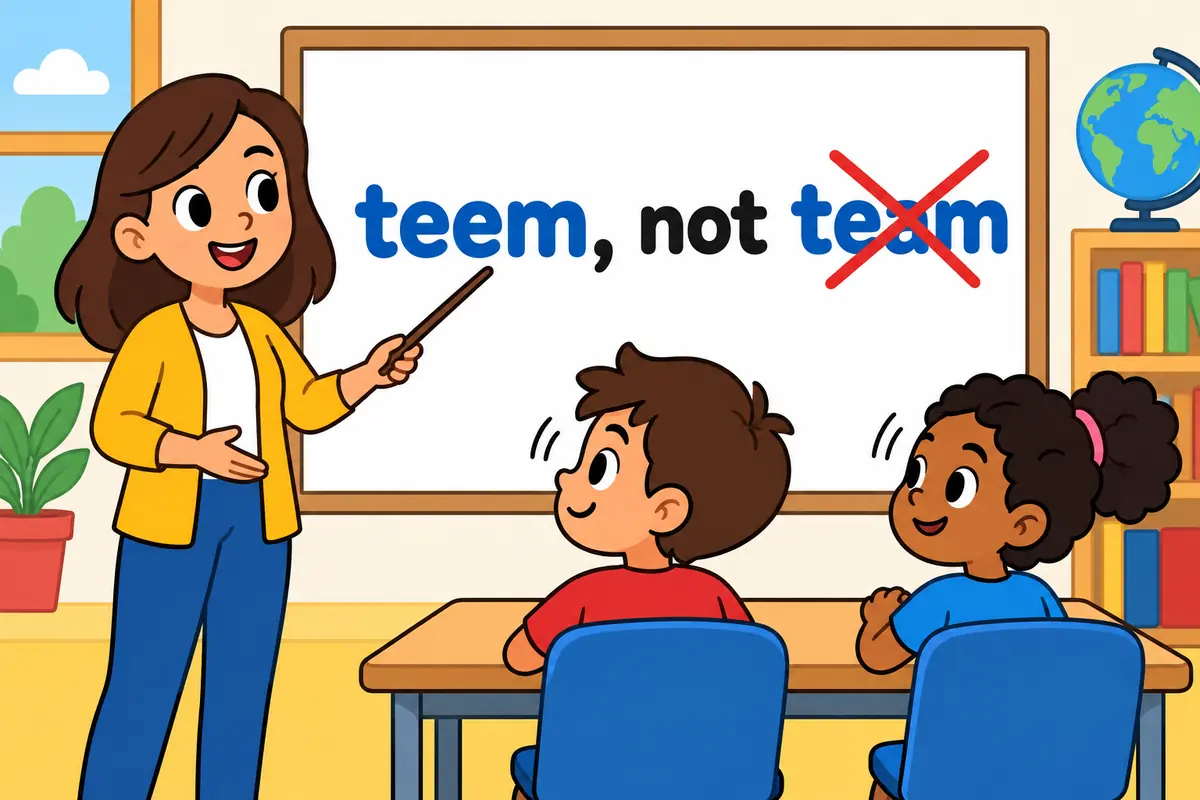
| teaming with | non-standard for teeming with | Avoid teaming with crowds; write teeming with crowds. |
The adjective swarm covers a similar crowd of insects, and brim describes a container filled to the edge.
Common mistakes with team and teem
- Incorrect:
The square was teaming with visitors.Correct: The square was teeming with visitors. Rule: Full of moving people is teem; teaming only means joining a group. - Incorrect:
The lake teems fish.Correct: The lake teems with fish. Rule: Teem needs with before what fills the place. - Incorrect:
A teem of players warmed up.Correct: A team of players warmed up. Rule: Teem is never a noun for a group. - Incorrect:
I team with the sales office last year.Correct: I teamed with the sales office last year. Rule: The past tense of team adds -ed. - Incorrect:
She teemed a scarf with her coat.Correct: She teamed a scarf with her coat. Rule: Matching two items uses team, not teem.
Practice using team and teem
Work through the six items, then read the reasoning rather than only the key.
- Fill the gap: The night market ______ with people and lanterns.
- Choose the better word: Our (team / teem) won the regional final.
- Correct the error: The garden was teaming with butterflies.
- Build a sentence: use team up with about a class working with a local charity.
- Spot the register: which fits a nature guide — the reef teems with colour, or the reef is totally packed?
- Rewrite with teem: There are many fish in the bay.
Answers
- teems — a place full of moving things takes teem with, not team.
- team — the group of players is the noun team, so no confusion with teem.
- The garden was teeming with butterflies — the -ing form of teem has two e’s.
- Model answer: Our class teamed up with a local charity to plant trees.
- The reef teems with colour — a nature guide uses teem and avoids the casual packed.
- The bay teems with fish — the verb teem with turns the count into abundance.
The bottom line
Use team for a group of people, for joining forces, or for matching two things, and teem for a place that is full of moving life, almost always with with. The two decision points are grammar and meaning: team can be a noun, teem cannot, and only teem takes with. When you mean simply plenty, group and abound are safer, clearer alternatives.
Frequently asked questions about team vs teem
Is team a verb?
Yes. Besides the noun, team works as a verb meaning to join forces or to match two things. It usually appears as team up with a person or group, or as team one item with another. The past tense is teamed, as in they teamed up last spring.
What does teem with mean?
Teem with means to be full of something moving or plentiful, as in the pond teems with frogs. The with names what fills the place, and it is nearly obligatory. The phrase is common in nature, travel and news writing to create a sense of lively abundance.
Is it team up with or team with?
Both appear, but team up with is the common phrasal form for joining forces, as in we teamed up with the choir. Team with is shorter and more formal, and it usually appears in writing about partnerships or matching. Choose team up with in everyday speech and team with in reports.
Is teeming with correct grammar?
Yes. Teeming with is the standard present participle of teem and the phrase most writers need: the beach was teeming with children. The spelling teaming with is the error, because teaming refers to joining a group. Check for the double e whenever the meaning is full of.