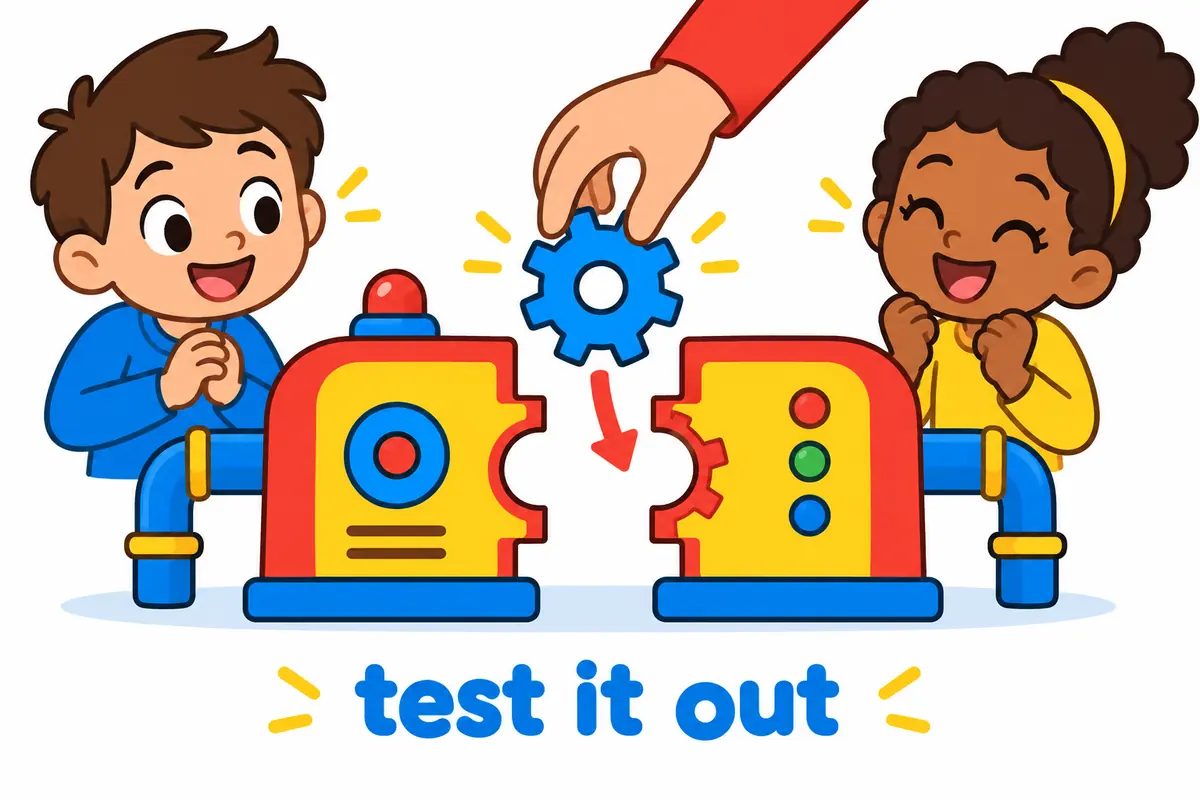
Test out is a phrasal verb meaning to try something in real conditions to see whether it works, and also to qualify for a course by passing an exam instead of taking it. It is transitive and separable, so you test out the new system or test the new system out: “We tested it out first.”
Test Out at a glance
- Test out is a separable, transitive phrasal verb; its forms are tests out, tested out and testing out.
- A pronoun object goes between the verb and the particle, as in test it out.
- One sense is to try something in practice; another is to qualify by exam with test out of.
- Common collocations are test out a theory, test out new software and test out of a class.
- The commonest error is confusing test out with try out, which focuses on a trial for people.
What does test out mean?
Test out is a phrasal verb meaning to try something under real conditions to see whether it works, or to gain credit for a course by passing an exam rather than attending it. The Cambridge entry for test out keeps both senses, and the object separates them: you test out equipment, but you test out of a class. The noun trial names the process, while test out names the act.
| Sense | Plain meaning | Example sentence |
|---|---|---|
| Try in practice | Check something under real conditions | Engineers tested out the new brake on a closed track. |
| Trial a person | Give someone a chance to show ability | The coach tested out two new defenders. |
| Qualify by exam | Skip a course by passing a test | She tested out of the introductory course. |
One limitation is worth stating plainly. Test out does not mean prove. A trial shows how something behaves; it does not guarantee the result will hold everywhere. It is also distinct from verify, which confirms a fact already suspected, and from check out, which means to examine or borrow.
How do you use test out in a sentence?
Test out is separable, so a noun object may follow the particle or sit between the words, but a pronoun must split the verb. The qualifying sense adds the preposition of and an inseparable shape.
| Pattern | Example | What it signals |
|---|---|---|
| test out + noun | We tested out the new software. | The standard order, particle first. |
| test + noun + out | We tested the new software out. | Separated form, common in speech. |
| test + pronoun + out | We tested it out before buying. | A pronoun must split the verb. |
| test out of + course | He tested out of the first level. | Qualifying by exam, particle before of. |
| be tested out | The design was tested out in the field. | Passive form, common in reports. |
| test out + on + group | They tested the app out on a small group. | Names who the trial ran with. |
The particle out never strands at the end of a clause, so the design was tested out is right and the design was tested is a different sentence. Notice too that the qualifying phrase keeps of, so test out of works like a single unit and cannot be split.
Test out in a sentence: examples across contexts
Test out stays close to its meaning while moving between a classroom, a workshop and a sports club. The eleven sentences below each name what was tried and under what conditions.
| Context | Example sentence | Why this works |
|---|---|---|
| Classroom | The class tested out a paper bridge before the contest. | A concrete object tried under pressure. |
| Workplace email | We will test out the new booking system this week. | Names the tool and the timing. |
| News report | The city tested out a ban on cars in the old quarter. | Formal reporting of a pilot scheme. |
| Engineering | Engineers tested out the prototype on a rough track. | Real conditions make the trial meaningful. |
| Education | She tested out of two language courses in her first term. | The qualify-by-exam sense with of. |
| Sports report | The coach tested out three academy players in the friendly. | The trial-a-person sense. |
| Product writing | Customers can test it out free for a month. | Pronoun form and a simple timeframe. |
| Research note | The team tested out the hypothesis on a small sample. | Links the trial to a clear group. |
| Conversation | Let us test it out and see how it feels. | Everyday register, pronoun object. |
| Project report | The design was tested out before full production. | Passive form, standard in reports. |
| Teaching practice | The teacher tested out a new game with the younger class. | A method tried on a specific group. |
Three near-synonyms split the work. Experiment stresses the search for a result, pilot names a formal trial run, and assess names the judgement that follows, while test out simply describes the trying.
Test out vs try out
Test out and try out both describe a trial, but they lean toward different subjects and different purposes.
| Attribute | test out | try out |
|---|---|---|
| Core idea | Try something to see if it works | Try something to see if you like it or qualify |
| Usual object | Equipment, software, an idea | A person, a role, a sport, a recipe |
| Focus | Whether the thing performs | Whether the person or thing fits |
| Common setting | Labs, launches and reviews | Casting, teams and hobbies |
| Register | Neutral to technical | Neutral and casual |
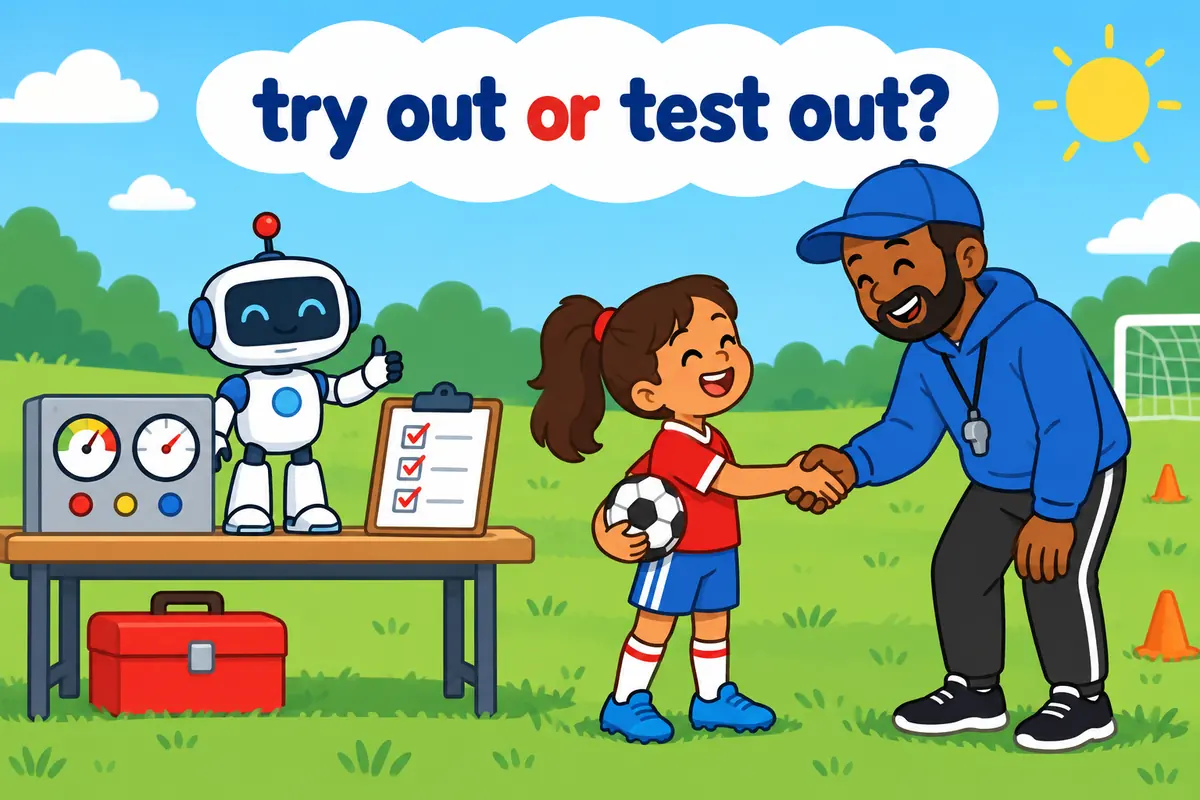
Verdict: test out a product, a theory or a design, and try out a player, a recipe or a new hobby. The two overlap enough that choose what sounds natural, but the object usually decides. Where the trial leads to a formal judgement, evaluate is the word that names it.
Word forms and grammar of test out
Test out inflects on the base verb and the particle never changes. A few fixed compounds keep the two words joined with a hyphen when they work as a noun or adjective.
| Form | Part of speech | Example |
|---|---|---|
| test out | phrasal verb, base form | We should test out the app. |
| tests out | verb, third person singular | She tests out every new tool. |
| tested out | verb, past and past participle | They tested out the plan in June. |
| testing out | verb, present participle | He is testing out the new route. |
| test-out | noun or adjective, hyphenated | A test-out exam covered the whole term. |
| test out of | fixed phrase | She tested out of the beginner class. |
When the words act as a verb, keep them apart. The hyphen appears only when the pair becomes a label for a procedure, as in a test-out option or a test-out exam, and that use is far less common than the verb.
Common mistakes with test out
- Incorrect:
We tested out it first.Correct: We tested it out first. Rule: A pronoun object must sit between the verb and the particle. - Incorrect:
The trial tested out the medicine safe.Correct: The trial showed that the medicine was safe. Rule: Test out takes a noun object, never an adjective or that-clause. - Incorrect:
She tested out the exam and skipped the class.Correct: She tested out of the exam and skipped the class. Rule: Qualifying by exam uses test out of. - Incorrect:
We will test out with the plan tomorrow.Correct: We will test out the plan tomorrow. Rule: The verb is transitive, so it needs an object, not with. - Incorrect:
I tested out a book from the library.Correct: I checked out a book from the library. Rule: Check out means to borrow or examine; test out means to run a trial.
Practice using test out
Work through the seven items, then read the reasoning rather than only the answer.
- Fill the gap: The engineers will ______ the new pump before the winter.
- Choose the better word: The scouts (tested out / tried out) a new climbing wall at camp.
- Correct the error: We tested out it during the quiet hour.
- Build a sentence: use test out of about a student skipping a beginner class.
- Spot the register: which belongs in a project report — the design was tested out in May, or we gave it a go in May?
- Rewrite in the separated form: The team tested out the theory. Put the object before the particle.
- Fix the confusion: I tested out a book from the school library. Use the correct phrasal verb.
Answers
- test out — the pump is the object being tried under real conditions.
- tried out — the scouts are people trialling something, so try out fits better.
- We tested it out during the quiet hour — the pronoun belongs between verb and particle.
- Model answer: Mia tested out of the beginner class after one exam.
- The design was tested out in May — a report keeps the precise passive verb.
- The team tested the theory out — the object now sits before the particle.
- I checked out a book from the school library — borrowing is check out, not test out.
The bottom line
Use test out in a sentence when something is tried under real conditions, or when test out of marks qualifying by exam, and place the object so the separable verb reads naturally. The two nuances that decide most sentences are the object position, which a pronoun fixes between the words, and the split from try out, which suits people and roles rather than equipment. When the point is a formal judgement, evaluate says it best.
Frequently asked questions about test out
Is test out a separable phrasal verb?
Yes. A noun object can follow the particle, as in test out the system, or sit between the words, as in test the system out. A pronoun object must split the verb, so test it out is correct and test out it is wrong. The particle out never strands at the end.
What does test out of a class mean?
It means to skip a course by passing an exam that shows you already know the material. The pattern keeps of after out, as in she tested out of Spanish, and it behaves as a fixed unit. The credit is granted for proven knowledge rather than for attendance.
Can test out be used without an object?
No. In its central sense the verb is transitive, so something must be tested out, whether a product, a theory or a player. The only object-free-looking pattern is test out of, which still takes a course or level after of. A sentence that stops at test out sounds unfinished.
What is the difference between test out and test?
Plain test is general and can happen anywhere, on paper or in a lab. Test out adds the idea of trying something in real conditions for a short trial, as in test out the software. The particle out adds practical use, which is why the two are not always interchangeable.