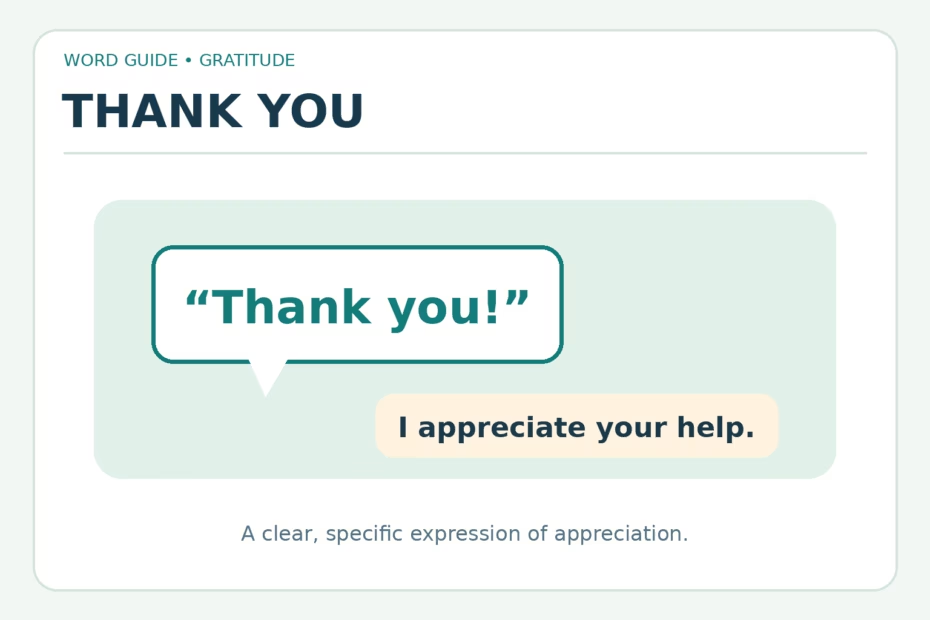
“Thank you” is an expression used to show gratitude, acknowledge a gift or action, and respond politely to an offer or remark. A useful sentence pattern is Thank you for + a noun or Thank you for + an -ing verb: “Thank you for the book” and “Thank you for checking my work.” Add the specific reason when you want your appreciation to sound clear and personal.
- For a gift or action: “Thank you for the thoughtful card.”
- For help: “Thank you for staying late to explain the process.”
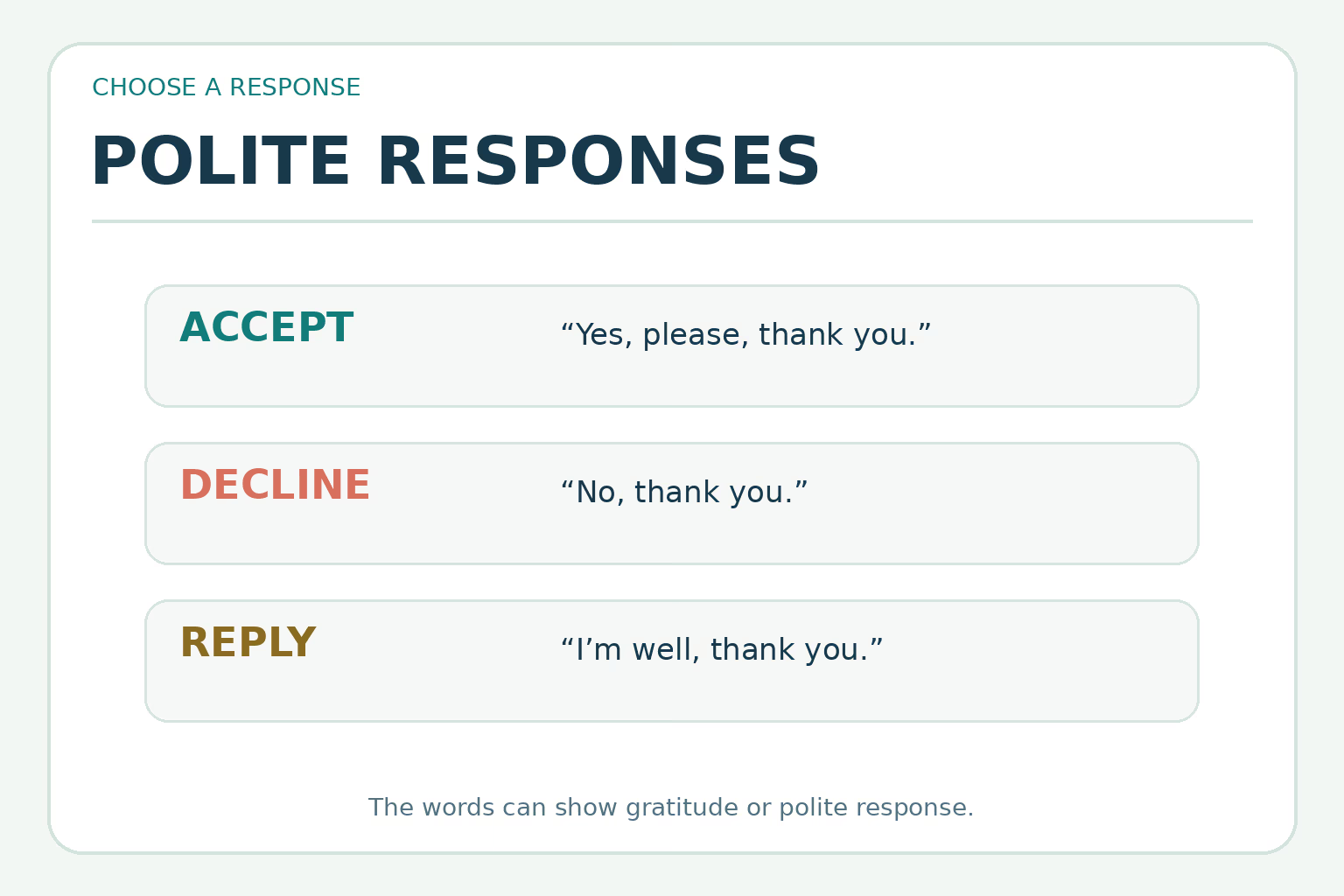
- To accept or decline: “Yes, please, thank you” or “No, thank you.”
- As a noun: “She sent a thank-you note.”
What does “thank you” mean?
Thank you is most often an exclamation or set phrase that expresses appreciation because someone gave, offered, or did something. It can also answer a polite question or remark (“I’m fine, thank you”) and help accept or refuse an offer (“Yes, thank you” / “No, thank you”). As a noun, a thank you means an expression or act of appreciation: “The volunteers received a big thank you.” Cambridge Dictionary records these uses and also gives the hyphenated form thank-you before a noun, as in a thank-you note.
The words themselves are simple, but the detail around them tells the listener what you noticed. “Thank you” acknowledges appreciation; “Thank you for covering my shift on Friday” identifies the action and its effect. The second version is often more useful in a note, message, or conversation because it makes the reason specific.
How to use “thank you” in a sentence
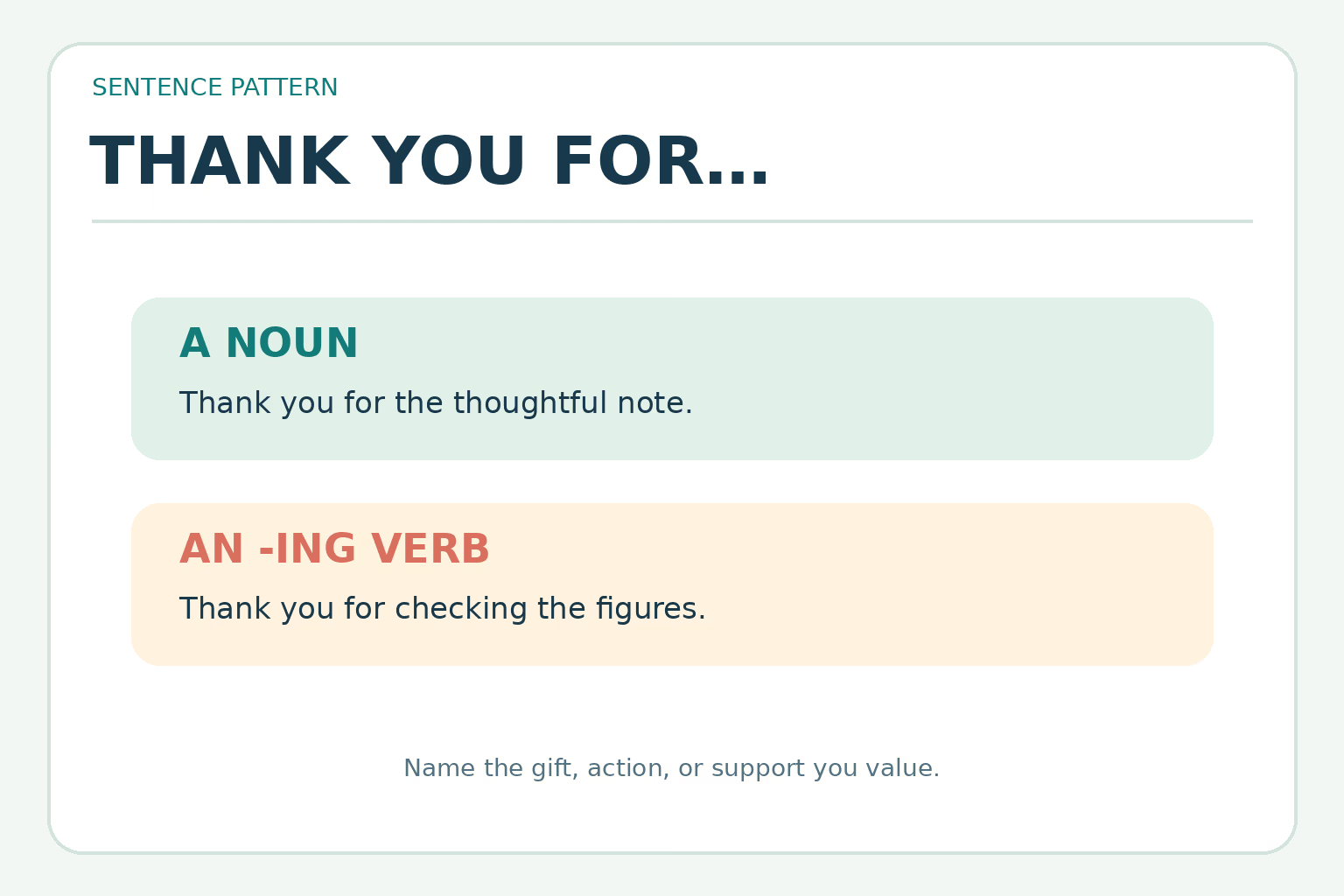
Use thank you for + a noun to name the thing or service: Thank you for the recommendation. Use thank you for + an -ing verb to name an action: Thank you for recommending that book. After for, the action takes the -ing form, not an infinitive: write Thank you for helping, not Thank you for help when you mean the action, or Thank you for to help.
You can place a name or pronoun after thank: I thanked Maya for the reminder or We thanked them for staying late. In direct speech, thank you addresses the listener: Thank you for your help. In reported speech, use the verb form thank: I thanked her for her help. If the person receiving the thanks is not clear from context, name them so the sentence is complete.
Sentence examples with “thank you”
- After a favor: “Thank you for picking up my package while I was away.”
- For a gift: “Thank you for the handmade scarf; I’ll wear it this winter.”
- At work: “Thank you for sending the revised schedule before the meeting.”
- In an email: “Thank you for your quick response.”
- For advice: “Thank you for explaining the two options so clearly.”
- To accept an offer: “Yes, please, thank you. Tea would be lovely.”
- To decline politely: “No, thank you; I’ve already had enough.”
- After a compliment: “Thank you. I’m glad you like the design.”
- To a group: “Thank you, everyone, for making time to be here.”
- As a noun: “A handwritten thank-you meant a lot to the neighbors.”
Choose a level of detail that fits the situation. A brief Thank you! works for a small, immediate courtesy. When someone has spent time, offered support, or given a meaningful gift, name what they did and, if natural, explain how it helped. A specific sentence usually sounds warmer than adding several intensifiers without saying what you appreciate.
Choose a “thank you” that fits the situation
The setting helps determine whether to keep the message brief or add detail. For a quick exchange with a friend, “Thanks for grabbing my coat” is natural and conversational. In a work message, “Thank you for sending the updated figures before the deadline” is courteous and specific. For a formal letter, “I would like to thank you for taking the time to meet with me” gives the sentence a more measured tone.
When replying to a compliment, a plain “Thank you” is enough; you can add a short comment if it feels right: “Thank you. I enjoyed putting the presentation together.” When declining food or help, place no before the phrase: “No, thank you.” When accepting, yes, please makes the choice clear: “Yes, please, thank you.” The phrase does not need to be repeated several times to sound sincere.
A useful note follows three steps: greet the person, name what you appreciate, and add a brief effect or closing. For example: “Hi Lina, thank you for lending me your camera for the weekend. It helped me capture the tournament, and I’ll return it on Monday. Best, Sam.” This pattern works for a gift, a favor, advice, or professional support; change the detail so it describes the real action rather than relying on a generic sentence.
- Quick courtesy: “Thank you for holding the door.”
- Work message: “Thank you for reviewing the draft; your comments helped me clarify the recommendation.”
- Formal follow-up: “Thank you for meeting with me today. I appreciated learning more about the role.”
“Thank you,” “thanks,” and “thank-you”
Thank you is a neutral, widely suitable expression. Thanks is usually more informal, so it often fits casual conversation and short messages. Both can be made more emphatic with words such as very much or so much, but emphasis should fit the relationship and the favor. For a formal note, a complete sentence naming the action is often clearer than relying on a very casual shorthand.
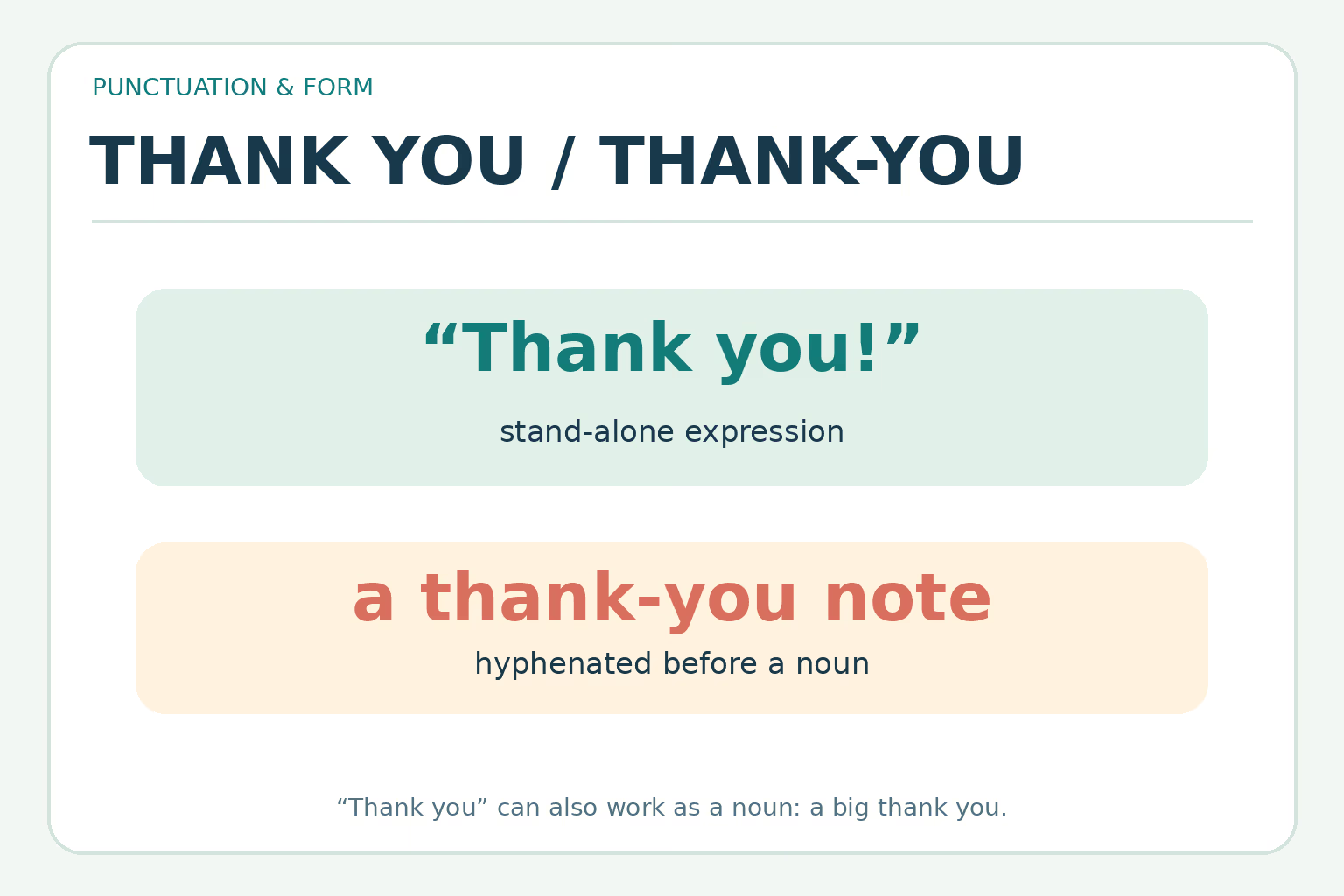
As a noun, thank you is commonly written as two words: Please accept this as a small thank you. Before another noun, the hyphenated form thank-you is used in expressions such as thank-you note, thank-you card, or thank-you message. As a standalone expression, write Thank you. The punctuation depends on the sentence: use a period for a calm statement and an exclamation mark when the tone is more enthusiastic.
Common mistakes to avoid
- Using the wrong form after “for”: use a noun or an -ing verb: Thank you for the call or Thank you for calling.
- Leaving the recipient unclear: if the reader may not know who is being thanked, say I’d like to thank the team.
- Making the sentence overly general: add the action or gift when that detail would make the message more meaningful.
- Hyphenating every use: the standalone expression is thank you; use thank-you in a compound modifier such as thank-you card.
- Confusing “thank you” with “you’re welcome”: the first expresses gratitude; the second is a common response to gratitude.
Frequently asked questions
How do you use “thank you” in a sentence?
Use it to show appreciation or respond politely, then add a reason when useful: “Thank you for helping me prepare for the interview.”
Should I write “thank you for your help” or “thank you for helping”?
Both are correct. The first uses the noun help; the second uses the -ing form helping.
Is “thank-you” one word or two?
The expression is two words: thank you. It is commonly hyphenated before a noun, as in a thank-you note.
Is “thanks” the same as “thank you”?
Both express gratitude, but thanks is generally more informal. Choose the expression that suits the setting and relationship.
Can “thank you” politely refuse an offer?
Yes. “No, thank you” is a courteous way to decline. “Yes, please, thank you” accepts an offer.
Sources and usage note
Cambridge Dictionary describes “thank you” as an expression of gratitude, a polite response, and a noun, and shows the hyphenated compound in thank-you note. Cambridge Grammar explains “please” and “thank you” in polite exchanges and notes that thank you for can be followed by an -ing form. The example sentences in this guide are original.

Have you ever struggled with finding the right words to express gratitude? A phrase often used to convey appreciation for something someone has done or said is “thank you.”
“Thank you” is a simple expression of gratitude that can be used in various social interactions to acknowledge kindness, support, or assistance. It is a universal sentiment that holds the power to show appreciation and build positive relationships.
7 Examples Of Thank You Used In a Sentence For Kids
- Thank you for sharing your toys with me.
- Can you please pass me the crayons? Thank you.
- Thank you for helping me tie my shoelaces.
- I liked the story you read. Thank you.
- Thank you for playing with me during recess.
- Let’s say “please” and thank you when we ask for things.
- Thank you for being my friend.
14 Sentences with Thank You Examples
- Thank you for helping me with my assignment, I really appreciate it.
- It was so kind of you to lend me your notes; thank you so much.
- Thank you for sharing your textbook with me, it’s a huge help.
- I wanted to say thank you for studying with me, it made a big difference.
- Thank you for explaining that concept to me, I feel much more confident now.
- I can’t believe you woke up early to help me practice for my presentation, thank you.
- Thank you for inviting me to your study group, I learned a lot.
- I really appreciate you proofreading my paper, thank you for taking the time.
- Thank you for tutoring me in math, I couldn’t have passed without your help.
- Thank you for motivating me to do better, I needed that push.
- Your advice on choosing electives was really helpful, thank you for guiding me.
- Thank you for sharing your project ideas with me, it sparked my creativity.
- I wanted to say a big thank you for supporting me during exam week.
- Thank you for being such a great friend and study buddy, I’m lucky to have you.
How To Use Thank You in Sentences?
To use Thank You in a sentence, you can express gratitude or appreciation towards someone for their actions or gestures. It is a polite way of showing acknowledgment and recognizing the kindness shown to you by others.
Example sentences:
– “I wanted to thank you for helping me with my project.”
– “I just wanted to say thank you for the lovely gift.”
– “Please accept my thanks) for your support during this difficult time.”
When using Thank You in a sentence, it is important to consider the context and tone in which it is being used. Make sure to tailor your expression of thanks based on the situation and the relationship you have with the person you are thanking.
Additionally, it is always appreciated to be specific about what you are thanking someone for. This shows that you genuinely appreciate their actions and are grateful for the effort they put in.
Remember, saying Thank You is a simple yet powerful way to show your appreciation and build positive relationships with others. Whether it’s in person, through a text, or in a handwritten note, taking the time to express your gratitude can go a long way in making someone feel valued and acknowledged.
Conclusion
In conclusion, expressing gratitude through phrases like “thank you” is a simple yet powerful way to show appreciation and acknowledge kindness or help received from others. “Thank you” sentences can range from casual interactions like “Thank you for holding the door” to more formal scenarios such as “Thank you for your generous donation.” These words hold the ability to foster positive relationships, strengthen connections, and create a sense of mutual respect in various social and professional settings.
By incorporating “thank you” into our daily interactions, we can cultivate a culture of appreciation, kindness, and empathy. These small gestures of gratitude can have a significant impact on not only the recipient but also on our own well-being by fostering a sense of positivity and goodwill. So, let’s remember the power of “thank you” and continue to spread kindness through our words and actions.


