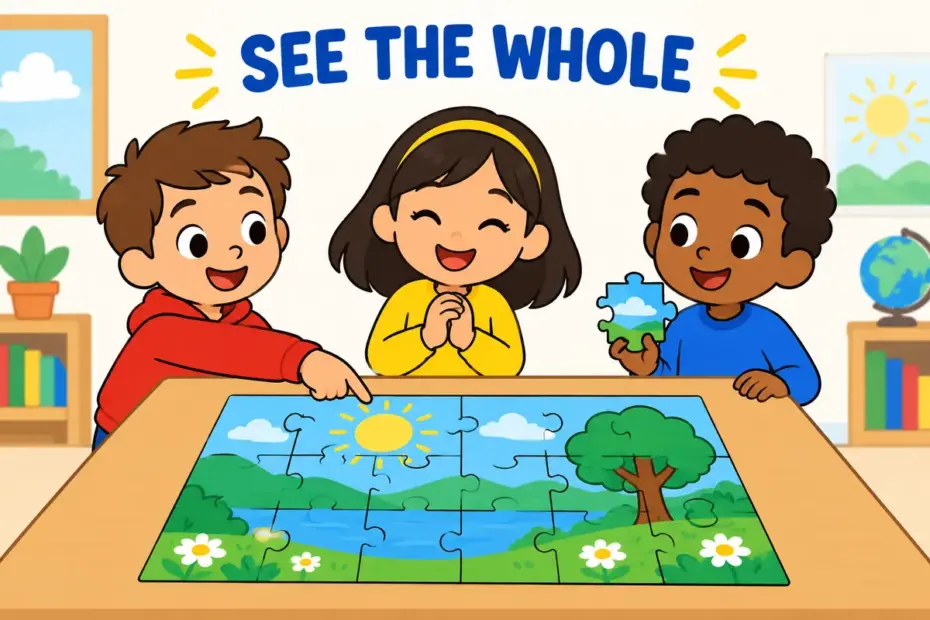
The big picture is the whole situation seen as one connected scene rather than a set of separate details. To use the big picture in a sentence, pair it with a verb such as see, get, keep or lose: “Try to see the big picture before you complain.” The phrase is nearly always fixed with the.
The big picture at a glance
- The big picture is a fixed noun phrase meaning the whole situation and how its parts connect.
- It keeps the definite article in almost every sentence; a big picture is not the same idiom.
- The usual verbs are see, get, keep, lose sight of, look at and paint.
- The phrase suits speech, meetings and journalism more than technical or legal writing.
- The commonest error is dropping the, which turns an idiom into a fragment.
What does the big picture mean?
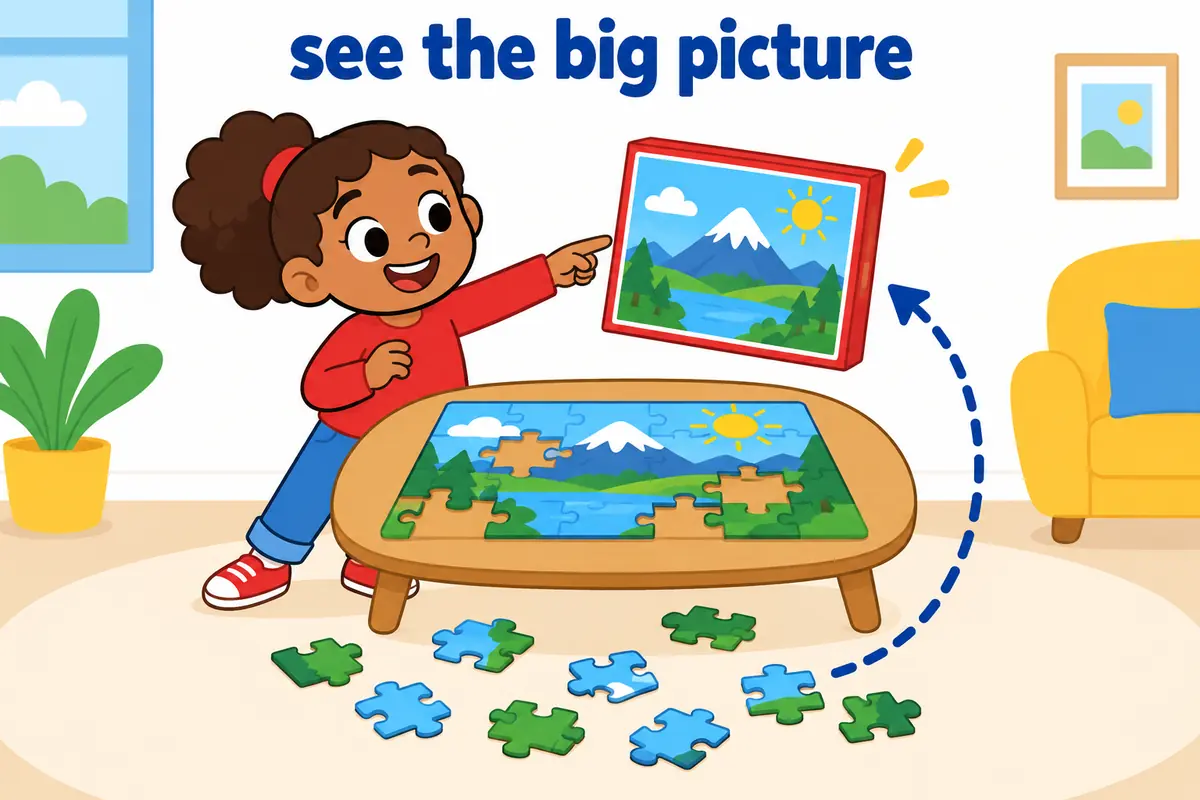
The big picture is the whole situation seen as one connected scene, rather than the separate details that make it up. The Cambridge entry for the big picture treats it as a fixed phrase for the most important facts or the general situation. Seeing the big picture means placing each detail in its wider context and judging what matters most. It is not a literal photograph: nobody is being asked to look at a canvas.
| Use | Plain meaning | Example sentence |
|---|---|---|
| The overall situation | All the important facts taken together | Before we argue, let us agree on the big picture. |
| A strategic view | The long-term aim rather than today’s tasks | Managers are paid to keep the big picture in mind. |
| Understanding | The moment somebody finally grasps the situation | After the tour, I finally got the big picture. |
One limitation belongs here. The big picture is not a synonym for detail, and it is not a summary of every fact. It is about how facts connect. In technical writing, where precision matters more than impression, the phrase can sound vague, and a plainer word such as perspective or design may serve the sentence better.
How do you use the big picture in a sentence?
The phrase is fixed at its core, so most sentences simply choose a verb before it. The five patterns below cover ordinary use, and the verb decides whether the sentence praises focus or warns that focus has narrowed. Only the surrounding scope changes with context, not the wording of the phrase itself.
| Pattern | Example | What it signals |
|---|---|---|
| see or look at + the big picture | Step back and see the big picture. | Advice to look beyond the details. |
| get + the big picture | New staff get the big picture in their first week. | Understanding arrives rather than being sought. |
| keep or bear in mind + the big picture | Keep the big picture in mind when you plan. | A reminder about priorities. |
| lose sight of + the big picture | We lost sight of the big picture during the audit. | A warning that attention has narrowed. |
| paint or sketch + the big picture | The report paints the big picture for the board. | Somebody presents a broad view to others. |
The big picture in a sentence: examples across contexts
The phrase holds its meaning while the setting changes, so the sentences below move from a playground to a planning meeting. Each one names the wider view and the decision it should change.
| Context | Example sentence | Why this works |
|---|---|---|
| Classroom | Look at the big picture: one low mark will not decide your year. | Uses a colon to show the wider view changing a reaction. |
| Conversation | You are arguing about the label and missing the big picture. | Contrasts a small detail with the whole situation. |
| Workplace email | Please keep the big picture in mind before you cut the training budget. | Names the decision the broad view should influence. |
| News report | The summit’s failure matters less than the big picture of steady trade growth. | Compares one event with a longer trend. |
| Business analysis | The board asked for the big picture, not another list of complaints. | Shows the phrase doing the work of a request. |
| Sports report | One defeat should not hide the big picture of a rebuilding side. | Sets a single result against a season’s plan. |
| Academic prose | Students who see the big picture transfer methods between subjects. | Uses the phrase as a cognitive goal rather than a slogan. |
| Parenting | When you are tired it is hard to see the big picture. | Makes the phrase sympathetic instead of managerial. |
| Project update | The timeline slipped, so we reframed the big picture for the client. | Shows the phrase being actively reframed. |
| Interview | Tell me about a time you lost sight of the big picture. | Uses the fixed collocation as a prompt. |
| Travel writing | From the hill you get the big picture of the whole valley. | Returns the phrase to its almost literal sense. |
The big picture vs an overview
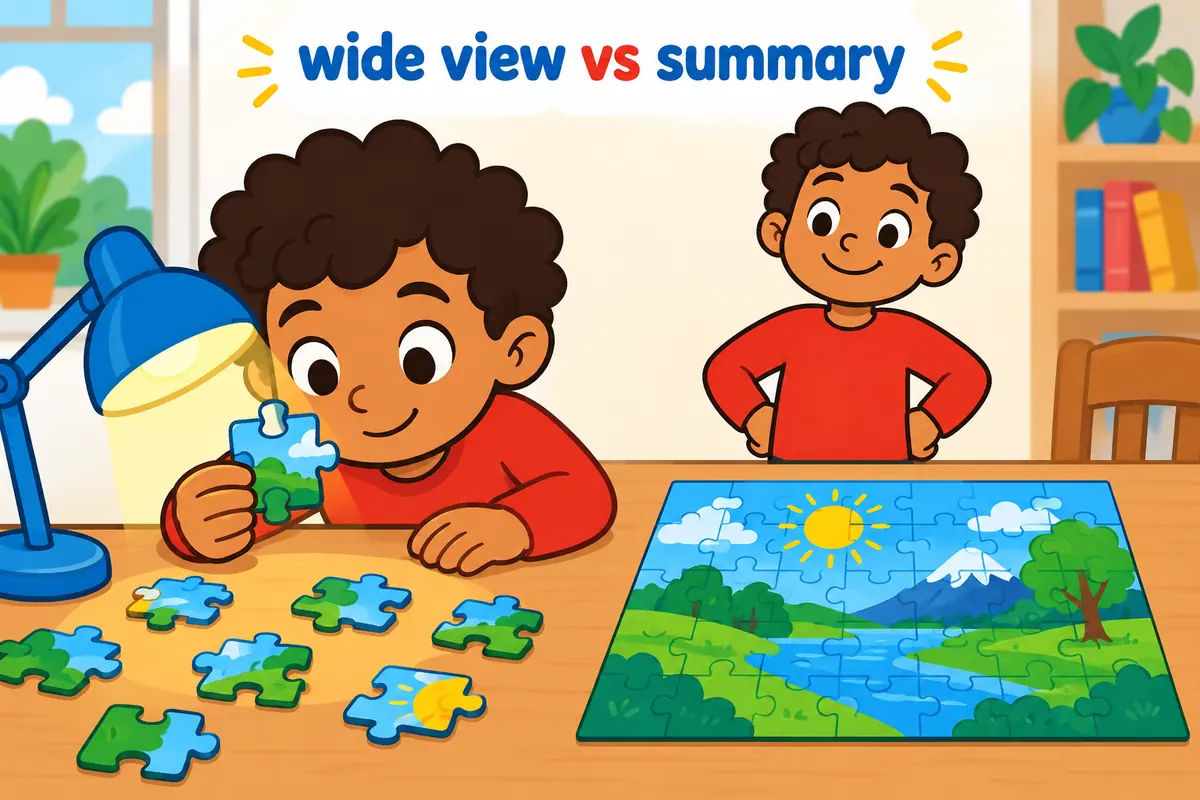
The big picture and an overview both step back from detail, but they do different jobs. The big picture explains how the parts connect; an overview reports what the parts are. The table sets them apart.
| Attribute | the big picture | an overview |
|---|---|---|
| Core idea | How everything fits together | A short account of the main points |
| What it adds | Judgement about what matters | Coverage of what exists |
| Typical verb | see, get, lose sight of | give, provide, begin with |
| Usual setting | Strategy, planning, conversation | Reports, talks, introductions |
| Tone | Reflective, sometimes clichéd | Neutral and factual |
| Risk | Vagueness if no decision follows | Shallowness if nothing is left out |
Verdict: choose the big picture when the point is connection and priority, and an overview when you simply need to state the main points in order.
Word forms and grammar of the big picture
The phrase is fixed, so the useful question is what may change inside it. The table separates the parts that are locked from the few that move. Note the unrelated adjective picturesque, which shares the root but describes a scenic view, and the noun synthesis, which names the act of combining details into a whole.
| Element | Fixed or free | Example or note |
|---|---|---|
| the | Fixed in the idiom | lose the big picture, never lose big picture |
| big | Fixed | large picture or huge picture sounds wrong in the idiom |
| picture | Singular | plural pictures belongs to walls, not to strategy |
| big-picture (adjective) | Free, with a hyphen | a big-picture strategy |
| possessive before the phrase | Free | her big picture of the market |
| verb before the phrase | Free | see, get, keep, lose sight of, paint |
Is the big picture a cliche?
The phrase is a business cliche, and honest writing admits it. In a slide deck or a weekly meeting it has become filler, and a manager who asks everyone to focus on the big picture often means only that the meeting is nearly over. The test is whether the sentence names the wider situation. If it does, the phrase earns its place; if it could be deleted without loss, cut it.
Two replacements usually sharpen a sentence. Name the horizon, as in the five-year plan rather than the big picture, or name the decision the broad view should change. Reserve the phrase for speech, where its familiarity helps, and prefer a concrete noun in formal writing, where readers expect the parts to be named.
Common mistakes with the big picture
- Incorrect:
We need to see big picture.Correct: We need to see the big picture. Rule: The idiom keeps the definite article, so dropping the breaks the phrase. - Incorrect:
He big-pictured the problem.Correct: He took a big-picture view of the problem. Rule: There is no standard verb big-picture; use the hyphenated adjective with view or approach. - Incorrect:
I lost the big picture for a week.Correct: I lost sight of the big picture for a week. Rule: The fixed collocation is lose sight of, not lose. - Incorrect:
Look at the big picture in detail.Correct: Look at the big picture before the details. Rule: Detail contradicts the phrase, so pair it with before or instead of. - Incorrect:
The big picture of the two figures is that they differ.Correct: The two figures differ by a wide margin. Rule: When no wider situation exists, the phrase is filler and should be cut.
Practice using the big picture
Work through the seven items, then check the reasoning rather than only the answer.
- Fill the gap: Keep ______ in mind when you set next year’s targets.
- Choose the better expression: The report gives (the big picture / an overview) of the three options before the detailed costs.
- Correct the error: Managers must see big picture to plan well.
- Build a sentence: use lose sight of the big picture about a team that obsesses over a minor bug.
- Spot the register: which belongs in a formal proposal — a five-year view of demand, or seeing the big picture?
- Rewrite without the cliche: The board lost the big picture. Name the horizon instead.
- Use the attributive form: describe a strategy that keeps long-term aims in view.
Answers
- the big picture — the idiom keeps the definite article and the fixed order.
- an overview — the sentence summarises options rather than judging how they connect.
- Managers must see the big picture to plan well — the article is required.
- Model answer: The team lost sight of the big picture while chasing a minor bug.
- A five-year view of demand — formal writing prefers a named horizon to a cliche.
- Model answer: The board ignored how the new tariff would shape the next decade.
- Model answer: a big-picture strategy that protects long-term aims.
The bottom line
Use the big picture in a sentence when you mean the whole situation and how its parts connect, and keep the definite article that makes the idiom work. The two nuances that decide most sentences are these: the phrase needs a verb such as see, get or lose sight of, and it earns its place only when the sentence names the wider view or the decision it should change. Where you simply want the main points, an overview is the more precise choice.
Frequently asked questions about the big picture
Does the big picture always need the word the?
In the idiom, yes. The phrase works as a fixed unit with the definite article, so see the big picture and lose sight of the big picture are standard. A sentence such as see big picture sounds like a fragment. The article can disappear only in the hyphenated attributive form, as in a big-picture strategy.
Is the big picture a formal phrase?
The phrase sits in the middle of the range: common in meetings, journalism and everyday speech, but treated as a cliche in careful formal writing. A proposal usually names the horizon instead, such as a five-year plan. In conversation the familiarity of the phrase is an advantage rather than a fault.
What is the opposite of the big picture?
The opposite is the details, or the small print, rather than a single antonym. English often expresses the contrast as the big picture against the nitty-gritty. A sentence can move between the two, as in agree the details later but keep the big picture in mind now.
Can you say a big picture?
You can only say a big picture in a literal sense about an actual image, and even then it is unusual. As an idiom it is always the big picture. The related adjective big-picture is free, however, and takes a hyphen, as in a big-picture view of the year ahead.