Welcome to the definitive guide to mastering the verbs has, have, and had. While these three words may seem small, they form the backbone of English grammar, serving as a powerful trio that expresses possession, state of being, and, most importantly, the completion of actions across different timelines. This comprehensive article will not only clarify the rules of their usage but also provide you with a deeper understanding of the grammatical logic behind them, ensuring you can use them with confidence and precision in any conversation or written piece.
At its core, the verb “to have” is a chameleon of the English language. It can stand on its own as a main verb to signify ownership, as in “I have a car.” It can also act as an indispensable auxiliary or helping verb, partnering with other verbs to create the perfect tenses, which describe completed actions. For example, “They have finished the race” conveys an action that is complete in the present. By grasping this dual function, you unlock the ability to construct a wide array of sentences that are both grammatically correct and rich in meaning.
Understanding the Present: “Has” vs. “Have”
The primary distinction between “has” and “have” lies in the principle of subject-verb agreement in the present tense. Choosing the correct verb hinges on knowing your subject.
When to Use “Has” ?
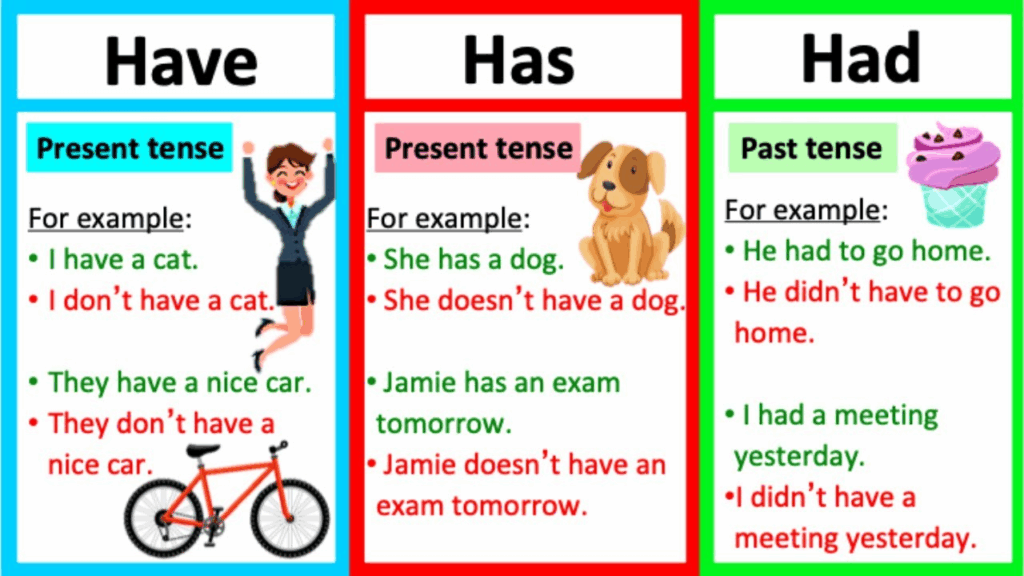
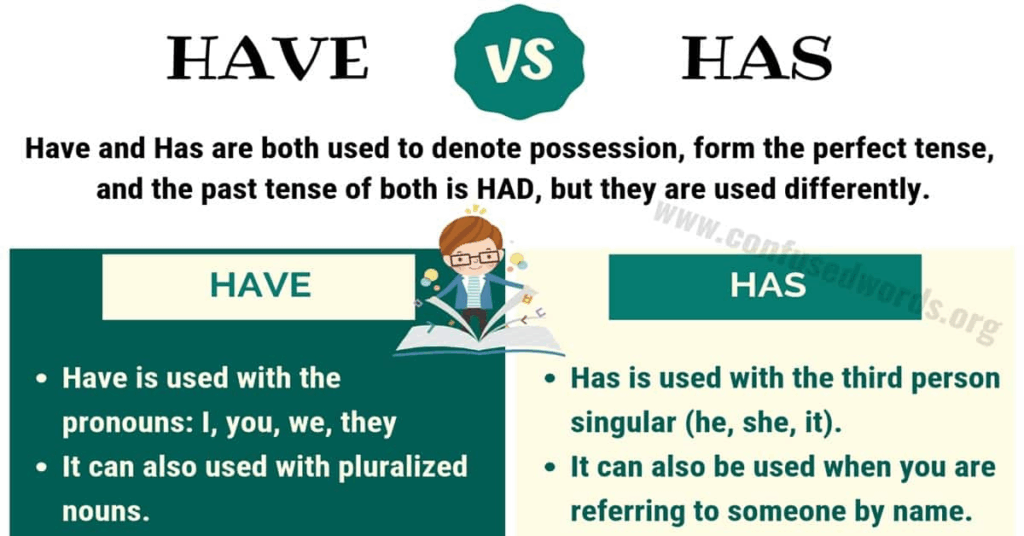
Has is the verb for third-person singular subjects. Think of it as the verb form that matches the solo star in a sentence. This includes:
- Singular pronouns: he, she, it. For example, “He has a new job.”
- Singular nouns: Any single person, place, or thing. For example, “The cat has a fluffy tail,” or “Emma has a brilliant idea.”
This usage extends to both its main verb and helping verb roles. For instance, in “The wind has blown the leaves away,” the wind is a singular subject, so it pairs with “has” to form the present perfect tense. This grammatical consistency is a key to mastering its usage.
When to Use “Have” ?
Have is a more versatile verb, pairing with a wider range of subjects in the present tense. It is the verb of choice for both the speaker and for groups. This includes:
- First-person singular and plural pronouns: I, we. For example, “I have a question.”
- Second-person singular and plural pronoun: you. For example, “You have a knack for this.”
- Third-person plural pronouns: they. For example, “They have a new album out.”
- Plural nouns: Any group of people, places, or things. For example, “The students have their books open.”
As with “has,” “have” is used for both possession and forming the present perfect tense. In the sentence, “We have seen that movie before,” “have” is the auxiliary verb that connects the subject “we” to the completed action “seen.”
Traveling to the Past with “Had” ?️
The verb had offers a reprieve from the complexities of present-tense subject-verb agreement. As the past tense form of “to have,” it works universally with all subjects—singular and plural alike. This simplicity is one of its most valuable features.
“Had” for Past Possession and Actions
Use had to express ownership or to describe an action that occurred in the past. It sets a scene that has already transpired.
- Past Possession: “She had a red dress for the party last night.”
- Past Action: “They had a delicious dinner at the restaurant.”
The Past Perfect Tense: Actions in Sequence
The most sophisticated use of “had” is in the past perfect tense, which describes an action that was completed before another action in the past. This tense is a crucial tool for narrating sequential events, allowing you to establish a clear timeline for your reader or listener.
- Example: “I had already eaten when you called.” Here, the action of eating was completed before the action of calling took place.
- Example: “She had finished the report before the meeting began.” The report’s completion happened before the meeting.
This two-part structure—”had” plus a past participle—is the key to unlocking the power of the past perfect tense, providing depth and clarity to your storytelling.
Advanced Usage and Common Mistakes
To truly master these verbs, it’s worth exploring some of their more nuanced applications and recognizing common errors.
“Had Had”: A Grammatically Correct Enigma
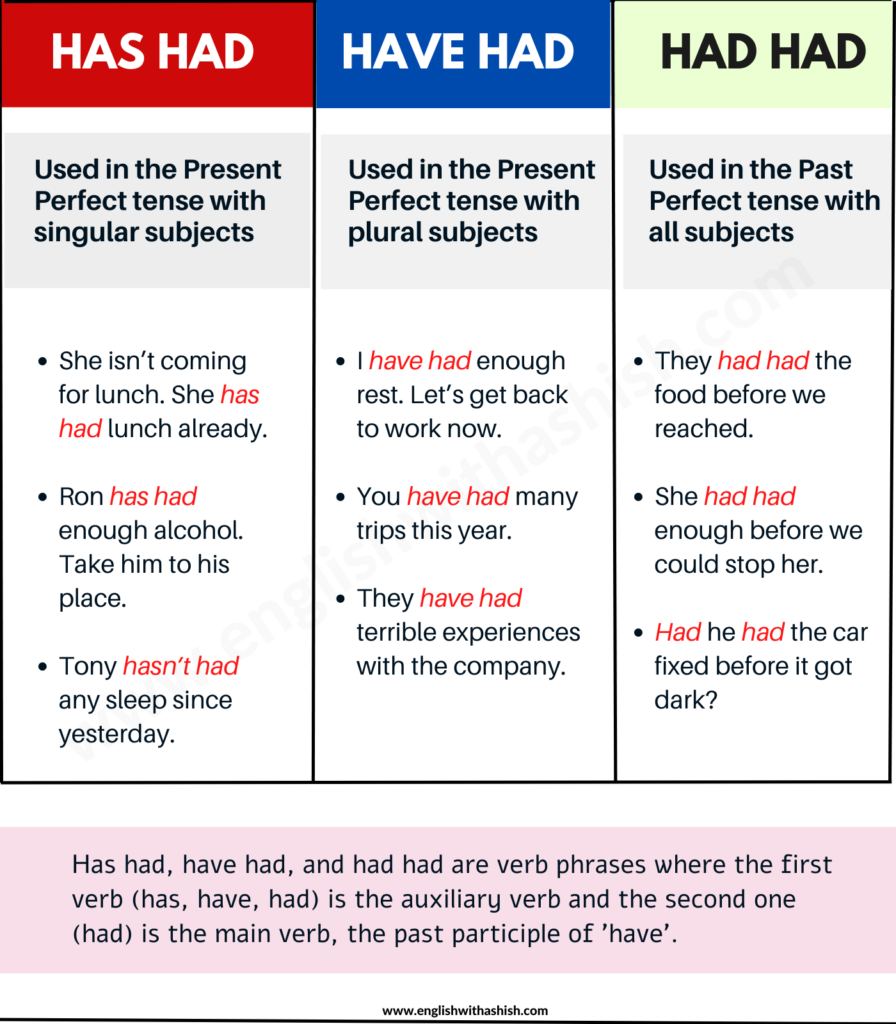
A phrase that often causes confusion is “had had.” This construction is grammatically correct and is used in the past perfect tense when the main verb is also “to have.”
- Example: “I had had enough by the time the presentation ended.” The first “had” is the auxiliary for the past perfect, and the second “had” is the past participle of the verb “to have,” meaning to experience.
“Have to” vs. “Has to”
These phrases express obligation or necessity. The choice between them follows the same subject-verb agreement rules as “has” and “have.”
- “Have to” is used with I, you, we, and they. For instance, “We have to leave now.”
- “Has to” is used with he, she, and it. For instance, “He has to study for his final exam.”
Avoiding Common Mistakes
- Incorrect Subject-Verb Agreement: The most frequent error is mixing up “has” and “have.” Remember: Singular subjects get “has,” plural subjects (and I, you) get “have.”
- Incorrect Verb Form with “Had”: Always use the past participle after “had.” For example, it’s “had gone,” not “had went.”
By internalizing these rules and practicing their application, you will build a solid foundation for more complex English grammar, enabling you to communicate with greater precision and elegance.
Quick Reference: Has, Have, and Had
| Form | Common use | Example |
|---|---|---|
| have | Present with I, you, we, they, and plural subjects | They have a plan. |
| has | Present with a third-person singular subject | Rina has a plan. |
| had | Simple past with any subject | We had a plan yesterday. |
| have/has + past participle | Present perfect | Rina has finished; they have finished. |
| had + past participle | Past perfect | They had finished before noon. |
The main forms are have (base form), has (third-person singular present), and had (simple past and past participle). The correct choice depends on the subject and the sentence structure. Cambridge Grammar describes the present perfect pattern as have/has plus a past participle and the past perfect as had plus a past participle; see its guide to have and present perfect explanation.
Subject Agreement: When to Use Have or Has
In a simple present statement, use has with a third-person singular subject: the teacher has, Amir has, she has, or it has. Use have with I, you, we, and they, as well as plural subjects: the teachers have, Amir and Jo have. “You” takes have whether it refers to one person or several.
Find the subject before choosing the verb. In “The box of notebooks has a blue cover,” the subject is box, not the nearby plural noun notebooks. Indefinite pronouns such as everyone, someone, and each are grammatically singular in standard usage: “Everyone has a copy.”

Questions and Negatives with the Main Verb Have
When have expresses possession, use do or does for most present-day questions and negatives: “Do you have a ticket?” “Does she have a ticket?” “We do not have time.” “He does not have time.” After does or does not, use the base form have, not has.
For the simple past, use did plus the base form: “Did they have breakfast?” and “Mara did not have her keys.” Avoid “Did they had?” and “Mara didn’t had.” The past marker is already carried by did, so the following verb stays in its base form.
Some varieties and formal styles also use have directly in questions (“Have you a moment?”), and the construction have got is common for present possession (“Have you got a moment?”). British Council’s grammar guide notes that have got/has got is present tense and uses had for the past: “I had a bike.” See its guide to have got.
Have and Has as Helping Verbs
When have or has is an auxiliary (helping) verb, it comes before a past participle to form the present perfect: “I have written,” “You have seen it,” “She has arrived,” “The team has completed the first stage.” This tense often connects an earlier event or experience to the present. The participle after it matters: say “has gone,” not “has went.”

Questions and negatives in the present perfect use the auxiliary itself: “Have you finished?” “Has he called?” “I have not finished.” “She has not called.” Do not add do to these forms: the usual patterns are “Have you seen it?” and “I haven’t seen it,” rather than “Do you have seen it?” or “I don’t have seen it.”
Past Perfect and the Phrase “Had Had”
The past perfect is had + past participle for every subject: “I had left,” “she had left,” “we had left.” Use it when you need to show that one event was already complete at a later past point: “By the time the bus arrived, we had waited for an hour.” Often the surrounding context makes the order clear with simple past alone, so choose the past perfect when it helps the reader follow the timeline.
“Had had” is correct when the verb have itself appears in the past perfect. The first had is the auxiliary; the second is the past participle of have: “By noon, I had had two meetings.” The sentence has two forms that look alike but do different grammatical jobs. In a question or negative, keep the auxiliary before the subject or add not: “Had you had lunch before the flight?” “They had not had a chance to reply.”

Have To, Has To, and Had To
Have to and has to express necessity or obligation in the present: “I have to leave,” “You have to register,” “The applicant has to sign.” In questions and negatives, use do/does or did plus have to: “Does Rina have to attend?” “He doesn’t have to attend.” “Did they have to reschedule?” The past form is had to with every subject: “We had to reschedule.”
Keep the helper and verb forms together: not “Does Rina has to attend?” or “Did they had to reschedule?” In “does Rina,” does carries present-tense agreement; in “did they,” did marks the past.
Common Errors to Check
- She have a key. → She has a key. A third-person singular subject takes has in a simple present statement.
- Does he has a key? → Does he have a key? Use the base form after does.
- They has arrived. → They have arrived. Use have with they in the present perfect.
- We had went home. → We had gone home. Use a past participle after had.
- Did she had lunch? → Did she have lunch? Use the base form after did.
- He don’t have time. → He doesn’t have time. Use doesn’t with a third-person singular subject.
Short Practice
- My neighbors ___ a new puppy. (have / has)
- ___ your sister ___ a library card? (Does / Do; have / has)
- We ___ already eaten when the guests arrived. (have / had)
- By the time I called, Lee ___ ___ lunch. (had / have)
Answers: 1. have; 2. Does your sister have; 3. had; 4. had had. In the last sentence, both instances of had are needed: the first forms the past perfect and the second is the participle meaning “eaten or experienced.”
For a quick check, identify the subject, decide whether have is the main verb or a helping verb, and look for a tense helper such as do, does, or did. Then choose have, has, or had and make sure the next verb form fits the pattern.