The Other Day in a Sentence: Meaning and Examples
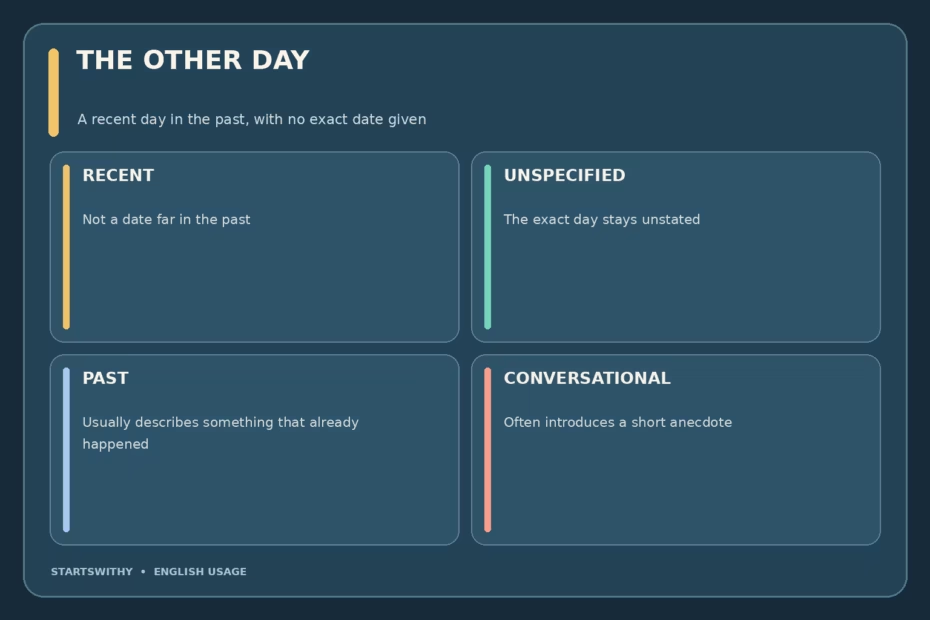
The other day means on a recent day in the past, without naming the exact date. It is a conversational, flexible time expression: the speaker remembers when something happened in a general way, but the particular day is not important or is not being specified. For example, “I ran into Maya at the market the other day” tells us the meeting was recent, but not whether it happened Monday or Thursday.
The phrase is common in everyday speech, messages, and informal writing. Cambridge Dictionary describes it as referring to a time in the recent past; its grammar guidance also groups “the other day” with expressions such as “recently” and “lately.” There is no fixed number of days that always defines it, so choose a more exact expression when timing matters.
What Does “The Other Day” Mean?
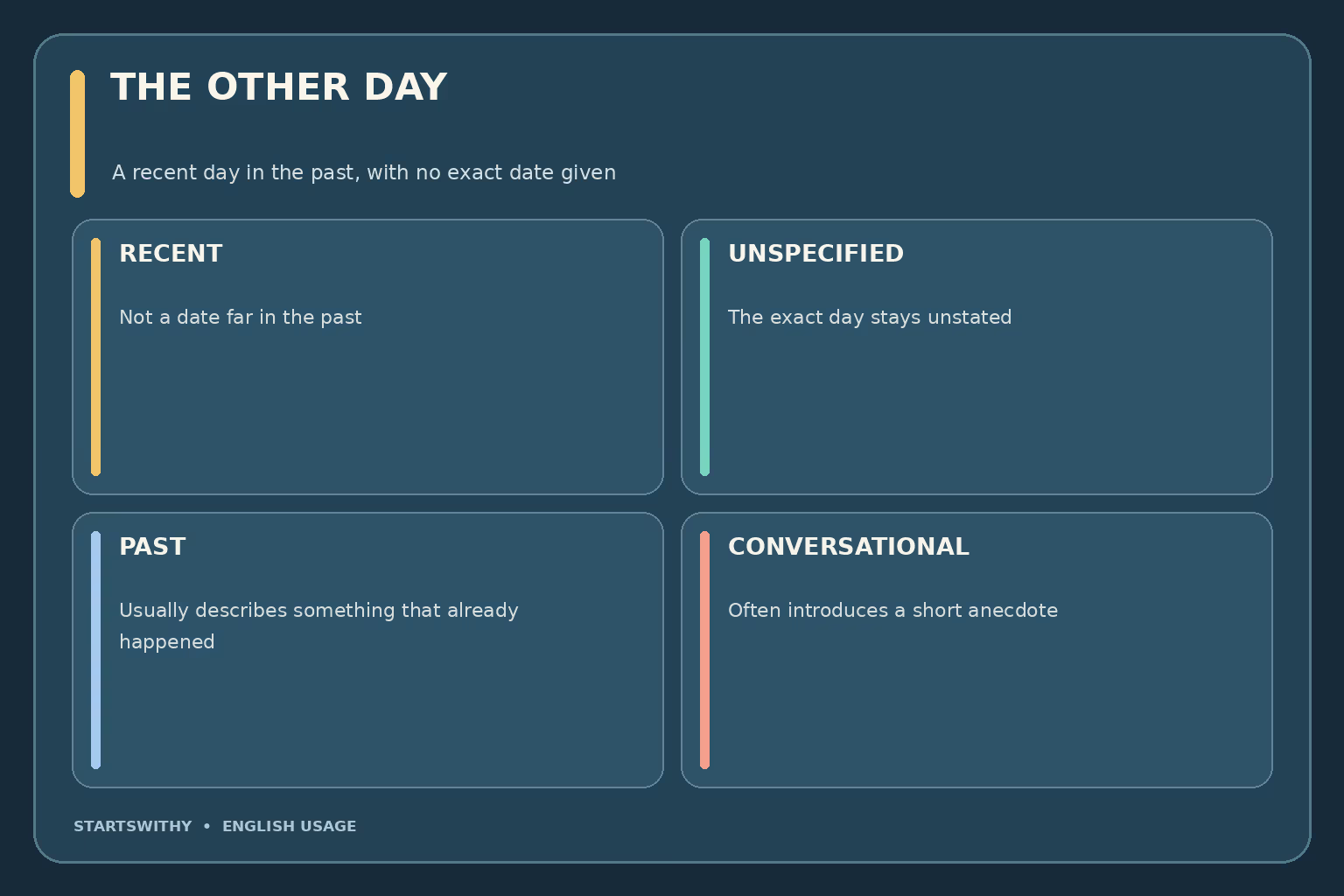
In this idiom, other does not identify a second day that the listener can calculate. It signals a day separate from today: one fairly recent occasion in the past. The expression leaves the date open, much like “a little while ago” or “recently,” but it often invites the listener to hear a short anecdote.
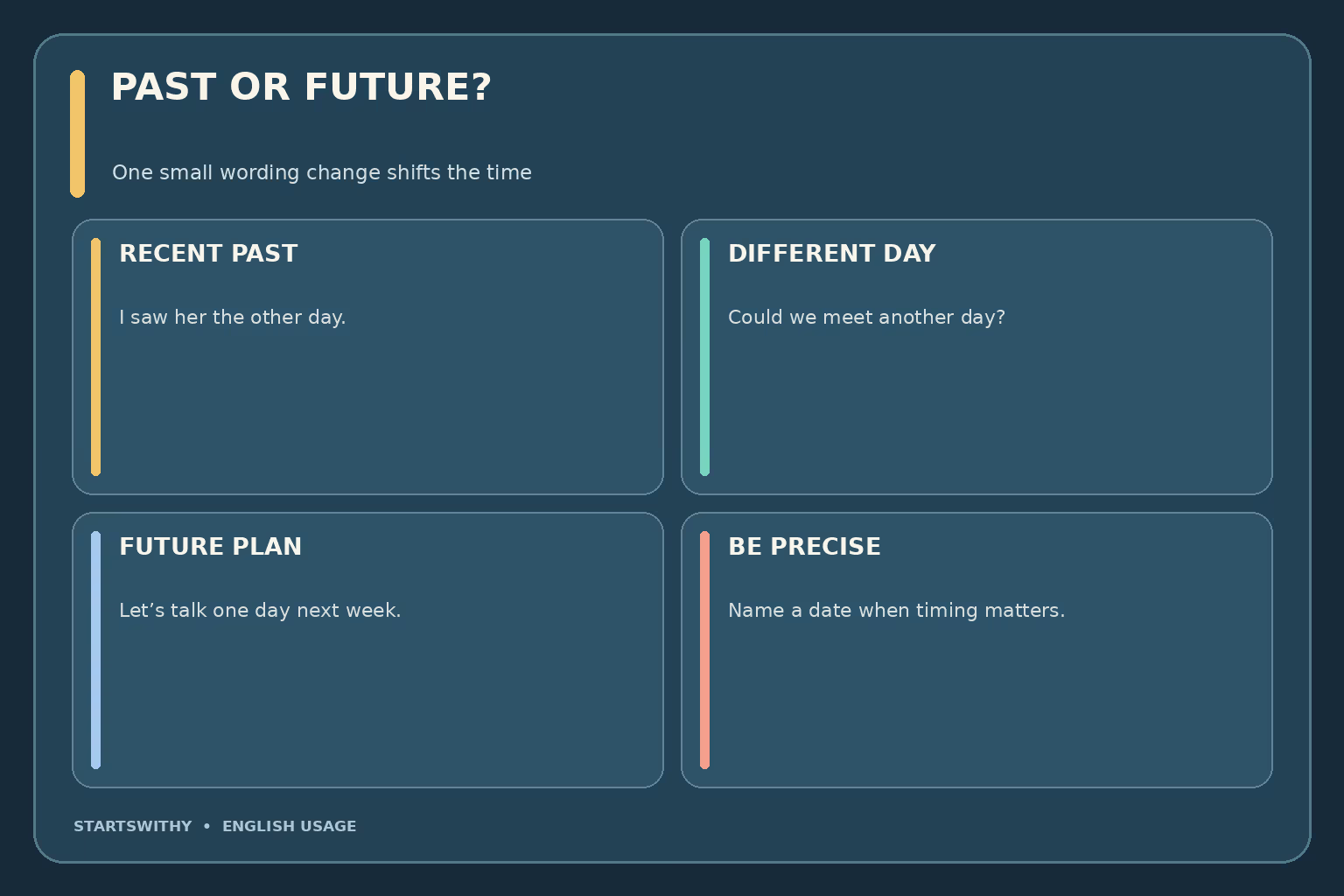
“I spoke to the building manager the other day” is useful when the conversation matters more than its date. If you need to arrange a follow-up, however, “I spoke to the building manager on Tuesday” is clearer. The exact range of “recent” depends on context, the speaker, and the event. A casual story may use the phrase for a day several days ago, while a work report may need a calendar date.
How to Use “The Other Day” in a Sentence
At the beginning
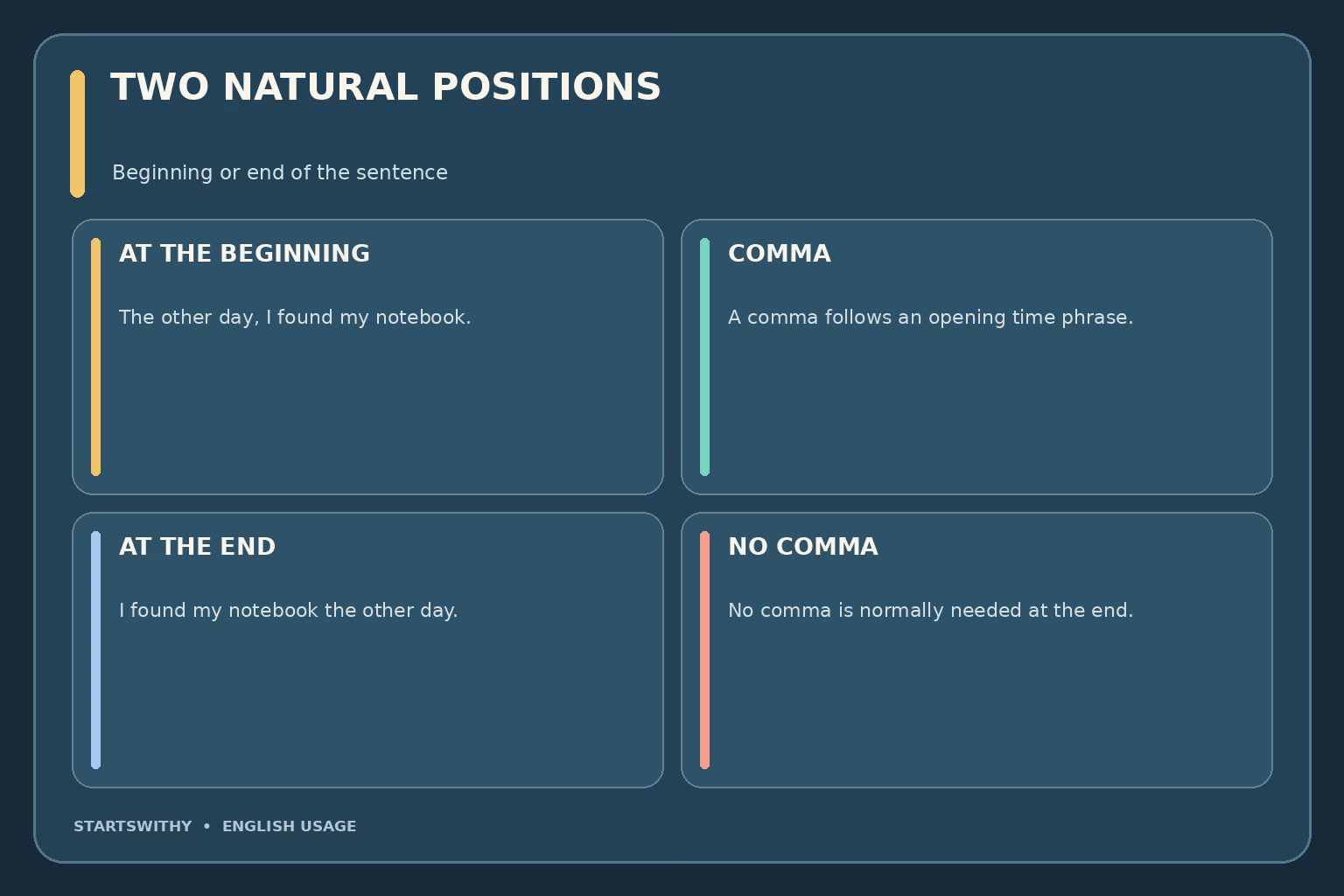
Put the phrase at the start to set the time before giving the main event. In ordinary prose, add a comma after this opening time phrase.
- The other day, our neighbor returned a parcel that had been delivered to the wrong apartment.
- The other day, I found the notebook I thought I had lost.
- The other day, the class compared two ways to solve the same problem.
At the end
At the end, it works as a time detail after the main clause. This position often sounds especially natural in conversation.
- I tried the new soup at the café the other day.
- We finally fixed the loose gate the other day.
- Did you see the notice in the lobby the other day?
With a past-tense verb
Because the expression normally points backward from the time of speaking, it commonly appears with the simple past: “They moved the meeting the other day.” It can also appear with other past forms when the meaning calls for them: “I was walking home the other day when the rain started,” or “I had seen that sign the other day, so I knew where to turn.” The surrounding meaning determines the tense; the phrase itself does not require one single verb form.
It is generally awkward to use the other day for a future event. Say “another day,” “one day next week,” or name the date instead: “Could we meet another day?” In that sentence, another day means a different or additional day, not a recent day in the past.
More “The Other Day” Example Sentences
- The other day, a former coworker sent me a photo from our first office.
- I heard a useful tip about pruning roses the other day.
- My keys were in the coat pocket I checked the other day.
- We talked about taking the train the other day, but we have not booked anything.
- The mechanic explained the warning light to me the other day.
- Didn’t you mention a good book the other day?
- The other day, Jordan asked whether the community garden needed volunteers.
- She showed us the shortcut she had found the other day.
- We ordered from that restaurant the other day and enjoyed the vegetable curry.
- The teacher gave us a quick review sheet the other day.
- I thought I had replied to your message the other day, but I had only saved a draft.
- It was sunny the other day, so the children ate lunch outside.
“The Other Day” vs. Similar Time Expressions
These expressions overlap, but they do not always carry the same emphasis:
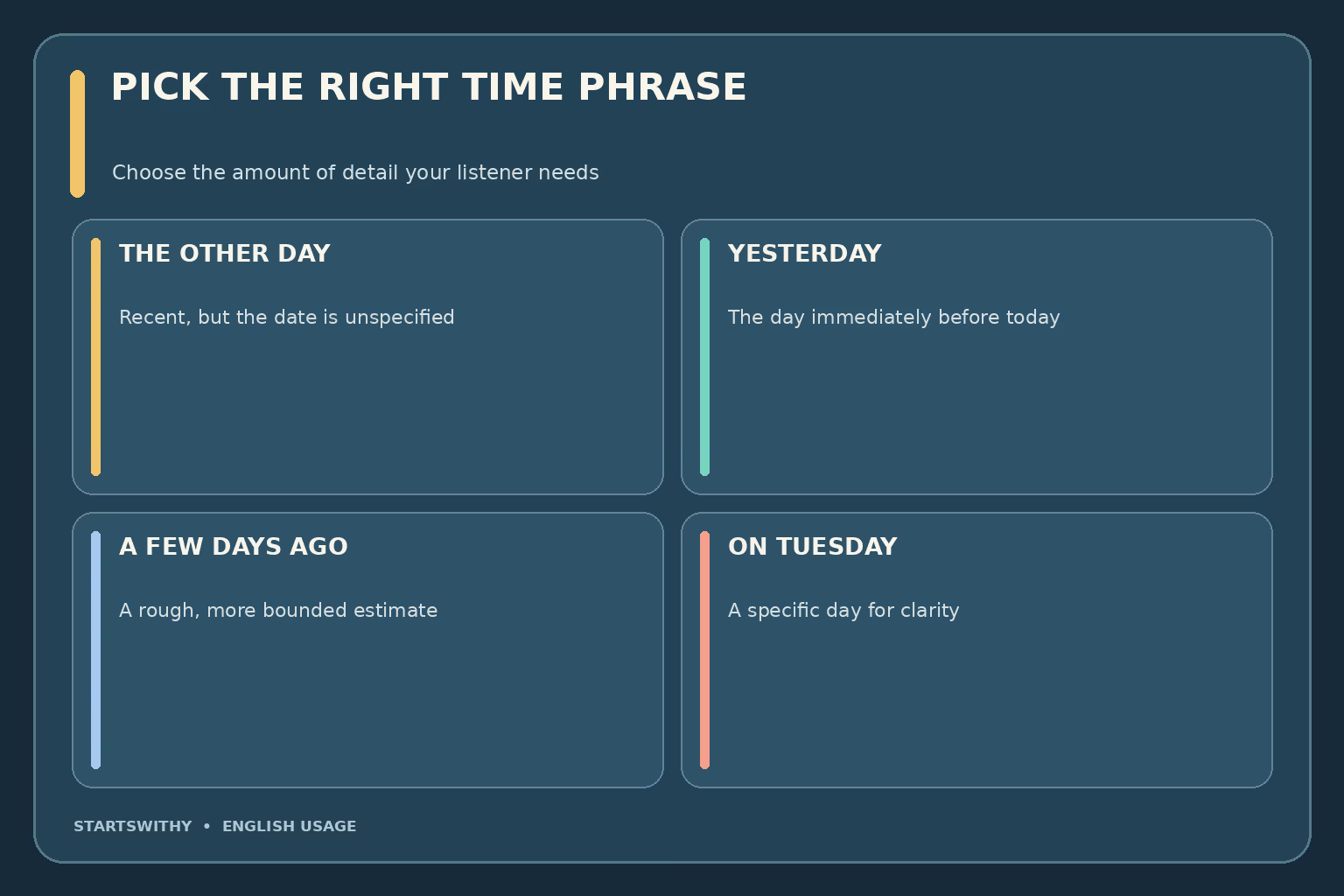
- The other day: an unspecified recent day in the past. “I saw Priya the other day.”
- Recently: at a time not long ago; it can describe an event or a broader change. “I recently started a new course.”
- A few days ago: a more bounded estimate of time. “The package arrived a few days ago.”
- Yesterday: the day immediately before today. “We spoke yesterday.”
- Last week: the previous week, which is useful when the week matters. “The repair happened last week.”
- Another day: a different or additional day, often one in the future. “Let’s finish the project another day.”
- One day: can refer to an unspecified day, often in a story or a hoped-for future. “One day, I hope to visit Kyoto.”
Cambridge’s usage guidance also notes “the other morning” and “the other week.” These use the same general idea: a recent but unspecified time. They do not provide a precise date either. When a schedule, deadline, or sequence depends on the timing, write the actual day or date.
Punctuation and Style Tips
When the phrase opens a sentence as an introductory time expression, a comma is a clear, standard choice: “The other day, I received a helpful note.” When it appears at the end, no comma is needed: “I received a helpful note the other day.” If it is placed in the middle as a parenthetical aside, commas can mark that interruption: “I received, the other day, a helpful note from the editor.” That middle placement is grammatical but can feel stilted; moving the phrase to the beginning or end is usually smoother.
Use lowercase in normal prose unless the phrase begins a sentence or appears in a title. Quotation marks are only needed when you are discussing the expression itself. Also avoid using it when the reader must know exactly which day you mean: “The deadline changed the other day” may be too vague in a project update; “The deadline changed on September 18” is more useful.
Common Mistakes to Avoid
- Treating it as an exact date: It does not tell the listener whether the event happened two days ago or last week. Give a date if precision matters.
- Using it for the future: Choose “another day” or “one day next week” for a future plan.
- Assuming it must mean yesterday: Use “yesterday” when you mean the day immediately before today.
- Forcing a comma at the end: “We met the other day” normally needs no comma.
- Overusing it in formal reports: It sounds conversational and may make a timeline unclear. Replace it with a specific date or a defined period where appropriate.
Quick Check
Ask yourself two questions: Did the event happen in the past, and is the exact day unimportant or unknown? If both answers are yes, “the other day” is likely a natural choice. If you are describing a future plan, a particular deadline, or a sequence that readers must follow, use a clearer time expression.
Sources: Cambridge Dictionary, “the other day”; Cambridge Dictionary Blog, “The day before yesterday: using time expressions”; Collins English Dictionary, “the other day”.

Have you ever found yourself sharing a recent anecdote starting with “the other day”? This phrase is commonly used to introduce a past event or experience in casual conversation. It sets the stage for a story or reflection that highlights something memorable or significant that happened recently.
When you begin an example sentence with “the other day,” you are inviting your listener to join you in revisiting a specific moment from the recent past. This phrase can lead to engaging storytelling or sharing personal insights, allowing for a deeper connection through shared experiences. So, next time you want to recount a recent adventure or occurrence, try starting with “the other day” to set the scene and capture your audience’s attention.
7 Examples Of The Other Day Used In a Sentence For Kids
- The other day I saw a big rainbow in the sky.
- The other day I played with my favorite toy car.
- The other day I ate a yummy chocolate ice cream.
- The other day I danced to my favorite song.
- The other day I read a story about a princess and a dragon.
- The other day I drew a picture of my family.
- The other day I helped my friend clean up the classroom.
14 Sentences with The Other Day Examples
- The other day I ran out of stationery during class and had to borrow a pen from a friend.
- The other day I missed the bus to college and had to take an auto-rickshaw to make it on time.
- The other day I forgot to pack my lunch and ended up buying a sandwich from the college canteen.
- The other day I left my textbook in my friend’s room and had to borrow their notes for the lecture.
- The other day I attended a seminar on campus and learned about a new internship opportunity.
- The other day I had a group project meeting and we decided to meet at the library to work on our presentation.
- The other day I lost my student ID card and had to go to the administration office to get a replacement.
- The other day I had a quiz in one of my classes and realized I forgot to study the night before.
- The other day I discovered a new coffee shop near college and tried their signature drink.
- The other day I had a heated debate in class about a current social issue with my classmates.
- The other day I attended a workshop on time management and learned some helpful tips for balancing academics and extracurricular activities.
- The other day I bumped into a senior from the same department and they shared some insights about potential career paths.
- The other day I participated in a cultural event organized by the college and tried my hand at traditional dance.
- The other day I stayed late at the campus computer lab to finish a coding assignment and ordered pizza for dinner.
How To Use The Other Day in Sentences?
The Other Day is a phrase used to refer to a specific day that occurred in the recent past. It can be used to describe any day that is not today. Here are some tips on how to use The Other Day in a sentence:
-
Identify the specific day: Think back to the day you are referring to when using The Other Day. This could be yesterday, last week, or any other day that is not today.
-
Use it in past tense: When using The Other Day, make sure to phrase your sentence in the past tense to indicate that the day you are talking about has already passed.
-
Provide context: To clearly communicate your message, provide context around what happened on The Other Day. This could be a specific event, conversation, or experience that occurred.
-
Examples:
- “I ran into an old friend at the grocery store the other day.”
- “We went to the beach the other day and had a great time.”
- “I watched a movie I hadn’t seen in years the other day.”
By following these guidelines, you can effectively use The Other Day in a sentence to describe a day that has recently passed. Remember to use it in the past tense and provide context to make your message clear to others.
Conclusion
In conclusion, using the phrase “the other day” is a casual and common way to refer to a recent past occurrence in English conversation. It is often used to recount a story, share an experience, or provide context to a situation that took place not long ago. For example, sentences such as “I ran into Sarah at the grocery store the other day” or “I watched a great movie the other day” showcase the flexibility and simplicity of incorporating this phrase into everyday language.
By incorporating “the other day” in your sentences, you can easily convey a sense of recency without specifying a precise date or time frame. This makes it a versatile and user-friendly term for expressing recent events or occurrences in a relaxed and informal manner.


