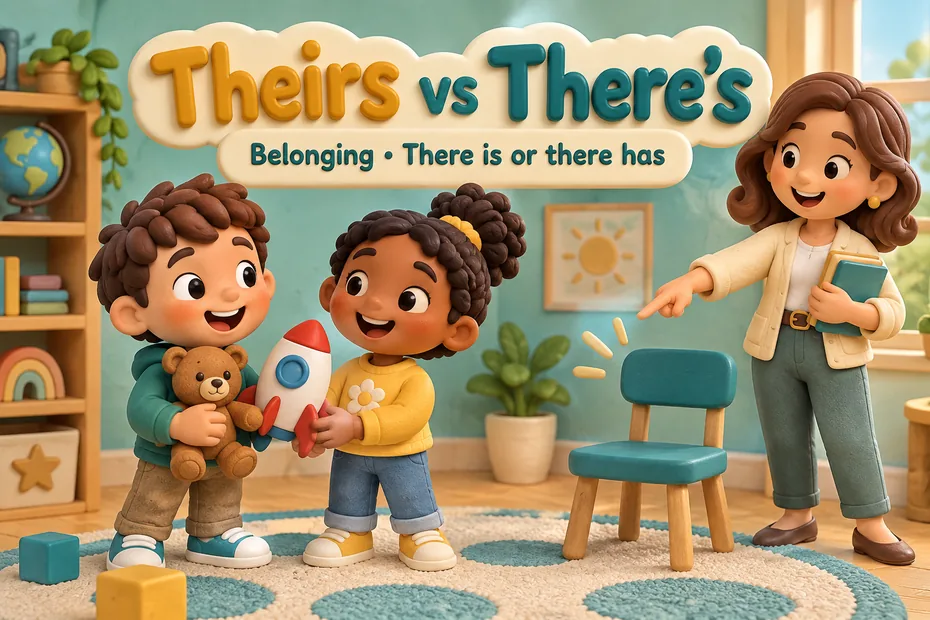
Theirs vs there’s: the correct spellings
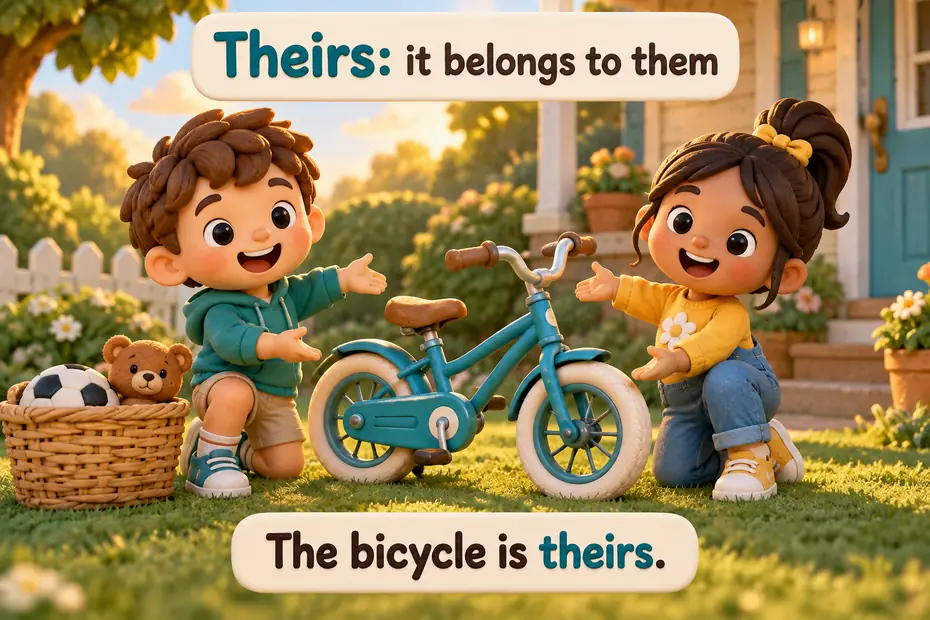
Theirs means something belongs to them: “The bicycles are theirs.” There’s is a contraction of there is or there has: “There’s a bicycle outside” and “There’s been a delay.” In ordinary standard writing, theres without the apostrophe is not the correct spelling of this contraction.
Correction to the older text: its examples that label “Theres a beautiful sunset” correct and “There’s a beautiful sunset” incorrect have the rule reversed. Write There’s a beautiful sunset. Its claim that theirs should be followed by a noun also confuses theirs with their. Write “their bicycle” or “the bicycle is theirs.”
Key facts and comparison table
| Form | Function | Correct example |
|---|---|---|
| Their | Possessive determiner before a noun | Their garden is small. |
| Theirs | Possessive pronoun standing for a noun phrase | The small garden is theirs. |
| There’s | Contraction of there is or there has | There’s a small garden outside. |
| There | Location word or introductory element | Put the chair there. |
| Theres | Missing an apostrophe if intended as the contraction | Correct it to there’s in standard prose. |
Merriam-Webster’s entries for theirs, there’s, and there verify these meanings. The apostrophe in there’s signals omitted letters. It does not show ownership.
Use theirs for possession
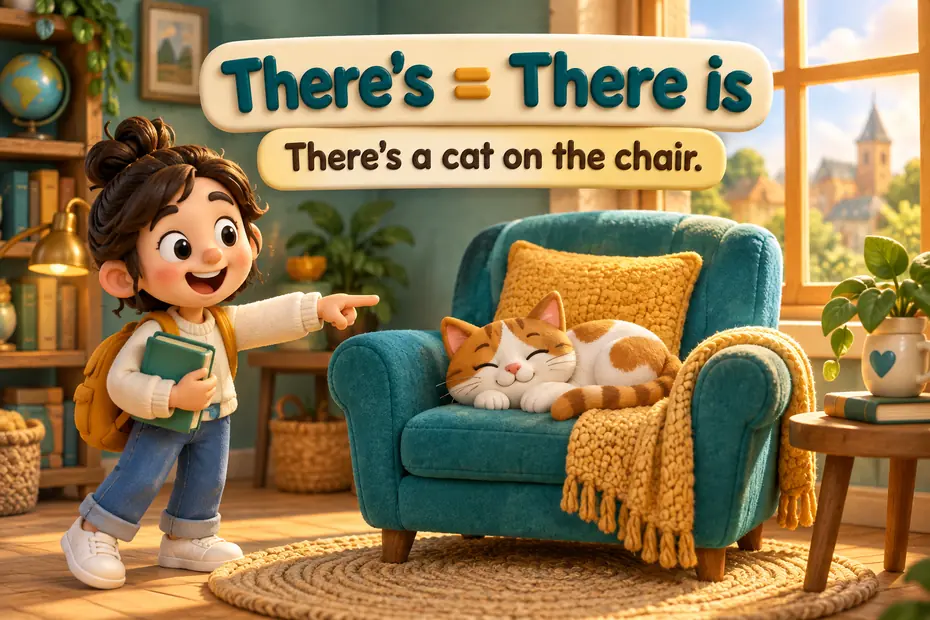
Compare “This is their room” with “This room is theirs.” In the first sentence, their comes before the noun. In the second, theirs stands for their room, so you do not add another noun directly after it. “This is theirs room” is not the standard construction.
No apostrophe belongs in the possessive pronoun theirs. The same pattern appears in yours, hers, and ours. This can feel surprising after learning that “the children’s room” needs an apostrophe, but a possessive noun and a possessive pronoun follow different spelling rules.
Theirs can refer to a single thing or several things. “The blue coat is theirs” concerns one coat. “The blue coats are theirs” concerns several coats. The verb agrees with the thing being discussed, not simply with the final s in theirs.
It can also refer to one person when used with singular they: “Someone left a coat; perhaps this one is theirs.” The older claim that theirs must always refer to multiple owners is too narrow. Make sure the surrounding context identifies the intended owner clearly.
Use there’s for there is or there has
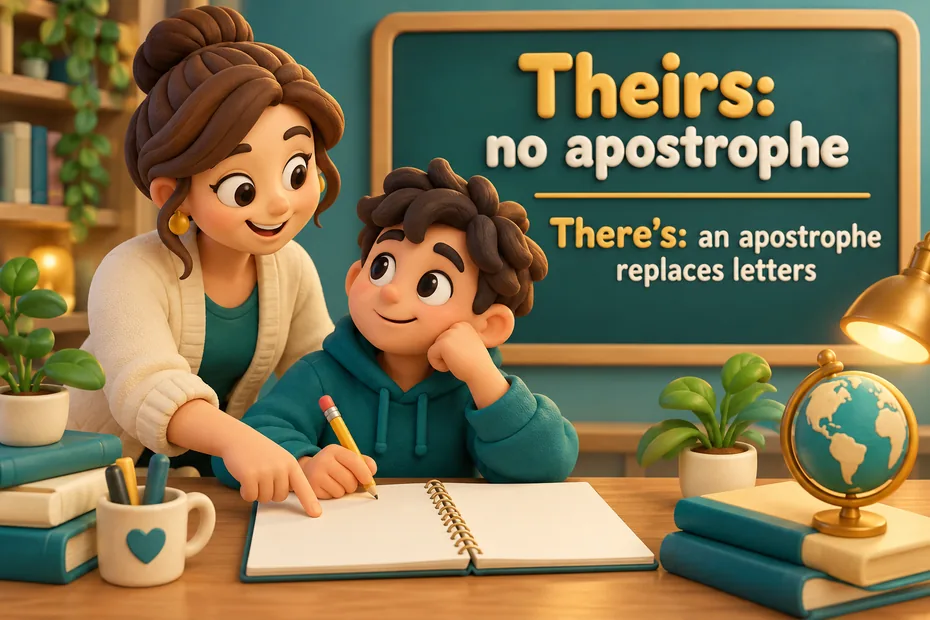
Expand the contraction to check it. “There’s a message” becomes “There is a message.” “There’s been an update” becomes “There has been an update.” Both expansions explain the apostrophe and help prevent confusion with ownership.
Do not add is again after the contraction. “There’s is a message” repeats the verb because there’s already contains it. If you want the uncontracted wording, write “There is a message.” In a more formal document, that full form may also be easier to read.
Check number in careful standard writing. “There is one chair” contracts to “There’s one chair.” With several chairs, write “There are three chairs.” You may hear “there’s three chairs” in conversation, but using there are avoids an agreement problem in an edited report or assignment.
There can introduce something or point to a place
In “The keys are there,” there identifies a location. In “There is a key on the table,” it introduces the existence or presence of a key. The word does not become a possessive merely because the sentence concerns a particular place.
A useful combined example is “There’s a bag over there, and it is theirs.” The first form introduces a bag, the second identifies a location, and the third identifies ownership. These different functions can appear in one natural sentence.
A quick proofreading method
- Test there is or there has. If the expanded phrase fits, choose there’s.
- Test belongs to them. If that expresses your meaning, choose theirs.
- Look for the next noun. Before a noun such as book, use their book, not theirs book.
- Check the apostrophe. Keep it in the contraction and omit it from the possessive pronoun.
These checks work even when the words sound alike. A spelling checker may accept the wrong correctly spelled word, so proofreading the sentence’s meaning is still necessary.
Practice and common questions
“This umbrella is ___” takes theirs. “___ an umbrella by the door” takes there’s. “___ umbrellas are by the door” takes their. “___ been heavy rain today” takes there’s, meaning there has.
Is theirs’ correct?
For the standard possessive pronoun, write theirs without an apostrophe.
Is theres acceptable in an essay?
If you mean there is or there has, write there’s or spell out the full phrase.
Can theirs begin a sentence?
Yes: “Theirs is the red bicycle.” The pronoun stands for the bicycle belonging to them.
Have you ever found yourself confused about when to use “theirs” and “theres”? You’re not alone. In this text, I’ll walk you through the correct usage of these two commonly misused words. Understanding the difference between “theirs” and “theres” is essential for effective communication. Whether you’re writing an email, a report, or even a text message, using these words appropriately can make a significant impact on your message’s clarity and professionalism. So, let’s immerse and unravel the mystery of “theirs” and “theres” once and for all.
Key Takeaways
- “Theirs” is a pronoun indicating possession, while “theres” is a contraction indicating existence or presence.
- “Theirs” is used to show that something belongs to a group or individuals, while “theres” is used to indicate the existence or presence of something.
- “Theirs” is a pronoun used alone in a sentence, while “theres” is a contraction used in combination with “is” or “has”.
- Using “theirs” incorrectly as a contraction of “there is” is a common mistake, and the correct contraction is “there’s”.
- “Theres” is not a valid word and should be avoided altogether.
- Paying attention to sentence structure and proofreading can help ensure accurate usage of “theirs” and “theres” in writing.
What is “theirs” and “theres”
“Theirs” and “theres” are two commonly confused words in the English language. Understanding the difference between them is crucial for effective communication. In this section, I’ll provide a clear definition of each word and explain how they are used in sentences.
Definition of “theirs”
“Theirs” is a pronoun that indicates possession. It is used to show that something belongs to a group of people or individuals. It is the possessive form of the pronoun “they.” For example:
- The house at the end of the street is theirs.
- The decision is theirs to make.
Definition of “theres”
“On the other hand, “theres” is a contraction of “there” and “is” or “there” and “has.” It is used to indicate the existence or presence of something. For example:
- There’s an apple on the table.
- There’s no need to worry.
Note that “theres” is commonly mistaken for the possessive form of “there,” but that is incorrect.
The difference between “theirs” and “theres”
The key difference between “theirs” and “theres” lies in their function and usage.
- “Theirs” is used to show possession, indicating that something belongs to a group or individuals.
- “Theres” is used to indicate the existence or presence of something.
To differentiate further:
- “Theirs” is a pronoun, while “theres” is a contraction.
- “Theirs” is used alone in a sentence, while “theres” is used in combination with “is” or “has.”
By understanding these differences, you can ensure accurate and clear communication in your writing.
In the next section, let’s explore some examples that illustrate the proper usage of “theirs” and “theres” to reinforce your understanding.
Understanding the difference between “theirs” and “theres”
When it comes to written communication, using the correct words is crucial. One common source of confusion for many people is distinguishing between “theirs” and “theres.” Understanding the difference between these two words will help you convey your thoughts accurately and effectively. Let’s jump into it!
Definition of “Theirs”:
“Theirs” is a pronoun used to indicate possession. It is the plural form of “his” or “hers” and is commonly used to refer to something that belongs to more than one person. For example:
- It’s their car. (meaning the car belongs to them)
Definition of “Theres”:
“On the other hand, “theres” is a contraction that combines the words “there” and “is,” or “there” and “has”. It is used to indicate the existence or presence of something. Here’s how it is used:
- There’s a new restaurant in town. (meaning there is a new restaurant)
Similarities and Differences:
Though “theirs” and “theres” might sound similar, they have distinct roles and meanings in a sentence. Here’s a breakdown of their similarities and differences:
Similarities:
- Both “theirs” and “theres” are pronouns.
- They are used to refer to something or someone.
Differences:
- “Theirs” indicates possession, while “theres” indicates existence or presence.
- “Theirs” is followed by a noun, while “theres” is followed by a verb or a noun.
Examples:
To further solidify your understanding, here are a few examples of how “theirs” and “theres” are used in sentences correctly:
- Their house is beautiful. (possessive)
- There’s a party tonight. (existence)
- Their opinions differ on this matter. (possessive)
- There’s no time to waste. (existence)
Remember, using “theirs” when you should be using “theres” or vice versa can lead to confusion and misunderstandings. Take the time to understand the difference and use them accurately in your writing.
Common mistakes while using “theirs” and “theres”
As a writer, it’s essential to have a firm grasp on the correct usage of words to effectively convey your message. Unfortunately, some words can be easily confused, leading to misunderstandings in communication. Two such words that are commonly misused are “theirs” and “theres.” Let’s take a closer look at some of the common mistakes people make when using these words.
Using “Theirs” Incorrectly
One mistake that people often make is using “theirs” when they should be using “there’s”. “Theirs” is a pronoun that indicates possession. It is used to show that something belongs to a group of people.
For example:
- “The blue car is theirs.”
- “The decision is theirs to make.”
But, people sometimes mistakenly use “theirs” as a contraction of “there is”. This is incorrect, and the proper contraction in this case is “there’s”.
Confusing “There’s” and “Theres”
Another common mistake is confusing “there’s” and “theres”. “There’s” is a contraction of “there is”, indicating the existence or presence of something. On the other hand, “theres” is simply incorrect and should be avoided altogether. It is not a valid contraction and can lead to confusion in your writing.
Here are some examples of correct usage:
- “There’s a cat on the roof.”
- “There’s an interesting book on the shelf.”
Avoid the mistake of using “theres” as it is not grammatically correct.
Understanding the Difference
To summarize, “theirs” is used to indicate possession, while “there’s” is a contraction of “there is” and shows the existence or presence of something. Remember, “theres” is not a valid word and should be avoided.
By understanding the difference between these words and avoiding common mistakes, you can ensure clear and effective communication in your writing. Now that we’ve covered the common mistakes, let’s move on to exploring some examples to reinforce our understanding of “theirs” and “there’s” in practical usage.
Tips for using “theirs” and “theres” correctly
As a language expert, I want to share some helpful tips to ensure that you use “theirs” and “theres” correctly in your writing. It’s important to understand the difference between these two commonly confused words to communicate effectively. Let’s dive right in!
- Know the Definitions:
- “Theirs” is a pronoun that indicates possession. It shows that something belongs to others.
- “Theres” is a contraction of “there is” or “there’s” and indicates the existence or presence of something.
- Use “Theirs” for Possession:
- When you want to show that something belongs to someone else, use “theirs.” It’s essential to remember, “theirs” is plural and does not require an apostrophe.
- Example: The house is theirs, not mine.
- Use “Theres” for Existence or Presence:
- When you want to express that something exists or is present in a particular location, use “theres.”
- Example: Theres a delicious aroma coming from the kitchen.
- Avoid Common Mistakes:
- Be cautious of common errors like using “there’s” or “they’res.”
- Correct: Theres a beautiful sunset.
- Incorrect: There’s a beautiful sunset / They’res a beautiful sunset.
- Pay Attention to Sentence Structure:
- In sentences using “theirs,” the word usually follows a possessive determiner like “my,” “your,” or “his.”
- Example: The car is theirs, not mine.
- Proofread and Edit:
- Always proofread your work to ensure that you have used “theirs” and “theres” correctly. Mistakes can easily slip through, so take the time to review and edit your writing.
Remember, using “theirs” and “theres” correctly is crucial for effective communication. By understanding the definitions and following these tips, you’ll enhance your writing skills and avoid confusion and misunderstandings.
Final thoughts and conclusion
Mastering the proper usage of “theirs” and “theres” is crucial for clear and effective communication. Throughout this article, I have provided valuable tips and examples to help you navigate the complexities of these commonly confused words.
By understanding the definitions and nuances of “theirs” and “theres,” you can avoid common mistakes and ensure your writing is accurate and precise. Remember to proofread and edit your work to catch any errors or inconsistencies.
Using “theirs” correctly shows ownership, while “theres” indicates a location. These subtle differences can greatly impact the meaning and clarity of your sentences.
So, the next time you find yourself unsure about whether to use “theirs” or “theres,” refer back to this article for guidance. With practice and attention to detail, you can confidently incorporate these words into your writing, enhancing your skills and avoiding confusion.
Continue to refine your language skills, and soon you’ll be using “theirs” and “theres” effortlessly, making your writing more polished and professional.
Frequently Asked Questions
Q: What is the difference between “theirs” and “theres”?
A: “Theirs” is a pronoun used to indicate possession, while “theres” is a contraction of “there” and “is.” “Theirs” shows ownership by a group, while “theres” indicates the existence or location of something. For example, “The book is theirs” and “There’s a cat on the roof.”
Q: How can I use “theirs” and “theres” correctly in my writing?
A: To use “theirs,” ensure that it represents ownership by a group, and place it after the noun it refers to. For “theres,” combine “there” and “is” and use it to indicate existence or location. Remember to proofread and edit your writing to ensure accuracy.
Q: What are common mistakes to avoid when using “theirs” and “theres”?
A: Common mistakes include confusing “their” (possessive adjective) with “theirs,” and using “there’s” when “their” should be used. Additionally, be careful with word order, as placing “theirs” or “theres” in the wrong location can result in incorrect meaning. Proofreading and editing can help avoid these mistakes.
Q: Why is it important to use “theirs” and “theres” correctly in writing?
A: Using “theirs” and “theres” correctly enhances communication by conveying ownership and indicating existence or location accurately. Proper usage helps readers understand the intended meaning and prevents confusion or misunderstandings. It also showcases your writing skills and attention to detail.


