
What does thrilled mean in a sentence?
Thrilled means very pleased and excited. “I was thrilled to receive the invitation” tells the reader that the invitation caused a strong happy reaction. The word works for good news, an achievement, an enjoyable experience or the prospect of something welcome. It does not require a surprise: “We are thrilled about our planned visit” describes excitement about an event already arranged.

Key facts and useful sentence patterns
Thrilled commonly acts as an adjective after be or feel: “She is thrilled” and “They felt thrilled.” It can also be the past tense or past participle of thrill: “The performance thrilled the audience.” These two uses share the idea of an exciting effect, but their grammar differs. In the adjective example, she has the feeling. In the verb example, the performance causes it.
| Pattern | Example | Focus |
|---|---|---|
| Thrilled about a noun | We are thrilled about the visit. | The news, plan or event |
| Thrilled with a noun | I am thrilled with the result. | A satisfying outcome or thing |
| Thrilled to + verb | She was thrilled to meet the author. | A welcome action or experience |
| Thrilled that + clause | They are thrilled that you can come. | A complete statement explaining why |
Merriam-Webster’s thrilled entry confirms the adjective’s strong positive meaning and the related verb forms. The teaching examples here apply those distinctions to ordinary sentences. Use the preposition or clause that best explains the reason for the reaction.
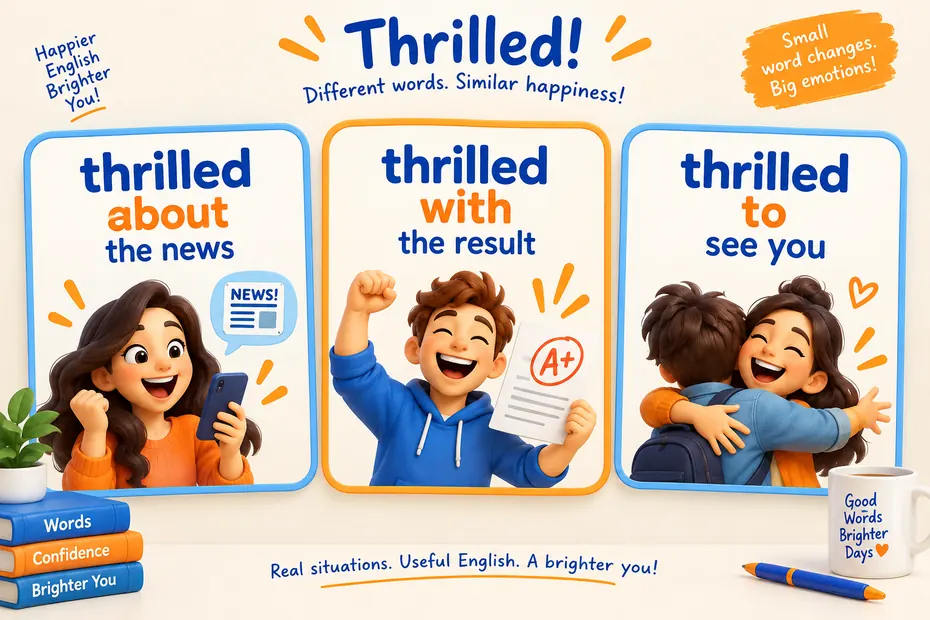
Thrilled about, thrilled with and thrilled to
Use about to introduce the topic of excitement: “Maya is thrilled about the school trip.” Use with for something that gives satisfaction: “Maya is thrilled with her new sketchbook.” Use to before a base verb: “Maya is thrilled to join the art club.” These are helpful patterns, rather than absolute rules that make every other choice wrong. Sometimes both about and with sound natural, with a slightly different emphasis.
A that-clause can explain the cause fully: “I am thrilled that my cousin can visit.” You can often express a similar idea with an infinitive: “I am thrilled to see my cousin.” The first sentence highlights the fact that the visit is possible; the second highlights the experience of seeing the cousin. Choose the form that matches what you want readers to notice.
The surrounding verb places the emotion in time. “I am thrilled” describes the present. “I was thrilled” describes a past reaction. “I have been thrilled with the results” connects a past period with the present. In each case, thrilled keeps the same spelling. Avoid “I am thrill” when you mean that you feel excited and pleased.
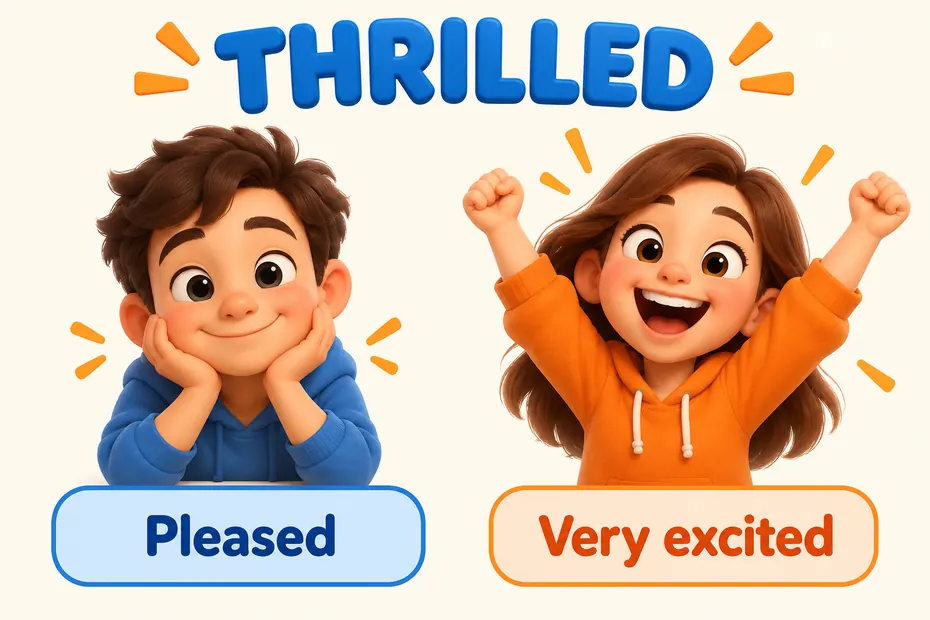
Thrilled versus thrilling
Thrilled describes the person experiencing the feeling; thrilling describes something exciting. Compare “The children were thrilled by the performance” and “The performance was thrilling.” A person can also be thrilling when that person provides an exciting experience, but “I am thrilling” does not normally communicate “I feel excited.” This is the same useful distinction seen in interested versus interesting.
Consider “The thrilling finish left the spectators thrilled.” The finish causes excitement; the spectators experience it. When you revise a sentence, identify the experiencer and the cause before choosing the ending. That small check prevents a common mistake in writing about emotions and events.
Fresh examples for different situations
- We were thrilled to find our missing dog safe at home.
- The class was thrilled about the museum visit.
- I am thrilled with the way the painting turned out.
- Her grandparents were thrilled that she could stay for the weekend.
- The young musician was thrilled to perform her own song.
- He looked thrilled when his name was announced.
- The unexpected encore thrilled the audience.
- They were thrilled by the warm welcome.
These examples name a particular reason for happiness. That makes them more informative than repeatedly writing “I was thrilled” without context. In a story, you can add a visible reaction: “Nora was thrilled to hear the news and immediately called her brother.” The action supports the emotion without requiring a description of every thought she had.
Meaning, tone and corrections to the original examples
Thrilled is stronger than merely pleased. It can sound enthusiastic in a thank-you note or announcement, but a restrained report may prefer pleased or satisfied. Do not assume that anyone who says “I am thrilled” must experience a particular physical sensation or a measurable rush of euphoria. Everyday vocabulary does not make a clinical claim about a person’s emotional state.
The butterfly sentence in the original list below is personification: it gives insects a human emotional description for a playful story. It is not evidence that butterflies react to flowers with the human feeling described by thrilled. Also, thrilled does not need to appear at the start or end of a sentence. In “Our team was thrilled with the result,” its ordinary position follows was.
Practice and frequently asked questions
Choose the best word: “The audience was thrilled/thrilling.” “It was a thrilled/thrilling match.” “We are thrilled to/with meet you.” The answers are thrilled, thrilling and to. The audience has the feeling, the match provides excitement, and to introduces the verb meet.
Is thrilled an adjective?
Yes, it commonly describes a strong happy feeling. It can also be a form of the verb thrill, as in “The news thrilled us.”
Can I say thrilled with the result?
Yes. That wording naturally describes strong satisfaction with an outcome.
Does thrilled mean surprised?
No. A surprise can cause the feeling, but a planned and expected event can also make someone thrilled.
What does not thrilled mean?
It indicates a lack of enthusiasm or pleasure. Depending on context and tone, it can be a mild way of expressing disappointment or disapproval.

Have you ever been thrilled by an unexpected surprise or exciting news? The feeling of being thrilled is characterized by intense excitement or joy, often brought on by something highly anticipated or surprising.
When someone is thrilled, they experience a rush of euphoria and happiness that typically leaves them feeling exhilarated and eagerly looking forward to what comes next. This emotion can be triggered by various events or circumstances, such as achieving a long-awaited goal, receiving positive feedback, or being presented with an unexpected opportunity.
7 Examples Of Thrilled Used In a Sentence For Kids
- I am thrilled to go to school today.
- The teachers were thrilled to see our project.
- We were thrilled to have ice cream for lunch.
- I am thrilled to have new crayons to color with.
- My friends were thrilled to play with me at recess.
- The butterflies were thrilled to see the flowers in the garden.
- I am thrilled to learn new songs in music class.
14 Sentences with Thrilled Examples
- I was thrilled to find out that I aced my final exams.
- My friends were thrilled when I announced that I got an internship at a top company.
- I felt thrilled to be selected as the captain of our college basketball team.
- We were all thrilled to be given a day off from classes for a campus event.
- My parents were thrilled when I told them I received a scholarship for my studies.
- We were thrilled to hear that our college is organizing a music festival next month.
- I was thrilled to receive a letter of recommendation from my professor for a study abroad program.
- My classmates were thrilled when our professor canceled a difficult assignment.
- I was thrilled to be asked to be a part of the organizing committee for our college fest.
- The entire college was thrilled to hear that a renowned guest speaker will be visiting our campus next week.
- I was thrilled when I got accepted to present my research at a national conference.
- Our group project presentation went so well, and we were all thrilled with the feedback we received.
- My friends were thrilled when I suggested having a movie marathon at my place during the weekend.
- I was thrilled when I found out that our college library has a new collection of books by my favorite author.
How To Use Thrilled in Sentences?
To use “Thrilled” in a sentence, start by identifying a situation that brought you extreme joy or excitement. For example, “I was thrilled when I received a promotion at work.”
Next, consider the context in which the word will be used. “Thrilled” is typically used to express a feeling of great happiness or excitement. It is important to make sure the sentence conveys this emotion clearly.
Ensure that “Thrilled” is placed in the appropriate part of the sentence to maintain the clarity of your message. It is often used at the beginning or end of a sentence for emphasis. For instance, “My sister was thrilled to receive tickets to her favorite band’s concert.”
Don’t forget to use proper grammar and punctuation to enhance the impact of the sentence. Proofread your sentence to check for any errors that might detract from the overall effect.
Remember that “Thrilled” is a powerful word that conveys a strong positive emotion. Be sure to use it in situations that truly evoke a feeling of extreme joy or excitement to fully capture its meaning.
Incorporating “Thrilled” into your vocabulary will allow you to express your happiness and excitement in a more vibrant and energetic way.
Conclusion
In conclusion, the use of “thrilled” in sentences conveys a sense of excitement, happiness, and anticipation. Whether expressing joy over an accomplishment, an upcoming event, or a pleasant surprise, this word adds an energetic and positive tone to communication. For example, “I was thrilled to receive the promotion” and “She was thrilled with the surprise party” both illustrate the impact of “thrilled” in conveying strong emotions of delight.
Overall, incorporating “thrilled” into sentences enhances the expression of enthusiasm and satisfaction. It serves as a powerful term to express genuine happiness and contentment, making it a valuable addition to language for conveying positive sentiments.


