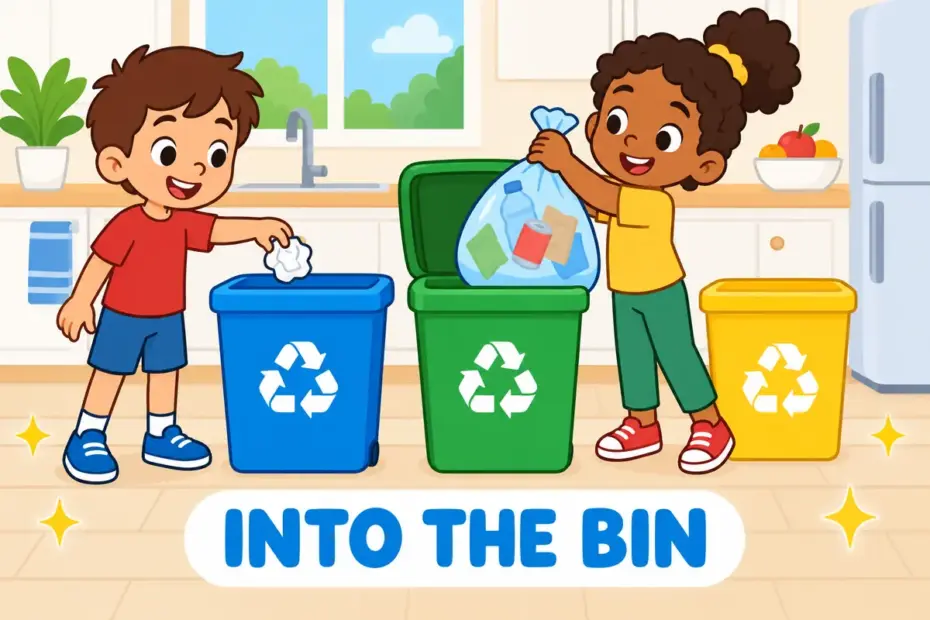
Throw away is a phrasal verb meaning to discard something as rubbish or to waste a chance. In a sentence the object may follow the phrase, as in “Throw away the wrapper,” or sit between the verb and the particle, as in “Throw it away.” A pronoun must take the middle position.
Throw away at a glance
- Throw away is a separable phrasal verb; its forms are throws away, threw away and thrown away.
- The literal sense discards something as no longer wanted: “Throw away the empty carton.”
- The figurative sense wastes an advantage: “They threw away a two-goal lead.”
- The particle may move after the object, but a pronoun goes between: “throw it away.”
- It is neutral in register, while formal writing prefers discard and waste.
- The commonest error is the order “throw away it,” which English does not allow.
What does throw away mean?
Throw away is a separable phrasal verb meaning to discard something as rubbish, or to waste an opportunity or advantage. The Cambridge entry for throw away records both senses, and the object tells you which is meant: wrappers, boxes and old clothes are discarded, while leads, chances and money are wasted. In formal writing discard often replaces throw away when the object is a document or an old rule, and when a chance is wasted on a large scale, squander is the stronger verb.
| Sense | Plain meaning | Example sentence |
|---|---|---|
| Discard | Put something in the rubbish | Throw away the packaging before you store it. |
| Waste | Lose a chance or advantage carelessly | The team threw away a comfortable lead. |
| Sports | Give up a winning position | They threw the match away in the last minute. |
Throw away is the wrong register for a legal or academic text about abandoning rules, where discard or reject reads more precisely, and it never means to destroy something deliberately, which is a different act from putting it in the bin.
How do you use throw away in a sentence?
Five patterns cover the verb, and the position of the object is the part that trips learners.
| Pattern | Example | What it signals |
|---|---|---|
| throw away + object | Throw away the old batteries. | the object after the whole phrase |
| throw + object + away | Throw the old batteries away. | the same action with the object first |
| throw + pronoun + away | Throw them away. | the only order a pronoun allows |
| throw away + chance / lead | They threw away the chance to win. | the figurative wasting sense |
| be thrown away (passive) | The notes were thrown away by mistake. | lost or discarded in the passive |
For a quick, careless action, toss is lighter than throw away, and for time, money or effort, waste states the loss more directly than throw away does.
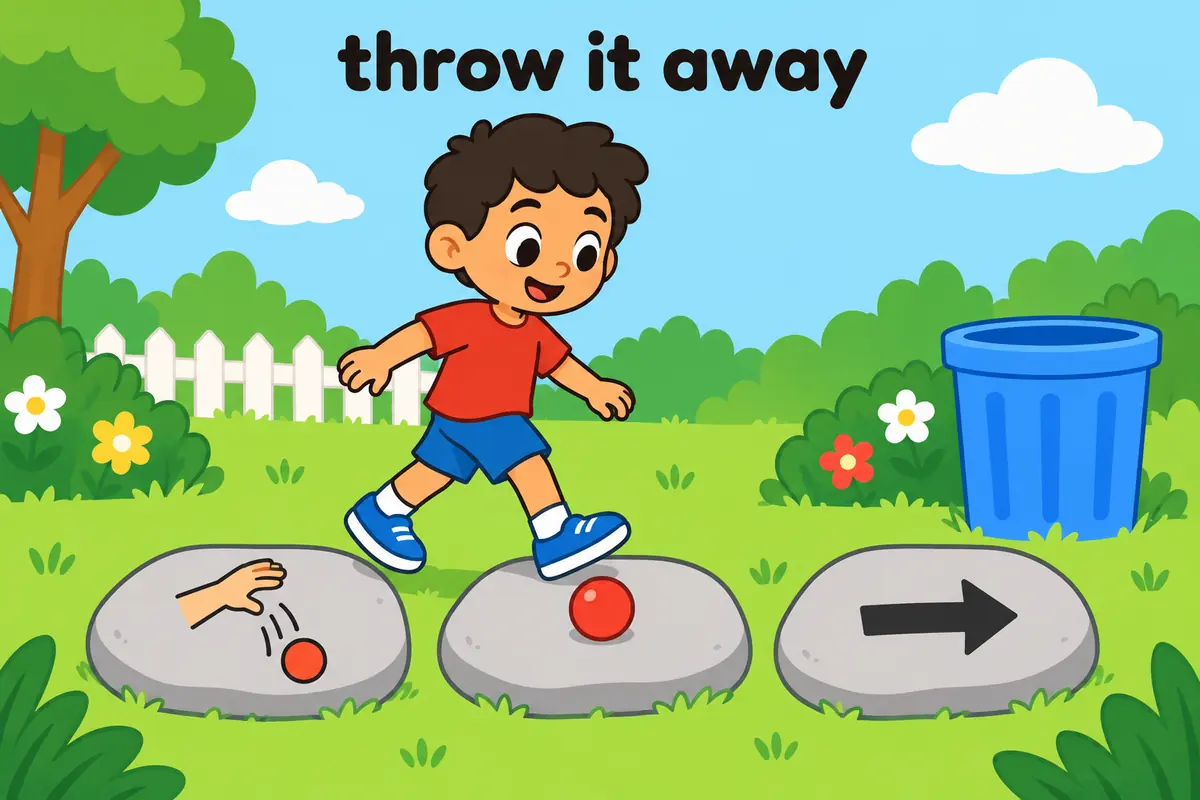
Throw away in a sentence: examples across contexts
| Context | Example sentence | Why this works |
|---|---|---|
| Classroom | Throw away your scrap paper at the end of the lesson. | A clear instruction with the object after the phrase. |
| Workplace email | Please do not throw away the signed originals. | A polite request using the separable form. |
| News report | The club threw away a two-goal lead in ten minutes. | The wasting sense, which suits a report. |
| Environmental writing | Consumers throw away millions of bottles each day. | The discarding sense on a large scale. |
| Conversation | Just throw it away if it is broken. | A pronoun takes the middle position. |
| Academic writing | The study warns that firms throw away valuable knowledge. | A figurative example in formal prose. |
| Sports report | They threw the game away with three late errors. | The sports sense of losing a winning position. |
| Home advice | Throw away food that has passed its date. | Practical instruction with a concrete object. |
| Business writing | The board threw away the chance to expand. | The wasted-opportunity sense in a formal setting. |
Throw away vs throw out and squander
The three sit close together, but each covers a different kind of loss.
| Attribute | Throw away | Throw out | Squander |
|---|---|---|---|
| Core meaning | Discard as rubbish or waste a chance | Discard, or force someone out | Waste something valuable over time |
| Typical object | rubbish, a lead, an opportunity | rubbish, a person, an idea | money, time, talent |
| Tone | neutral, everyday | neutral, can be forceful | critical, formal |
| Extra sense | none | ejecting a person | none |
| What it implies | something given up as unwanted | a removal, sometimes by force | a slow, damaging loss |
Use throw away for rubbish or a lost chance, throw out when a person or thing is ejected, and squander when something valuable is wasted over time. In American speech trash can mean to ruin or destroy, and cast off suggests shedding something old and restrictive rather than binning rubbish.
Word forms and grammar of throw away
| Form | Part of speech | Example |
|---|---|---|
| throw away (base) | phrasal verb | Do not throw away the receipt. |
| throws away (third person) | phrasal verb | He throws away nothing useful. |
| threw away (past) | phrasal verb | They threw away the box yesterday. |
| thrown away (past participle) | phrasal verb | The letters were thrown away by mistake. |
| throwing away (present participle) | phrasal verb | Throwing away food wastes money. |
The spelling learners get wrong is “thrown” in the passive, which they sometimes write as “throwed,” but throw keeps the irregular forms threw and thrown throughout.
Common mistakes with throw away
- Incorrect:
Throw away it before it smells.Correct: Throw it away before it smells. Rule: a pronoun object goes between the verb and the particle. - Incorrect:
He throwed away the old tickets.Correct: He threw away the old tickets. Rule: throw has the irregular past threw. - Incorrect:
The notes were throwed away.Correct: The notes were thrown away. Rule: the past participle is thrown. - Incorrect:
They threw away the match out.Correct: They threw the match away. Rule: use one particle, not two, in this phrasal verb. - Incorrect:
Please discard of the wrapper.Correct: Please discard the wrapper. Rule: discard is transitive and takes no of.
Practice using throw away
Six tasks cover the rubbish sense, the wasted-chance sense and the pronoun rule.
- Please ______ the empty bottles in the green bin. (fill in the blank)
- The team ______ a three-goal lead in the second half. (fill in the blank)
- Choose the better verb: Do not ______ your talent on easy work. (throw away / squander)
- Correct this sentence: “Throw away it if it is torn.”
- Build a sentence with throw away about a club losing a winning position.
- Which sentence belongs in a formal report? (A) The firm discarded the outdated policy. (B) The firm threw away the outdated policy.
Answers
- throw away — the rubbish sense takes the object after the phrase.
- threw away — the wasted-advantage sense in the past.
- squander — large-scale waste of talent takes the stronger word.
- Throw it away if it is torn — the pronoun goes in the middle.
- The club threw away a winning position in the final minutes — the sports sense.
- Sentence A — formal writing prefers discard to throw away.
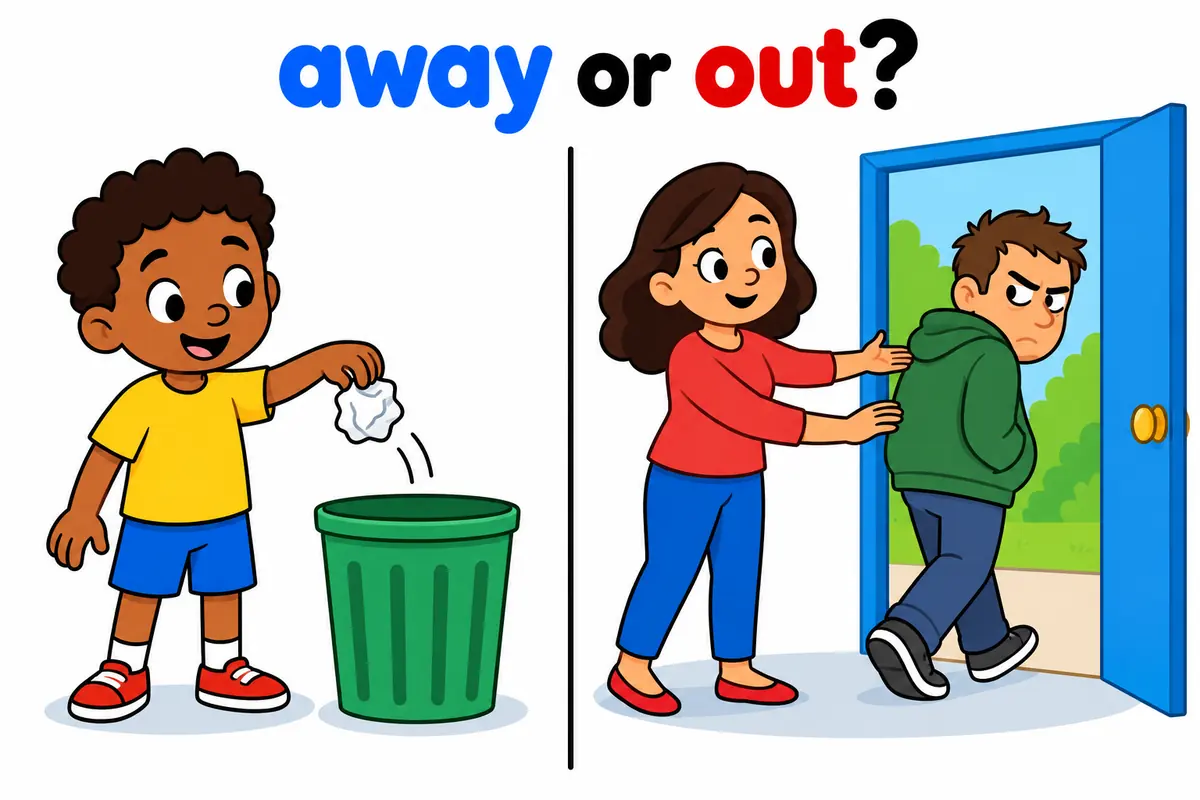
The bottom line
Throw away does two familiar jobs: it sends rubbish to the bin and it wastes a chance or a lead. It is separable, so the object may follow the phrase, but a pronoun must sit between throw and away. Keep discard for formal documents and squander for a large-scale loss. Used with the object in the right place, throw away in a sentence reads naturally in speech and in writing.
Frequently asked questions about throw away
Is throw away separable?
Yes. The particle may follow the object, as in throw the box away, or stay with the verb, as in throw away the box. The one firm rule is that a pronoun goes between them: throw it away is correct, and throw away it is not. That test marks every separable phrasal verb.
Can throw away mean to waste money?
Yes. Beyond rubbish, throw away covers wasted money, time and chances, as in they threw away their savings on a bad deal. The idea of no further use links the two senses. For a slow, damaging loss of something valuable, squander carries more force.
Is throw away formal or informal?
It is neutral and common in speech and general writing. Formal documents tend to prefer discard, dispose of or reject, which sound more measured. Choose throw away for everyday contexts and discard when the sentence belongs in a policy, a report or an academic paper.
Where does a pronoun go in throw away?
A pronoun always goes between the verb and the particle, so it is throw it away, throw them away and throw that away. Placing the pronoun after the phrase, as in throw away it, sounds wrong to native speakers and is a clear sign that the phrasal verb is separable.
Have you ever wondered how to effectively get rid of unwanted items? “Throw away” is a phrasal verb that means to discard or dispose of something that you no longer want or need. It is a common phrase used in everyday conversations and can help convey the action of getting rid of something.
When you “throw away” something, you are essentially putting it in the trash or disposing of it in a proper manner. This action can help declutter your space and make room for things that are more useful or important to you. Understanding how to properly “throw away” items can contribute to a cleaner living environment and a more organized lifestyle.
7 Examples Of Throw Away Used In a Sentence For Kids
- Throw away the used paper in the dustbin.
- Do not throw away food, save it for later.
- Let’s throw away the broken toy and get a new one.
- Remember to throw away plastic bottles in the recycling bin.
- Throw away banana peels in the compost for plants.
- It is important to throw away empty cans in the trash.
- Please throw away the wrappers in the bin, keep the classroom clean.
14 Sentences with Throw Away Examples
- Throw away those empty instant noodle packets lying around in your room.
- Don’t forget to throw away the old study notes after the exams are over.
- It’s time to throw away the broken pens and markers from your stationery drawer.
- Remember to throw away the expired snacks from your hostel room.
- Make sure to throw away the old newspapers and magazines piling up in your study area.
- Throw away the worn-out shoes that you no longer wear.
- Throw away the empty bottles and cans cluttering your desk.
- Don’t hesitate to throw away the torn and stained clothes from your wardrobe.
- It’s time to throw away the used batteries and electronic waste responsibly.
- Throw away the unnecessary photocopies and printouts to reduce clutter in your study space.
- Remember to throw away the expired toiletries and cosmetics from your bag.
- Don’t forget to throw away the empty medicine packages cluttering your study desk.
- It’s important to throw away the old and outdated study materials to make room for new ones.
- Throw away the broken headphones and chargers that are of no use to you.
How To Use Throw Away in Sentences?
Throw away means to dispose of or get rid of something that is no longer needed or wanted. It is often used when you want to discard an item or object that is no longer useful.
For example, you can say, “I need to throw away these old magazines that are cluttering up my living room.” In this sentence, throw away is used to indicate the action of getting rid of the old magazines.
When using throw away, it is important to remember that it is a phrasal verb, which means it consists of two or more words that function as a single unit. In this case, throw is the main verb and away is the particle that gives the verb its meaning.
To use throw away in a sentence, simply place the object you want to discard after the verb. For instance, “I need to throw away these empty bottles.” In this sentence, the object of the verb throw away is the empty bottles.
Overall, using throw away in a sentence is a simple and convenient way to express the action of disposing of something. Just remember to place the object you want to get rid of after the verb to form a complete sentence.
Conclusion
In everyday life, we frequently encounter situations where we discard or throw away items that are no longer useful or needed. Whether it’s old clothes, expired food, or broken appliances, the act of throwing away things is a common practice in our society.
However, it is important to be mindful of our consumption habits and the impact that throwing away items can have on the environment. By reducing waste, reusing items when possible, and recycling whenever we can, we can help minimize our carbon footprint and contribute to a more sustainable future. Making conscious decisions about what we throw away can ultimately lead to a healthier planet and a better world for future generations.


