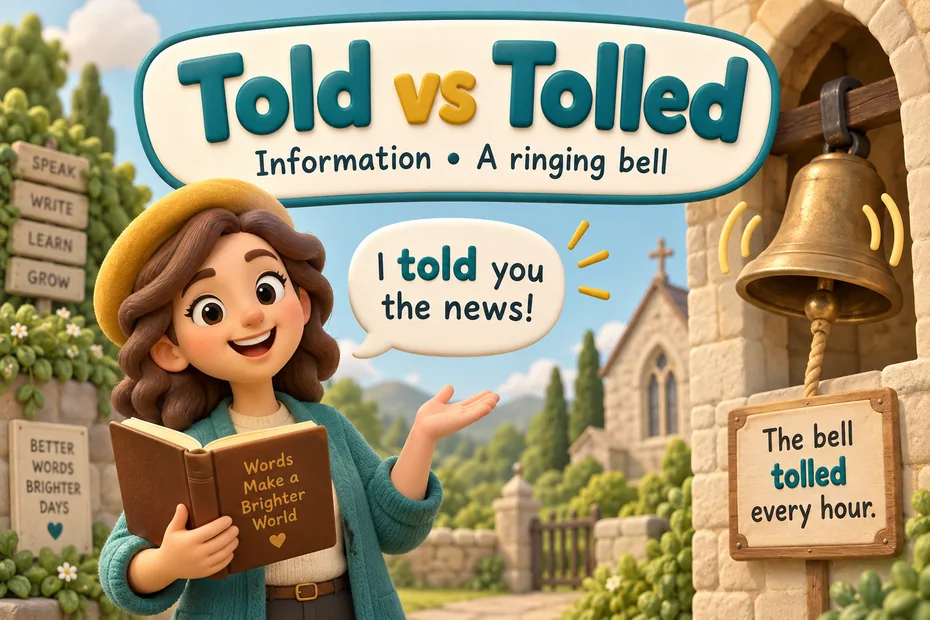
Told is the past tense and participle of tell; tolled is the past tense and participle of toll. Use told for giving information, narrating, or instructing. Use tolled for a bell ringing in measured strokes, or for another documented sense of toll. Their shared sound does not make their meanings interchangeable.
Told vs tolled: key facts
- Tell changes irregularly to told, not telled.
- Toll changes regularly to tolled.
- Told commonly introduces information given to a person.
- Tolled commonly describes a bell’s measured ringing.
- A noun such as toll or tolling is not automatically the verb told.

Which spelling does the sentence need?
| Meaning | Choice | Original example | Check |
|---|---|---|---|
| Give information | Told | Amir told us the meeting time. | Did someone communicate information? |
| Narrate | Told | Leah told a story after dinner. | Was something recounted? |
| Give an instruction | Told | The guide told us to wait. | Was someone directed to act? |
| Ring a bell in measured strokes | Tolled | The tower bell tolled at noon. | Is this the verb toll? |
Merriam-Webster’s tell entry records the form told and the information, narration, and instruction senses. Its toll entry records the separate verb and its ringing sense. Start with the original verb, rather than trying to choose a spelling from the sound alone.
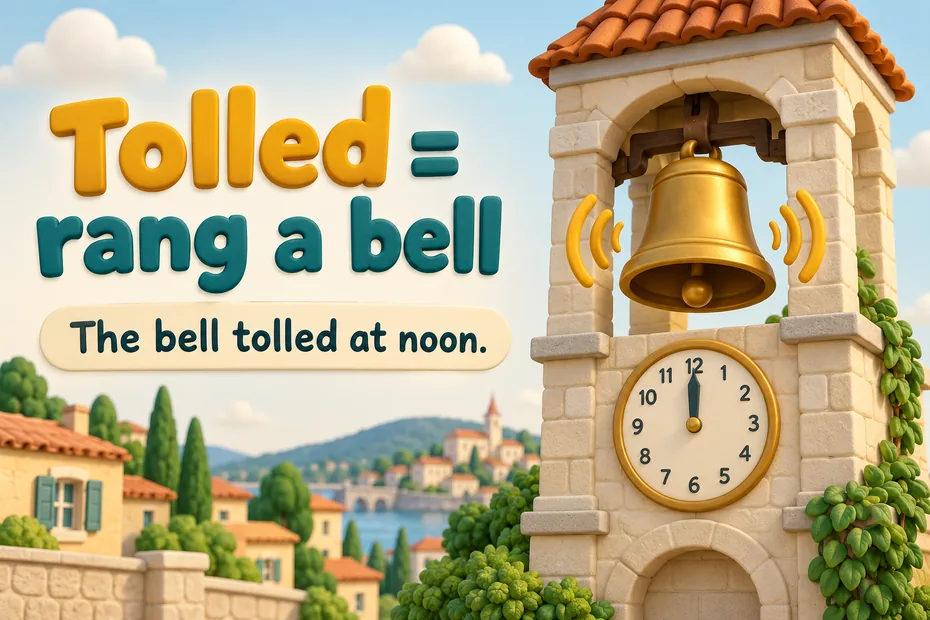
How do you build a sentence with told?
Told often takes a person as an object: “She told me the address.” The person identifies who received the information, while the rest identifies what was communicated. A common instruction pattern is told someone to do something: “The organizer told everyone to bring a notebook.” Neither of these sentences needs tolled.
A person is not required in every construction. “She told a story” names what was narrated, and “She told the truth” names what was expressed. Avoid a rule that demands a listener after every told. Instead, check whether the verb’s meaning and the information following it form a complete, clear sentence.
Compare “She said that the shop was closed” with “She told me that the shop was closed.” When giving a listener in this ordinary reported-speech pattern, told fits directly before me. Do not use told merely as a letter-for-letter replacement for said without checking the rest of the construction.
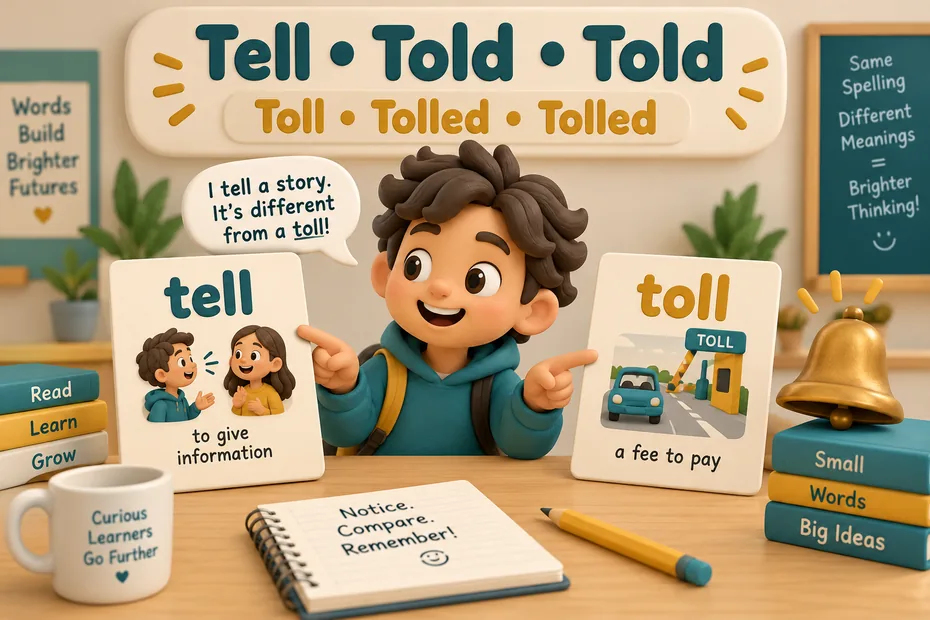
Does tolled mean any alarm sounded?
Tolled is especially associated with measured strokes of a bell. A siren sounding or a phone buzzing is not automatically described as tolling. The older explanation below mentions alarms broadly; for precise modern wording, identify the actual sound and choose rang, sounded, buzzed, or tolled according to what happened.
“The bell tolled six times” gives a count of strokes. “The bell was tolled six times” is passive and indicates that something or someone caused the ringing. Both constructions use tolled. “The bell told six times” would instead use tell and would not express the ordinary ringing action intended by those examples.
Toll also has senses beyond bells, including charging a toll and specialized terminology. This page is a spelling guide rather than a guide to those technical subjects. If tolled appears in a specialized document, check the relevant meaning before replacing it with told just because the sentence does not mention a bell.
How do the past tense and participle differ?
The same word told serves both roles: “I told her yesterday” uses the simple past, and “I have told her already” uses the participle after have. Tolled behaves similarly: “The bell tolled” and “The bell has tolled.” The supporting verbs establish the tense, while the spelling identifies which action you mean.
- “Maya ___ me where to meet.” Choose told for information.
- “The old bell ___ across the village.” Choose tolled for ringing.
- “We have ___ the children the plan.” Choose told after have.
- “The guide ___ us to stay together.” Choose told for an instruction.
After editing, replace the word mentally with a meaning rather than another sound-alike spelling. Communicated or recounted points toward told; rang in measured strokes points toward tolled. Then reread the whole sentence to confirm that the listener, information, or bell is identified clearly enough for the reader.
Frequently asked questions
Is telled the past tense of tell?
No. The standard past tense of tell is told, and the past participle is also told. Write “She told me,” “She has told me,” and “I was told.” Telled applies a regular ending to an irregular verb. Tolled is valid for the different verb toll, not an alternative past form of tell.
Can told be used in the passive voice?
Yes. “We were told to wait” is a passive construction meaning that someone gave us an instruction. The speaker may be omitted when it is unknown or unimportant. “We were tolled to wait” would use the wrong verb and would not express the intended communication or instruction.
Must a sentence with told mention a listener?
Not always. “She told a story” and “He told the truth” are complete familiar constructions without an explicitly named listener. In other patterns, the listener matters: “She told me that the event was canceled.” Check the whole construction rather than applying one rigid rule to every use of told.
Is tolled a word only used for funerals?
No. Tolled can describe a bell ringing in measured strokes in other settings, such as marking a time or an occasion. The surrounding context establishes why it rings. Do not infer a funeral solely from the verb, and do not substitute told unless the intended meaning concerns tell rather than toll.
Have you ever found yourself confused between the words “told” and “tolled”? Don’t worry, you’re not alone. As an expert writer, I’ve encountered this dilemma countless times. In this text, I’ll guide you through the proper usage of these two words, ensuring that you never mix them up again.
We’ll start by clarifying the definitions of “told” and “tolled” and examining their distinct meanings and contexts. Understanding the differences between these words is crucial for effective communication. Also, I’ll provide you with practical examples and tips to help you use them appropriately in your writing.
So, whether you’re a seasoned writer looking to brush up on your grammar skills or a beginner eager to avoid common mistakes, this article is for you. Let’s immerse and unravel the mystery of “told” versus “tolled” together.
Key Takeaways
- The key difference between “told” and “tolled” is their function and usage.
- “Told” is used to communicate information or give an account of past events, while “tolled” is used when referring to the ringing of a bell or sounding an alarm.
- Understanding the definitions and contexts of these words is crucial for clear communication.
- Tips for using “told” and “tolled” correctly include understanding their definitions, considering the context, using “told” for communication, using “tolled” for bells and alarms, and double-checking your usage.
What is the difference between “told” and “tolled”?
When it comes to the words “told” and “tolled,” it’s easy to get confused due to their similar pronunciations. But, they have completely different meanings and usage. Let’s investigate into the definitions and contexts of these words to understand how they differ.
Definition of “Told”
The word “told” is the past tense of the verb “tell.” It is used to indicate communicating information, giving instructions, or narrating a story to someone. When I say “I told him about the meeting,” I’m conveying that I shared information with him. “Told” can also refer to giving an account of past events or experiences, such as “She told me about her holiday in Greece.”
Definition of “Tolled”
On the other hand, “tolled” is the past tense of the verb “toll,” which has a different meaning altogether. While “told” is about conveying information, “tolled” is associated with ringing a bell or sounding an alarm, typically in a slow and deliberate manner. For example, “The church bells tolled mournfully as the funeral procession passed by.”
The Difference between “Told” and “Tolled”
To summarize, the key difference between “told” and “tolled” is their function and usage.
- “Told” is used to communicate information or give an account of past events, while “tolled” is used when referring to the ringing of a bell or sounding an alarm.
- “Told” is about conveying information to someone, while “tolled” relates to the sound or action associated with ringing a bell.
In everyday writing and conversation, it is crucial to use these words correctly to avoid confusion and miscommunication.
Remember:
- If you want to communicate information or narrate a story, use “told.”
- If you want to refer to the sound of a bell or alarm, use “tolled.”
By understanding the distinction between these two words, you can enhance your writing and communication skills. Let’s move on to the next section to explore some practical examples and tips for using “told” and “tolled” correctly in your writing.
Understanding the definitions of “told” and “tolled”
To properly understand and use the words “told” and “tolled,” it is important to grasp their definitions and the contexts in which they are used. Let’s investigate into the definitions of these words to clarify any confusion and ensure their appropriate usage.
- “Told” is the past tense of the verb “tell.” It is used to communicate information or give an account of past events. When we say, “I told her about the party,” we are indicating that we conveyed information to someone. The act of telling involves sharing details, instructions, or an account of something that has happened.
- “Tolled” is the past tense of the verb “toll.” This word is associated with ringing a bell or sounding an alarm. When we hear that a bell “tolled,” it means it rang slowly and repeatedly, often used to signify a funeral or a solemn occasion. It can also refer to the tolling of an alarm, indicating a warning or signal. The word “tolled” is specifically connected to the action of producing a ringing or chiming sound.
The key difference between “told” and “tolled” lies in their function and usage. “Told” is used to convey information or provide an account of past events, while “tolled” is used to describe the act of ringing a bell or sounding an alarm. Understanding this distinction is crucial to ensure clear communication and avoid confusion.
Now that we have established the definitions of “told” and “tolled,” we can investigate deeper into their proper usage in the next section.
Context and usage of “told” and “tolled”
When it comes to the English language, there are numerous words that can easily be confused or misused. One such case is the confusion between “told” and “tolled”. While these words may sound similar, they have distinct meanings and functions. Let’s investigate into the context and usage of each word to better understand their differences.
Definition of “Told”
First, let’s start with “told”. “Told” is the past tense of the verb “tell”, which means to communicate information or provide an account of past events. It is a versatile word that can be used in different contexts, such as sharing a story, giving instructions, or conveying a message. When I say “I told him about my trip”, it means that I informed or shared information with him.
Definition of “Tolled”
On the other hand, “tolled” is the past tense of the verb “toll” and has a very specific meaning. “Toll” refers to the act of ringing a bell or sounding an alarm, often associated with solemn occasions such as funerals or memorial services. Hence, when we say “The bell tolled”, it suggests that the bell rang softly and mournfully.
Difference between “Told” and “Tolled”
The key difference between “told” and “tolled” lies in their function and usage. While “told” is used to share information or give an account of past events, “tolled” specifically refers to the act of ringing a bell or sounding an alarm. Understanding this distinction is crucial to ensure clear communication and avoid confusion.
To summarize, “told” is used when communicating information or giving an account, while “tolled” is used when referring to the ringing of a bell. Let’s take a look at some examples to solidify our understanding of these words.
Examples of “Told”:
- She told me her secret.
- He told us a funny story.
- I told them about the upcoming meeting.
- The church bells tolled at midnight.
- The alarm tolled, signaling the end of the game.
- The bell tolled mournfully during the funeral.
Examples of using “told” and “tolled” correctly
Let’s jump into some examples that will help clarify the difference between “told” and “tolled” and how they are used appropriately.
Example 1: Using “told”
- I told my friend about the party. In this sentence, “told” is used to communicate information. It indicates that I shared or conveyed the details of the party to my friend.
- She told me an interesting story. Here, “told” is again used to describe the action of conveying information. It shows that someone shared an engaging or intriguing story with me.
- He told the truth about what happened. In this example, “told” is used to indicate that someone gave an account of past events. It implies that he was honest about the sequence of events or facts.
- The church bells tolled throughout the town. Here, “tolled” is used to describe the ringing of the church bells. It suggests that the sound of the bells echoed or resonated across the entire town.
- The alarm tolled, signaling the end of the school day. In this sentence, “tolled” implies that an alarm or bell sounded to indicate the conclusion of the school day.
- The grandfather clock tolled midnight as the new year began. Here, “tolled” is used to describe the sound of the grandfather clock as it struck midnight, symbolizing the start of a new year.
These examples demonstrate the appropriate usage of both “told” and “tolled” in various contexts. Remember, “told” is used to communicate information or give an account of past events, while “tolled” specifically refers to the ringing of a bell or sounding an alarm. Understanding and using these words correctly will help ensure clear and effective communication.
Now that we have explored multiple examples, let’s investigate deeper into the key differences between “told” and “tolled” and how to use them appropriately in different situations.
Tips for using “told” and “tolled” appropriately in writing
When it comes to using “told” and “tolled” correctly in writing, there are a few tips that can help ensure accurate and effective communication. Let’s jump into these tips so you can confidently navigate the differences between these commonly confused words.
- Understand the Definitions: To use “told” and “tolled” appropriately, it’s important to grasp their respective meanings. “Told” is the past tense and past participle of the verb “tell.” It is used to communicate information or give an account of past events. On the other hand, “tolled” is the past tense and past participle of the verb “toll.” It specifically refers to the ringing of a bell or sounding an alarm.
- Consider the Context: Pay attention to the context in which these words are used. While “told” can be used in a variety of contexts to convey information or recount events, “tolled” is limited to situations involving bells or alarms. Take a moment to assess the context and choose the appropriate word accordingly.
- Use “Told” for Communication: When you want to express that someone shared information or gave an account of something, use “told.” For example, “He told me the details of the meeting” or “She told her friends about her trip to Europe.” Remember, “told” is about conveying information.
- Use “Tolled” for Bells and Alarms: If you’re discussing the ringing of a bell, such as in a church or during a funeral procession, use “tolled.” For instance, “The church bells tolled solemnly” or “The alarm tolled, signaling the end of the drill.” Keep in mind that “tolled” is specifically related to the ringing of bells or sounding of alarms.
- Double-Check Your Usage: To ensure accuracy, take a moment to review your writing and confirm that you have used the correct word. Look out for instances where “told” or “tolled” may have been mistakenly interchanged. Proofreading can help catch any errors and maintain clarity in your writing.
Conclusion
Understanding the appropriate usage of “told” and “tolled” is key to effective writing. By grasping the definitions and considering the context in which these words are used, we can communicate our ideas with precision and clarity.
When we want to convey that someone shared information or gave an account of something, “told” is the word to use. It serves as a powerful tool to express past events and communicate narratives.
On the other hand, “tolled” is reserved for the specific act of ringing a bell or sounding an alarm. It carries a sense of urgency and is used to describe these specific actions.
To ensure accuracy and avoid confusion, it’s crucial to double-check our usage of these words. By doing so, we can maintain the integrity of our writing and effectively convey our intended meaning.
Remember, using the correct word not only enhances our writing but also demonstrates our command of the English language. So, let’s continue to refine our skills and confidently wield “told” and “tolled” in our future compositions.
Frequently Asked Questions
Q: What is the importance of understanding the definitions of the words “told” and “tolled”?
A: Understanding the definitions of “told” and “tolled” is important because it allows writers to use these words appropriately in their writing, ensuring accuracy and clarity.
Q: How is “told” used in writing?
A: “Told” is used to communicate information or give an account of past events. It refers to sharing information or expressing that someone communicated something.
Q: What does “tolled” specifically refer to?
A: “Tolled” specifically refers to the ringing of a bell or sounding an alarm. It is used to describe the action of a bell ringing or an alarm sounding.
Q: When should I use “told” in my writing?
A: You should use “told” when you want to express that someone shared information or gave an account of something in the past. It is the appropriate word to use in this context.
Q: When should I use “tolled” in my writing?
A: Use “tolled” when you want to discuss the ringing of a bell or sounding of an alarm. It is the correct word to use when referring to this specific action.
Q: What is the advice for using “told” and “tolled” in writing?
A: The advice is to understand the definitions of both words, consider the context in which they are used, and use “told” for sharing information or giving an account, and “tolled” for describing the ringing of a bell or sounding of an alarm. Double-check usage for accuracy and clarity in writing.


