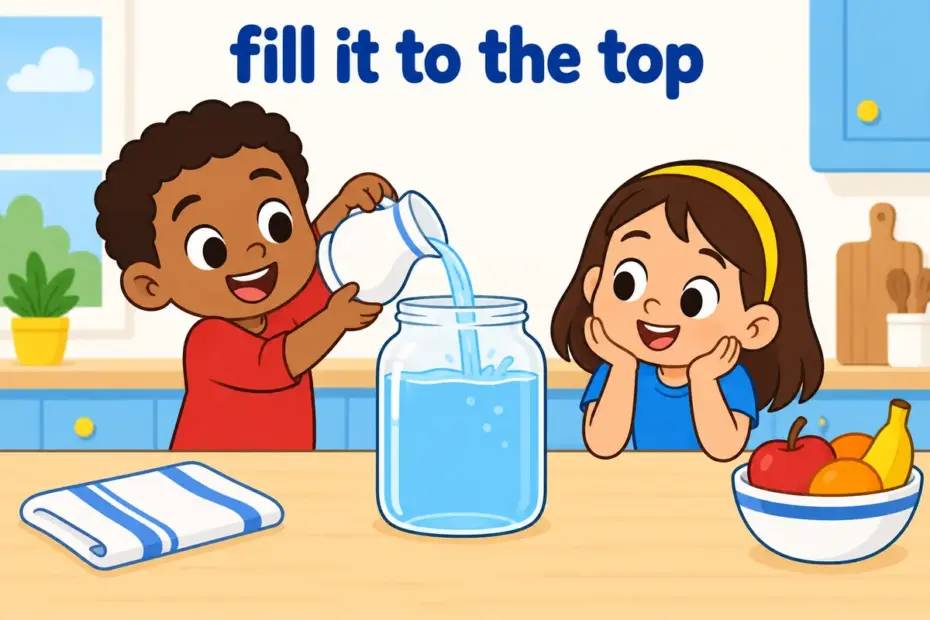
Top off is a phrasal verb meaning to fill a container that is already partly full, or to finish something in a satisfying way. It is separable, so “top off the tank” and “top the tank off” both work, and a pronoun goes in the middle: “top it off.”
Top Off at a glance
- Top off is a transitive phrasal verb meaning to fill a container that is already partly full.
- A second sense means to complete or finish something in a pleasing way.
- It is separable: top off the tank or top the tank off.
- With a pronoun the particle must follow: top it off, never top off it.
- The idiom to top it all off adds a final point, often an unwelcome one.
- The nearest confusable is top up, which restores a level rather than filling to the brim.
What does top off mean?
Top off is a phrasal verb meaning to fill a partly full container to the top, or to finish a series of events with one last pleasing item. The Cambridge entry for top off and the Merriam-Webster entry for top off record the filling sense clearly, and the completing sense grows straight out of it.
| Sense | Plain meaning | Example sentence |
|---|---|---|
| Fill to the top | Add liquid or fuel until a partly full container is full | Top off the tank before the long drive. |
| Complete pleasantly | Finish an event or list with one good final item | They topped off the meal with fresh fruit. |
| Add a final point | Idiom: introduce a last item, often a bad one | To top it all off, the bus was late. |
The first sense is concrete: something is already there, and top off removes the remaining space. The second sense is figurative, turning a small finishing amount into a satisfying conclusion. Top off does not fit abstract totals, where complete or finish is the plainer verb.
In the filling sense the amount added is small and the container is already usable: the point is to remove the last gap before a journey or a meal. In the completing sense the amount is symbolic, and the final item is chosen for pleasure rather than volume, which is why the object is often a dessert, a firework or a view.
How do you use top off in a sentence?
Top off is transitive and separable, so the object may sit before or after the particle, except when it is a pronoun.
| Pattern | Example | What it signals |
|---|---|---|
| top off + object | She topped off the glasses before the toast. | transitive filling sense |
| top + object + off | She topped the glasses off before the toast. | particle may strand |
| top + pronoun + off | She topped them off before the toast. | pronoun must sit between |
| be topped off | The radiator was topped off with water. | passive, focus on the container |
| to top it all off | To top it all off, the lights failed. | fixed idiom, no separation |
The idiom is frozen: to top it all off never becomes to top off it all, and the pronoun cannot change. Away from that idiom the verb behaves like other particle verbs, such as when talks break off without warning.
Separability also changes the rhythm of a sentence. Top off the tank reads as one brisk instruction, while top the tank off sounds slightly more conversational, so manuals tend to keep the object next to the verb. To empty a container is to drain it, the exact opposite of topping it off.
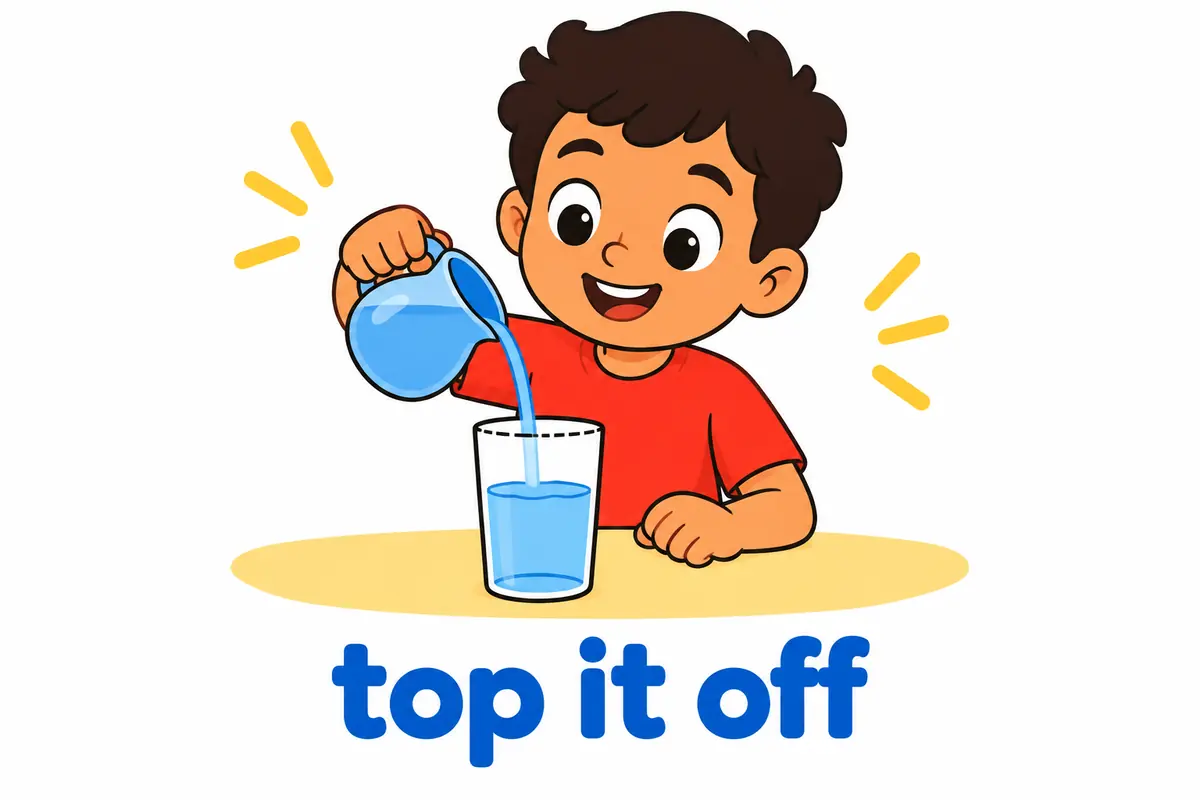
Top Off in a sentence: examples across contexts
The examples below show the two senses side by side, from a petrol station to a restaurant table. The completing sense usually follows a with-phrase that names the final pleasure, while the filling sense names the container directly.
| Context | Example sentence | Why this works |
|---|---|---|
| Driving | Top off the tank at the next station. | Everyday command, concrete object. |
| Restaurant | The waiter topped off our water glasses. | Service register, pleasant detail. |
| Gardening | He topped off the watering can from the tap. | Tool treated as a container. |
| Car maintenance | Oil was topped off during the service. | Passive, technical tone. |
| Celebration | They topped off the evening with fireworks. | Figurative completing sense. |
| Workplace email | Please top off the printer cartridges before Monday. | Direct instruction. |
| Cooking | Top off the soup with a little cream. | Finishing a dish. |
| News feature | To top it all off, the storm cut the power. | Idiom adding a final blow. |
| Travel writing | We topped off the trip with a mountain sunrise. | Pleasing conclusion. |
| Nursing note | The drip was topped off at the start of the shift. | Clinical passive use. |
| Conversation | Let me top off your mug. | Warm everyday offer. |
| Sports report | They topped off the season with a clean win. | Figurative, celebratory. |
Top off vs top up
| Attribute | Top off | Top up |
|---|---|---|
| Core meaning | fill a partly full container to the brim | add enough to restore a level |
| Focus | completing the fill | replacing what was used |
| Typical object | tank, glass, mug, radiator | phone credit, card, account, drink |
| Regional bias | common in American English | common in British English |
| Result | the container is full | the balance is usable again |
| Register | everyday to technical | everyday to financial |
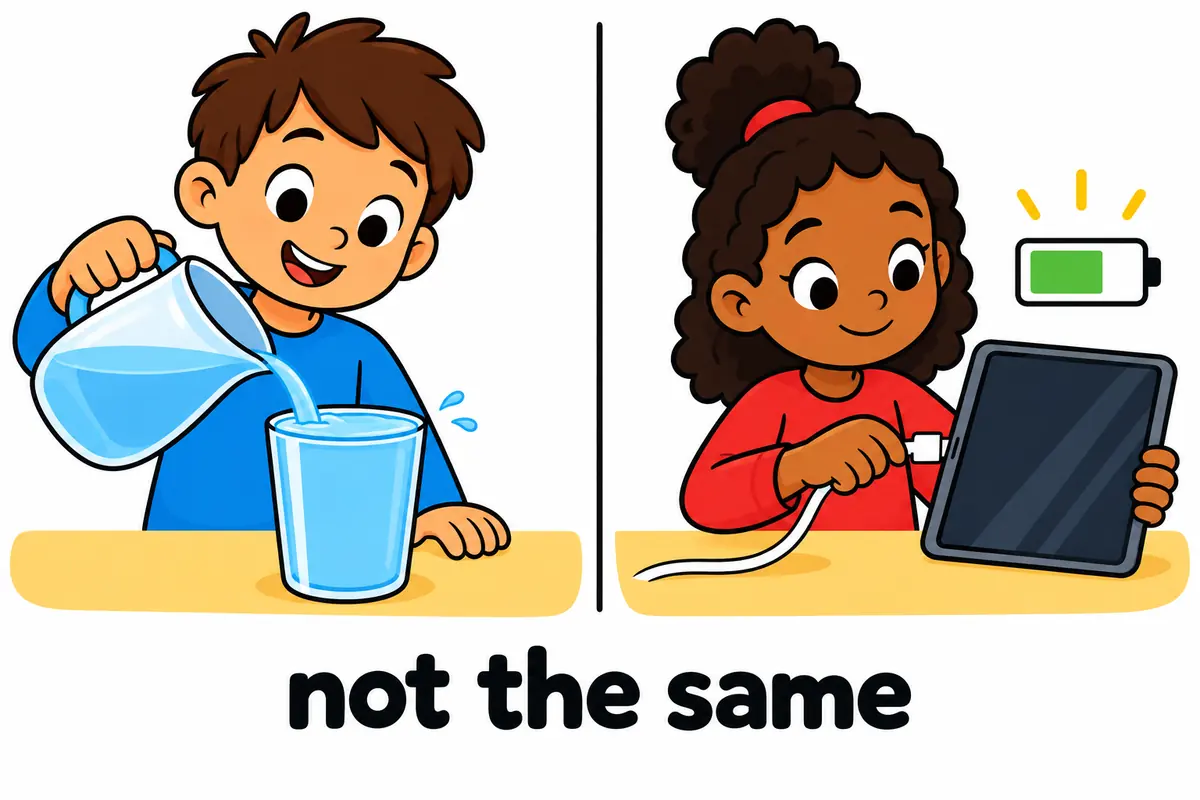
Choose top off when a physical container reaches its brim and top up when a measured level needs replenishing rather than filling. A phone is topped up, while a petrol tank at the pump is topped off.
A useful memory hook: top off is what you do at a fuel pump, and top up is what you do to a phone. The first completes a container, the second restores a balance, and only the completed container can be said to be full.
Word forms and grammar of top off
| Form | Part of speech | Example |
|---|---|---|
| top off | phrasal verb | They top off the pool each morning. |
| tops off | third person singular | She tops off the kettle before tea. |
| topped off | past tense or participle | He topped off the battery cells. |
| topping off | present participle | They are topping off the tank now. |
| to top it all off | fixed idiom | To top it all off, it began to rain. |
Because the verb is separable, both topped the tank off and topped off the tank are standard. When the aim is simply to finish a job, finish carries no idea of filling.
The passive, be topped off, is common in technical writing because the equipment matters more than the person. A garage note reads the coolant was topped off, not the mechanic topped off the coolant, and the same shift of focus keeps a service record impersonal.
Common mistakes with top off
- Incorrect: Please top off it before we leave. Corrected: Please top it off before we leave. Rule: a pronoun must sit between the verb and its particle.
- Incorrect: We topped off the evening. Corrected: We topped off the evening with a dessert. Rule: the completing sense normally names the final item with with.
- Incorrect: The app was topped off with credit. Corrected: The app was topped up with credit. Rule: digital balances take top up, not top off.
- Incorrect: To top off it all, the flight was delayed. Corrected: To top it all off, the flight was delayed. Rule: the idiom keeps it before all and off last.
- Incorrect: He topped off the report by finishing it. Corrected: He finished the report with a summary. Rule: for abstract tasks, plain finish or complete is better.
- Incorrect: The team topped off the budget with more funds. Corrected: The team topped up the budget. Rule: money and budgets take top up, because a level is restored rather than filled.
- Incorrect: She topped off the empty jug. Corrected: She filled the empty jug. Rule: top off needs a container that already holds something.
Practice using top off
- Fill in the blank: ______ the radiator before the cold snap.
- Choose the better word: Her phone was (topped off / topped up) with ten pounds of credit.
- Correct the error: Could you top off them for me?
- Build a sentence: use top off with a pronoun object about water glasses.
- Spot the register: Which sentence suits a car manual, (A) or (B)? (A) Top off the coolant to the marked line. (B) Give the coolant a cheeky top-off, yeah?
- Fill in the blank: The garage topped ______ the oil during the service.
- Complete the idiom: To top it all ______, the printer jammed.
- Build a sentence: use top off about preparing a car before a long journey.
- Correct the error: They topped off the empty pool from scratch.
Answers
- Top off. The command takes the radiator as object.
- topped up. A credit balance is restored, not filled to the brim.
- Could you top them off for me? The pronoun goes between verb and particle.
- The host topped them off before the toast. The pronoun follows top.
- (A) suits the manual, because it gives a precise technical instruction.
- off. The verb is transitive and the particle closes the sentence.
- off. The idiom ends with off.
- We topped off the tank before the drive. The container is already partly full.
- They filled the empty pool from scratch. Top off requires a container that is already partly full.
The bottom line
Top off is a separable phrasal verb for filling a partly full container or finishing something pleasantly. Used correctly, top off in a sentence keeps a pronoun between the verb and the particle, and the fixed idiom to top it all off never splits. Choose top off for physical filling and top up for restoring a balance.
Frequently asked questions about top off
Is top off the same as top up?
No. Top off means filling a partly full container until it is full, such as a petrol tank at the pump. Top up means adding enough to bring a level back to usable, as with phone credit or a bank balance. The container need not be full after a top up.
Can you separate top off?
Yes. Top off is a separable transitive phrasal verb, so you may write top off the tank or top the tank off. When the object is a pronoun, it must sit between the two parts, giving top it off. The frozen idiom to top it all off does not change.
What does to top it all off mean?
The idiom to top it all off introduces a final point in a list of events, and it often signals something unwelcome, as in the flight was delayed and, to top it all off, the luggage went missing. The wording is fixed, so the pronoun and the order never change.
Is top off used in British English?
Top off appears in British English but is far more common in American usage, especially for fuel and drinks. British speakers are more likely to say top up for the same physical acts. Both forms are understood on either side of the Atlantic.