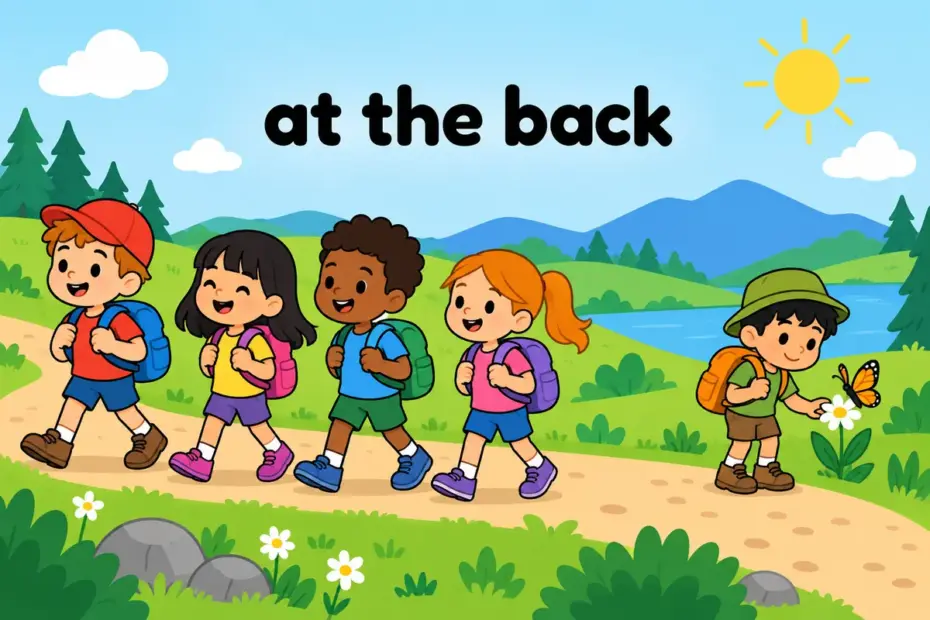
Trail behind means to stay at the back of a group or to be less advanced than others. To use trail behind in a sentence, name who or what is behind: “Two hikers trailed behind the rest of the group.” The phrase is intransitive, and the thing being followed comes after behind.
Trail Behind at a glance
- Trail behind is a phrase meaning to stay at the back or fall short of others.
- It works as an intransitive verb phrase; the thing ahead usually comes after behind.
- Its forms are trails behind, trailed behind and trailing behind.
- It applies to people, teams and companies, and to scores, prices and sales.
- The commonest error is mixing it with lag behind, which stresses a measurable gap rather than position.
What does trail behind mean?
Trail behind means to move or remain at the back of a group, or to be less advanced than a rival or a standard. The Cambridge entry for trail behind records the physical sense of following at a distance, and the same frame carries into business and sport, where a company or a team trails behind the leaders. The word behind is fixed inside the phrase, so it cannot be swapped for a synonym, and the emphasis stays on relative position. A walker who falls back slowly may straggle in, but the group as a whole trails behind.
| Sense | Plain meaning | Example sentence |
|---|---|---|
| Stay at the back | Move behind the rest of a group | The youngest child trailed behind the others. |
| Be less advanced | Fall short of a standard or rival | The firm trails behind its rivals in sales. |
| Follow at a distance | Move slowly after someone | The dog trailed behind us all the way home. |
One limitation matters. Trail behind describes position or progress, not intent, so it does not say the subject is tired or unwilling. That is why it suits teams, prices and scores as readily as walkers. Where you mean a deliberately slow pace, dawdle or linger says more about the choice.
How do you use trail behind in a sentence?
Trail behind is intransitive, so it needs no object, and the group or standard being followed usually appears after behind as a prepositional phrase. The phrase inflects on trail, never on behind. When the gap is measurable, as in points or sales, writers often prefer lag behind, which points to a number rather than a position.
| Pattern | Example | What it signals |
|---|---|---|
| subject + trail behind | The team trailed behind for most of the match. | States position with no group named. |
| trail behind + the + noun | One runner trailed behind the pack. | Behind acts as a preposition taking the pack. |
| trail behind + in + area | The brand trails behind in online sales. | Names the field where progress is short. |
| be trailing behind | They are trailing behind by two goals. | Progressive form with a measured margin. |
| trailing behind + noun | A line of cars trailed behind the bus. | Participle describing a following group. |
Because trail behind is a fixed phrase, nothing may be inserted between the two words. You can say the runner trailed far behind, with far as an adverb before behind, but never the runner trailed the pack behind, because that turns an intransitive phrase into something it is not.
Trail Behind in a sentence: examples across contexts
Trail behind shifts easily between walking and winning. The twelve sentences below keep the same phrase while moving from a nature walk to a quarterly report, and each one shows what the subject is behind. When a person slows down on purpose, linger is the more deliberate word.
| Context | Example sentence | Why this works |
|---|---|---|
| Nature walk | Two walkers trailed behind the group to photograph the birds. | Names the group and gives a reason for the gap. |
| Sports report | The champions trailed behind from the tenth minute. | Uses the phrase for a score deficit. |
| Business news | The chain trails behind its competitors on delivery speed. | Names the field where it is behind. |
| Classroom | One pupil trailed behind the class in reading all term. | Applies the phrase to progress, not distance. |
| Travel writing | A mule trailed behind the hikers on the steep path. | Uses the simple physical sense. |
| Technology blog | The smaller brand trails behind in battery life. | Measures the gap by a feature. |
| Election coverage | The third candidate trailed behind by six points. | Adds a precise margin after behind. |
| Parenting story | Our son trailed behind us, collecting stones. | Shows the unhurried, everyday use. |
| Economics essay | Wages trail behind prices during a sudden spike. | Transfers the phrase to abstract trends. |
| Sports coaching | Nobody likes to trail behind at the final whistle. | Uses the infinitive to state a feeling. |
| Volunteer group | One van trailed behind and arrived an hour late. | Applies the phrase to vehicles. |
| Everyday talk | I trailed behind everyone on the hill and still enjoyed it. | Keeps the tone light and personal. |
Trail Behind vs lag behind
Trail behind and lag behind look like twins and are used differently. Trail behind usually describes physical position or broad progress, while lag behind stresses a measured shortfall and often takes a figure. Where a rival pulls away quickly, the leader may get behind the schedule rather than the field.
| Attribute | trail behind | lag behind |
|---|---|---|
| Core meaning | Stay at the back or be less advanced | Fall short by a measurable amount |
| Typical subject | Walkers, teams, brands | Figures, wages, production |
| Commonest frame | trail behind the group | lag behind by ten percent |
| What it stresses | Relative position | Size of the gap |
| Register | Neutral and descriptive | Analytical and often numeric |
Verdict: choose trail behind when position or broad progress is the point, and lag behind when you can attach a number or a rate. The opposite direction is to outpace the field, which names the margin rather than the place.
Word forms and grammar of trail behind
Trail behind inflects on trail only, and the particle-like word behind never changes. The related adjective behindhand means late or in arrears and covers a similar idea in formal writing and business records.
| Form | Part of speech | Example |
|---|---|---|
| trail behind | phrase, base form | Do not trail behind on the climb. |
| trails behind | phrase, third person singular | She trails behind when she reads. |
| trailed behind | phrase, past and past participle | They trailed behind all season. |
| trailing behind | phrase, present participle | We are trailing behind by a lap. |
| trail-off | different phrase | A trail off means a voice fading away, not a position. |
Common mistakes with trail behind
- Incorrect:
The runner trailed the pack behind.Correct: The runner trailed behind the pack. Rule: The phrase is fixed in order, so behind cannot move to the end. - Incorrect:
Our sales trailed behind of last year.Correct: Our sales trailed behind last year. Rule: Behind takes a bare noun, never of before it. - Incorrect:
They trailed behind by the leaders.Correct: They trailed behind the leaders. Rule: Behind marks the group followed, so by is wrong unless a margin follows, as in by six points. - Incorrect:
The tired child trailed behind on purpose.Correct: The tired child lagged behind. Rule: Trail behind does not imply choice, so a deliberate pause needs a different word. - Incorrect:
The company outpaces behind its rivals.Correct: The company trails behind its rivals. Rule: Outpace already means move ahead, so it cannot take behind.
Practice using trail behind
Work through the seven items, then read the reasoning rather than only the answer.
- Fill the gap: The slowest cyclist ______ the rest of the club each week.
- Choose the better word: Sales (trailed behind / outpaced behind) the forecast all quarter.
- Correct the error: The puppy trailed the family behind on the walk.
- Build a sentence: use trail behind about a small shop falling short of a big chain.
- Spot the register: which belongs in a market report – the brand trails behind its rivals, or the brand is way back of everybody?
- Add the right word: The team trailed ______ by two goals at half time.
- Rewrite with lag behind: The factory trailed behind the others in output. Use lag behind and a figure.
Answers
- trails behind – the phrase takes the third person singular form of trail.
- trailed behind – outpaced would mean moving ahead, which contradicts behind.
- The puppy trailed behind the family on the walk – the phrase keeps its fixed order.
- Model answer: The corner shop trails behind the chain in stock and range.
- The brand trails behind its rivals – the report keeps the neutral descriptive phrase.
- behind – behind plus the margin by two goals follows the phrase directly.
- The factory lagged behind the others by ten percent in output – lag behind carries the figure.
The bottom line
Use trail behind in a sentence to say that a person, team or company is at the back or less advanced than the rest, and let the group or standard follow behind. The two details that decide most sentences are that the phrase is intransitive and fixed, so nothing splits it or reorders behind, and that it reports position rather than intent. When a measurable gap or a rate is the point, lag behind is the sharper partner.
Frequently asked questions about trail behind
Is trail behind one word or two?
Trail behind is always two words when it is used as a verb phrase, as in the team trailed behind. It is not a single-word verb, so it never appears as trailbehind in standard writing. The two words keep a fixed order, and only trail changes its ending for tense.
Does trail behind need an object?
Trail behind is intransitive in the sense that it needs no object, but it very often takes a phrase beginning with behind, such as trail behind the group or trail behind the leaders. That noun belongs to behind, not to trail, which is why the phrase can also stand completely alone, as in the team is trailing behind.
What is the difference between trail behind and lag behind?
Trail behind describes relative position or broad progress, so it suits walkers, teams and brands. Lag behind stresses a measurable shortfall and usually takes a figure, as in lag behind by ten percent. Both can describe a losing position, but only lag behind points to the size of the gap.
Can trail behind describe a company?
Yes. Companies, brands and economies all trail behind rivals when they are less advanced in sales, technology or growth. In this business sense the phrase usually names the field, as in trail behind in online sales, so the reader knows where the shortfall lies. It remains neutral about the cause.