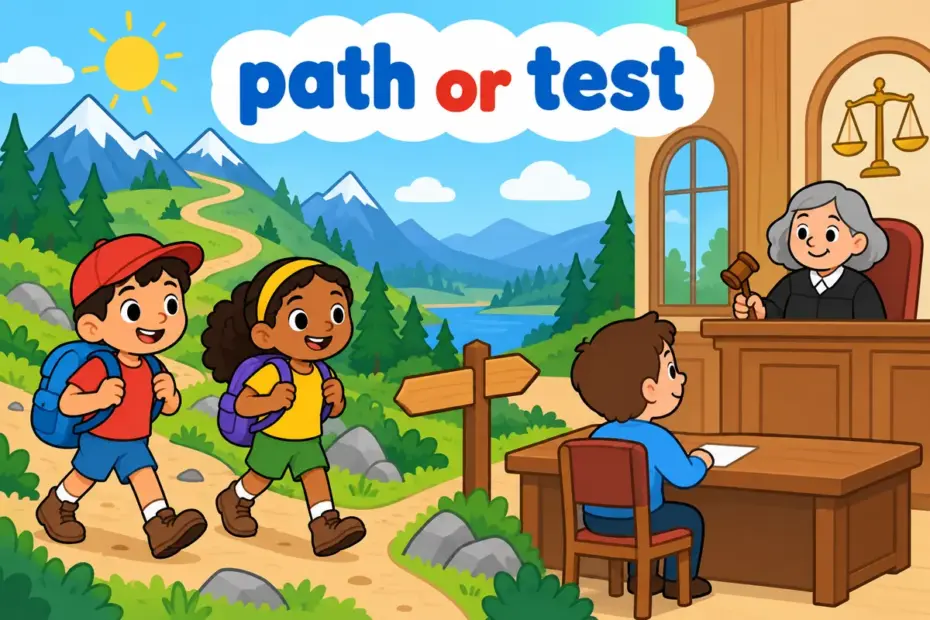
Trail vs trial is a choice between a path and a test, so use trail for a route, a mark or a lagging position, and trial for a court case, a test or a hardship. A hiker follows a trail, while a defendant faces a trial. The two words sound nearly alike, so their spelling and their placement deserve care.
Trail vs trial at a glance
- Trail is a noun and a verb about paths, marks, scent and lagging behind.
- Trial is a noun for a court case, a test, a preliminary contest or a hardship.
- Trail ends in -ail and rhymes with mail; trial ends in -ial and rhymes with file.
- Trail appears in hiking, tracking, sport and detective work; trial in law, science and sport.
- The commonest error is writing on trail when the legal phrase is on trial.
Trail vs trial: the quick comparison
The two words share only their sound, not their sense, so the fastest way to choose is to ask what the sentence is actually about: a route or a proceeding. The table below weighs the decisions that separate them in real writing.
| Criterion | trail | trial |
|---|---|---|
| Word class | Noun and verb | Noun, and a rarer verb meaning to test |
| Core meaning | A path, a mark, a scent or a lagging position | A court case, a test or a hardship |
| Typical subject | A hiker, a dog, a storm or a contestant | A defendant, a scientist, a coach or a patient |
| Common collocations | mountain trail, paper trail, hot on the trail | murder trial, clinical trial, trial and error |
| Register | Neutral to descriptive | Formal in law, neutral elsewhere |
| Spelling shape | -ail, as in mail | -ial, as in file |
| Memory hook | A trail is something you walk along | A trial is something you go through |
What does trail mean?
Trail is a noun and a verb meaning a path or route, the marks or scent left by a moving thing, or a position behind the leader. The Cambridge Dictionary entry for trail records the path sense and the tracking sense together, because a trail is both the route and the evidence that someone passed along it.
| Sense | Plain meaning | Example sentence |
|---|---|---|
| A path | A rough route through countryside or forest | We followed the trail up to the ridge. |
| Marks or scent | The signs a person or animal leaves behind | The dogs picked up the trail at the river. |
| A lagging position | Being behind the leader in a contest | The champion was on the trail after two laps. |
| To follow or drag | To move behind someone, or to pull along the ground | Her scarf trailed in the mud behind her. |
What does trial mean?
Trial is a noun meaning a formal court case, a test of how well something works, or a difficult experience that tests a person. The Cambridge Dictionary entry for trial lists the legal sense first and the test sense second, which reflects how the word is used in practice.
| Sense | Plain meaning | Example sentence |
|---|---|---|
| A court case | A formal hearing that decides guilt or liability | The trial lasted three weeks and ended in acquittal. |
| A test | A period of testing a product, drug or method | The new engine passed its first trial. |
| A preliminary contest | A match used to select team members | She won a place at the regional trials. |
| A hardship | A difficult experience that tests endurance | Caring for the farm through winter was a trial. |
One honest limitation applies to both words. Trail is not the legal word, and trial is not the word for a route, so a hiker never walks a trial and a defendant never stands on trail. The two look closest in their plural forms, trails and trials, which is exactly where hurried writers slip.
How do you use trail and trial in a sentence?
Trail works as a noun and a verb, while trial works almost always as a noun and only rarely as a verb meaning to test. The patterns below run the two words side by side so the grammar stays parallel.
| Pattern | Example | What it signals |
|---|---|---|
| trail as a noun | The trail crosses the meadow and ends at a waterfall. | Names a physical route. |
| trail as a verb | The team trailed by ten points at half time. | Shows a lagging position or a following action. |
| trial as a noun | The trial begins in the county court on Monday. | Names a formal legal proceeding. |
| trial in a compound | They ran a clinical trial of the new vaccine. | Shows trial naming a structured test. |
| on trial / on the trail | The suspect is on trial; the hounds are on the trail. | Contrasts the two fixed prepositional phrases. |
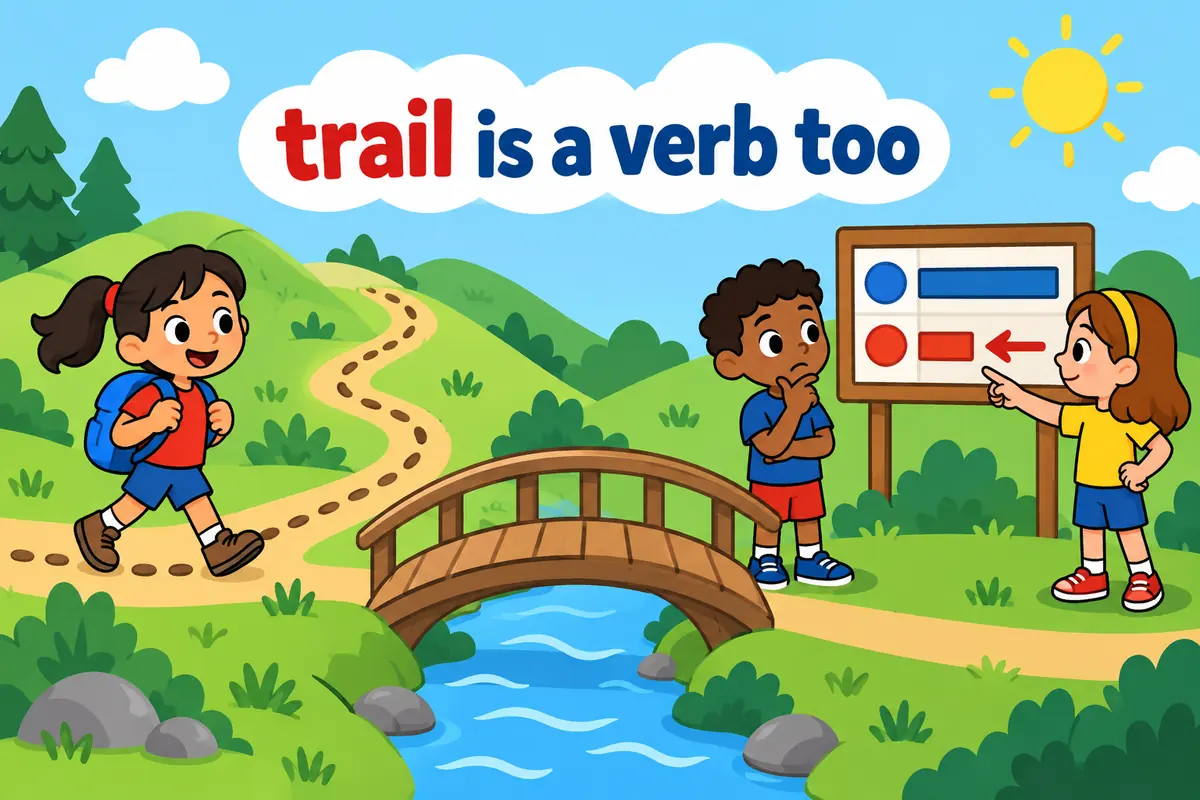
Trail and trial in a sentence: examples across contexts
The words separate cleanly once the subject appears, because trail moves and trial judges. Each row below fixes the context and explains why the sentence works.
| Context | Example sentence | Why this works |
|---|---|---|
| Classroom | The class mapped the nature trail beside the school. | Uses trail as a concrete place. |
| Workplace email | Keep a paper trail for every expense. | Uses the records sense of trail. |
| News report | The fraud trial resumes after a week-long break. | Trial names the legal proceeding. |
| Science writing | The trial showed the drug reduced symptoms. | Trial names a controlled test. |
| Sports report | The sprinter trailed until the final bend. | Uses trail as a verb for a lagging place. |
| Sports selection | Two hundred players entered the Olympic trials. | Trial names a qualifying contest. |
| Travel writing | Snow had covered the trail to the summit. | Keeps trail as the route. |
| Legal writing | The defendant asked for a trial by jury. | Uses the formal legal collocation. |
| Detective fiction | The detective was hot on the trail of the thief. | Uses the tracking idiom correctly. |
| Everyday conversation | Adopting the puppy was a real trial at first. | Uses trial for a testing experience. |
| Medical note | She joined the trial of a new treatment. | Trial names participation in research. |
| History essay | The king faced trial before the new parliament. | Keeps the legal sense in a historical frame. |
Which should you use?
Five situations cover almost every real choice. Read the subject first, because it usually settles the word before any other decision.
| Situation | Choose | Example |
|---|---|---|
| A walking route or a set of marks | trail | Mark the trail with small blue signs. |
| A lagging competitor or following someone | trail | Our team trailed at the interval. |
| A court case or a hearing | trial | The trial opens next week. |
| A test of a product or a drug | trial | The device is on trial in three schools. |
| A hard experience | trial | The long winter was a trial for everyone. |
Where the sense is still unclear, the safer word is usually the one that matches the verb: if you speak of following or walking, use trail; if you speak of testing or appearing in court, use trial. Where the sense is simply falling behind, lag behind states it more plainly than trail does.
Word forms and grammar of trail and trial
Trail takes regular verb endings, while trial is mainly a noun and only occasionally a verb with two accepted spellings in the past tense.
| Form | Part of speech | Example |
|---|---|---|
| trail | noun or verb, base form | They trail the leaders by a lap. |
| trails | noun plural or verb, third person | The trails meet at the old bridge. |
| trailed | verb, past and past participle | Mud trailed across the kitchen floor. |
| trailing | verb, present participle | A trailing ribbon hung from the kite. |
| trial | noun, and rare verb | They will trial the scheme in two towns. |
| trials | noun plural | The safety trials continue for a year. |
| trialed / trialled | verb, past (US / UK) | The system was trialed in schools. |
The two nouns also sit among useful neighbours: a garden path is simply a way through, a follow is the action a trail invites, and a court hearing is the step before a full trial.
Common mistakes with trail and trial
- Incorrect:
The hikers followed the trial into the woods.Correct: The hikers followed the trail into the woods. Rule: A route is a trail; a trial is a test or a case. - Incorrect:
The suspect will stand on trail in June.Correct: The suspect will stand on trial in June. Rule: The legal phrase uses trial with -ial. - Incorrect:
We learned by trail and error.Correct: We learned by trial and error. Rule: The fixed phrase names repeated testing, so it uses trial. - Incorrect:
The doctor ran a clinical trail.Correct: The doctor ran a clinical trial. Rule: Research tests are trials, never trails. - Incorrect:
Our team is on trail in the league.Correct: Our team trails in the league, or is on the trail of the leaders. Rule: Trailing is a verb; the noun phrase on the trail needs the. - Incorrect:
The trial wound through the valley.Correct: The trail wound through the valley. Rule: Only a physical route winds along the ground.
Practice using trail and trial
- Fill in the blank: The mountain ______ climbs steeply past the waterfall.
- Choose the better word: The new drug is still in (trail / trial).
- Correct the error: The case will come to trail in October.
- Build a sentence: use paper trail about a workplace expense record.
- Spot the register: which suits a news report – the murder trial continues, or the murder trail continues?
- Fill in the blank: Our team began to ______ after the second goal.
- Fix the phrase: They solved it by trail and error.
Answers
- trail — a climbable route is a trail with -ail.
- trial — a drug test is a trial with -ial.
- The case will come to trial in October — the legal word is trial.
- Model answer: The manager kept a paper trail for every expense.
- The murder trial continues — a court proceeding is a trial.
- trail — lagging behind is the verb trail.
- They solved it by trial and error — the fixed phrase uses trial.
The bottom line
The choice of trail vs trial comes down to whether the subject is a route or a proceeding: use trail for a path, a set of marks or a lagging position, and trial for a court case, a test or a hard experience. The two facts that decide most sentences are that trail is both a noun and a verb while trial is almost always a noun, and that the fixed phrases on trial, trial and error and clinical trial all use the -ial spelling. When in doubt, read the subject aloud and let it choose the word.
Frequently asked questions about trail vs trial
Why do trail and trial sound so similar?
Both words end in a similar unstressed syllable, so the vowels in the middle are easy to confuse in speech, and the spellings differ by a single letter. The meanings are unrelated, which is why context has to do all the work. Reading the whole sentence aloud usually reveals which word the speaker intended.
Is a trail always a path?
No. A trail can also be a set of marks or a scent left behind, as in a paper trail or a scent trail, and as a verb it means to follow or to lag behind. The path sense is only the most concrete one. Detectives, hikers and sports reporters all use the same word for different ideas.
Can trial be used as a verb?
Yes, though it is less common than the noun. To trial something is to test it, as in the school trials a new reading scheme. American English usually writes trialed and trialing, while British English doubles the l to write trialled and trialling. Most everyday sentences keep trial as a noun.
What does on trial mean?
On trial means appearing in a court case to have guilt or liability decided, as in the manager is on trial for fraud. It is a legal phrase and always uses trial. Do not confuse it with on the trail, which means following someone or something, as in the reporter was on the trail of a scandal.