Traverse means to travel across or through a place or area. To use traverse in a sentence, put the thing crossed straight after the verb: “The hikers traversed the ridge before noon.” Traverse is transitive and slightly formal, so it suits reports, guides and academic writing.
Traverse at a glance
- Traverse is a transitive verb; the forms are traverses, traversed, traversing and traversal.
- The object is the place, surface or distance crossed, never a person.
- Traverse appears in hiking, geography, law and technical writing.
- The prepositions across and through are implied, so they are usually left out.
- The commonest error is confusing traverse with averse, which means unwilling.
What does traverse mean?
Traverse is a transitive verb meaning to travel across or through something, or to span it from side to side. The Cambridge entry for traverse records the travel sense and the related idea of crossing a surface, and the second sense is the one that reaches beyond walking. Where the crossing is short and physical, cross the valley is the plainer choice, because traverse adds a note of distance and effort.
| Sense | Plain meaning | Example sentence |
|---|---|---|
| Travel across land | Go over a large area or terrain | The team traversed the glacier in two days. |
| Cross a surface | Span or pass over something | A steel bridge traverses the river at the narrow point. |
| Move along a course | Go over a route or site in order | The inspector traversed the whole site twice. |
One limitation is worth stating plainly. Traverse always needs an object, so it cannot describe a general trip: a sentence such as I traversed to Paris is wrong. It also says nothing about how easy the crossing was, only that something was crossed.
How do you use traverse in a sentence?
The place or distance being crossed follows the verb directly, with no preposition. Five patterns cover nearly every real sentence, and the passive is common when the landscape, not the traveller, is the topic.
| Pattern | Example | What it signals |
|---|---|---|
| traverse + terrain | They traversed the desert by night. | The object is a large area of land. |
| traverse + distance | The runners traversed twenty miles of coast path. | A measured length is covered. |
| be traversed by + feature | The plain is traversed by three rivers. | Passive voice puts the landscape first. |
| traverse + route | The convoy traversed the mountain pass at dawn. | A named route is crossed from end to end. |
| traverse + field (figurative) | Her book traverses four centuries. | A range is covered, not a physical place. |
Guides who navigate the trail on paper plan the crossing before they set out, and the verb they use for the completed walk is traverse. The practitioner rule is simple: if you can replace the word with crossed, traverse fits.
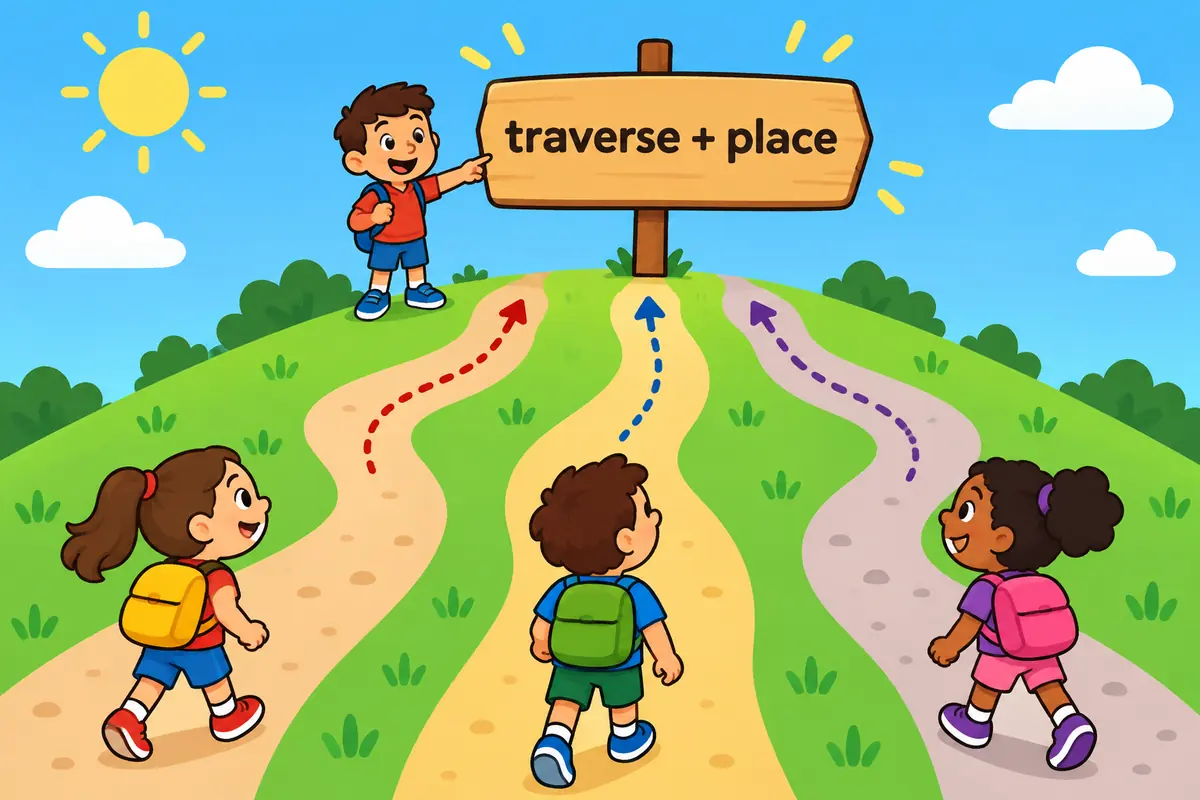
Traverse in a sentence: examples across contexts
Traverse keeps the same meaning while the register shifts. Every example describes a real journey across ground, water or a set route. The eight sentences below move from a classroom to a technical report.
| Context | Example sentence | Why this works |
|---|---|---|
| Classroom | The class traversed the school field to count the oldest trees. | A familiar place makes the formal verb easy to grasp. |
| Travel writing | They traversed the island on foot in a single week. | Names the area and the method, which a travel reader expects. |
| Workplace report | Surveyors traversed the site before the foundations were poured. | The technical register fits a professional report. |
| News report | The convoy traversed the border region without incident. | A set route and a safe outcome suit a hard-news sentence. |
| Geography | A railway line traverses the valley from north to south. | The passive-like subject is the structure, not a person. |
| History essay | Roman roads traversed the province in almost straight lines. | Past tense with a named network reads as a settled fact. |
| Sports commentary | The cyclist traversed forty kilometres of cobbles before the first fall. | A measured distance keeps the sentence precise. |
| Academic prose | The study traverses four decades of policy change. | The figurative sense covers a range of material. |
Only the travel and history examples place a person in subject position. The rest keep the route or the landscape in focus, which is where this verb feels most natural.
Traverse vs averse
Traverse and averse look alike and mean nothing alike. A team averse to danger will not traverse an exposed ridge, so the two words can meet in one sentence only as a contrast.
| Attribute | traverse | averse |
|---|---|---|
| Meaning | Travel across or through | Unwilling or opposed |
| Part of speech | Verb | Adjective |
| Typical use | Land, routes, distances | People and their attitudes |
| What follows | A direct object | Usually the preposition to |
| Memory hook | Traverse contains travel | Averse contains the a of against |
Verdict: use traverse for the act of crossing and averse for a reluctance, and never let the shared opening letters pull the two together.
Word forms and grammar of traverse
Traverse inflects regularly, and its derived words spread across travel writing and computing. Only a a traversable pass lets a convoy traverse the range in winter, so the adjective does real work.
| Form | Part of speech | Example |
|---|---|---|
| traverse | verb, base form | They will traverse the ridge at first light. |
| traverses | verb, third person singular | The path traverses a narrow gully. |
| traversed | verb, past | The convoy traversed the plain in a day. |
| traversing | verb, present participle | She spent the morning traversing the dunes. |
| traversal | noun | The traversal of the pass took six hours. |
| traversable | adjective | The track stays traversable until the snows. |
The noun traversal and the adjective traversable are the forms learners meet in technical writing, where a network or a route is described rather than a person.
Common mistakes with traverse
- Incorrect:
We traversed to the island by ferry.Correct: We crossed to the island by ferry. Rule: Traverse needs the thing crossed as its object, not a destination introduced by to. - Incorrect:
She is traverse of the dark.Correct: She is averse to the dark. Rule: Averse means unwilling; traverse is the verb for crossing. - Incorrect:
The river traverses the bridge.Correct: The bridge traverses the river. Rule: The subject is the thing that does the crossing, not the obstacle. - Incorrect:
They traversed through the forest.Correct: They traversed the forest. Rule: Traverse already implies through, so the preposition is redundant.
Practice using traverse
Work through the six items, then check the reasoning rather than only the answer.
- Fill the gap: The expedition ______ the ice field in three days.
- Choose the better word: The hikers were (averse / traverse) to walking after dark.
- Correct the error: The patrol traversed through the mountain pass.
- Build a sentence: use be traversed by about a region crossed by a river.
- Spot the register: which belongs in a geography report — the team walked over the plain, or the team traversed the plain?
- Rewrite as a noun: They traversed the pass. Use traversal as the subject.
Answers
- traversed — the ice field is the object crossed, with no preposition.
- averse — unwilling takes averse; traverse can never describe an attitude.
- The patrol traversed the mountain pass — traverse already implies through.
- Model answer: The delta is traversed by dozens of small channels.
- The team traversed the plain — a report prefers the precise single verb.
- The traversal of the pass took six hours — the noun names the crossing.
The bottom line
Use traverse in a sentence when something crosses a defined place, surface or range, and put that thing directly after the verb. Two nuances decide most sentences: the verb is transitive, so a bare destination is impossible, and it carries a formal tone that suits reports better than conversation. When the crossing is short and casual, crossed or went across state the same idea more plainly.
Frequently asked questions about traverse
What does traverse mean in simple words?
Traverse means to travel across or through something. A walker traverses a valley, a bridge traverses a river, and a report might say a region is traversed by a railway. The simple test is to replace the word with crossed or went across, and if the sentence still makes sense, traverse fits.
Is traverse the same as cross?
Traverse and cross overlap, but traverse suggests a longer or more deliberate movement across a defined area. Cross works for a street or a room, while traverse suits a desert, a ridge or a mountain range. Both take the thing passed over as a direct object, so the grammar is the same.
Can traverse be a noun?
Yes. A traverse is a sideways route across a slope, a term climbers and skiers use, and traversal is the more general noun for the act of crossing. In everyday writing the noun is rare, so most readers meet traverse as a verb and see the noun only in sport or technical prose.
How is traverse used in technical writing?
Software and engineering texts use traverse for moving through a structure such as a list, a tree or a network. The meaning stays close to the everyday one, because the program crosses every node in order. The noun in that setting is usually traversal, as in a depth-first traversal of the tree.
Have you ever come across the term “traverse” and wondered what it means? In simple terms, to traverse is to travel or move across a place or area.
The word “traverse” can be used to describe the act of crossing, navigating, or moving through a landscape, terrain, or any kind of space. The term is often employed to convey the idea of crossing or moving from one point to another, indicating a journey or passage from one location to another.
7 Examples Of Traverse Used In a Sentence For Kids
- Traverse the playground to reach the swings.
- Let’s traverse the park to find the ice cream shop.
- We can traverse the classroom to find our seats.
- Traverse the garden to pick beautiful flowers.
- I want to traverse the library to choose a book.
- Can you traverse the hallway to find the restroom?
- Traverse the field to play games with friends.
14 Sentences with Traverse Examples
- Traverse the library to find the best references for your research paper.
- Don’t forget to traverse the campus to familiarize yourself with all the buildings and facilities.
- It’s important to traverse different subjects before deciding on your major.
- Make sure to traverse the career fair to explore job opportunities and network with professionals.
- Traverse the city to discover new study spots and cafes to hang out with friends.
- Take a break from studying and traverse the nearby hills for a refreshing hike.
- Traverse different study groups to find the one that best fits your learning style.
- Join a club or organization to traverse new interests and meet like-minded individuals.
- Traverse the local markets to find affordable groceries and supplies for your dorm.
- Don’t be afraid to traverse outside your comfort zone and try new activities or sports.
- Use public transportation to easily traverse the city and explore all it has to offer.
- Traverse various internship opportunities to gain hands-on experience in your field.
- Make time to traverse the nearby cultural attractions and historical sites during your free time.
- Utilize online platforms to traverse virtual workshops and webinars related to your field of study.
How To Use Traverse in Sentences?
Traverse is a verb that means to travel across or move through a place. When using Traverse in a sentence, it is important to remember a few key points.
First, the word Traverse should generally be followed by a preposition that indicates the area being traveled through. For example, “She traversed the forest” or “They traveled across the mountains.” This helps to clarify the specific location or terrain being crossed.
Second, Traverse can also be used metaphorically to indicate moving through a series of challenges or obstacles. For instance, “He traversed the difficult path to success” or “She moved through the complicated situation with ease.”
Third, Traverse is a versatile word that can be used in different tenses. For example, “I will traverse the desert tomorrow” (future tense), “She is traversing the river right now” (present continuous tense), or “He had traversed the entire country before settling down” (past perfect tense).
Finally, when using Traverse in a sentence, make sure to consider the context and tone of your writing. Traverse can convey a sense of movement, journey, or exploration, so use it to add depth and vivid imagery to your writing.
Conclusion
In conclusion, the examples of sentences using the keyword “traverse” showcase its versatility in describing various actions, such as walking across a room, exploring unknown territories, or navigating a challenging terrain. These sentences highlight the word’s ability to convey movement, progression, and the overcoming of obstacles.
Whether it’s a simple traversal from one point to another or a more complex journey through different landscapes, “traverse” captures the essence of crossing and moving through different spaces. The diverse examples demonstrate how this word can be applied in both literal and figurative contexts, making it a valuable addition to one’s vocabulary for expressing acts of exploration, progression, and advancement.


