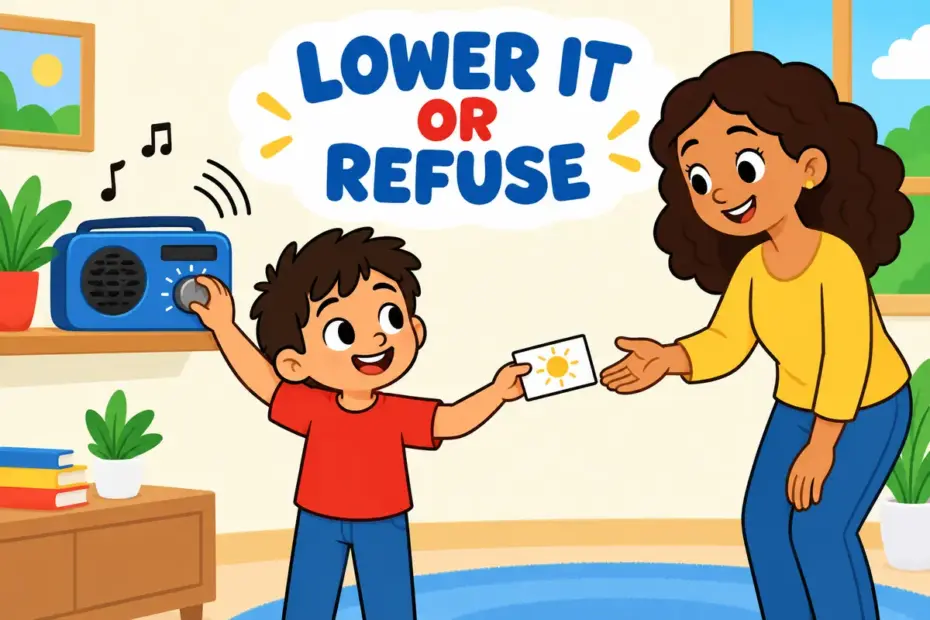
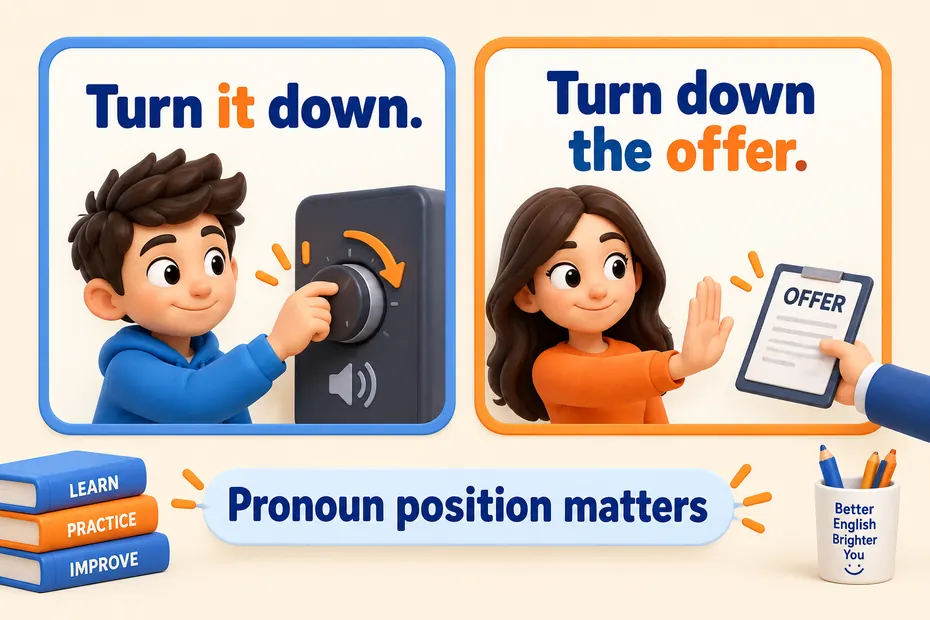
Turn down is a separable phrasal verb that means either to lower a setting or to refuse an offer, and the object tells you which sense is meant. To use turn down in a sentence, keep a pronoun between the verb and the particle: “Turn it down before the neighbours complain.”
Turn down at a glance
- Turn down is a separable phrasal verb with two main senses: to lower a setting and to refuse an offer.
- The particle down may follow the object or the object may move in front, but a pronoun must sit between.
- It is transitive, so it always needs an object such as the music, the heat, an offer or a request.
- A third, less common sense means to fold something down, as in turn down the bed sheet.
- The commonest error is placing a pronoun after the particle, as in turn down it.
What does turn down mean?
Turn down is a phrasal verb with two frequent senses and one rare one. The Cambridge entry for turn down records both the lowering and the refusing senses, and the object separates them: a dial, a volume or a heater signals a lower setting, while an offer, request or invitation signals a refusal. The third sense, folding a sheet or collar down, is much less common. Because the verb is separable, the object can move, but a pronoun must sit between the verb and the particle.
| Sense | Plain meaning | Example sentence |
|---|---|---|
| Lower a setting | Reduce the level of sound, heat or light | Please turn down the music before the test. |
| Refuse an offer | Say no to a request, offer or person | She turned down the job in another city. |
| Fold down | Fold back a sheet, collar or corner | Turn down the blanket before the child climbs in. |
How do you use turn down in a sentence?
Turn down is transitive and separable. The table shows how the object moves and where a pronoun must stay.
| Pattern | Example | What it signals |
|---|---|---|
| turn down + object | The nurse turned down the heating. | The neutral order, particle before the object. |
| turn + object + down | The nurse turned the heating down. | The separable order, common with longer objects. |
| turn + pronoun + down | The nurse turned it down. | The only correct place for a pronoun. |
| turn down + offer | He turned down the promotion. | The refusal sense with an abstract object. |
| be turned down | Their bid was turned down. | Passive form, common in business and news. |
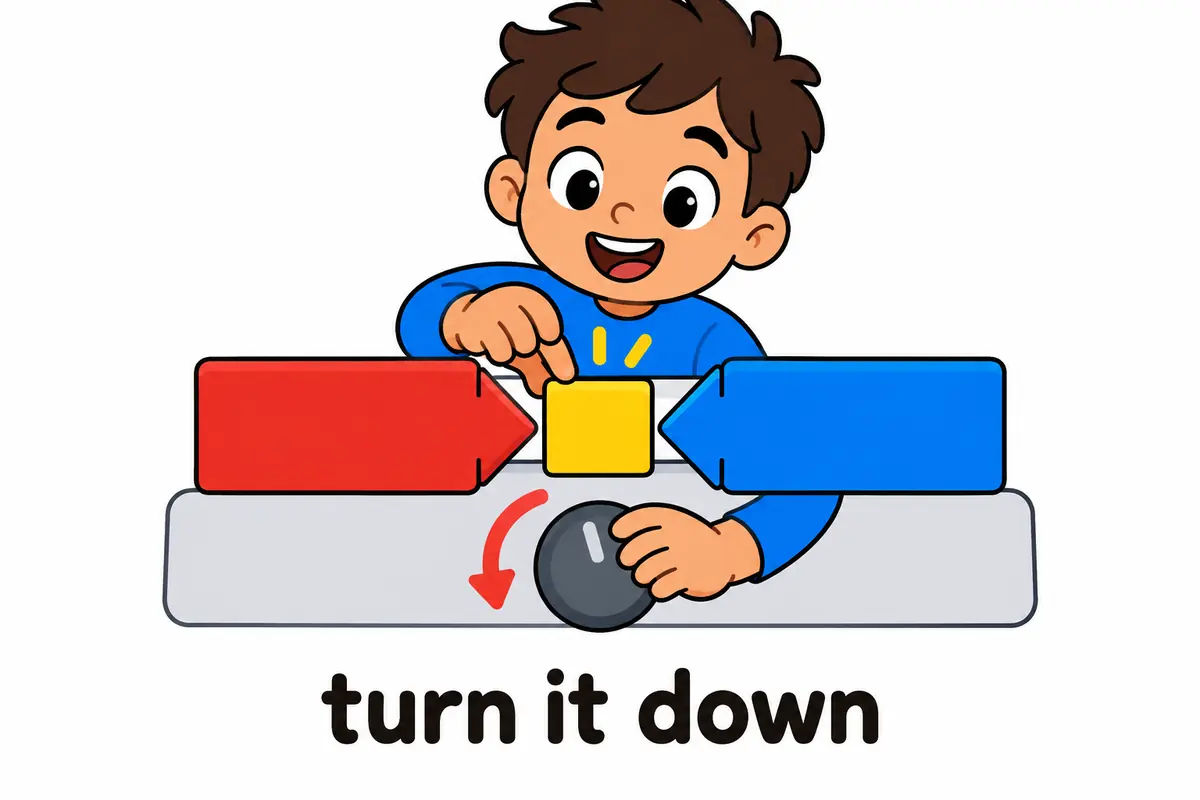
Turn down in a sentence: examples across contexts
Each row places turn down in a different register, with the reason the sentence works.
| Context | Example sentence | Why this works |
|---|---|---|
| Classroom | The teacher asked the class to turn the projector down. | The separable order keeps the object clear. |
| Workplace email | We regret that we must turn down your request for an extension. | A polite formal refusal. |
| News report | The board rejected the offer and turned it down within a day. | Pairs a formal synonym with the phrasal verb. |
| Conversation | I asked him to reduce the volume, so he turned it down. | A relaxed exchange in speech. |
| Business | The firm declined the invitation and turned the meeting down. | Shows the refusal sense in a professional frame. |
| Home | Turn down the oven before the cake browns. | Everyday instruction with the setting sense. |
| Sports | The club turned down a bid for its captain. | A refusal reported in a sports register. |
| Restaurant | She politely turned down the dessert menu. | A gentle refusal at a social setting. |
| Dating | He asked her out, and she turned him down. | The pronoun sits between verb and particle. |
Turn down vs refuse
Turn down and refuse both mean saying no, and decline is the polite formal cousin. The table sets them apart.
| Attribute | turn down | refuse |
|---|---|---|
| Core meaning | Say no to an offer, or lower a setting | Say no to a request or offer |
| Register | Neutral, used in speech and writing | Slightly formal |
| Typical object | An offer, invitation, request or person | A request, offer or permission |
| Other sense | Lower sound, heat or light | None; it never means lowering |
| What it adds | A plain, everyday refusal or a physical reduction | A firm, deliberate no |
Use turn down in everyday speech and refuse for a firmer, more formal no; neither should be confused with accept, its opposite.
Word forms and grammar of turn down
Turn down behaves like other separable phrasal verbs, and its hyphenated form is a noun or an adjective. A related particle verb is back down, which means to withdraw a demand.
| Form | Part of speech | Example |
|---|---|---|
| turn down | base phrasal verb | They turn down offers that arrive late. |
| turns down | third person singular | She turns down the radio each morning. |
| turned down | past and participle | He turned down the scholarship. |
| turning down | present participle | Turning down the heat saved fuel, and turning up the heat wastes it. |
| turn-down | attributive adjective, hyphenated | A turn-down service folds the sheets. |
Common mistakes with turn down
The errors come almost entirely from the pronoun rule and from mixing the phrasal verb with the single verb refuse.
- Incorrect:
Please turn down it.Correct: Please turn it down. Rule: A pronoun object must sit between the verb and the particle, never after it. - Incorrect:
She turned down him at the dance.Correct: She turned him down at the dance. Rule: The same pronoun rule holds in the refusal sense, so him goes in the middle. - Incorrect:
The music was turned down by the neighbour.Correct: The neighbour turned the music down. Rule: The passive is possible but clumsy here, so the active, separable form reads better. - Incorrect:
He refused the invitation down.Correct: He turned the invitation down. Rule: Refuse never takes down; the particle belongs only to the phrasal verb. - Incorrect:
They turned down to the offer.Correct: They turned down the offer. Rule: Turn down is transitive and takes a bare object, with no preposition after it.
Practice using turn down
Try the six items, then compare your answers with the reasoned list.
- Fill the gap: The room was too warm, so I ______ the radiator.
- Choose the better word: She (refused / turned down) him, and he took it well.
- Correct the error: Please turn down it before the baby wakes.
- Build a sentence: use turn the offer down about a job in another country.
- Spot the register: which fits a job rejection letter — We must turn down your application, or We have to say no to your application.
- Rewrite with the pronoun: They turned down the plan. Replace the plan with it.
Answers
- turned down — lowering a radiator is the setting sense, and the object is the radiator.
- turned down — the refusal of a person prefers the phrasal verb, and him sits between.
- Please turn it down before the baby wakes — the pronoun goes between verb and particle.
- Model answer: He had to turn the offer down because the job was in another country.
- We must turn down your application — a rejection letter keeps the neutral phrasal verb.
- They turned it down — a pronoun object always sits between verb and particle.
The bottom line
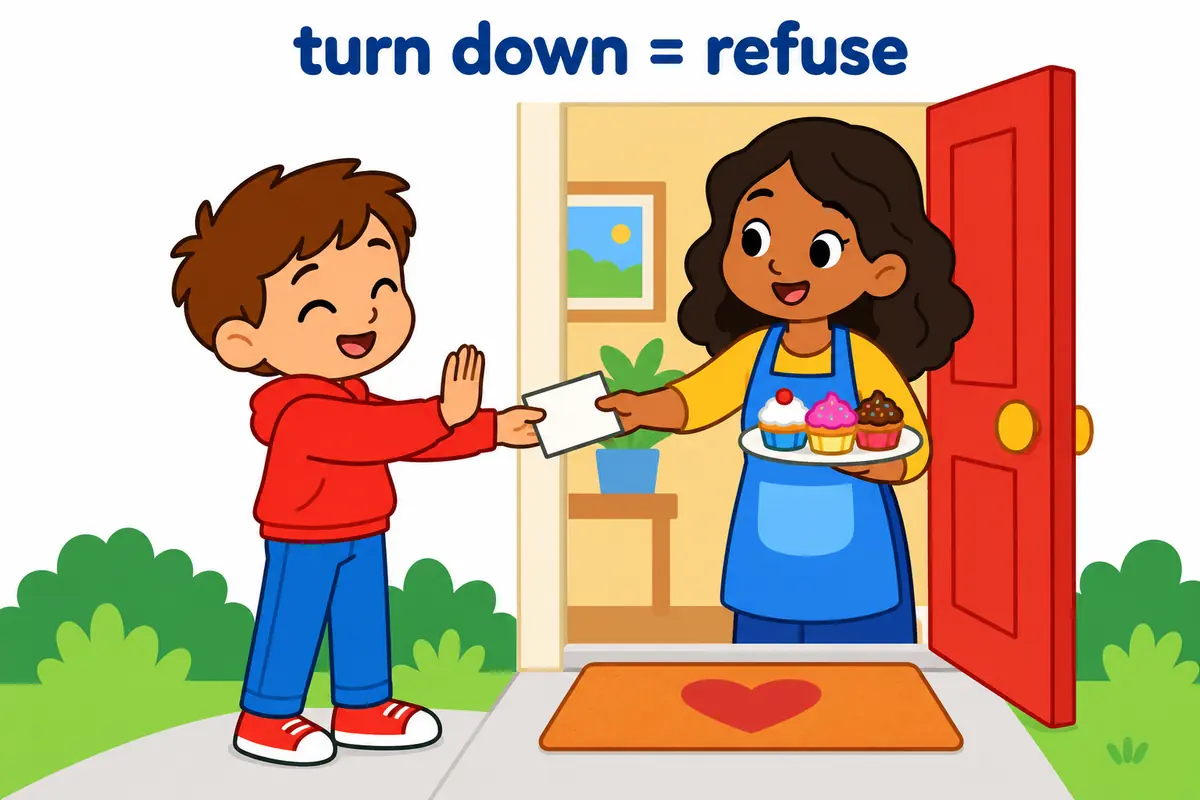
Turn down is a transitive, separable phrasal verb that lowers a setting or refuses an offer, and the object decides which sense appears. Keep a pronoun between the verb and the particle, and choose the order that reads most naturally for a longer noun. Use turn down in everyday and professional writing, but never place a pronoun after down. Watch the register against refuse and the meaning against its opposite accept.
Frequently asked questions about turn down
Which senses does turn down cover?
Turn down has two main senses. It can lower a setting, as in turn down the music. It can refuse an offer, as in turn down a job. The object tells you which sense applies, because a dial and an offer point to different meanings.
Where does the pronoun go in turn down?
A pronoun always goes between the verb and the particle, so you say turn it down, never turn down it. The same rule holds for him, her, them and us. With a full noun object you have a choice: turn the music down and turn down the music are both correct.
Can turn down be used without an object?
No. Turn down is transitive, so it always needs an object, whether that is a setting such as the heat or an offer such as a promotion. A sentence like they turned down sounds unfinished because the reader waits for the thing that was refused or lowered.
What does it mean to turn down a person?
To turn down a person means to refuse their offer or invitation, most often a request for a date or a proposal. The phrase is a gentle way to describe a refusal, and the pronoun sits between the verb and the particle: she turned him down. It carries no insult by itself; the tone decides how kind it sounds.
What does turn down mean in a sentence?
Turn down means to lower a setting or to refuse something offered. Compare “Please turn down the music” with “I had to turn down the invitation.” The first sentence asks for less sound; the second says that someone did not accept an invitation. The object usually tells you which meaning applies. A dial, volume, light or heater suggests a lower setting. An offer, request or invitation suggests refusal.
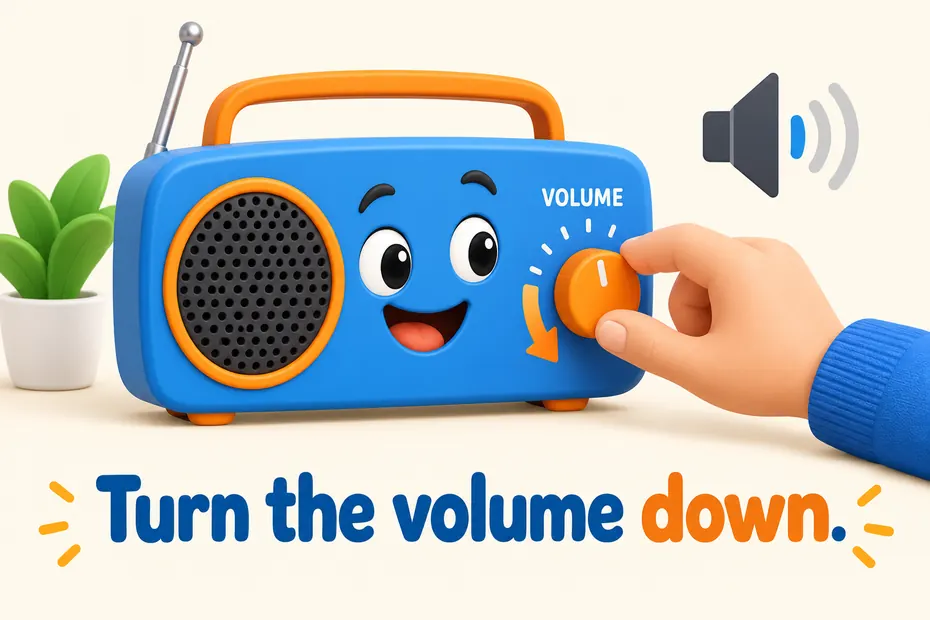
Key facts about turn down
Turn down is a phrasal verb: the main verb combines with the particle down. Its forms are turns down, turned down and turning down. The words can separate around an object in these common uses. You can say “turn down the radio” or “turn the radio down.” With an object pronoun, use “turn it down,” not “turn down it.” Keep this distinction in mind when reading the original examples further below.
| Meaning | Example | What happens? |
|---|---|---|
| Lower a setting | We turned down the heater. | The setting becomes lower. |
| Refuse an offer | Rosa turned down the invitation. | She does not accept it. |
| Fold downward | He turned down the collar. | The collar folds down. |
Merriam-Webster’s turn down entry supports these different senses. The explanations, practice situations and teaching examples here show how to choose between them. Read the whole sentence before deciding what has been reduced, refused or folded.

How to arrange the words correctly
A noun object gives you two natural arrangements: “Leo turned down the offer” and “Leo turned the offer down.” A pronoun object goes between the verb and particle: “Leo turned it down.” The same pattern works for sound: “Turn down the television,” “Turn the television down” and “Turn it down.” In the last sentence, the listener needs to know what it refers to.
The verb changes for tense, while down stays the same. Write “She turns down extra work when her schedule is full” for a usual action. Write “She turned down extra work yesterday” for a past event. Write “She is turning down the offer” for an action in progress. After will, can or should, use the base verb: “She may turn down the offer.”
In a question with did, return to the base form: “Did you turn down the invitation?” A negative past sentence follows the same rule: “I did not turn down the invitation.” Compare the affirmative “I turned it down” with the negative “I did not turn it down.” Do not write “did not turned.”
Natural examples for everyday situations
- Please turn down the speaker so everyone can hear the announcement.
- I turned the lamp down before starting the film.
- We had to turn down the invitation because we were away that weekend.
- Omar turned down a second slice of cake.
- The editor turned down the proposed article.
- They offered me another task, but I turned it down.
- Could you turn it down a little?
- She turned down the corner of the page to mark her place.
These sentences show an action without automatically judging it. Turning down an invitation can be reasonable, disappointing, abrupt or polite depending on the circumstances and wording. The phrasal verb itself does not guarantee respectful behavior. “He rudely turned down my request” is perfectly possible.
Turn down, turn off and turn up
Turn down a device generally means reduce its setting; turn off means stop its operation. “Turn the radio down” allows quieter music to continue. “Turn the radio off” stops it. Turn up can mean increase a setting: “Turn up the volume.” These opposites apply to settings, but turn up is not the normal opposite of refusing an invitation. For that meaning, use accept: “She accepted the invitation.”
For refusal, decline is often a useful alternative in formal writing: “The applicant declined the offer.” Reject may sound firmer in some contexts. For a setting, lower or reduce can be clearer when there is no physical control involved. Choose the alternative that fits the action rather than treating every synonym as interchangeable.
Corrections and a quick practice check
The original material below says that turn and down should always stay together. The separated forms above show why that advice needs qualification. Its label “Subject-Object-Verb” also conflicts with its own explanation: the ordinary example “She turned down the offer” follows subject–verb–object order. Finally, “resist the urge to procrastinate” and “resist temptation” are more natural than “turn down the urge” or “turn down temptation.”
Complete these sentences: “The music is loud; please turn ___ down.” “She ___ down the invitation yesterday.” “He offered help, but I did not ___ it down.” The answers are it, turned and turn. Explain whether each sentence refers to reducing a setting or refusing something before checking the verb form.
Frequently asked questions
Is turn down one word?
The verb is two words. Turndown occurs as a noun or adjective, including in the expression turndown service.
Can I say turn down it?
Use turn it down. A pronoun object belongs between turn and down in these constructions.
Does turn down always mean reject?
No. It can refer to lowering a setting or folding something downward. The object and context decide the meaning.
How can I refuse politely?
Try “Thank you for inviting me, but I cannot come.” You can describe that action afterward by saying that you turned down the invitation.

Have you ever been in a situation where you needed to politely refuse an offer or request? This is where the phrase “turn down” comes in handy. In English, when you “turn down” something, you are declining or rejecting it in a respectful manner.
For instance, if someone invites you to a party but you already have plans, you would “turn down” the invitation. Or if a colleague offers you more work but you’re already overloaded, you might need to “turn down” their proposition.
7 Examples Of Turn Down Used In a Sentence For Kids
- Turn down the volume of the music, please.
- Can you turn down the brightness of the screen?
- It’s important to turn down the heat when the weather is hot.
- Remember to turn down the lights before going to bed.
- We should always remember to turn down our voices when we are indoors.
- I will turn down the fan if you feel cold.
- It’s polite to turn down the volume of your voice when speaking with others.
14 Sentences with Turn Down Examples
- Turn down the volume on your speakers while attending online classes to avoid disturbing others in your household.
- It’s okay to turn down an invitation to hang out if you have a lot of assignments to complete.
- Don’t forget to turn down the brightness of your laptop screen to reduce eye strain during long study sessions.
- Remember to turn down any offers to join last-minute group projects if you already have too much on your plate.
- It’s important to turn down the temptation to skip classes, as attendance can impact your grades.
- Make sure to turn down any late-night study sessions that could affect your sleep schedule.
- Don’t be afraid to turn down unhealthy food options when studying late – your body will thank you for it.
- Always turn down the urge to procrastinate on assignments – staying on top of deadlines is key in college.
- If you’re feeling overwhelmed, it’s okay to turn down social gatherings to take care of yourself.
- Before exams, it’s crucial to turn down social media distractions to focus on studying.
- It’s important to turn down the opportunity to cheat on exams – academic integrity is essential in college.
- Remember to turn down the volume on your phone when in the library or study areas.
- It’s okay to turn down the pressure to join every club and activity – focus on quality over quantity.
- Always turn down opportunities that compromise your values or beliefs while in college.
How To Use Turn Down in Sentences?
To use “Turn Down” correctly in a sentence, turn down should be used when you want to decrease the intensity or volume of something. For example, if the music is too loud, you can turn down the volume. Here are some tips on how to use it effectively in a sentence:
-
Verb placement: In the sentence, the phrase “turn down” should be used as a phrasal verb and placed together. For instance, “Can you please turn down the TV?”
-
Subject-Object-Verb: Follow the subject-verb-object order when structuring a sentence with “turn down.” For example, “She decided to turn down the offer.”
-
Context: Make sure the context of the sentence matches the meaning of “turn down.” This could involve situations where you are reducing something’s intensity, like lowering the volume on a stereo.
-
Tense: Ensure the verb “turn down” is conjugated correctly based on the tense of the sentence. For example, “He will turn down the job offer.”
Remember, “Turn Down” is a simple yet versatile phrase used in everyday conversations. Practicing using it in different contexts will help you become more comfortable incorporating it into your vocabulary.
Conclusion
In various situations, individuals may choose to “turn down” opportunities, offers, or requests. This phrase is commonly used to signify rejecting something, whether it be a job offer, an invitation, or a proposal. It is a polite and respectful way to decline an opportunity that may not align with one’s interests, schedule, or values.
By acknowledging when to “turn down” certain opportunities, individuals can prioritize their time, focus on what truly matters to them, and maintain boundaries. It is a crucial skill to learn how to decline in a respectful and kind manner without feeling obligated to say yes to everything. Understanding when to confidently “turn down” can lead to a more fulfilling and balanced lifestyle.


