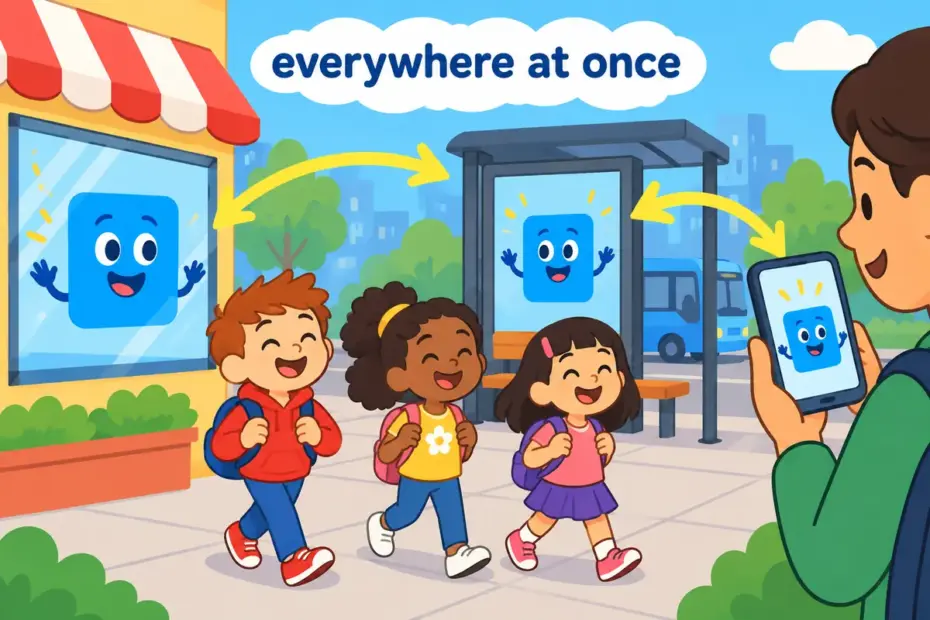
Ubiquitous is an adjective meaning present or found everywhere at the same time. To use ubiquitous in a sentence, place it before the noun it describes and pair it with something genuinely widespread: “Smartphones are ubiquitous in city life.” It is stronger than common and less absolute than omnipresent.
Ubiquitous at a glance
- Ubiquitous is an adjective meaning present in almost every place.
- It usually appears before a noun or after become, seem and be.
- It is stronger than common or widespread but weaker than all-present.
- The usual hedges are almost, nearly and increasingly.
- The commonest error is calling one object ubiquitous inside a single room.
What does ubiquitous mean?
Ubiquitous is an adjective meaning present or found everywhere at the same time. The Cambridge entry for ubiquitous defines it as seeming to be everywhere. The word is often slightly exaggerated, since a phone that people check constantly is called ubiquitous even though a few people still avoid phones.
| Sense | Plain meaning | Example sentence |
|---|---|---|
| Present everywhere | Found in nearly every place | Plastic waste is ubiquitous along the coast. |
| Constantly met | Encountered again and again | Advertising is ubiquitous on free websites. |
| Seeming to be everywhere | So widespread that it is hard to avoid | The teacher seemed ubiquitous during the exam. |
Nearby words show a scale. Widespread means spread over a large area, and frequent means happening often, but neither claims as much coverage as ubiquitous.
One limitation is worth stating plainly. Ubiquitous does not mean eternal and it does not mean identical everywhere. For something that is merely common, the plainer words common, widespread or frequent are more accurate, and a single object inside one room is never ubiquitous.
How do you use ubiquitous in a sentence?
The adjective takes no article and usually needs a hedge, because literal everywhere is rare. Most natural sentences use become or seem with it, or place it directly before a noun.
| Pattern | Example | What it signals |
|---|---|---|
| become or seem + ubiquitous | Cameras have become ubiquitous in cities. | Reports a spread that happened over time. |
| almost or nearly + ubiquitous | Cash is almost ubiquitous in small towns. | Hedges the claim to keep it accurate. |
| ubiquitous + noun | Ubiquitous screens fill the station. | Attributive use, the commonest position. |
| so ubiquitous that + clause | The tune was so ubiquitous that nobody noticed it. | Joins the spread to a consequence. |
| ubiquitous in or among + group | The slang is ubiquitous among teenagers. | Narrows the reach to a group or place. |

Ubiquitous in a sentence: examples across contexts
Ubiquitous travels easily between registers because it names extent rather than quality. A global product and a prevalent habit are both widespread, but the nine sentences below keep the word in a natural position.
| Context | Example sentence | Why this works |
|---|---|---|
| Classroom | Printed dictionaries were once ubiquitous in every classroom. | Places the word before a noun. |
| Workplace email | Remote meetings have become ubiquitous since the policy changed. | Uses become, the commonest verb with this adjective. |
| News report | Cameras are now almost ubiquitous on city streets. | Adds almost to keep the claim honest. |
| Technology writing | The app is ubiquitous among commuters on the morning train. | Narrows the reach to a group. |
| Academic writing | Plastic particles are ubiquitous in ocean samples. | Uses the adjective in a measured scientific claim. |
| Conversation | That song was so ubiquitous that I still hum it. | Uses so that to add a consequence. |
| Advertising | Reviews are ubiquitous on shopping pages. | Uses the attributive position for a short, punchy line. |
| Travel writing | Motorbikes are ubiquitous on the island. | Reports a fact about one place. |
| Literary prose | A ubiquitous grey light filled the city. | Uses the adjective to suggest an atmosphere. |
Only the last sentence uses ubiquitous for a mood rather than a thing, and even there the spread is the point. That is the boundary of the word.
Ubiquitous vs omnipresent
Ubiquitous and omnipresent are close, and the difference is one of degree and register. Omnipresent means present in all places at once and often carries a religious or philosophical tone, while pervasive stresses how deeply something has spread rather than how widely.
| Attribute | ubiquitous | omnipresent |
|---|---|---|
| Meaning | Found nearly everywhere in practice | Present in every place at once |
| Strength | Strong but human-scale | The strongest of the three |
| Typical subject | Phones, screens, ads, slang | A deity, a spirit, an idea |
| Register | Neutral, journalism and essays | Formal, literary or religious |
| Hyperbole | Common and usually acceptable | Rare; usually meant literally |
Verdict: choose ubiquitous for things that feel inescapable in daily life, and reserve omnipresent for something that is genuinely everywhere at once.
Word forms and grammar of ubiquitous
Ubiquitous has one adjective and a small family of related forms. Its noun ubiquity, as in the ubiquity of smartphones, is the form writers reach for when they need a subject.
| Form | Part of speech | Example |
|---|---|---|
| ubiquitous | adjective | Cameras are ubiquitous here. |
| ubiquitously | adverb | The drink is ubiquitously advertised. |
| ubiquity | noun | The ubiquity of screens changed the street. |
| ubiquitousness | noun, rare | The ubiquitousness of the trend passed quickly. |
| more ubiquitous | comparative adjective | Landlines are less ubiquitous than they were. |
Common mistakes with ubiquitous
- Incorrect:
The ubiquitous of phones worries teachers.Correct: The ubiquity of phones worries teachers. Rule: Ubiquitous is an adjective; the noun is ubiquity. - Incorrect:
Water is very ubiquitous in the ocean.Correct: Water is everywhere in the ocean. Rule: Ubiquitous already means everywhere, and one place is not a spread. - Incorrect:
The city is ubiquitous with shops.Correct: Shops are ubiquitous in the city. Rule: The widespread thing is the subject, and the place takes in. - Incorrect:
His ubiquitous smile appeared once.Correct: His ever-present smile appeared wherever he went. Rule: A single appearance contradicts the meaning of everywhere. - Incorrect:
The teacher was ubiquitous in the classroom.Correct: The teacher seemed to be everywhere in the classroom. Rule: Ubiquitous usually modifies a thing or quality, not one person in one room.
Practice using ubiquitous
Work through the six items, then check the reasoning rather than only the answer.
- Fill the gap: Mobile payments are now ______ in most large cities.
- Choose the better word: The festival is (ubiquitous / omnipresent) among students, though it is rare elsewhere.
- Correct the error: The ubiquitous of plastic in the sea is a serious problem.
- Build a sentence: use so ubiquitous that about a popular ringtone.
- Spot the register: which belongs in an academic essay — social media is ubiquitous among teenagers, or social media is everywhere, like, all the time?
- Rewrite with the noun: Smartphones are ubiquitous in schools. Use ubiquity.
Answers
- ubiquitous — the adjective follows are and names a wide daily spread.
- ubiquitous — the spread is among one group, not every place at once, so omnipresent is too strong.
- The ubiquity of plastic in the sea is a serious problem — the noun is needed as the subject.
- Model answer: The ringtone was so ubiquitous that everyone knew it — so that links the spread to a result.
- Social media is ubiquitous among teenagers — an essay stays formal and drops the filler.
- The ubiquity of smartphones in schools — the noun replaces the adjective before a preposition.
The bottom line
Use ubiquitous in a sentence for something present or found everywhere, and keep it before a noun or after become and seem. The two decisive points are degree and register, because ubiquitous is strong but human-scale, while omnipresent is absolute and often religious in tone. For a trait that is merely common, widespread or frequent is the more accurate word.
Frequently asked questions about ubiquitous
What is the noun form of ubiquitous?
The noun is ubiquity, as in the ubiquity of smartphones. The adverb is ubiquitously. Ubiquitousness exists but is rare, so most writers prefer ubiquity whenever a noun is needed. For example, writers discuss the ubiquity of screens rather than the ubiquitousness of screens.
Is ubiquitous a positive or negative word?
Ubiquitous is neutral and takes its tone from the noun beside it. Ubiquitous help can sound grateful, while ubiquitous advertising can sound weary. The adjective reports how widely something appears, not whether that spread is welcome. A phrase like ubiquitous cameras can even feel like a warning.
Can a person be ubiquitous?
A person can be called ubiquitous in a light, figurative way, usually meaning they seem to turn up in many places. The adjective more often describes things, habits, images and technologies. For one person in one room, everywhere is the safer phrase.
What is the difference between ubiquitous and universal?
Universal means true or shared by all members of a group, while ubiquitous means found in many places. A universal rule has no exceptions among the people it covers, but a ubiquitous habit is simply very common and can still have its exceptions.
Have you ever wondered about the meaning of the word “ubiquitous”? This term refers to something that is present, or seems to be present, everywhere at the same time.
Ubiquitous is a word often used to describe something that is widespread or common in a particular context. It denotes the presence of something in such a way that it seems to be ever-present and all-encompassing.
7 Examples Of Ubiquitous Used In a Sentence For Kids
- Ubiquitous means something that is everywhere.
- In India, cows are ubiquitous animals.
- Birds are another example of something ubiquitous.
- Trees are ubiquitous in parks and forests.
- The sun is always ubiquitous during the day.
- Flowers are ubiquitous in gardens and fields.
- People are ubiquitous in cities and villages.
14 Sentences with Ubiquitous Examples
- Ubiquitous food delivery services have made life easier for college students juggling assignments and classes.
- Laptops are ubiquitous on campus as students use them for research, studying, and completing assignments.
- Smartphones have become ubiquitous among college students, serving as a tool for communication and staying connected.
- The use of social media is ubiquitous among college students, with many using platforms like Instagram and Snapchat daily.
- Ubiquitous coffee shops near universities are popular hangout spots for students to study and socialize.
- Online shopping has become ubiquitous for college students who are looking for convenient ways to purchase textbooks and essentials.
- The availability of fast food chains is ubiquitous near college campuses, providing quick and affordable meal options for students.
- The use of public transportation is ubiquitous among college students who rely on buses and trains to commute to and from campus.
- Access to free Wi-Fi is ubiquitous on college campuses, enabling students to stay connected and work on their assignments.
- The use of online resources such as Google Scholar is ubiquitous among college students for research purposes.
- The presence of career fairs on campus is ubiquitous, providing opportunities for students to network and explore job options.
- The popularity of streaming services like Netflix is ubiquitous among college students, who enjoy watching shows and movies in their spare time.
- The availability of study groups is ubiquitous on campus, offering students a collaborative approach to learning and reviewing material.
- The use of digital payment apps like Paytm is ubiquitous among college students, who find it convenient for transactions and splitting bills.
How To Use Ubiquitous in Sentences?
To use the word Ubiquitous in a sentence, you can follow these simple steps:
-
Understand the meaning of Ubiquitous: Ubiquitous means something that is everywhere or constantly encountered. It refers to something that is widely present or common.
-
Identify a situation or concept that is found everywhere or very common. For example, technology has become ubiquitous in modern society.
-
Begin constructing your sentence by placing the word Ubiquitous in the appropriate context. For instance, “Smartphones are now ubiquitous among people of all ages.”
-
Make sure the sentence clearly conveys the idea that the subject is present everywhere or very common in a given context.
-
Double-check that the sentence flows well and accurately represents the meaning of the word Ubiquitous.
In summary, when using the word Ubiquitous in a sentence, it is essential to understand its meaning and apply it to situations or objects that are widespread or common. By following these steps, beginners can effectively incorporate the word Ubiquitous into their writing to enhance clarity and precision.
Conclusion
In conclusion, ubiquitous means something that is found or existing everywhere. This term can be applied to various aspects of daily life, such as smartphones being ubiquitous in modern society or the internet being ubiquitous in our interconnected world. It is clear that ubiquitous technologies, like social media platforms, have become fundamental to how we communicate and interact with one another. Additionally, with the rise of online shopping, e-commerce has become an ubiquitous part of retail experiences for many consumers.
As our dependence on technology continues to grow, it is evident that ubiquitous elements are shaping our everyday routines in significant ways. Understanding and adapting to the constant presence of these ubiquitous influences is essential in navigating the increasingly interconnected and digitally driven world we live in today.


