Undefiled is an adjective meaning not spoiled, polluted, or made impure. It often describes a place, substance, reputation, or moral quality that remains clean or uncorrupted; the word is formal or literary, so a more specific everyday alternative may sound more natural.
What does “undefiled” mean?
Undefiled describes something that has not been spoiled or made less pure or beautiful. Cambridge Dictionary gives that broad sense, while Collins labels the word literary and includes physical, moral, and religious uses (Cambridge Dictionary; Collins English Dictionary).
- Physical: a landscape or water source remains free from visible damage or pollution.
- Figurative: a record or reputation has not been stained by wrongdoing.
- Moral or religious: a person, belief, or practice is portrayed as pure or uncorrupted; this sense can sound solemn or old-fashioned.
The word does not prove that something is literally sterile, safe, untouched by people, or morally perfect. It expresses a judgment about whether something has been spoiled, so specify what kind of harm or change is absent when precision matters.

Undefiled in a sentence: examples and patterns
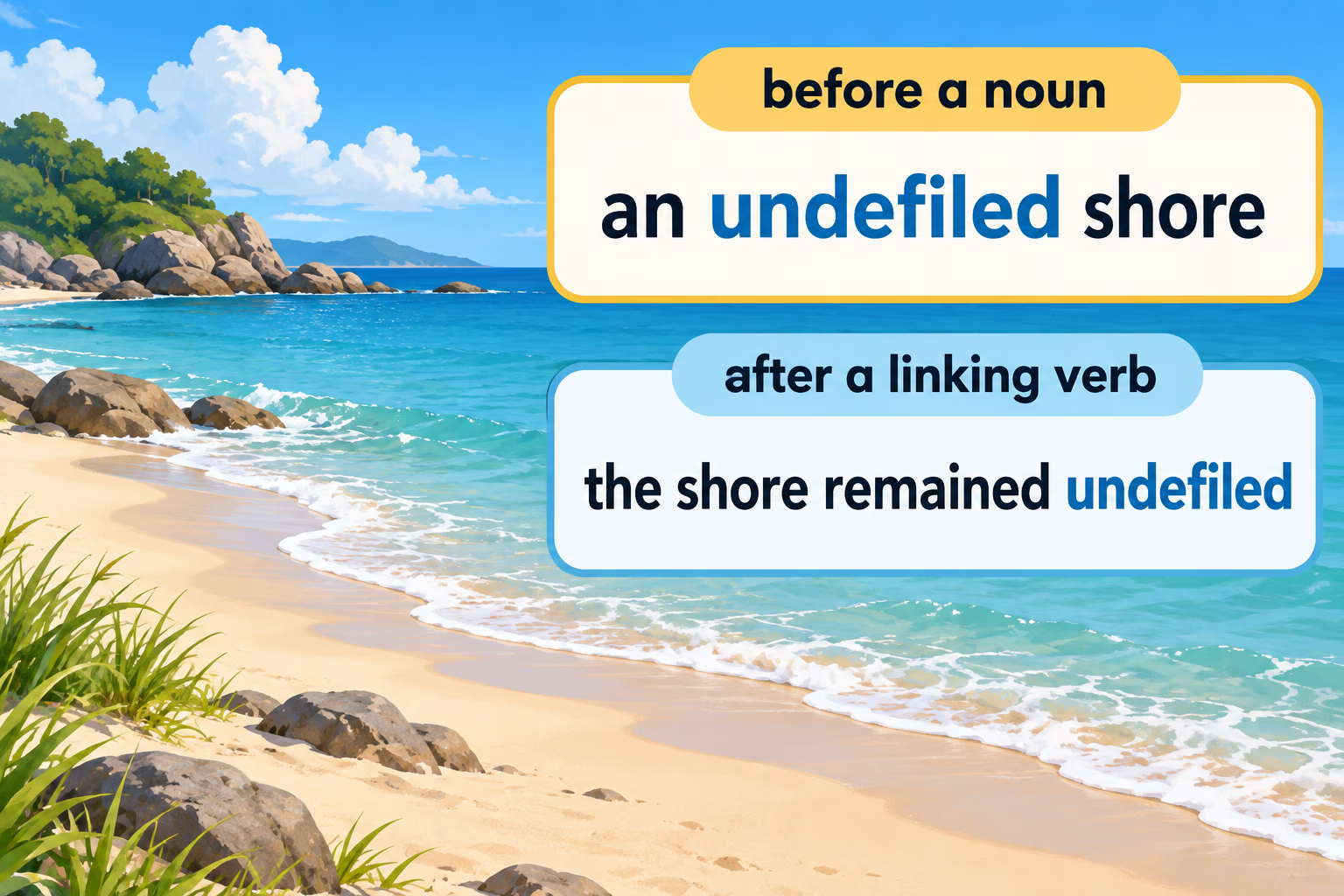
Undefiled commonly appears before a noun (“an undefiled shore”) or after a linking verb (“the shore remained undefiled”). The pattern undefiled by names the influence or damage that has not spoiled something.
| Pattern | Example | What it conveys |
|---|---|---|
| undefiled + noun | They found an undefiled stretch of coastline. | The place appears not to have been spoiled. |
| remain / stay + undefiled | The archive remained undefiled after the flood. | The subject kept its prior condition. |
| undefiled by + cause | The marsh was still undefiled by construction. | The phrase names the absent source of damage. |
| figurative noun | She hoped to leave the process with an undefiled reputation. | The reputation is described as untainted. |
Examples in complete sentences
- After the cleanup, the stream looked undefiled by oil or debris.
- The conservation agreement aimed to keep the island’s interior undefiled by new roads.
- In the novel, the witness’s motives are portrayed as undefiled by personal gain.
- The archivist handled the manuscript carefully so its pages would remain undefiled by ink.
- Her account was not undefiled by bias; it reflected the limits of what she had observed.
- The poet imagined an undefiled garden untouched by the city’s noise.
- He described the award as a rare achievement undefiled by scandal.
- The phrase “undefiled by advertising” presents the open field as visually unspoiled.
These are illustrative sentences, not claims about real sites or people. In factual writing, name the evidence behind words such as polluted, unspoiled, or untainted rather than relying on appearance alone.
How is “undefiled” different from similar words?
Undefiled is broader and more elevated in tone than many close alternatives. Choose the word that identifies the condition you mean; the terms below are not interchangeable in every sentence.
| Word | Best fit | Example |
|---|---|---|
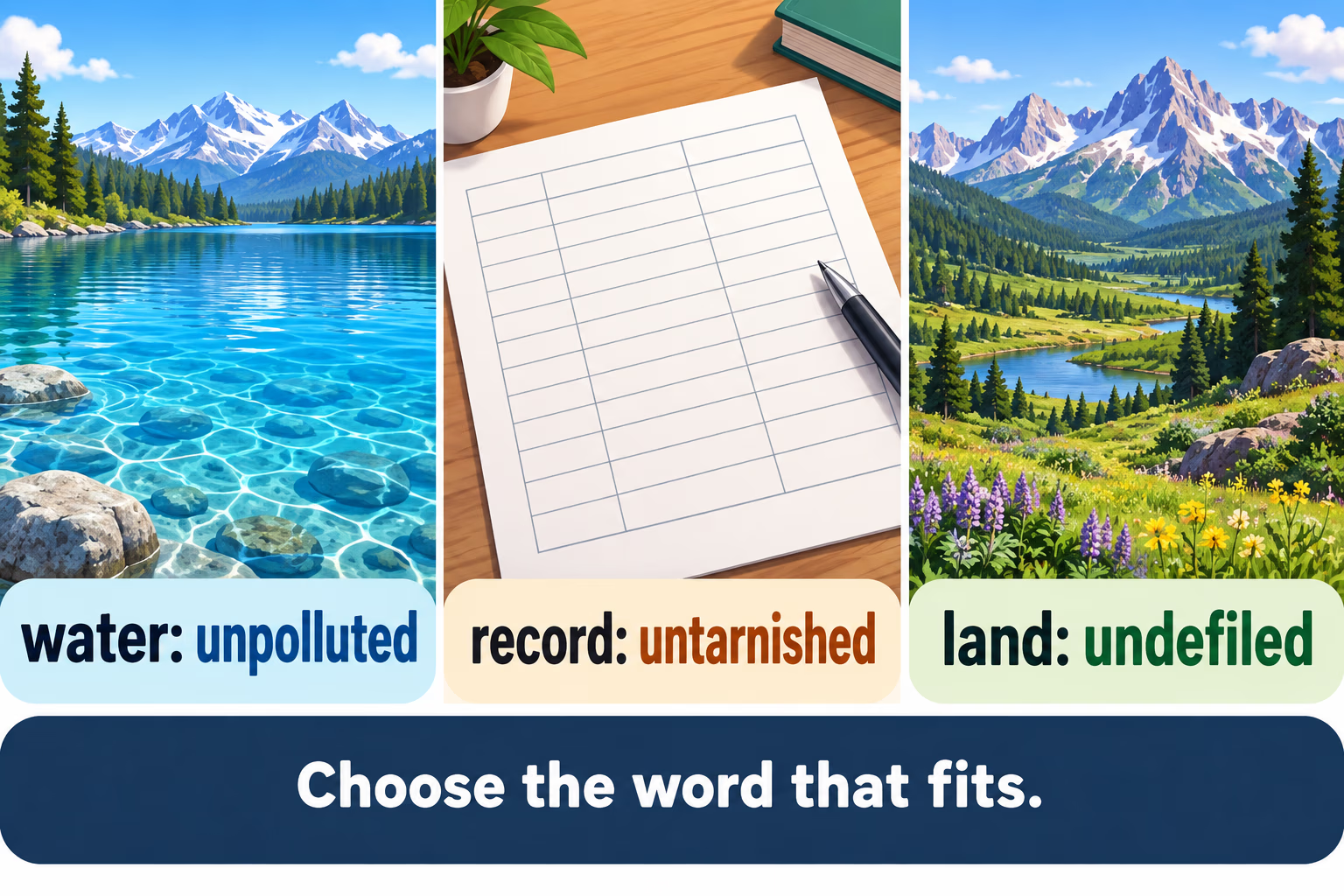
| unpolluted | A substance or environment free from contaminants | Testing found no measured pollutants in the water. |
| unspoiled | A place or experience not damaged or diminished | The beach remains largely unspoiled by development. |
| untarnished | A reputation, record, or image without a stain | She maintained an untarnished professional record. |
| pristine | Something in its original, clean, or near-perfect condition | The collector kept the book in pristine condition. |
| undefiled | A literary or emphatic claim that something remains pure or unsullied | The story presents the sanctuary as undefiled. |
Clean is usually the simplest choice for an ordinary object; unpolluted is more precise for contamination; undefiled carries a stronger sense of purity or sanctity. “Untouched” means not handled or altered, which is different from merely remaining unspoiled.
When should you avoid using “undefiled”?
Undefiled can sound solemn, moralizing, or archaic in casual writing. For a clean desk, fresh notebook, or orderly folder, use clean, unused, or unmarked; for measured environmental conditions, state the tested contaminant or use unpolluted only when evidence supports it.
The word also carries associations with moral or religious purity. Describing people as “undefiled” may imply a judgment about their character or sexuality, so use it only when that meaning is intended and appropriate. For a person’s professional history, unblemished or untarnished is usually clearer.
How do you use “undefiled by” correctly?
Place by after undefiled to identify the thing that has not spoiled the subject: “a valley undefiled by commercial development.” The phrase works best when the named cause could plausibly damage, contaminate, or corrupt the noun; it is less natural for routine distractions or ordinary mess.
- Natural: “The record remained undefiled by scandal.”
- More direct: “The desk was clean and free of clutter.”
- Awkward: “The schedule was undefiled by other activities.” A schedule can instead be “uninterrupted” or “free of conflicts.”
Original examples and source note
Source-preservation note: The original examples and usage guidance below are retained exactly as published. Some lines use undefiled where a simpler word such as clean, neat, or focused would be more idiomatic in contemporary English; treat those lines as preserved vocabulary exercises, not recommendations for natural everyday phrasing.

Frequently asked questions
Is “undefiled” a common everyday word?
No. Undefiled is understandable but formal or literary; Cambridge records current examples, and Collins explicitly labels it literary. In ordinary conversation, clean, unspoiled, or unpolluted is often clearer.
Can “undefiled” describe a place?
Yes. Undefiled can describe a place portrayed as not spoiled, polluted, or desecrated. For an objective environmental claim, state what has been measured or observed instead of treating “undefiled” as a technical certification.
Does “undefiled” mean untouched?
Not exactly. Undefiled means not spoiled or made impure; something may have been visited or used and still be described that way. Untouched more directly means not handled, altered, or affected.
What is the opposite of “undefiled”?
Depending on the sense, opposites include defiled, polluted, spoiled, tainted, or corrupted. Choose the opposite that names the actual harm: pollution is physical contamination, while corruption is usually moral or figurative.
The bottom line
Undefiled means not spoiled, polluted, or made impure, and it works as an adjective before a noun or after a linking verb. Its formal, sometimes moral or religious tone makes it more suitable for deliberate emphasis than for routine descriptions; choose a narrower word when the type of purity or damage matters.
Looking for ways to enhance your vocabulary? The term “undefiled” refers to something that is pure, untouched, or unspoiled.
Adding words like “undefiled” to your vocabulary can elevate the sophistication of your writing and communication. It allows you to express ideas with precision and clarity, painting a vivid picture for your audience.
7 Examples Of Undefiled Used In a Sentence For Kids
- Flowers grow in undefiled soil.
- The snow was undefiled and sparkling.
- The little pond looked undefiled and clear.
- The teacher praised the students’ undefiled artwork.
- The baby’s laugh was pure and undefiled.
- The butterfly landed on the undefiled petals.
- The sky was a beautiful, undefiled blue.
14 Sentences with Undefiled Examples
- Undefiled notebooks are essential for taking neat and organized notes in class.
- It is important to keep our study area undefiled to maintain focus and productivity.
- A clean and undefiled desktop background can help reduce distractions while studying.
- Using undefiled flashcards is a great way to memorize and review key concepts for exams.
- Keeping our academic resources undefiled will make them easier to access when needed.
- Creating a study schedule can help ensure that our study time remains undefiled by other activities.
- An undefiled bookmark can save our progress in textbooks and make it easier to continue reading.
- Writing in undefiled textbooks can help retain their value for future use or resale.
- It is important to keep our study group discussions undefiled by staying focused on the topic at hand.
- Sharing undefiled lecture notes with classmates can help everyone stay on track with the course material.
- A clean and undefiled work space can contribute to a more positive and productive study environment.
- Storing our school supplies in an undefiled pencil case can help keep them organized and easily accessible.
- Participating in undefiled group projects can help build teamwork and communication skills.
- Keeping our digital files and folders undefiled can save time when searching for important documents.
How To Use Undefiled in Sentences?
To use the word Undefiled in a sentence, you first need to understand its meaning. Undefiled is an adjective that describes something that is pure, untainted, or free from impurities.
Here is a simple guide on how to use Undefiled in a sentence:
- Identify a subject or object that exemplifies purity or cleanliness.
- Determine if the subject or object is free from any form of contamination or corruption.
- Use the word Undefiled to describe the pureness of the subject or object in the sentence.
For example:
- “The Undefiled water from the mountain spring was crystal clear and refreshing.”
- “Her heart remained Undefiled by the darkness that surrounded her.”
By following these steps and incorporating the word Undefiled into your sentence appropriately, you will effectively convey the idea of purity and cleanliness to your readers. Remember to ensure that the context of your sentence aligns with the meaning of the word Undefiled to enhance clarity in your communication.
Conclusion
In conclusion, sentences with the keyword “undefiled” typically describe something that is pure, untouched, or free from contamination. These sentences often emphasize cleanliness, innocence, or the absence of impurities. By using “undefiled” in sentences, writers convey a sense of pristine beauty or moral uprightness, highlighting the purity and sanctity of the subject being described.
Overall, sentences featuring the word “undefiled” evoke imagery of wholesomeness and perfection, painting a picture of something untouched by corruption or decay. This term adds a sense of purity and innocence to the description, emphasizing the immaculate nature of the subject at hand.


