
Undergrowth in a Sentence: Meaning and Examples
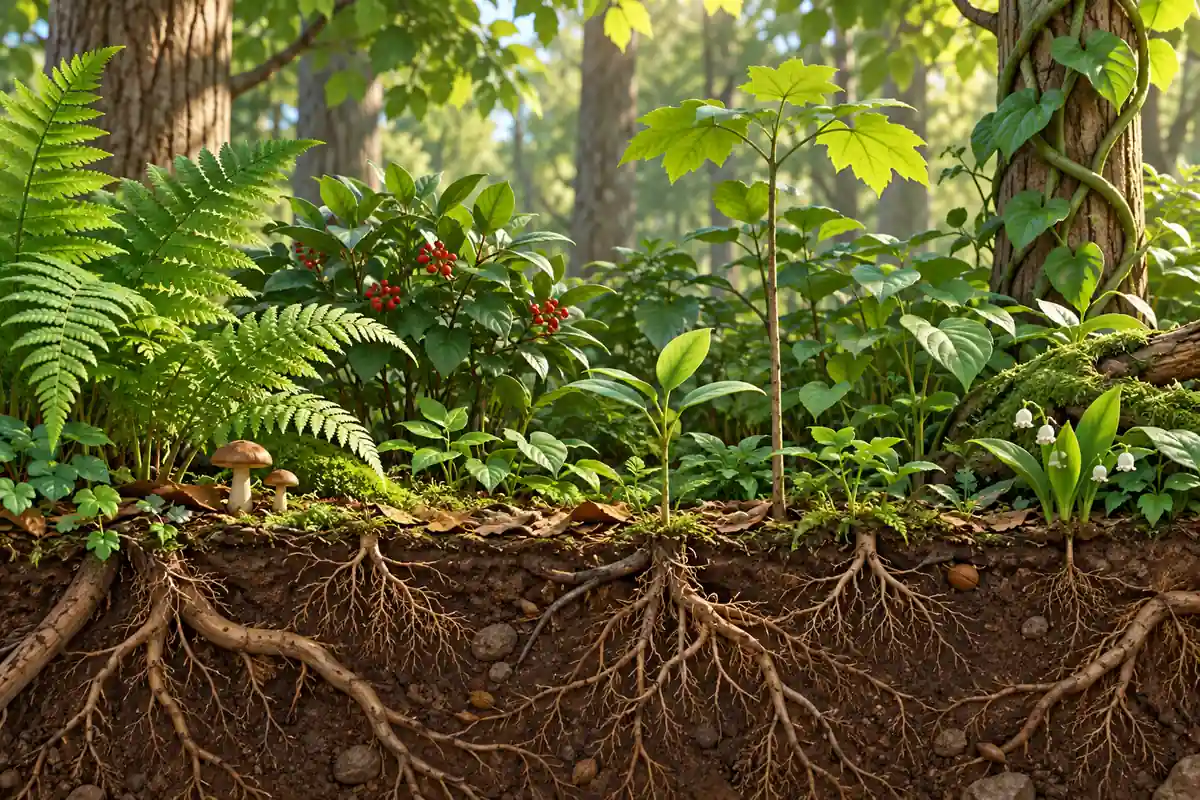
Undergrowth is a mass of bushes, small trees, and other plants growing beneath or among taller trees, especially in a forest. “The narrow path disappeared into thick undergrowth” shows the noun in context. In US English, underbrush is a common synonym.
Key facts at a glance
- Undergrowth is an uncountable noun for dense low plants, bushes, and small trees.
- It commonly grows beneath taller trees in forests or wooded places.
- Thick, dense, and tangled are frequent descriptive collocations.
- Underbrush is a common US synonym; undergrowth can also be used in American English.
What does undergrowth mean?
Undergrowth means a mass of bushes, small trees, and plants, especially those growing beneath trees in a forest. It is an uncountable noun: writers normally say “thick undergrowth” or “patches of undergrowth,” not “an undergrowth.” The word describes dense low vegetation rather than the entire forest.
Cambridge Dictionary lists underbrush as a US synonym. Undergrowth may include shrubs, young trees, grasses, vines, and other plants; the exact mix depends on the habitat and season.
How do you use undergrowth in a sentence?
Use undergrowth as a noun, often with a descriptive adjective such as thick, dense, or tangled. “A fox slipped through the undergrowth” places the vegetation between the animal and the observer. “They cleared a small patch of undergrowth” treats it as a mass of plants.
| Pattern | Example | Use |
|---|---|---|
| thick undergrowth | The path wound through thick undergrowth. | Describe density |
| patches of undergrowth | Sunlight reached patches of undergrowth. | Describe separate areas |
| underbrush (US) | The deer disappeared into the underbrush. | Common American synonym |
Is undergrowth countable or uncountable?
Undergrowth is generally uncountable, so it does not normally take the indefinite article a or a plural ending. Say “some undergrowth,” “a belt of undergrowth,” or “two patches of undergrowth.” The countable noun is the area or clump, not the vegetation considered as a mass.
This grammar is similar to many mass nouns. A sentence such as “The undergrowth was dense” treats the vegetation as one collective mass, so the verb is singular. When counting distinct areas, add a measure noun: “Three strips of undergrowth bordered the trail.”

What is the difference between undergrowth and underbrush?
Undergrowth and underbrush refer to dense low vegetation, and Cambridge Dictionary identifies underbrush as a US synonym for undergrowth. Both are useful in a wooded setting. Regional preference varies, so choose the form that sounds natural for your audience.
Neither word simply means “forest floor.” The forest floor can include soil, leaf litter, fallen branches, and low vegetation; undergrowth specifically refers to the mass of plants. In science writing, use a more precise ecological term when the exact vegetation layer or species matters.
Frequently asked questions
What is a simple sentence with undergrowth?
“A rabbit darted into the undergrowth” is a simple sentence using the noun for dense low plants in a wooded area. The phrase “into the undergrowth” shows where the rabbit went. A descriptive adjective can add detail, as in “thick undergrowth.”
Is undergrowth one word or two?
Undergrowth is one word, spelled as a single compound noun. It usually refers to dense plants growing beneath or among taller trees. The related US synonym underbrush is also written as one word. Neither term takes a hyphen in standard spelling.
What is another word for undergrowth?
Underbrush is a common US synonym for undergrowth. Depending on context, writers might use brush, shrubs, or dense vegetation, but those terms can be broader or narrower. Choose a substitute that preserves the exact type of plants and setting; regional preference can vary.
Can you say an undergrowth?
Usually no. Undergrowth is an uncountable noun, so standard phrasing is “some undergrowth,” “the undergrowth,” or “a patch of undergrowth.” To count separate areas, add a measure noun such as patch, strip, or area. “An area of undergrowth” is also acceptable.
Conclusion
Use undergrowth for a mass of low plants, bushes, and small trees beneath or among taller trees. It is generally uncountable, takes descriptive words such as thick or tangled, and has the common US synonym underbrush.
Have you ever wandered through a dense forest and noticed the thick vegetation carpeting the forest floor? This dense layer of low-lying plants, shrubs, and small trees is known as undergrowth.
Undergrowth plays a vital role in the ecosystem, providing shelter and food for many species of animals while also enriching the soil with organic matter as it decomposes.
7 Examples Of Undergrowth Used In a Sentence For Kids
- Undergrowth is the small plants and bushes that grow on the forest floor.
- Be careful when walking through the undergrowth so you don’t trip.
- Many animals like to hide in the undergrowth to stay safe.
- We can find colorful flowers growing in the undergrowth.
- Some insects live among the leaves of the undergrowth.
- It is fun to explore the undergrowth and see what we can find.
- Remember not to disturb the animals living in the undergrowth.
14 Sentences with Undergrowth Examples
- Undergrowth can sometimes make it difficult to navigate through the forest during our college camping trip.
- We had to be careful of the undergrowth while trekking to our field trip destination in the mountains.
- The monsoon season caused a lot of undergrowth to flourish around our college campus.
- We spent the afternoon clearing out the undergrowth to make space for our upcoming outdoor college event.
- The wildlife club organized a clean-up drive to remove the undergrowth from the nearby nature trail.
- The botany students collected samples of different types of undergrowth for their research project.
- Due to heavy rainfall, the undergrowth in the park near the college grew rapidly.
- The conservation group planted native species to help control the spread of undergrowth in the region.
- A group of students volunteered to prune the undergrowth in the botanical garden as part of their environmental studies program.
- The biology professor explained the importance of maintaining a balance in the ecosystem, including managing the growth of undergrowth.
- As part of their outdoor leadership course, the students learned how to identify different types of undergrowth in the wilderness.
- The environmental science students studied the role of undergrowth in providing habitats for various species in the ecosystem.
- One of the challenges faced during the college nature trail expedition was trekking through dense undergrowth.
- The horticulture department organized a workshop on how to effectively manage and maintain undergrowth in gardens and landscapes.
How To Use Undergrowth in Sentences?
Undergrowth is a noun that refers to the low-lying vegetation and plants that grow beneath a forest canopy or in dense areas. When using Undergrowth in a sentence, it is important to remember its meaning and context.
Here are some examples of Undergrowth used in sentences:
- “The hikers struggled to make their way through the dense undergrowth of the forest.”
- “Small animals find shelter and food in the thick undergrowth of the jungle.”
- “The forest floor was covered in moss, ferns, and other types of undergrowth.”
To use undergrowth effectively in a sentence, remember its role as a collective term for the plants and vegetation found beneath the main vegetation in a forest or dense area. It is usually used to describe the thick, tangled growth of plants and shrubs that make navigation difficult.
When constructing a sentence with Undergrowth, consider incorporating adjectives to provide more detail about the type of Undergrowth being referenced. This can help paint a clearer picture for the reader.
Overall, using Undergrowth in a sentence is about accurately describing the vegetation and plants found beneath the main canopy in a forest or dense area. With practice and understanding of its meaning, incorporating Undergrowth into your writing will become easier and more natural.
Conclusion
In conclusion, the undergrowth within the forest consisted of dense shrubs, twining vines, and fallen branches, creating a challenging terrain for hikers to navigate. These conditions can obscure paths, harbor wildlife, and pose safety risks for those exploring forested areas. It is important for outdoor enthusiasts to tread carefully and be mindful of their surroundings when hiking through undergrowth, as visibility may be limited and obstacles may be present.
Furthermore, undergrowth plays a crucial role in the ecosystem by providing habitats for various plants, insects, and small animals. This layer of vegetation contributes to biodiversity, nutrient recycling, and soil protection. Understanding the significance of undergrowth in the forest ecosystem can foster appreciation for its complexity and importance in supporting the delicate balance of nature.